Get in Touch with Didi Land

Sensory Room Equipment: What to Include in a Commercial Indoor Play Space


Sensory room equipment is the collection of controllable products and room features used to provide visual, auditory, tactile, movement, and lower-input options. Select it as an operating system, not as a shopping list. Start with the room’s users, purpose, supervision, controls, access, cleaning plan, utilities, and building limits. Then choose only equipment with a clear function, a responsible operator, and a documented installation and service path.
Short answer: A commercial sensory room may include controllable visual equipment, carefully managed sound, tactile panels and loose items, floor-based movement options, quiet seating, soft surfaces, and storage. The right sensory equipment mix changes with the users and venue. There is no universal list that proves a room is accessible, suitable, or ready to operate.
If you are planning activities for young children rather than procuring a commercial room, use Didi Land’s guide to preschool sensory play activities and materials. This article stays on the commercial decision: what to specify, what to defer, and what evidence to request from a supplier.
Start With the Room Brief, Not a Shopping List

Neither a bubble tube, wall panel, swing, projector, nor beanbag is automatically a good purchase because it appears on a popular sensory room equipment list. Procurement needs a one-page brief that turns the concept into operating conditions. Without it, different vendors will quote different rooms, and the lowest price will not be a meaningful comparison.
Users and operating patternRecord the intended age mix, mobility and communication considerations, expected occupancy, whether use is individual or simultaneous, and who can provide user or qualified-professional input.
Purpose and boundariesDefine the room’s role inside the venue. Is it a quieter choice, a supervised activity room, a transition space, or a bookable program area? Do not turn that purpose into a treatment promise.
Control and responseName who can change intensity, mute or stop equipment, restore a known starting state, observe feedback, and escalate concerns. A stop/reset procedure belongs in the brief before product selection.
Site and ownershipRecord room dimensions, utilities, structure, routes, adjacent noise, staff position, cleaning owner, inspection owner, storage, repair responsibility, and reopening authority.
The practical rejection rule is simple: no purpose, no product. If a proposed item cannot be connected to the brief and an operating owner, keep it out of the initial equipment schedule.
The 5-Zone Input-to-Action Matrix
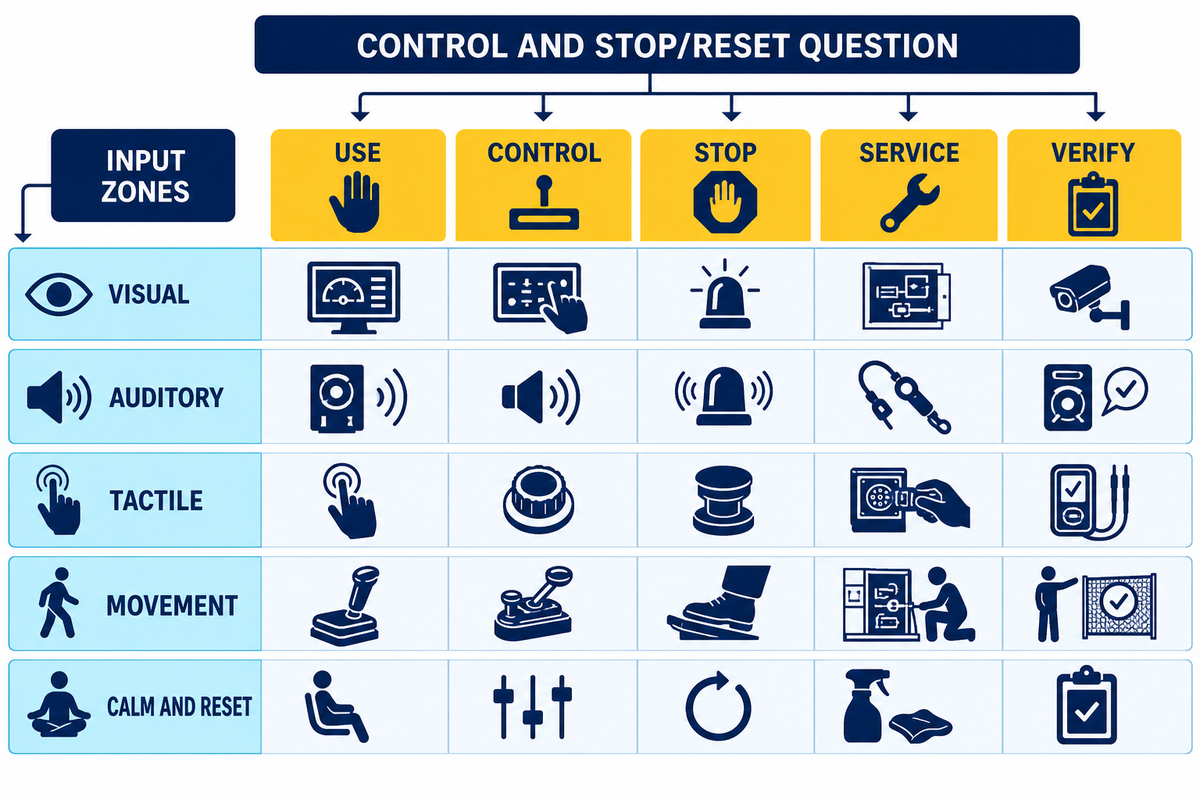
Use five equipment zones to organize the shortlist: visual, auditory, tactile, movement/body-position, and calm/reset. These are procurement categories, not fixed rooms and not a clinical protocol. Because one product may cross several zones, the matrix cannot predict combined-stimulus risk from each item in isolation.
| Zone | Equipment examples | Room function to define | Control and stop/reset question | Space, utility, and maintenance check |
|---|---|---|---|---|
| Visual | Bubble tube, fiber-optic lighting, projector, illuminated panel | What visual interaction is intended, and when should it be reduced or unavailable? | Who adjusts color, brightness, motion, or program? Can staff stop it quickly and restore a known state? | Power, heat, mounting, water or consumables, cleaning access, lamp/part replacement, glare and spill |
| Auditory | Directional audio, sound-responsive panel, music source | Is sound an activity, feedback signal, or optional layer? | Where are volume, mute, source selection, and maximum operating settings controlled? | Sound transfer, speaker protection, cable route, maintenance access, conflict with quiet use |
| Tactile | Wall panels, texture boards, manipulatives, loose supervised items | What action should the user be able to repeat, compare, or explore? | Which pieces are removable, restricted, rotated, isolated, or taken out of service? | Reach, fixing method, small/removable parts, seams, cleanability, storage and inventory |
| Movement and body position | Floor cushions, rollers, balance elements, soft-play forms, suspended equipment | What movement is intended, for whom, and under what supervision? | How is use started, stopped, separated, or restricted? | Structure, anchors, manufacturer clearances, impact conditions, routes, transfer space, inspection access |
| Calm and reset | Supportive seating, low-stimulation corner, canopy, storage, neutral lighting scene | What lower-input choice should remain available? | Can staff reduce competing inputs without trapping, hiding, or obstructing supervision? | Sightline, ventilation, access, fabric/cover care, drying, storage, damage checks |
Evidence boundary: The 5-Zone Input-to-Action Matrix is an editorial procurement tool. It does not validate individual compatibility, combined stimulus intensity, adverse-response monitoring, accessibility, safety, or outcomes. Those questions require the appropriate user input, product documents, project review, and responsible professionals.
What Is the Best Equipment for a Sensory Room?
The best equipment is the set that matches the room brief and can be operated, stopped, cleaned, inspected, and serviced in the actual venue. For a given concept, a controllable light may be useful or distracting. A suspended item may be feasible in one building and unsuitable in the next. Compare function, adjustability, control ownership, space, utilities, access, supervision, and maintenance before brand or novelty.
Ask the operator, designer, installer, and care owner to review the same shortlist. Record each unresolved dependency beside the proposed model, then remove or defer any item whose owner, evidence, or building condition is still unknown. If the supplier cannot explain those fields for the offered model, the product is not ready for approval.
What Is Essential vs Optional? The 3-Tier Buy Sequence

The first budget should make the room operable. It should not try to buy every possible sensory effect. The 3-Tier Buy Sequence separates room essentials from justified enhancements and building-dependent items: Tier 1 establishes the operating baseline, Tier 2 adds features only when the brief supports them, and Tier 3 waits for building and exact-model evidence.
| Purchase tier | What belongs here | Approval test | Do not choose when |
|---|---|---|---|
| Tier 1: Room essentials | General lighting control, a lower-input option, appropriate seating or floor-use support, storage, supervision position, stop/reset method, cleaning and inspection ownership | The room cannot operate consistently without it. | The item has no owner, no documented care path, or duplicates another function without reason. |
| Tier 2: Add when the brief supports it | Bubble tube, fiber optics, interactive projection, selected tactile panels, portable supervised items, additional control interfaces | A named user need or operating purpose justifies the feature, and staff can control and maintain it. | It is included only because it looks impressive in a concept image. |
| Tier 3: Building-dependent | Suspended movement equipment, major fixed structures, water-dependent systems, ceiling-mounted equipment, complex integrated controls | Structure, anchors, clearances, routes, installation scope, inspection access, and local requirements are reviewed. | The actual building information or exact-model instructions are missing. |
This sequence is not an evidence-based sensory intervention guideline. It is a capital-priority tool for owners, finance teams, designers, operations staff, and procurement. It helps the team fund an operable baseline before optional features consume budget.
What Do I Need in a Sensory Room?
You need a clear purpose, controllable general conditions, a lower-input choice, appropriate seating or floor support, storage, supervision, a stop/reset method, and named cleaning and inspection owners. Add equipment only where the brief supports it. Mounted, suspended, powered, or water-dependent products need exact-model documentation and project review. No universal list can account for users, the building, simultaneous use, accessibility scope, or operating capacity.
Visual and Auditory Equipment: Specify Controls and a Known Reset State

When comparing bubble tubes, fiber optics, projectors, interactive walls, or sound-responsive products, request the exact model’s instructions. A current manufacturer manual hub, for example, separates manuals across bubble tubes, fiber-optic products, projectors, wall panels, room packages, and lighting. That is a useful procurement signal: the operating and installation questions are model-specific.
| Product type | Required control question | Stop/reset question | Installation and service question |
|---|---|---|---|
| Bubble tube or wall | What can the user and staff change? Where are controls located and protected? | Can staff stop motion/light and restore the approved starting state? | What are the power, fixing, water, cleaning, draining, access, and replacement-part requirements? |
| Fiber-optic feature | Is intensity, color, or program adjustable? Is the control accessible to the intended operator? | What happens after power loss or emergency shutoff? | How are the light source, tails, covers, fixings, and worn parts inspected or replaced? |
| Projector or interactive wall | Who selects content and sensitivity? Can settings be locked? | Is there a neutral/off scene that staff can reach immediately? | Check mounting, glare, shadows, calibration, cable protection, software/content ownership, and service support. |
| Audio or sound-responsive panel | Where are mute, volume, source, and maximum operating settings controlled? | Can the sound layer be removed without disabling unrelated equipment? | Review sound spill, mounting, speaker protection, cables, cleaning, and replacement. |
A peer-reviewed study of 41 autistic children aged 4–12 compared active and passive control of sensory changes. Because it did not test equipment quantity, a universal reset-state design, toddlers, adults, other disability groups, or simultaneous commercial use, using it to justify a fixed package would be an evidence overreach. Several measured outcomes did not differ significantly. The safe procurement lesson is narrow: ask who controls each change and how staff stop it. Do not convert that study into a treatment or outcome promise.
Tactile and Movement Equipment: Space and Installation Constraints

Tactile walls, manipulatives, soft-play forms, balance elements, and suspended movement equipment create different dependencies. Review small or removable parts, fixing methods, pinch or entrapment questions, access, transfer conditions, inspection points, and manufacturer instructions for the offered item. Suspended equipment also needs the actual structure, anchors, clearances, impact conditions, and inspection access reviewed before ordering. This guide does not provide a universal load or clearance.
Accessibility must also be scoped correctly. A product described as “inclusive” cannot prove an accessible room.
“The Access Board does not certify or endorse any products.”
Routes, clear space, approach, reach, transfer conditions, and operable parts matter, but they may not be the whole analysis. If the room or equipment is part of a play area, play component, or soft-contained play structure, the applicable component and entry-point provisions also need project-specific review.
Standards note: ASTM’s official public page currently lists ASTM F1918-21 as active for soft-contained play equipment within its stated scope. That does not mean F1918 governs every sensory product, covers accessibility, or proves a complete room is compliant. Applicable building, fire, electrical, accessibility, product-safety, health, licensing, and local requirements remain separate project checks where relevant. Ask the supplier to name the exact standard, edition, model, and evidence being offered. For broader context, see Didi Land’s guide to indoor playground safety standards.
Quiet-Zone Seating, Soft Surfaces, Storage, and Cleaning

Low-stimulation equipment still has a commercial service burden. Check covers, seams, inserts, moisture traps, removable parts, storage, inspection access, spares, and the procedure for isolating damaged or contaminated items. A comfortable product that cannot be dried, inspected, repaired, or replaced without closing the room may be a poor commercial choice.
| Serviceability field | Evidence to request | Operating decision |
|---|---|---|
| Surface and cover | Material and exact-model cleaning instructions; removable-cover details; incompatible products | Can staff complete the documented task with available time, storage, and drying space? |
| Seams and hidden areas | Inspection access, opening/closing method, moisture points, replacement instructions | Can condition be checked without dismantling unrelated equipment? |
| Loose items | Inventory, storage, cleaning path, damage criteria, replacement source | Who counts, rotates, isolates, and returns items to service? |
| Damage or contamination | Isolation, repair, disposal, reopening, and documentation procedure | Who has authority to remove and reopen the item? |
The official EPA page distinguishes cleaning, sanitizing, and disinfecting. Clean first where applicable, use products suited to the surface, and follow the product label and manufacturer directions. This article does not prescribe a chemical, dilution, interval, contact time, drying period, or reopening time. Build item-level procedures into the venue’s broader commercial play equipment maintenance program, and compare adjacent commercial soft play equipment specifications where soft components overlap.
Put the Room Inside an Indoor Play Space Without Creating Conflicts

A room can work in a quiet design meeting and fail during peak operation. A facility operator should test the entrance, waiting area, sound and light spill, age mix, occupancy pattern, simultaneous use, staff position, supervision ownership, accessible approach, emergency access, storage route, and transition back to active play. Separate conflicting activities rather than assuming the door solves every boundary.
Hidden Bottleneck Map: Control-Installation-Service Chain
Control
Who changes intensity, stops the item, restores a known state, observes feedback, and escalates?
Who changes intensity, stops the item, restores a known state, observes feedback, and escalates?
→
Installation
Which structure, route, clearance, utility, access, and applicable scoping conditions must be resolved?
Which structure, route, clearance, utility, access, and applicable scoping conditions must be resolved?
→
Service
Who cleans, isolates, inspects, repairs, replaces, documents, and reopens the item?
Who cleans, isolates, inspects, repairs, replaces, documents, and reopens the item?
If any link has no owner or document, the equipment is not ready for final approval. This map is a commercial review aid, not a claim that the room is safe or accessible. Use the site’s whole-facility indoor playground layout guide for capacity, circulation, and broader zoning rather than expanding this equipment brief into a full floor plan.
Turn the Selection Into an RFQ and Custom-Design Handoff

Send every vendor the same room brief and equipment schedule. Ask them to identify exactly what is included, what is excluded, which party supplies utilities or building work, what documents arrive before installation, what training and spares are included, and what evidence will be provided at acceptance.
Commercial Sensory Room RFQ Scorecard
Treat these fields as buyer-side due diligence for comparable quotes, not as a universal legal checklist. The applicable requirements still depend on the product, site, use, and jurisdiction.
| Equipment and scope field | Evidence required in the quote | Reject or clarify when |
|---|---|---|
| Room and users | Room role, intended users, age mix, occupancy pattern, simultaneous-use assumption, and operating owner | The proposal assumes a different user group or operating pattern. |
| Equipment schedule | Exact manufacturer, model, intended function, quantity, and substitution rule | Descriptions are generic, or substitutions need no written approval. |
| Controls and reset | Control owner, accessible control method, adjustment range, stop method, and known reset state | Staff cannot promptly stop the item or restore the approved state. |
| Room dependencies | Dimensions, utilities, mounting, structure, clearances, routes, service access, and room conditions | Building work or site information is left as an unnamed assumption. |
| Standards and evidence | Applicable standard and edition claimed for each relevant item, evidence scope, and explicit exclusions | A broad compliance badge replaces model- and scope-specific evidence. |
| Care and service | Cleaning, sanitizing, disinfecting, drying, isolation, inspection, repair, and reopening documents | No responsible owner or exact-model care path is defined. |
| Delivery support | Submittals, samples, approvals, installation responsibilities, training, spares, warranty, and response times | Important support is described as optional without scope or price. |
| Acceptance | Acceptance deliverables, defect route, unresolved dependencies, and named decision owner | Handover has no evidence list, open-issue owner, or acceptance authority. |
Score completeness before price because an inexpensive quote with vague controls, missing utilities, or no service path can create expensive changes after installation, especially when the installer, electrical contractor, owner, and equipment supplier have not assigned the unresolved work in writing. Didi Land describes its own process as moving from a client brief through design, engineering, production, and installation. Treat that as first-party process information, then use your completed brief as the starting point for custom indoor playground design.
Sensory Room Equipment for Schools: What Do Buyers Need?
Schools need equipment that fits their students, program purpose, supervision model, room, cleaning resources, and documentation requirements, not a diagnosis-based shopping list. Start with controllable general conditions, a lower-input option, appropriate seating or floor support, storage, and a stop/reset procedure. Add fixed, powered, tactile, or movement equipment only when the function and responsible operator are clear. Seek input from users and the school’s qualified professionals, and require exact-model installation, cleaning, inspection, service, and warranty documents.
Build the Brief Before You Request the Concept
Bring Didi Land your floor plan, age mix, operating model, theme, budget, and completed equipment questions. The next conversation can then focus on fit, exclusions, and project responsibilities instead of a generic product list.
How Should Buyers Read Vendor Sensory Terminology?

Treat vendor terminology as a prompt for due diligence, not as a performance specification. The same phrase may describe a product category, a room concept, an intended user, or an outcome claim. Ask what the supplier means, which exact model supports that meaning, what evidence is available, who can evaluate the claim, and what remains the buyer’s responsibility.
| Language found in supplier and search materials | Commercial buyer’s response |
|---|---|
| Clinical or user-context language: sensory processing, special needs, sensory integration, sensory integration therapy, autism sensory room, occupational therapy, therapy settings, processing disorders, sensory needs, sensory preferences, sensory regulation, self-regulation, emotional regulation, motor skills, fine motor skills, sensory development, arousal levels, self-regulate, and support sensory | Separate a category label from an individual requirement or promised outcome. Ask who is qualified to interpret the phrase, which users it applies to, and whether the supplier is making a claim outside the product documentation. |
| Movement and loading language: sensory swing, therapy swings, trampoline, weighted blankets, vestibular, vestibular input, vestibular system, proprioceptive, proprioceptive input, proprioceptive and vestibular, deep pressure input, sensory input, specific sensory, stimulating experiences, and either calm | Do not infer suitable intensity, duration, mounting, supervision, or user fit from the label. Request the exact model’s intended use, limitations, installation requirements, inspection method, and stop procedure, then obtain qualified input where the room brief requires it. |
| Product and format language: sensory tools, sensory bins, sensory room items, equipment used, sensory wall panels, tools and equipment, specialized equipment, sensory stations, range of sensory, sand and water, existing space, selection of sensory, quality sensory equipment, and built to last | Translate every category or quality phrase into measurable submittal fields: model, materials, fixing or storage, utilities, cleaning method, parts, warranty, inspection access, exclusions, and service path. |
| Room and experience language: sensory space, dedicated sensory, dedicated sensory rooms, creating a sensory room, used in a sensory room, sensory support, sensory activities, sensory exploration, explore sensory, sensory experience, immersive sensory, interactive sensory, immersive, whole room, immersive projection, interactive projection systems, visual input, touch experiences, sensory-friendly, and learning spaces | Define the day-to-day meaning in the project brief. A room label does not establish accessibility, safe combined use, staffing, building compatibility, or a better outcome. |
| Claim constructions: sensory input in a safe setting, designed to support a user group, or provide sensory benefits | Ask for the complete claim, the evidence behind it, the population and conditions covered, and the exact responsibility the supplier accepts. If those answers are missing, rewrite the requirement around controllable function and documented operating limits. |
Terminology boundary: Listing these search and supplier phrases does not endorse them as diagnoses, interventions, outcomes, or equipment specifications. It shows buyers which labels need to be converted into evidence and project responsibilities before approval.
Features to Verify, Not Trends to Chase

Interactive projection, wireless controls, waterless visual products, modular components, and app-based settings may appear in vendor proposals. Because the research reviewed for this guide does not prove that these features are industry-wide trends or produce better commercial outcomes, treat superiority language as an evidence risk. Convert each advertised feature into a verification question.
- Can the intended operator adjust it, stop it, and restore the approved state?
- What happens after power loss, network loss, software change, or staff turnover?
- Can damaged or contaminated parts be isolated, repaired, and replaced without closing unrelated equipment?
- Does the quote identify the exact model and manual revision, software/content ownership, parts path, and service response?
Do not use search interest as a reason to buy technology. Operational fit remains the stronger procurement test.
Frequently Asked Questions
References & Sources
- U.S. Access Board, Guide to the ADA Accessibility Standards: Play Areas
- U.S. EPA, What’s the Difference Between Products That Disinfect, Sanitize, and Clean Surfaces?
- CDC, How to Clean and Disinfect Early Care and Education Settings (independently accessible; retained as corroborating early-care guidance)
- ASTM International, ASTM F1918-21 public status and scope page
- Unwin et al. — Control of sensory changes in a multi-sensory environment
- Experia USA, Product instruction manual library (manufacturer documentation; used only for exact-model documentation context)
SYS.00 // E-E-A-T Disclosure
Why I Write This
As the CEO and Co-Founder of a specialized manufacturing facility, my objective is to provide unvarnished, factory-direct technical insights into commercial indoor playground engineering, safety compliance, and project planning. I aim to bridge the information gap for global buyers seeking reliable structural and material data, ensuring you make informed, ROI-driven decisions without the marketing fluff.
About My Business
Guangzhou Didi Land Amusement Equipment Co., Ltd. (Brand: Didi Land) is a commercial indoor playground equipment manufacturer founded in 2014. Operating from Panyu, Guangzhou, China, we engineer, produce, and export commercial-grade play structures to over 40 countries worldwide. Our production lines strictly adhere to international safety frameworks, ensuring durability and safety for high-traffic environments.
Our Services
We provide end-to-end B2B commercial solutions: from custom 3D spatial design and OEM manufacturing to worldwide export logistics and compliance testing. Our focus is on empowering Family Entertainment Centers (FECs), shopping malls, kindergartens, and hospitality venues with reliable, high-capacity play infrastructure.
DATA_MATRIX // MANUFACTURER_PROFILE
Name:
Cherry
Role:
CEO & Co-Founder
Brand Name:
Didi Land
Company:
Guangzhou Didi Land Amusement Equipment Co., Ltd.
Location:
Guangzhou, Panyu, China
Founded:
2014
Products:
Indoor Playground Equipment, Soft Play Equipment, Themed Playground Design, FEC Play Zones, Trampoline Modules, Ninja / Obstacle Course Modules
Email:
conglizhang1@gmail.com
Phone:
+86 199 2587 9517
Website:
didiplayarea.com
COMPLIANCE & STANDARDS:
ASTM F1487 · ASTM F1918 · EN 1176 · CPSIA · CE · ISO 9001 · IPEMA
Contact Factory Direct
ASTM F1487 · ASTM F1918 · EN 1176 · CPSIA · CE · ISO 9001 · IPEMA
![Custom Dinosaur Playground Equipment [Design Guide]](https://didiplayarea.com/wp-content/uploads/2026/09/custom-dinosaur-playground-equipment-r2-featured-1-768x512.png)
![Custom Dinosaur Playground Equipment [Design Guide]](https://didiplayarea.com/wp-content/uploads/2026/09/custom-dinosaur-playground-equipment-r2-featured-1-150x150.png)