Get in Touch with Didi Land


Updated November 2026 | Technical Compliance and Engineering Review by Guangzhou Didi Land Amusement Equipment Co., Ltd. (Didi Land) Engineering Team
An ADA playground is a newly constructed or altered public or commercial play area serving ages 2 and older that must connect at least 50 percent of elevated play components on open structures. If an open structure reaches 20 elevated units, ramps must serve at least 25 percent of them on ASTM F1951 routes. According to 2010 ADA Standards Sections 240 and 1008, enclosed soft-contained structures follow entry-point rules instead. This document addresses calculations of components and ramp geometry, surfacing costs, and submittal checks in CAD.
Direct Answer: An ADA playground serving ages 2 and older follows 2010 ADA Standards Sections 240 and 1008 for new builds and covered alterations. Open composite structures must connect at least 50% of elevated play components and Table 240.2.1.2 ground counts and types (unless ramps connect 50% of elevated units across three play types). Once 20 or more elevated units exist, ramps must serve at least 25% of them, while enclosed soft-contained units follow Section 206.2.17.2 entry counts.
Key Engineering Takeaways at a Glance
- Surfacing Failure Risk: In a U.S. Access Board field study, every tested surfacing category recorded at least one site deficiency within the first year, driven heavily by loose-fill settlement and steepened slopes.
- 20-Component Cliff: Once an open composite structure reaches 20 elevated play components, transfer systems alone no longer suffice. At least 25% of elevated components require wheelchair ramps.
- Enclosed soft-contained elements follow the entry-count rules of Section 240.1 and Section 206.2.17.2. Open, rigid, steel frames located inside indoor venues follow full Section 240.2 component scoping.
- Under-1,000 sq ft Route Exception: Play areas under 1,000 sq ft may narrow internal ground routes from 60 inches to 44 inches. Narrowed runs exceeding 30 ft must include a Section 304.3 turning space.
- 1991 Safe Harbor Exclusion: Existing play areas receive no 1991 element safe harbor under 28 CFR 36.304(d)(2)(iii)(H). Under Section 240.1 Exception 4 and Section 202.4, intact ground surfaces stay exempt during equipment-only upgrades only if accessible surfacing costs exceed 20% of equipment alteration cost. Surfacing costing 20% or less must be upgraded (summarized as under 20% in Access Board guidance).
Intent of regulation also varies by site. Outdoor public parks plan accessible equipment across wide site routes. Indoor commercial venues keep spaces ADA accessible by separating contained netting systems from open modular frames before fabrication starts.
Quick Specs: 2010 ADA Playground Compliance Baseline
| Specification Parameter | Mandatory Requirement | Governing Code or Standard |
|---|---|---|
| Minimum User Age Scope | Children ages 2 and older (areas solely under age 2 excluded) | 2010 ADA Standards Section 240.1 |
| Elevated Ramp Trigger | Open composite: 20+ elevated require >=25% ramped and >=50% accessible | Section 240.2.2 and Section 1008.2.1 |
| Soft-Contained Entries | 1–3 total entries require >=1 accessible; 4+ entries require >=2 | Section 206.2.17.2 |
| Ground Route Clear Width | 60 in (1,525 mm) min internal play-area clear width; 44 in internal width (<1,000 sq ft) with Section 304.3 turn if >30 ft | Section 1008.2.4.1 Exception 1 |
| Elevated Ramp Geometry | 1:12 max running slope; 12 in (305 mm) max rise; 36 in (915 mm) width | Section 1008.2.4.2 and 1008.2.5.2 |
| Transfer Platform Size | 24 in x 14 in min platform; 11–18 in top height; 8 in max step rise | Section 1008.3.1 and 1008.3.2 |
| Ground Surfacing Requirements | ASTM F1951 along routes/spaces; ASTM F1292 (Gmax <=200, HIC <=1,000) in use zones | Section 1008.2.6 |
| Path-of-Travel Threshold | For primary-function alterations, path-of-travel improvement costs exceeding 20% of alteration costs are disproportionate (improvements required up to 20%; Title III aggregates qualifying alterations served by the same path over preceding three years) | Section 202.4 and 28 CFR 36.403 |
What Makes an ADA Playground Compliant Under Section 240 and Section 1008?
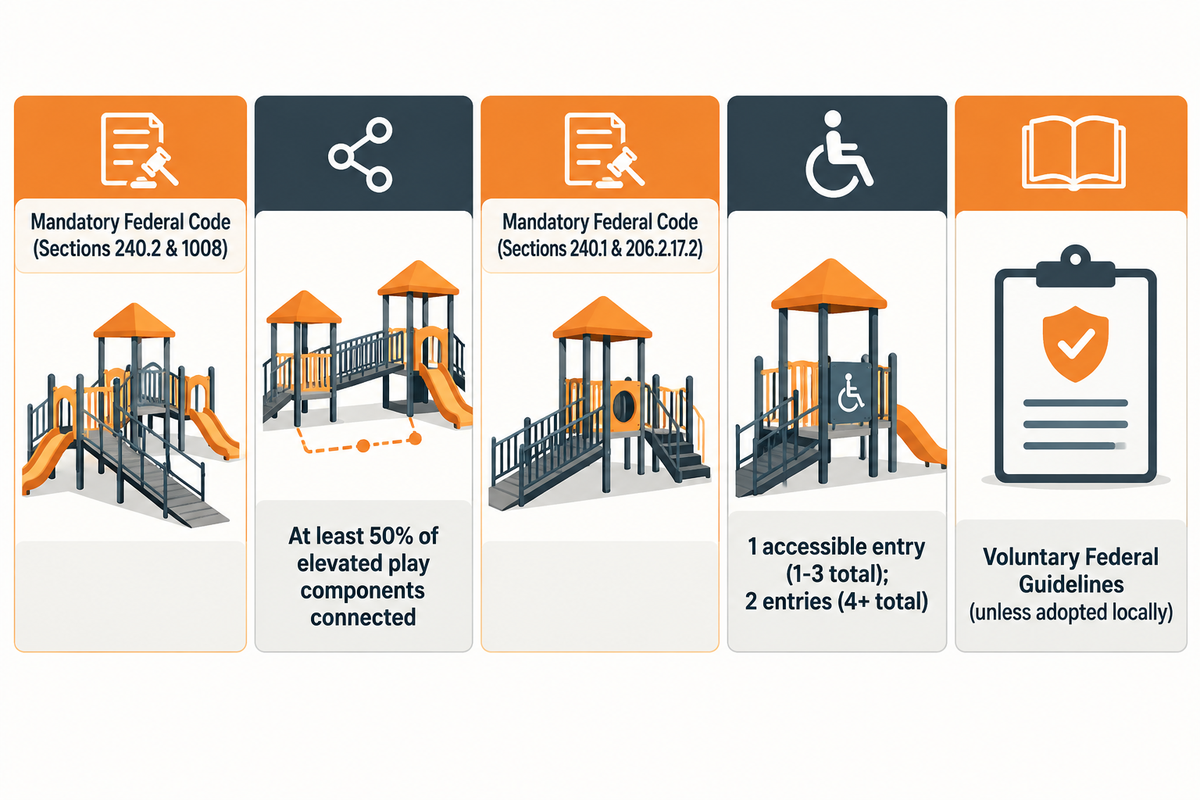
An ADA-compliant playground meets the 2010 enforceable ADA Standards as clarified by the U.S. Access Board Chapter 10 Play Areas Guide. Section 240 sets scoping counts to meet accessibility rules for elevated and ground play components. Section 1008 establishes route, ramp, transfer system, and ASTM F1951 standards for newly constructed or altered parks, schools, and commercial indoor sites serving ages 2 and older.
Distinguish open post-and-deck play equipment, which must connect ground and elevated components per Section 240.2, from enclosed soft-contained play equipment, for which Section 206.2.17.2 addresses entry points. Calling a rigid, open, steel, indoor modular frame a soft contained maze is a clear violation.
The Americans with Disabilities Act of 1990 (ADA) enforces binding Title II and Title III rules so covered parks meet ADA requirements for physical safety and accessibility. In contrast, CPSC Handbook #325 provides voluntary federal guidelines (as opposed to statutory ADA requirements). However, municipal risk managers and insurers apply CPSC reviews that can limit accessibility choices or directly impact underwriting premiums.
Ongoing maintenance carries equal legal weight. Purchasing ASTM-compliant materials on day one will not protect an owner from an accessibility barrier caused by surface erosion, which later blocks a mobility device. Continuous path usability is the responsibility of the facility operator.
“The Department would caution covered entities selecting among the ground surfacing materials that comply with the ASTM requirements that they must anticipate the maintenance costs that will be associated with some of the products. Permitting a surface to deteriorate so that it does not meet the 2010 Standards would be an independent violation of the Department’s ADA regulations.”
Source: Guidance on the 2010 ADA Standards for Accessible Design, U.S. Department of Justice
An operator might group a padded soft play equipment toddler corner exclusively for children under age 2 alongside a three-tier netted containment matrix and an adjacent open role-play village. Outside soft-contained netting, open play zones serving children ages 2 and older follow Section 240 component scoping rules, while areas exclusively for under-2 toddlers remain exempt from Section 240.
| Regulatory Dimension | Open Composite Post-and-Deck Structure | Soft-Contained Play Structure | CPSC #325 & Voluntary Safety Guides |
|---|---|---|---|
| Primary Legal Authority | Mandatory Federal Code (Sections 240.2 & 1008) | Mandatory Federal Code (Sections 240.1 & 206.2.17.2) | Voluntary Federal Guidelines (unless adopted locally) |
| Age Threshold Trigger | Ages 2 and older in public or commercial sites | Ages 2 and older inside commercial indoor envelopes | Breaks down ages 6–23 months, 2–5 years, and 5–12 years |
| Elevated Access Scoping | At least 50% of elevated play components connected | 1 accessible entry (1–3 total); 2 entries (4+ total) | Addresses barrier heights, guardrail gaps, and fall zones |
| Ground-Level Route Width | 60 in (1,525 mm) min; 44 in internal width inside <1,000 sq ft with Section 304.3 turn if >30 ft | Must connect exterior building route to entry points | No width mandate for accessibility propulsion |
| Applicable Product Standard | ASTM F1487-25 (public outdoor/rigid indoor) | ASTM F1918-21 (U.S.) or EN 1176-10 (EU) | CPSC Pub. #325 (revised July 2025) |
| Surface Compliance Check | ASTM F1951 routes/spaces and ASTM F1292 use zones | Tested mats meeting ASTM F1951 routes and F1292 use zones where required | Recommends ASTM F3313 field impact attenuation checks |
| Liability Focus | DOJ civil enforcement and ADA Title II/III lawsuits | Fire egress, occupant access, and ADA Title III audits | Insurance underwriting, premiums, and injury-risk audits |
What is the difference between a fully accessible playground system and one that simply has ADA access?
On open composite structures, minimum ADA access under Section 240.2 connects 50% of elevated play components and one ground unit per provided play type. Structures must also meet the ground-component counts and play-type minimums in Table 240.2.1.2, unless ramps reach at least 50% of elevated components across three play types. Enclosed soft-contained units follow Section 206.2.17.2 entry counts instead. A fully inclusive playground allows children with diverse abilities to use swings, slides and upper decks.
Compliance with the ADA provides a legal floor, but not full social equity. Minimum rules allow a playground to connect a transfer step while leaving high slides off accessible routes. Additional design adds ramps, companion seating, and shared sensory zones into the main play environments.
Accessible vs. Inclusive vs. Universal Playground Design: Which Facilities Need Each?
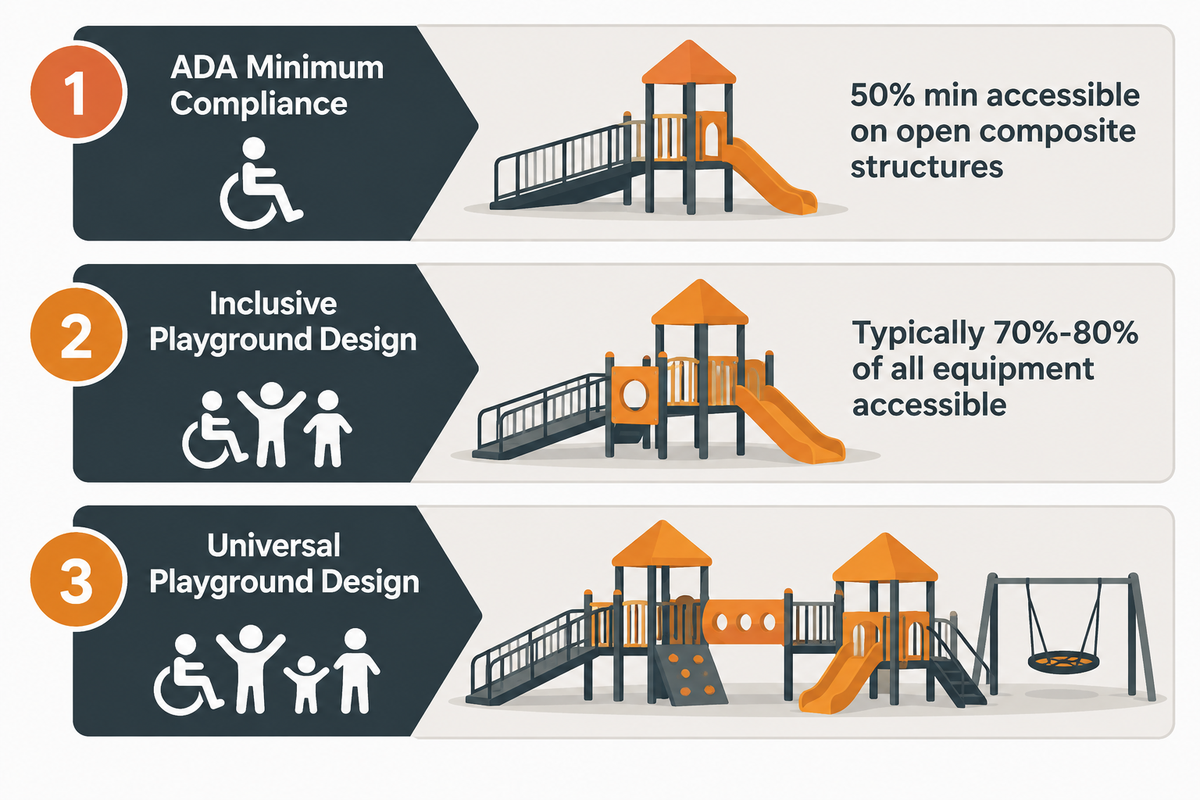
Public parks, schools, and commercial play facilities legally require accessible code compliance, while any facility may adopt inclusive or universal layouts to broaden peer participation. According to Athletic Business, 70 to 80 percent of the equipment in a typical inclusive playground is accessible. In North America, only about 2 percent of playgrounds reach a truly inclusive layout.
There is often confusion among buyers regarding three design terms that carry distinct budget implications. Minimum ADA accessibility hits the statutory requirements without extra sensory zones. Inclusive play design serves varied sensory needs and abilities allowing children of all abilities to share equipment. Universal design makes one space welcoming for all ages and abilities so peers and caregivers can play together from day one.
| Evaluation Factor | ADA Minimum Compliance | Inclusive Playground Design | Universal Playground Design |
|---|---|---|---|
| Primary Goal | Meet federal minimum accessibility requirements | Ensure children of all abilities play side by side | Serve all ages, mobility devices, and caregivers seamlessly |
| Elevated Play Share | 50% min accessible on open composite structures | Typically 70%–80% of all equipment accessible | Integrated ramped decks across primary play towers |
| Sensory & Cognitive Scope | Not mandated beyond physical reach rules | Adds quiet zones, tactile panels, and shade | Dual-route sensory regulation and acoustic zoning |
| Ground Surfacing Choice | Unitary or ASTM F1951 maintained loose-fill | Unitary rubber or turf preferred across play spaces | Flush transition unitary surfaces throughout |
| Transfer vs. Ramp Access | Transfer systems allowed below 20 elevated units | Ramps favored even below 20 components | Direct roll-in decks, spinners, and adult-rated seats |
| Legal Standing | Mandatory under 2010 ADA Standards | Voluntary design goal exceeding federal minimums | Voluntary gold standard exceeding code |
Entity ownership, construction or alteration dates on or after March 15, 2012, and lease status govern which ADA rules apply. Title II (28 CFR Section 35.150) requires local governments to provide program access across their systems, which does not necessarily require reconstructing every older park. Covered new construction and alterations on or after March 15, 2012, must meet applicable 2010 Standards rules.
Private commercial venues follow ADA Title III rules for public accommodations. Religious organizations have a statutory exemption for their ministries under Section 36.102(e). The DOJ Title III Technical Assistance Manual states that leasing space does not strip a church of its own exemption, but an independent commercial day care or indoor venue tenant bears its own Title III duties.
Play areas designed exclusively for children under age 2 are exempt from the requirements in Section 240 for play area scoping. Buyers who specify toddler indoor playground systems for the 6-to-23-month zones still follow general building egress and path rules as well as ASTM F2373 safety boundaries for non-contained toddler equipment.
| Facility Type | Governing ADA Title | Section 240 Trigger | Critical Compliance Nuance |
|---|---|---|---|
| Public Schools & Districts | Title II | Mandatory (ages 2+) | New builds and alterations must comply; existing yards follow program access |
| Municipal Public Playgrounds | Title II | Mandatory (ages 2+) | Requires continuous accessible route from parking or sidewalk |
| Commercial FECs & Malls | Title III | Mandatory (ages 2+) | Indoor soft-contained entries follow Section 206.2.17.2 |
| Private Commercial Daycares | Title III | Mandatory (ages 2+) | Family home care where proprietor resides is exempt from Section 240 |
| Restaurants, Cafes & Hotels | Title III | Mandatory (ages 2+) | Small play areas stay covered; internal routes inside <1,000 sq ft may use 44 in with 304.3 turns if >30 ft |
| Church Ministry Playgrounds | Title III Exempt | Exempt if church-controlled | Independent commercial tenants on church property carry their own Title III duties |
| Private Residential Yards | Not Covered | Exempt | Backyard family playsets fall outside federal commercial scope |
Do school playgrounds have to be ADA compliant?
Yes. New or altered play areas in public schools must be in compliance with ADA Title II, as well as 2010 ADA Standards, Sections 240 and 1008, for persons 2 years of age and older. Private schools must also adhere to these standards under Title III unless controlled by an exempt religious organization.
Under Title II, school districts have to ensure system-wide program access throughout their schools. Adding new structures, however, triggers full compliance with the 2010 ADA Standards for those altered elements.
ADA Playground Ramps vs. Transfer Systems: The 20-Component Threshold and Route Dimensions
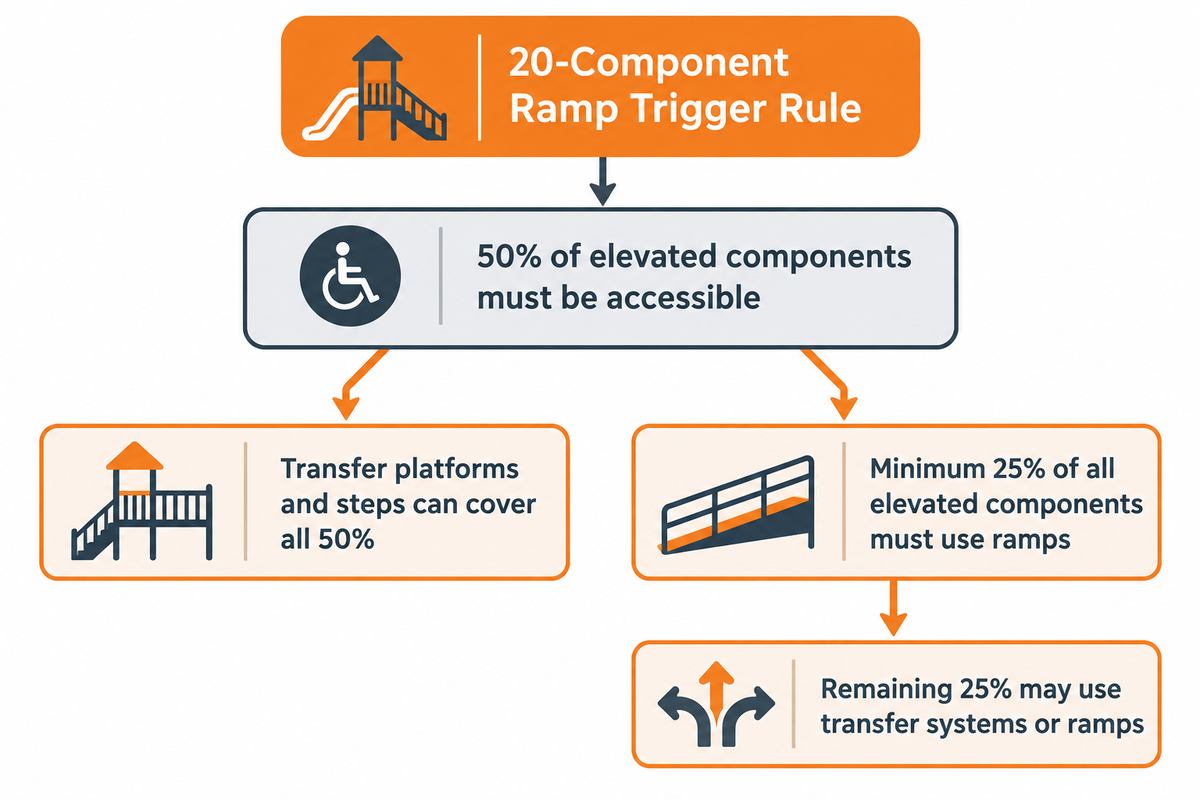
Open composite structures must place at least 50% of elevated play components on an accessible route. Once an open structure hits 20 elevated components, ramps must connect at least 25% of them. Below 20 components, a compliant transfer system can satisfy the full 50% requirement under Section 240.2.2 and Section 1008.2.1 Exception 1.
20+ UnitsElevated trigger for >=25% ramps
60 in (44 in)Internal route width (<1,000 sq ft + turn if >30 ft)
1:12 SlopeElevated ramp max (12 in rise max)
20-Component Ramp Trigger Rule
The 20-Component Ramp Trigger Rule states that adding a twentieth elevated play component requires wheelchair ramps to at least 25 percent of elevated items.
Buyers often confuse two separate 50% rules inside Section 240. Section 240.2.2 requires half of all elevated play components to sit on an accessible route. Separately, Section 240.2.1.2 lets you skip extra ground units when wheelchair ramps reach 50% of elevated components across three play types.
Under 20 Elevated Components (Open Structures)
- 50% of elevated components must be accessible
- Transfer platforms and steps can cover all 50%
- Zero mandatory elevated wheelchair ramps
- Must still follow Table 240.2.1.2 ground counts
20 or More Elevated Components (Open Structures)
- 50% of elevated components must be accessible
- Minimum 25% of all elevated components must use ramps
- Remaining 25% may use transfer systems or ramps
- Optional 50% ramp across 3 types waives extra ground units
Double slides are considered one elevated component. Surprise redesigns may occur during permit review if the number of elevated components is greater than expected. Decks, roofs, stairs, transfer platforms, and ramps are excluded from the elevated component total. Deck climbers, activity panels and elevated crawl tunnels are considered part of the total number of components.
Worked Section 240 Component Audit: 18-component vs. 22-component composite structure with Table 240.2.1.2 ground-level type offsets. Suppose a school compares two open systems using Section 240.2.1.2 rules. Layout A includes 18 elevated play components (below the 20-unit threshold). Multiplying 18 elevated components by 50% equals 9 accessible elevated components. Because 18 is under 20, one transfer system covers all 9 units without elevated ramps. Under Table 240.2.1.2 (17-to-19 elevated bracket), Layout A requires 6 ground-level components across 3 distinct play types, plus one ground component of each ground play type on site.
Now suppose the committee adds four small activity panels to reach 22 elevated play components in Layout B. Multiplying 22 by 50% equals 11 accessible elevated components. Since 22 reaches 20 units, multiplying 22 by 25% equals 5.5, which rounds up to 6 elevated components served by ramps. The remaining 5 accessible components may use a transfer system or ramps. According to Table 240.2.1.2, Layout B requires 7 ground components across 4 play types unless ramps connect all 11 elevated components across 3 play types.
Adding four small panels increases spatial demand quickly. Under Section 1008.2.5.2, an elevated ramp has a max slope of 1:12 and a max rise of 12 inches per run. Each vertical foot of deck therefore demands 12 feet of ramp plus a 60-inch landing, so designers should verify room dimensions carefully before fixing bay widths.
Elevated ramps permit steeper slopes than ground routes. Section 1008.2.5.1 limits ground route slopes to 1:16 with a 60-inch (1,525 mm) clear width. Section 1008.2.4.1 Exception 1 permits a 44-inch (1,120 mm) ground-level accessible route within a play area smaller than 1,000 sq ft (93 m2), with a Section 304.3 turning space where the restricted route exceeds 30 ft (9,145 mm). Exterior site paths from parking must still follow Chapter 4 building routes, and handrails must also prevent entrapment per American School & University accessibility engineering guidance.
| ADA Design Parameter | Minimum / Maximum Specification | Applies To | Code Reference |
|---|---|---|---|
| Ground Accessible Route Width | 60 in (1,525 mm) min clear; 36 in segments (<=60 in long) separated by 60 x 60 in segments | Play areas >= 1,000 sq ft | Section 1008.2.4.1 |
| Compact Ground Route Width | 44 in (1,120 mm) min clear; add Section 304.3 turn if run exceeds 30 ft | Play areas < 1,000 sq ft (93 m2) | Section 1008.2.4.1 Exc. 1 |
| Ground Ramp Max Slope | 1:16 maximum running slope | Ground accessible routes | Section 1008.2.5.1 |
| Elevated Ramp Max Rise & Width | 1:12 max slope; 12 in (305 mm) max rise; 36 in (915 mm) min clear width | Elevated play deck ramps | Section 1008.2.4.2 / 1008.2.5.2 |
| Ramp Landing Dimensions | Width >= connecting ramp; 60 in (1,525 mm) min length & turn width | Top, bottom, and turns | Section 405.7 (via 1008.2) |
| Transfer Platform Deck Size | 14 in (355 mm) min depth x 24 in (610 mm) min width | Transfer entry platforms | Section 1008.3.1.1 |
| Transfer Platform Elevation | 11 in (280 mm) min to 18 in (455 mm) max above surface | Unobstructed wheelchair transfer | Section 1008.3.1.2 |
| Transfer Step Height | 8 in (205 mm) max rise per step; 14 x 24 in min tread | Elevated step progression | Section 1008.3.2 |
| 17–19 Elevated Ground Count | Min 6 ground components across >=3 distinct play types | Composite structures <20 units | Table 240.2.1.2 |
| 20–22 Elevated Ground Count | Min 7 ground components across >=4 distinct play types | Composite structures >=20 units | Table 240.2.1.2 |
When must a ramp be used on a playground?
A wheelchair ramp must be installed whenever a composite play structure has 20 or more elevated play components. At that threshold, ramps must connect at least 25 percent of all elevated components, while the remaining accessible quota may use compliant transfer systems.
Designers occasionally install ramps on smaller structures to drop extra ground-level play elements. Connecting at least 50 percent of elevated components across three distinct play types via ramps waives additional Table 240.2.1.2 ground counts entirely.
ADA Playground Surfacing Compared: ASTM F1951 Accessibility, Fall Height, and Lifecycle Cost
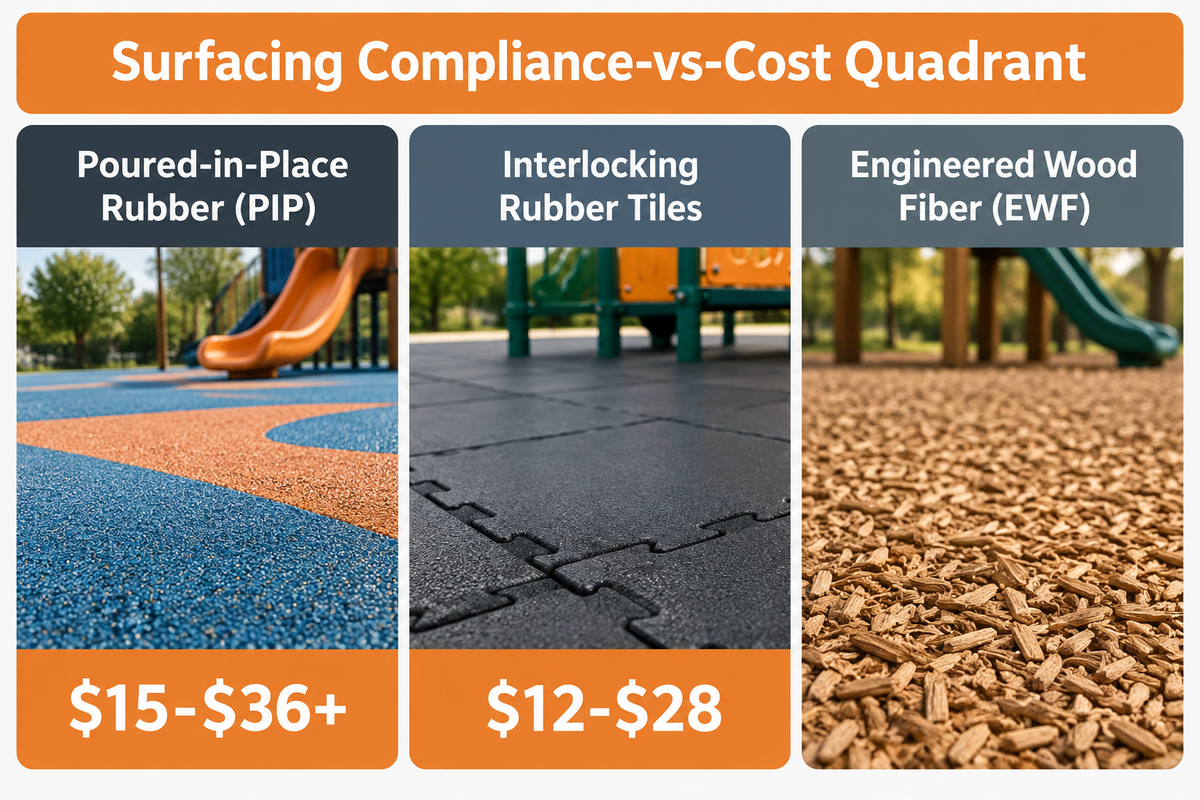
Unitary rubber, rubber tiles, bonded rubber, padded turf, and compacted wood fiber can comply when properly tested and maintained. Per Section 1008.2.6, accessible routes, clear and turning spaces must comply with ASTM F1951 accessibility standards. Only surfaces inside equipment use zones must also satisfy ASTM F1292 fall attenuation (Gmax <=200 and HIC <=1,000).
Surfacing Compliance-vs-Cost Quadrant
The Surfacing Compliance-vs-Cost Quadrant takes into account square foot pricing, fall rating and long-term maintenance against a consistent surface.
Do not assume day-one lab certificates promise years of ADA compliance in the field. In the U.S. Access Board National Center on Accessibility study of 35 playground sites, every tested surfacing category (all five material types) had at least one site with deficiencies inside 12 months. Engineered wood fiber logged the most route failures, settling 1 to 5 inches and creating transition slopes up to 16 percent, while PIP, tile, and hybrid issues emerged mostly after 24 to 36 months.
Mechanical wear explains why loose-fill surfaces lose compliance between raking cycles. ASTM F1951 compliance cannot be assured through moisture and tamping alone. Swing and slide traffic rapidly loosens fibers and breaks surface cohesion unless formulated and maintained on schedule.
Lack of compliance at borders is evident when the settled wood fiber drops below concrete walkways. As Playground Professionals warns, sweeping wood fiber from perimeter walks reveals curb drop-offs requiring ramped access, while flush transitions need no separate curb ramp. Rubber mulch resists decay for 10 to 15 years, provided buyers verify ASTM F3012 reports covering particle sizing, metal removal, and lead thresholds.
| Surfacing System | Installed Range (sq ft) | System-Rated Fall Height (F1292) | ASTM F1951 Stability & Condition | Sub-Base & Maintenance Burden |
|---|---|---|---|---|
| Poured-in-Place Rubber (PIP) | $15–$36+ | Varies by poured thickness and certified system report | Unitary; depends on binder ratio & base condition | Needs compacted stone/concrete base; patch wear years 7–10 |
| Synthetic Turf + Shock Pad | $17.50–$20 (broad guides $10–$25) | Varies by pad depth and full-assembly test report | Requires full-assembly test report | Needs infill grooming and drained aggregate base |
| Interlocking Rubber Tiles | $12–$28 | Rated per tile thickness and tested sub-base assembly | Check seam uplift and base washout | Concrete or compacted stone slab; 10–15 yr service life |
| Bonded Rubber Mulch | $8–$17 | Varies by poured thickness and manufacturer test report | Unitary polyurethane layer | Single poured layer; requires level compacted base |
| LMADRS Retrofit Matting | $13–$16 (excluding sub-base) | Varies by retrofit assembly and sound sub-base report | Unitary interlocking mat; repair cracked base before overlay | 1-day overlay over sound wood fiber or repaired PIP |
| Loose-Fill Rubber Mulch | $6–$10 | Varies by maintained depth and vendor F1292 test report | Accessible systems must pass ASTM F1951 testing; raking and leveling maintain the tested surface condition | Requires containment curbs and ASTM F3012 material checks |
| Engineered Wood Fiber (EWF) | $3–$5 | Rated per compacted lab depth and full F1292 report | Highest 12-month route deficiency rate in NCA study | ASTM F2075 wood; needs frequent raking and top-offs |
| Bare-Ground Base Preparation | +$5–$10 (add-on) | Not applicable | Required for unitary flatness | Excavation, stone sub-base, and sub-grade drainage |
| Old PIP Removal & Disposal | +$10 (approx. add-on) | Not applicable | Needed if base or binder fails; sound bases patch/overlay | Adds ~$20,000 on a 2,000 sq ft full tear-out job |
Installed poured-in-place rubber averages $15 to $36+ per square foot on prepared bases. Bare-ground excavation adds $5 to $10 per square foot before removing old surfacing. For RFP tenders, vendor surfacing guides such as SafetyFirst Playground advise requiring full ASTM F1292 certification documentation. Those documents verify HIC at or below 1,000 and Gmax at or below 200 for each fall height. Inside indoor venues, foam or vinyl mats must meet ASTM F1951 on routes and ASTM F1292 inside use zones. They also cap edge transitions at a 1:2 bevel up to 1/2 in under Section 303.3, as detailed in our commercial soft play floor mat thickness guide.
For a cost-effective hybrid layout, place unitary rubber surfacing on routes and swing bays while keeping wood fiber in quiet corners. Use the prepared-base schedule below to compare initial outlay against ongoing maintenance risk (maintenance labor is not included).
Multi-year installed & lifecycle risk profile (3,000 sq ft prepared outdoor play area):
| Cost item | Option A: Full PIP ($22/sq ft base) | Option B: Hybrid Tiles (2,200) + EWF (800) | Option C: Full EWF ($3–$5/sq ft) |
|---|---|---|---|
| Purchase price & surfacing install | $66,000 starting (3,000 sq ft x $22) | $28,800–$65,600 combined | $9,000–$15,000 material installed |
| Conditional bare-ground prep (excluded from prepared base) | +$15,000–$30,000 across 3,000 sq ft if unprepped | +$15,000–$30,000 across 3,000 sq ft if unprepped | +$15,000–$30,000 across 3,000 sq ft if unprepped + curbs |
| Maintenance & spares (unpriced ongoing labor) | Low until wear patching around years 7–10 | Tile checks plus periodic raking over 800 sq ft EWF | Frequent raking & recurring top-offs across 3,000 sq ft |
| Downtime risk | Low within initial service window | Low along primary 2,200 sq ft unitary access path | Highest: NCA study logged route failures within 12 months |
Payback example: On a prepared 3,000 sq ft base, Option A full poured rubber starts at $66,000 (3,000 x $22). Option B pairs 2,200 sq ft of tiles ($26,400 to $61,600) with 800 sq ft of wood fiber ($2,400 to $4,000). Option B totals $28,800 to $65,600, saving up to $37,200 upfront. On raw unprepped land instead, bare-ground excavation adds $5 to $10/sq ft ($15,000 to $30,000 across 3,000 sq ft). Within that total, $11,000 to $22,000 covers prepping the 2,200 sq ft tile zone. Routine wood fiber raking and top-off labor are excluded from material estimates.
What materials are safe and ADA-compliant for playground surfaces?
Safe, ADA-compliant playground surfacing includes poured rubber, bonded mulch, rubber tiles, LMADRS mats, padded turf, and maintained loose fill. Ground surfaces along accessible routes, clear spaces, and turning spaces must comply with ASTM F1951. Surfaces within equipment use zones must also comply with ASTM F1292 for each unit’s specified fall height.
Generally, unitary rubber surfaces require less wheelchair rolling effort than engineered wood fiber, but binder errors, torn seams, or base washout still cause failures. Loose-fill materials remain compliant only if crews are actively repairing ruts and maintaining depth of the wood fiber.
Commercial ADA Playground Equipment Selection: Swings, Spinners, Slides, and Sensory Play
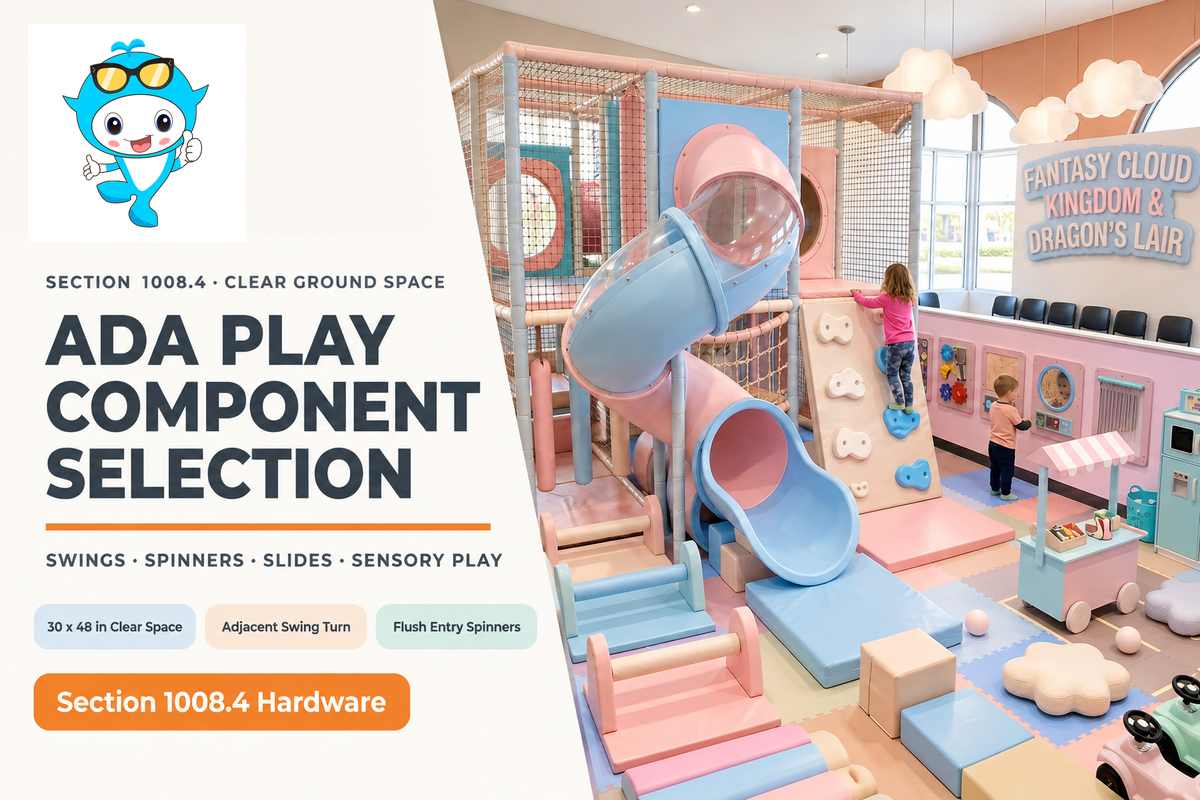
Under Section 240.2.1, at least one accessible ground-level play unit must be provided for each type of ground-level play experience offered. Examples of ground-level play experiences include swinging, sliding, spinning, rocking, climbing, and sensory play. For elevated play components installed above ground level, the requirements of Table 240.2.1.2 also apply. Those table additions drop if ramps connect 50% of elevated components across three play types.
Clear floor space and turning checks prevent failed inspections. Under 2010 ADA Standards Sections 305.3 and 1008.4.2, every required ground unit needs an adjacent 30 by 48 inch (760 by 1,220 mm) clear space. Section 1008.4.1 requires turning space complying with Section 304, a 60-inch circle or compliant T-shape, for ground-level play components on an accessible route. Where swings are provided, the required turning space must be immediately adjacent to the swing.
Swinging motion can displace wood fiber and erode clearances around adaptive swings. Unitary mats or poured-in-place rubber beneath swings can reduce rutting. Meanwhile, granted patent EP4208271B1 (June 2026) describes an articulated wheelchair swing platform with four parallel arms and pneumatic damping, according to Landscape Structures Inc. A full swing oscillation moves the platform up by three inches and shifts it 25 inches laterally.
Flush inclusive carousels provide a wide variety of accessible play options where peers play freely together. Zero-threshold ground decks allow simultaneous use of carousels by both wheeled and walking riders. Indoor centers pair acoustic alcoves with tactile walls using autism-inclusive indoor playground layouts so neurodivergent kids participate comfortably.
| Equipment Type | Play Experience Category | Mandatory Clear Space | Common Procurement Mistake |
|---|---|---|---|
| High-Back Molded Adaptive Swing | Swinging (transfer) | 30 x 48 in clear space + immediately adjacent Section 304 turn on same level | Installing over loose mulch without wear mats |
| Platform Wheelchair Swing | Swinging (roll-in) | 60 in turning space + gated lock zone | Mixing open-access public bay without fencing |
| Flush-Grade Merry-Go-Round | Spinning (roll-in) | Flush <=1/2 in gap + 30 x 48 in bay entry | Allowing lip drops above 1/2 in at deck edge |
| Transfer-Exit Embankment Slide | Sliding | 30 x 48 in transfer space at base exit | Ending slide chute in un-compacted mulch pit |
| Seated Spring Rocker | Rocking | 30 x 48 in clear space + back support | Seat heights outside 11–24 in transfer zone |
| Ground-Level Sensory & Music Panel | Sensory / Manipulative | 30 x 48 in clear space; advisory reach 20–36 in (ages 3–4), 18–40 in (5–8) | Mounting dials too high for seated ages 3–8 |
| Ground Crawl Tunnel / Arch | Crawling / Climbing | 30 x 48 in parallel approach at entry | Surrounding tunnel with curbs blocking access |
| Elevated Play Table (Sand/Water) | Sensory / Tactile | 31 in max rim height + 24 in knee clearance | Closing under-basin apron preventing leg roll-in |
Commercial Indoor Soft Play and Multi-Tier Play Structures Under ADA Rules
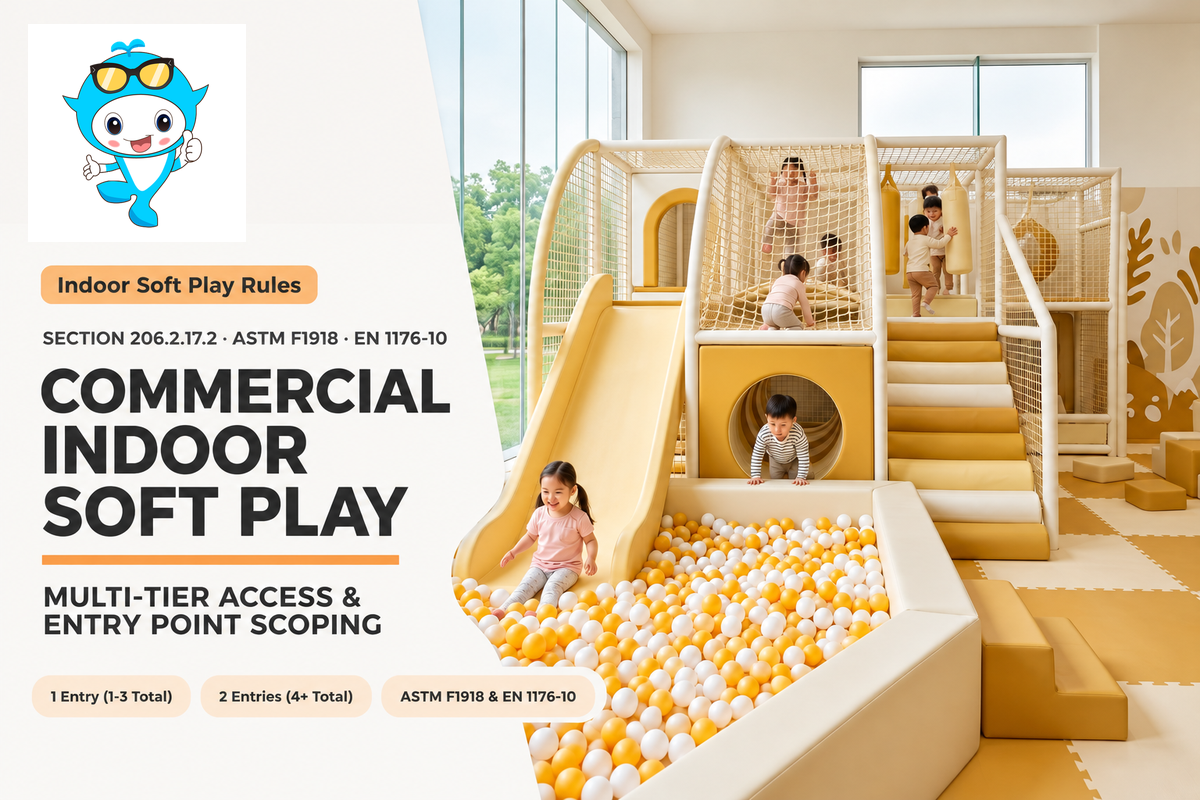
Commercial soft-contained play structures with three or fewer entries require one accessible entry, while those with four or more entries require two. Unlike outdoor post-and-deck play towers, enclosed netted mazes do not require internal wheelchair ramps across upper crawl tiers under Sections 240.1 and 206.2.17.2.
Multi-zone entertainment centers often overapply that exception across the entire playground area. Open play structures, freestanding blocks, and steel-post role-play villages outside containment nets serving children ages 2 and older must still have routes under Section 240.2. Review our commercial indoor play structures line to verify accessible entry points and aisle clearances.
Cross-border product codes produce a second procurement trap. U.S. soft-contained play structures comply with ASTM F1918-21, while European enclosed play structures comply with EN 1176-10. Inspections check whether submitted test documentation proves compliance with local standards rather than automatically accepting regional substitutes. Buyers also refer to ASTM F2223-19a surfacing selection guidance and verify local fire-code flammability rules.
| Indoor Venue Zone Type | Applicable ADA Scoping | Primary Safety Standard | Design Verification Requirement |
|---|---|---|---|
| Enclosed Soft-Contained Structure (1–3 Entries) | Min 1 entry on accessible route (§206.2.17.2) | ASTM F1918-21 (U.S.) or EN 1176-10 (EU) | Exterior building path must reach entry threshold |
| Enclosed Soft-Contained Structure (4+ Entries) | Min 2 entries on accessible route (§206.2.17.2) | ASTM F1918-21 (U.S.) or EN 1176-10 (EU) | Disperse both entries across perimeter circulation |
| Toddler Foam Play Corner (6–23 Months) | Exempt from Section 240; follow building egress rules | ASTM F2373 (6–23 months; infant/toddler) | Maintain general Title III entry and caregiver aisles |
| Open Rigid Modular Indoor Structure | Full Section 240.2 ground & elevated scoping | ASTM F1487-25 (rigid public equipment) | Cannot use soft-contained entry-only exemption |
| Floor-Level Soft Play Mats & Curbs | Level change <=1/4 in vertical (1:2 bevel up to 1/2 in) | ASTM F1951 & local fire/smoke code | Add beveled transition strips where edges <=1/2 in |
| Amusement Attractions & Mechanical Rides | Section 1002 amusement ride rules (§240.1 Exc. 3) | ASTM F2291 (amusement rides & devices) | Requires dedicated ride load/unload bay scoping |
Upgrading an Existing Playground and How the ADA 20 Percent Alteration Rule Works
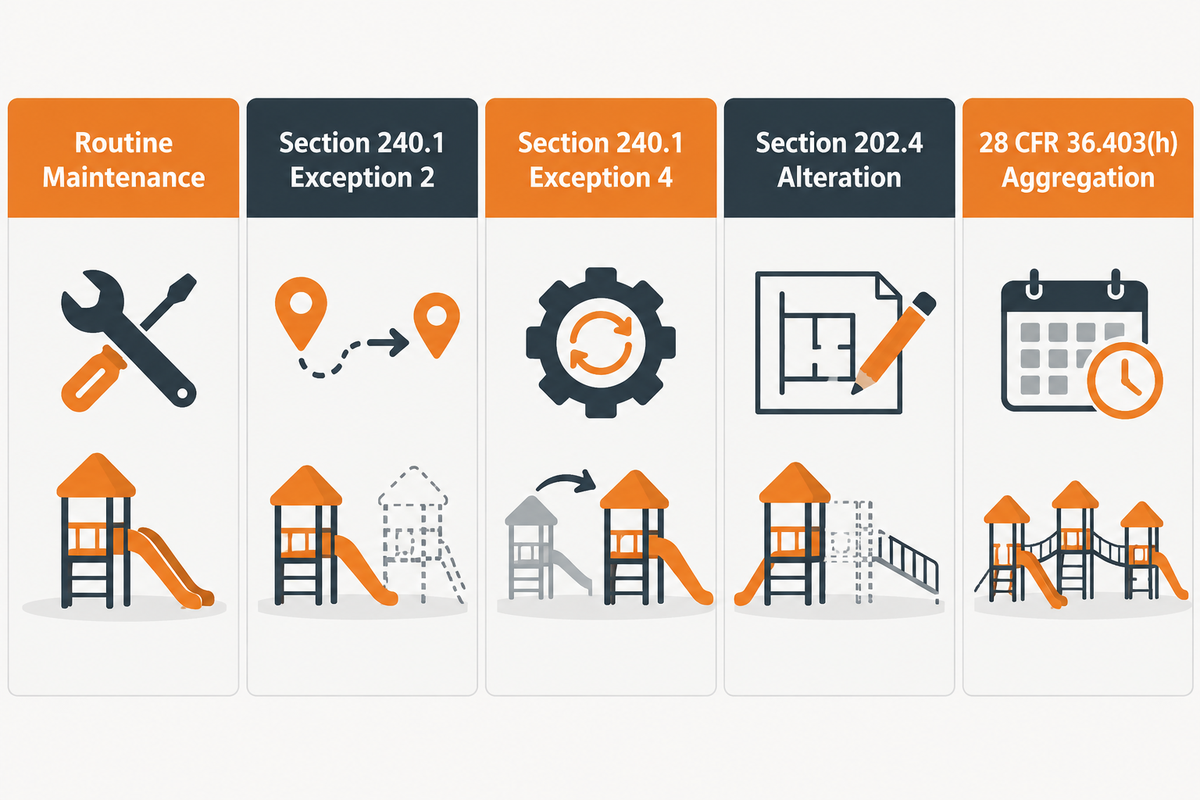
Upgrading play zones inside indoor or outdoor venues does not always require tearing out intact floors. Under Section 240.1 Exception 4, replacing only play components leaves unaltered ground surfaces exempt unless Section 202.4 requires compliance. That surfacing exemption ends whenever accessible ground surfacing costs 20% or less of equipment alteration cost (Access Board guidance summarizes this trigger as under 20%). Separately, broader Title III path-of-travel upgrades (restrooms, entrances, sidewalks) become disproportionate above 20% of primary alteration spending under 28 CFR 36.403(f)(1). Owners still fund priority path improvements up to 20%.
Owners often postpone repairs due to 28 CFR Section 36.403 path-of-travel rules. Routine maintenance (raking wood fiber, adding mulch depth, tightening bolts, or swapping identical worn panels) creates zero alteration triggers. Moving a piece purely for CPSC fall-zone clearance stays exempt under Section 240.1 Exception 2.
Once work becomes a primary play alteration, newly added pieces of equipment must meet Section 240/1008 rules regardless of cost thresholds. For private commercial facilities under Title III (Section 36.403(f)(1)), wider path-of-travel improvements include routes, entrances, and restrooms. Under Section 36.403(f)(1), accessible path-of-travel costs exceeding 20% of the cost of alterations to the primary-function area are considered disproportionate. In the DOJ Title III Manual illustration, a $20,000 facility renovation treats path upgrades above $4,000 ($20,000 x 0.20) as disproportionate. Owners still fund priority elements up to that 20% threshold. Section 36.403(h)(2)(i) aggregates phased primary-function contracts along one path across the preceding three years. Public parks follow parallel Title II rules under 28 CFR 35.151(b)(4).
Older facilities receive zero 1991 safe harbor protection because 28 CFR Section 36.304(d)(2)(iii)(H) excludes Section 240 play area elements from 1991 protections, so owners must remove barriers where readily achievable. Facilities should maintain documented scheduled indoor playground maintenance protocols, in order to prevent a violation for failing to maintain the facility in a manner that prevents surface deterioration.
| Project Activity | Legal Classification | Altered Item ADA Rule | Surface & Path-of-Travel Impact |
|---|---|---|---|
| Raking EWF, Top-Offs, Bolt Tightening | Routine Maintenance | No new alteration trigger | Required to prevent surface deterioration violation |
| Moving Existing Piece for Fall-Zone Safety | Section 240.1 Exception 2 | Exempt from new Section 240 trigger | Valid when ground stays untouched (<=1 use zone) |
| Replacing Equipment Only (Intact Floor) | Section 240.1 Exception 4 | New components must meet Section 240/1008 | Intact surface stays exempt only if accessible surfacing upgrade exceeds 20% of equipment alteration (<=20% requires upgrade per §202.4) |
| Primary Play Area Upgrade + Path Work | Section 202.4 Alteration | Full Section 240/1008 on altered zone | Altered zone must comply; wider path-of-travel upgrades required up to 20% threshold (prioritized below 20%) |
| Phased Equipment Upgrades (Three-Year Window) | 28 CFR 36.403(h) Aggregation | Full Section 240/1008 across phased pieces | Primary-function alteration costs served by the same path aggregate over preceding three years toward 20% threshold |
What if you want to make an established playground ADA compliant and more inclusive?
Starting at the perimeter curb ramps and surfacing main routes with tested tiles or poured rubber is the first step. Then, add compliant ground-level play types and check if the planned upgrades require path-of-travel surfacing up to the 20% threshold.
In cases where sub-bases remain structurally sound, cracked surfacing can be overlaid with interlocking retrofit matting to restore ASTM F1951 wheel rolling. That overlay option avoids full tear-out costs near $10 per square foot, though failed sub-bases still require full demolition.
ADA Playground Cost Breakdown, Budget Tiers, and RFP Submittal Requirements
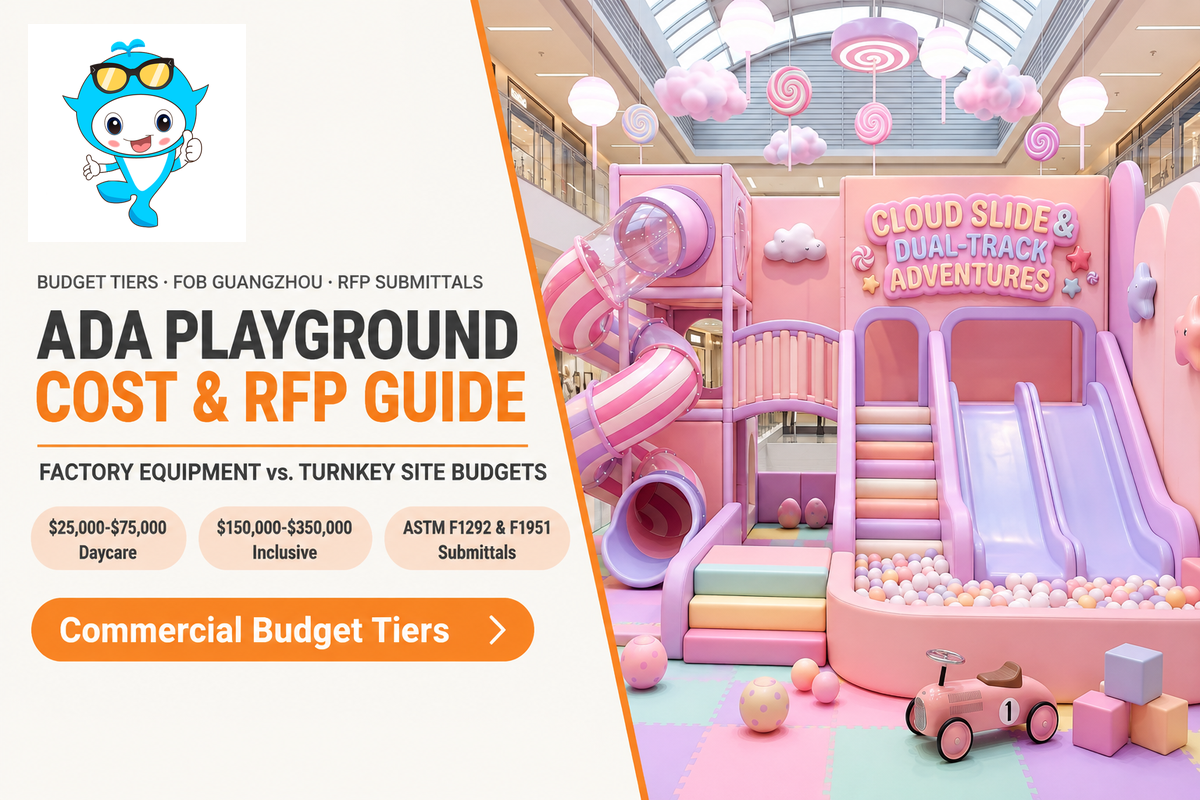
Commercial U.S. turnkey outdoor ADA playgrounds cost $25,000 to $75,000 for small daycare sites and $100,000 to $250,000+ for community parks. Destination inclusive playgrounds average $150,000 to $350,000. Play equipment accounts for 40% to 50% of total capital, while installation adds 25% to 35% of equipment price.
Poured-in-place rubber surfacing costs $15 to $36+ per square foot, excluding base preparation and removal of existing surfacing. Site prep (bare-ground) costs ($5 to $10 per square foot), freight, permits, and curbing determine the final total. Equipment-only factory prices should be evaluated separately from landed ocean freight, customs clearance, and U.S. installation labor.
For commercial indoor venues sourcing direct factory equipment, Guangzhou Didi Land publishes FOB Guangzhou hardware tiers by footprint and quotes EXW or DDP delivery on request. Compact modular indoor jungle gym packages run $8K to $18K for small spaces, $20K to $60K for mid-size builds, and $80K to $200K+ for multi-tier custom builds. Full multi-level indoor play structures range from $50K to $150K ($50,000–$150,000) for compact builds, $150K to $400K ($150,000–$400,000) mid-size, and $400K to $1M+ ($400,000–$1,000,000+) for flagship destinations. Toddler packages add $5K to $25K (compact), $25K to $80K (medium), and $80K to $300K+ (mega).
| Project Tier or Cost Line Item | Published Pricing Tier | Scope Basis & Exclusions |
|---|---|---|
| Small Daycare Outdoor Turnkey | $25,000–$75,000 | Installed U.S. outdoor build; site demolition priced separately |
| Community Park Turnkey / Destination Average | $100,000–$250,000+ (avg $150,000–$350,000) | Equipment is 40%–50% of budget; install adds 25%–35% of gear |
| Didi Land Compact Toddler Equipment | $5K–$25K (mid $25K–$80K; mega $80K–$300K+) | Factory equipment-only pricing; freight and install excluded |
| Didi Land Indoor Jungle Gym Tiers | $8K–$18K small / $20K–$60K mid / $80K–$200K+ custom | Factory hardware tiers (FOB Guangzhou); ocean freight quoted by CBM |
| Didi Land Multi-Level Indoor Play Structures | $50,000–$150,000 / $150,000–$400,000 / $400,000–$1,000,000+ | Small, medium, and flagship builds; shipping and site prep excluded |
| Safety Surfacing & Sub-Base Prep | $15–$36+/sq ft PIP + $5–$10/sq ft prep | Requires compacted aggregate or concrete sub-base slab |
Bid requests should reject vague assurances that equipment “meets ADA” and use Didi Land’s specification checklist below in tender documents. It ties third-party ASTM test reports and dimensioned Chapter 10 ADA drawings to contract milestones, helping reduce costly post-delivery site rework.
RFQ checklist: copy these into your quote request:
| Parameter | Recommended range | Why it matters | How to verify |
|---|---|---|---|
| Outdoor & Rigid Equipment Standard | ASTM F1487-25 (ages 2–12) | Current June 2025 revision governs entrapments and slide exits | Require current third-party IPEMA or lab test report |
| Indoor Soft-Contained Code | ASTM F1918-21 (U.S.) or EN 1176-10 (EU) | Certificates are not interchangeable across jurisdictions | Match test certificate number to project country |
| Toddler Play Equipment Scope | ASTM F2373 (6–23 months; infant/toddler equipment) | Prevents inappropriate older-child fall heights in infant zones | Verify age plaque and perimeter use-zone callout |
| Wheelchair Route Surfacing | ASTM F1951-21 full assembly pass | Proves wheelchair accessibility across the full installed surface | Demand full-system lab F1951 report, not fiber-only sheet |
| Fall Impact Attenuation | ASTM F1292 Gmax <=200 and HIC <=1,000 | Surfacing critical fall height must meet or exceed each unit’s specified fall height | Compare surfacing critical fall height against specified fall heights for all decks, swings, and climbers |
| Post-Install Field Drop Test | ASTM F3313-26 field impact testing | Measures in-situ Gmax and HIC attenuation after field installation | Optional contract clause: if specified in tender terms, tie contract retainage to passing field impact drop tests |
| Chapter 10 ADA CAD Callouts | 60 in turn, 30 x 48 in clear, 11–18 in platform, 8 in max step | Proves real clearance parity before shop fabrication starts | Require dimensioned DWG/CAD prior to sign-off |
Scope & Cost Boundaries for Project Buyers
- The 2010 ADA Standards cover Title II public parks and Title III commercial spaces for ages 2+. Purely private homes are exempt. Home-based commercial child care may bring Title III requirements to business spaces and access ways. Religious entities remain exempt from Title III. Private commercial tenants that lease church space remain covered.
- On open rigid structures indoors or outdoors, 1:12 ramps with 60-inch landings expand floor area sharply once elevated components reach 20. Soft-contained units rely on accessible entry counts.
- Published U.S. surfacing rates ($3 to $5 for EWF and $15 to $36+ for PIP) exclude base prep ($5 to $10/sq ft) and old rubber tear-out (~$10/sq ft).
- U.S. ASTM F1918 and European EN 1176-10 certificates will not substitute for one another, meaning that the client must lock in the project-country testing during the quotation stage.
- Landed freight, prevailing-wage labor, fabrication schedules, and itemized warranties are confirmed in each engineered CAD quote and purchase contract.
How to Evaluate Commercial ADA Playground Manufacturers and Verify CAD Submittals
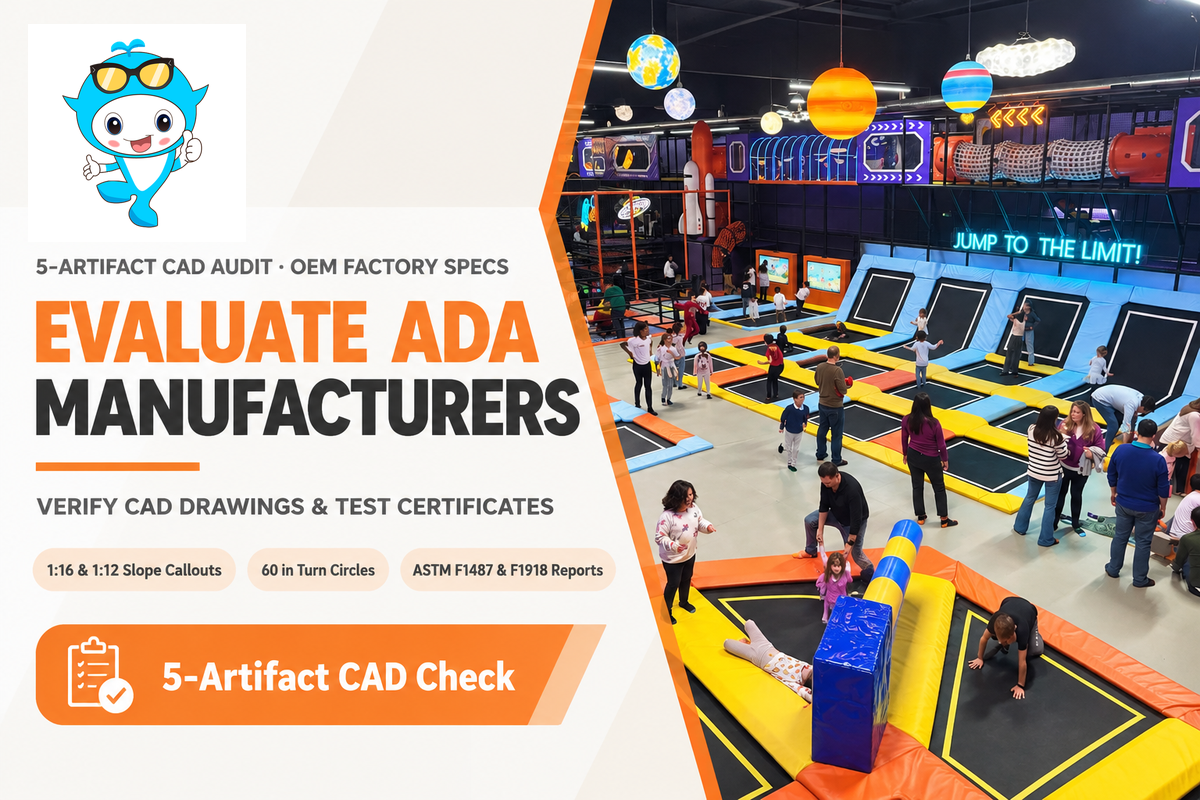
Dimensioned AutoCAD drawings with itemized fabrication schedules separate compliant builders from catalog resellers. Require 60-inch turning circles, component counts, and full ASTM test reports before approving production. While the top five global brands hold roughly 35% market share, many catalog traders ship 3D renders instead of compliance blueprints.
5-Artifact ADA CAD Submittal Check
The 5-Artifact ADA CAD Submittal Check audits component worksheets, dimensioned CAD clearances, full-assembly surfacing reports, factory seam specs, and written warranty clauses before fabrication. This process is done prior to fabrication.
Verifying these five deliverables prevents field changes and ensures the components are ready to be fabricated. Require third-party ASTM safety certificates and full multi-layer F1951 surfacing reports, as Playground surfacing guidance notes. Playground surfacing guidance shows that ASTM F1951 rolling scores reflect testing of fibers, infill, shock pad, and sub-base together. When auditing soft-contained packages, check buyer CAD clearances (60-inch turns, 30 x 48 in zones) alongside any OEM-specified seam standards.
Guangzhou Didi Land Amusement Equipment (Didi Land) supplies custom commercial indoor playground packages built from project floor plans. Didi Land does not ship pre-certified generic ADA compliance drawings because permits require building-specific site context. Instead, buyers submit a scaled architectural floor plan and clear ceiling height in millimeters. During Didi Land’s concept-intake 3D CAD layout review workflow, buyers and local inspectors verify 60-inch turns, 30 by 48 inch clear spaces, and entry counts before fabrication. Factory production spans variable standard, deep custom, full structures, and jungle gym tiers confirmed per quote. Where OEM-specified for soft-play padding, Didi Land builds to contract sewing tolerance and Velcro flaps per project quote. Quotes cover FOB, CIF, or DDP shipping options, with written warranty terms locked in contract.
Do
- Require scaled DWG plans marking 60 in turning spaces and 30 x 48 in zones
- Count elevated play components early to avoid crossing 19 into 20 units
- Lock full-assembly ASTM F1951 and F1292 reports to bid retainage
- Submit architectural floor plans and ceiling height in millimeters at intake
Avoid These Mistakes
- Reject 3D visual concepts lacking labeled transfer and ramp dimensions
- Refuse turf fiber brochures omitting complete assembly F1951 test reports
- Never substitute U.S. ASTM F1918 documents for European EN 1176-10 compliance
- Withhold deposit payments until written contracts lock itemized warranty terms
| Procurement Dimension | Domestic North American / EU Brands | Generic Bulk Catalog Traders | Direct Specialized OEM (Didi Land) |
|---|---|---|---|
| Minimum Order Quantity | Project-based turnkey packages | Batch minimums or full container defaults | 1 set (US$5,000 minimum project value) |
| Engineering Intake Method | Site survey and regional rep CAD | Fixed catalog stock modules only | Concept-intake 3D CAD layout verification from mm floor plan & ceiling height |
| Soft Play Tolerance Spec | Standardized per turnkey brand spec | — | Buyer-defined OEM spec for seam tolerance & Velcro flaps |
| Incoterms & Direct OEM Production Lead Time | Domestic freight & turnkey site install | Commonly EXW or FOB port-only delivery | FOB Guangzhou, EXW, or DDP; 25–35 days standard, 45–60 days custom |
| Warranty & Contract Control | Published tiered structural warranties | Limited after-sales parts support | Itemized warranty & schedule locked in written contract |
What Is Changing in ADA Playground Enforcement and Safety Standards
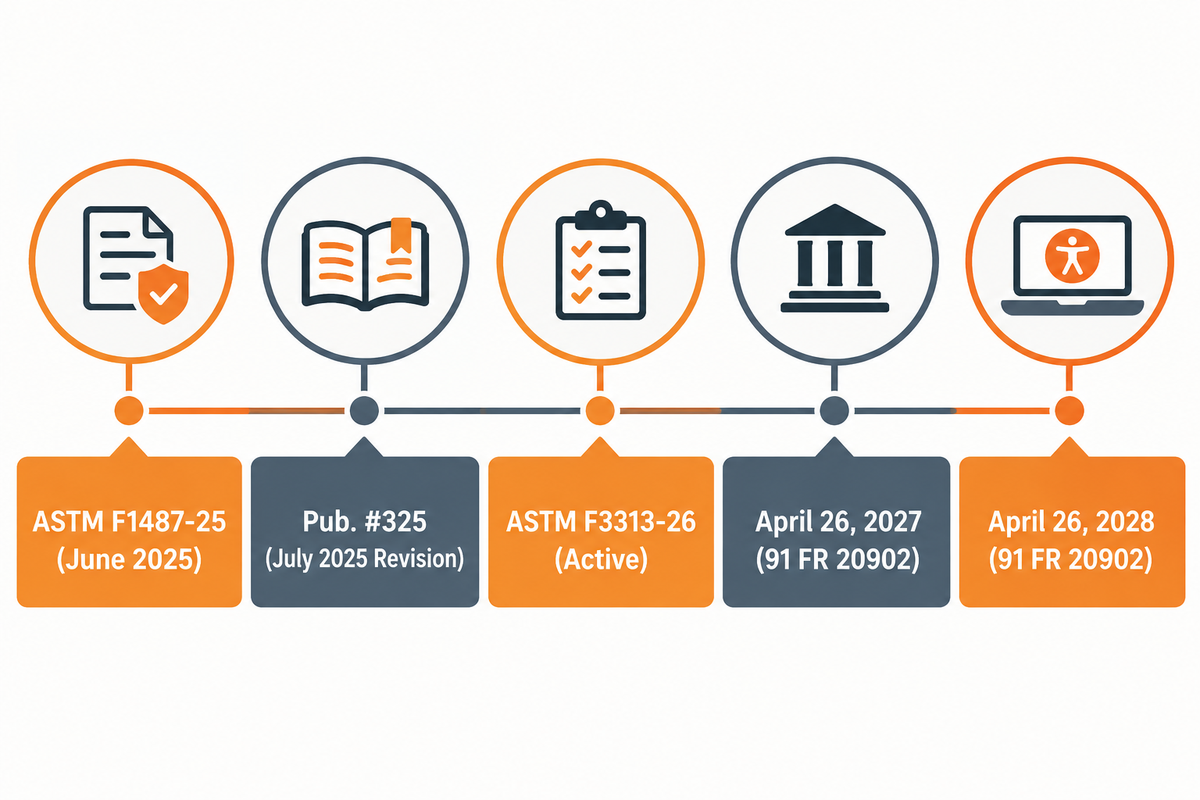
Updated product standards, voluntary safety handbooks, and U.S. Federal agency digital deadlines spanned 2025 and 2026. Physical accessibility rules in 2010 ADA Sections 240 and 1008 did not change. However, public park teams now apply revised ASTM test methods and CPSC inspection guidance. Extended Title II web compliance dates also impacted public park teams.
On April 20, 2026, the Department of Justice issued Interim Final Rule 91 FR 20902 amending 28 CFR 35.200(b). It pushed Title II digital compliance out by 12 months. Large governments serving 50,000+ residents face an April 26, 2027 deadline, while smaller districts have until April 26, 2028. Park portals, accessibility inventories, and booking pages must comply by those dates.
Safety inspections and product benchmarks moved onto new editions at the same time. In July 2025, CPSC Handbook #325 updated guidance on suspended items, loose surfacing, and underwriting checks. Vendor advisories such as All Aquatics Kids Play note that CPSC guidelines are voluntary rather than federal mandates. Even so, insurers, school districts, and local governments use them in risk assessments that affect coverage options and premiums. ASTM released F1487-25 for public gear in June 2025. Active standard ASTM F3313-26 details field impact testing procedures that buyers may optionally include in bid contracts as a retainage clause.
| Regulatory or Standard Milestone | Effective Date / Edition | Action Required for Facility Buyers |
|---|---|---|
| ASTM F1487 Public Play Equipment Standard | ASTM F1487-25 (June 2025) | Update new rigid outdoor/indoor bid specs to 2025 edition |
| CPSC Public Playground Safety Handbook | Pub. #325 (July 2025 Revision) | Align surfacing audits and insurer checklists with 2025 updates |
| Installed Surfacing Field Impact Testing | ASTM F3313-26 (Active) | Optional contract item: if specified in tender terms, verify passing calibrated drop testing before final payment |
| DOJ Title II Digital Portal Deadline (>=50k Pop.) | April 26, 2027 (91 FR 20902) | Audit online park accessibility maps and reservation portals |
| DOJ Title II Small Entity Deadline (<50k Pop.) | April 26, 2028 (91 FR 20902) | Complete WCAG 2.1 Level AA compliance for park websites |
Key takeaway
Every compliant ADA playground relies on checking elevated counts before hitting 20 components and separating enclosed netting from open gear. Ground surfaces on accessible routes and in required clear and turning spaces must comply with ASTM F1951; surfaces in equipment use zones must comply with ASTM F1292 for the equipment’s fall height.
Frequently Asked Questions About ADA Playgrounds
What are the ADA guidelines for playgrounds?
For ages 2+, 2010 ADA Standards Sections 240 and 1008 require open structures to connect 50% of elevated components and Table 240.2.1.2 ground counts. At 20 elevated components, ramps must serve at least 25%, while soft-contained builds provide one or two accessible entries. External accessible routes stay 36” clear width (200’ passing spaces). Inside play areas, ground routes stay 60” wide (44” under 1,000 sq ft, turning space past 30’) at 1:16 max slope on ASTM F1951 surfacing.
What is the 20% rule for ADA?
Under 28 CFR 36.403(f)(1), primary-function path upgrades (restrooms, sidewalks) exceeding 20% of primary alteration spending are disproportionate. Owners still fund priority upgrades up to 20%. In DOJ Title III Manual’s $20,000 example, upgrades reach up to $4,000 (20% of $20,000), aggregating related path alterations over three years. Section 240.1 Exception 4 exempts intact ground surfacing during equipment-only upgrades unless Section 202.4 applies. Surfacing costing 20% or less of alteration cost must upgrade (Access Board guidance: under 20%).
How much does an accessible playground cost?
Turnkey U.S. outdoor ADA playgrounds cost $25,000 to $75,000 for daycares, $100,000 to $250,000+ for community parks, and $150,000 to $350,000 for inclusive parks. FOB Guangzhou Didi Land hardware sets run $5K to $25K for compact toddler sets and $8K to $18K for jungle gyms. Full multi-level indoor structures run $50,000 to $1,000,000+, excluding shipping and site prep. Installed surfacing adds $3 to $5 per sq ft for EWF or $15 to $36+ for poured rubber.
What are the new ADA regulations for 2026?
Physical rules in 2010 ADA Sections 240 and 1008 did not change in 2026. On April 20, 2026, DOJ Rule 91 FR 20902 extended Title II web deadlines to April 26, 2027 (50,000+ pop.) and April 26, 2028 (smaller districts). Equipment buyers also reference ASTM F1487-25, July 2025 CPSC Handbook #325, and ASTM F3313-26 field tests.
Why do playgrounds not have seesaws anymore?
Traditional fulcrum seesaws faded after CPSC flagged pinch hazards and abrupt ground stops. Modern inclusive parks use cushioned spring-loaded seesaws with a backrest.
Can you give me an example of inclusive play?
Strong inclusive models feature zero-threshold spinners, musical panels, and swings with high backs over unitary rubber. Children of varying abilities use the same path.
How to make a playground handicap accessible?
Build a firm, slip-resistant external accessible route. Keep internal routes 60 inches wide, or 44 inches under 1,000 sq ft with turning spaces past 30 feet. Install ASTM F1951 surfacing on routes, ASTM F1292 in use zones, and 30 by 48 inch clear spaces per ground play type. Connect 50% of elevated components via transfer systems under 20 units, or 1:12 ramps for at least 25% at 20 or more units. Soft-contained builds provide accessible entries instead.
Should ADA swings be included in an inclusive playground?
Yes. Whenever a playground includes swings, Section 240.2.1 requires at least one accessible seat along an accessible route. Section 1008.4.1 requires a Section 304 turning space (a 60-inch circle or T-shape) on the same level as play components and immediately adjacent to any swing. Every ground unit has to have an adjacent clear floor space of 30 by 48 inches, also required by Section 1008.4.2.
Engineering Your Next Commercial ADA Play Space
Send your scaled floor plan and clear ceiling height in millimeters to Guangzhou Didi Land Amusement Equipment (Didi Land). Request a custom layout review, elevated unit count check, and FOB, CIF, or DDP quotation.
About This Analysis
This analysis was prepared by the engineering team at Guangzhou Didi Land Amusement Equipment (Didi Land), a commercial custom indoor playground manufacturer. Rules trace directly to the U.S. Access Board Chapter 10 guides, the 2010 ADA Standards, 28 CFR Parts 35 and 36, CPSC Handbook #325, ASTM surfacing specs, and published contractor pricing. Final project permits, local wage rates, and warranty schedules are defined in each executed contract.
References & Sources
- Guide on the ADA Standards: Chapter 10 Play Areas, U.S. Access Board
- 2010 ADA Standards for Accessible Design, U.S. Department of Justice
- Guidance on the 2010 ADA Standards for Accessible Design, U.S. Department of Justice
- Equal Opportunity Playgrounds, Athletic Business
- Title 28 CFR Section 35.150 (Existing Facilities), Electronic Code of Federal Regulations (U.S. Government Publishing Office)
- ADA Title III Technical Assistance Manual, U.S. Department of Justice
- Planning for Accessibility, American School & University
- ASTM F1951-21: Accessibility of Surface Systems Under and Around Playground Equipment, American National Standards Institute (ANSI)
- Guide on the ADA Standards: Play Surfaces Longitudinal Research, U.S. Access Board
- Loose-Fill and ADA Ramps, Playground Professionals
- Wheelchair Swing Patent EP4208271B1 (Granted June 2026), European Patent Office via Google Patents
- ASTM Playground Surfacing Standards Guide (F2223-19a), American National Standards Institute (ANSI)
- Title 28 CFR Part 36 (Nondiscrimination on the Basis of Disability by Public Accommodations), Electronic Code of Federal Regulations
- Federal Register 91 FR 20902: Title II Web and Mobile App Accessibility Compliance Date Extension, U.S. Department of Justice via GovInfo
- Public Playground Safety Handbook (Pub. No. 325, July 2025 Revision), U.S. Consumer Product Safety Commission
- ASTM F3313-26 Standard Test Method for Determining Impact Attenuation in the Field, ASTM International