Get in Touch with Didi Land


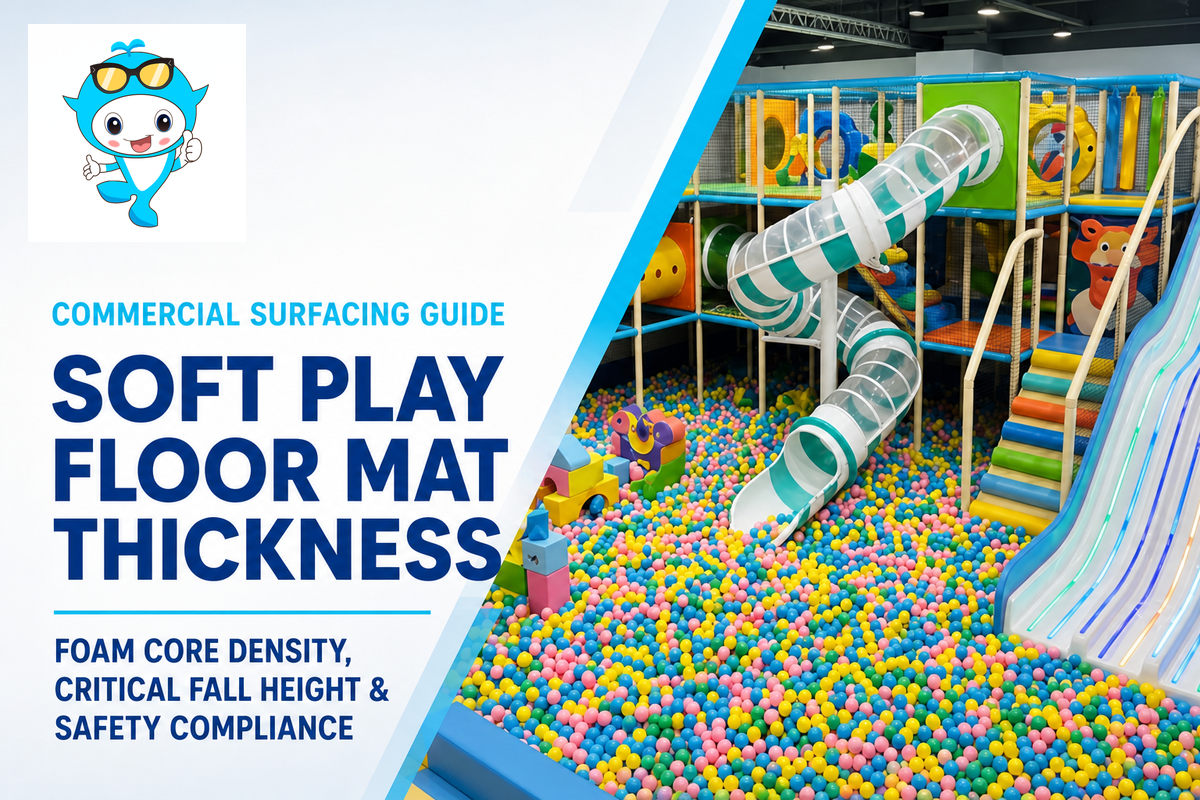
Soft Play Floor Mat Thickness: How to Specify Foam, Impact Protection, Seams, and Cleaning
Updated October 2026 · Technical Engineering Guide – Didi Land Playground Engineering Team
Soft play floor mat thickness is the primary kinetic deceleration parameter determining critical fall height compliance, shock absorption, and head injury prevention in commercial indoor playgrounds. Operators often assume that thicker padding automatically provides superior safety, or conversely, that budget-friendly interlocking foam puzzle tiles or modular rubber tiles suffice for high-traffic zones. Both assumptions routinely lead to premature equipment retirement, catastrophic joint injuries, subfloor contamination, and regulatory failure during local safety inspections. This detailed technical guide details the physics of impact attenuation under ASTM F1292 and EN 1177, establishes foam core density benchmarks (EPE, EVA, XPE, and bonded PU), solves seam failure mechanics, and delivers an auditable commercial procurement specification checklist. In designing any modern indoor play space, facility managers must balance impact absorption with footing stability across every square foot of play area surface, recognizing that high-quality commercial flooring requires far denser specifications than temporary outdoor use mats designed for generic indoor and outdoor events.
Engineering Summary in Short: Commercial soft play floor mat thickness must strictly correspond to the Critical Fall Height (CFH) of adjacent playground equipment rather than an arbitrary room aesthetic. Toddler crawling zones demand 20mm to 25mm of high-density closed-cell EPE (33–45 kg/m³) to avoid ankle instability. Conversely, multi-tier platforms, crawl tunnels, and slide runouts require 50mm to 75mm dual-density composite cores (20mm firm XPE top laminated over 30–55mm 100 kg/m³ bonded rebound PU) to arrest high-velocity falls below 200g peak deceleration and Head Injury Criterion (HIC) 1,000 without bottoming out. Concrete subfloors reflect kinetic energy rapidly, necessitating an additional 10mm to 15mm safety margin or closed-cell composite cushioning. Seams must employ heavy-duty 18oz knife-coated PVC with 100mm industrial hook-and-loop flaps or high-frequency dielectric welds to prevent biological fluid ingress into the slab.
Quick Specs: Commercial Soft Play Mat Engineering Matrix
| Primary Safety Standards | ASTM F1292-22 (North America) / EN 1177:2018+A1:2023 (Europe) / ASTM F1918-21 |
| Deceleration Thresholds | Peak deceleration g-max ≤ 200, Head Injury Criterion HIC ≤ 1000 across -4°C, 23°C, 49°C |
| Toddler Zone Thickness | 20mm–25mm Eco-friendly High-Density EPE (33–45 kg/m³) or firm XPE (firm footing, anti-rollover) |
| Elevated Fall Zones (>1.2m CFH) | 50mm–75mm Dual-Density Composite Core (20mm XPE + 30–55mm 100 kg/m³ Rebound PU) |
| Outer Envelope Fabric | 18oz/yd² (610 gsm) Knife-Coated Polyester-Reinforced PVC Vinyl, Tear Strength >250 N |
| Seam Containment | 100mm Industrial Velcro overlap flaps or High-Frequency Dielectric Welds; zero unsealed puzzle joints |
| Perimeter Termination | 20°–26° Beveled Edge Transition (anti-trip) or 1:12 ADA Accessible Entry Ramps (>13mm level rise) |
Introduction: Why Floor Mat Thickness Dictates Commercial Indoor Playground Safety
In an indoor playground, the protective floor mat must serve two mechanical purposes. It must provide firm, stable support for children’s running feet and dissipate kinetic energy when a child falls. If a child falls on protective floor mat, it should absorb the energy of the fall. If facility planners evaluate soft play floor mat thickness, they tend to analyze it in terms of aesthetics or comfort. They may also consider it in terms of superficial cushioning. In truth, the mechanism of action is a lot like the components of a protective structure, where pillow-like padding may, in fact, collapse during energy transfer, causing the child to fall directly on to the hard concrete floor.
In the case of the foam pad, selecting one that’s too dense or too unyielding can introduce deceleration shocks. When a surface pad fails to compress sufficiently on impact, the time window available to absorb the impact of the head reduces dramatically, and shockwaves are transferred directly to the skull and upper spine. Maintaining the right balance between compression and elastic recovery is key to absorbing the deceleration shocks. In playgrounds, mats are used to arrest the deceleration of a fall in a safe and controlled manner. Standard play rugs and residential playroom areas suited for tummy time or stylish spaces aren’t the same as commercial indoor facilities. High-durability foam play mat assemblies are required in commercial indoor facilities, unlike baby play areas, a residential home gym, or domestic home décor settings. In low-durability settings, such as the home, where the play rug is usually only used as a form of safety for toddlers and small children, parents usually install rubber tiles and thinner padding to provide softness safety. However, for high-durability and to reduce the risk of serious injuries around commercial climbing equipment to keep kids safe in indoor commercial facilities, operators can’t depend solely on the playmats safety measures used in the home. Commercial Operators must employ certificated high density shock attenuation mats across the entire surface area to provide a perfect play environment.
This trade-off is captured in The Dual-Zone Impact Deceleration Model. Within this engineering context, the indoor soft play areas are categorized into various risk zones based on impact energy. Crawling and walking corridors use impact matrices of shallow closed-cell foam (20mm to 25mm), limiting vertical foot depression to less than 4mm, thus eliminating ankle roll-over, gait fatigue and preventing Stumble injuries. In comparison, dynamic deceleration zones in high crawl tubes, low slides and climbing bridges use multi-layer composite foam (50mm to 75mm) to decouple surface foot firmness from deep-core shock absorption.
In commercial Family Entertainment Centers, it has been our experience that placing thin interlocking foam tiles (i.e., lightweight residential puzzle tiles) breaks this model. Permanent deformation under concentrated loads, piece-wise failure along interlocking teeth, and separation of the tile from the concrete slab are expected. Whether an operator assesses rubber or foam systems, solid rubber play tiles, or soft foam mats, specifying mat thickness isn’t an issue of interior styling; it’s the operator’s main defense against premises liability, and potentially devastating shutdown of the business.
Safety Standards and Critical Fall Height: Deciphering ASTM F1292 and EN 1177
Commercial indoor soft play surfacing is governed globally by stringent performance-based engineering standards rather than arbitrary prescriptive thickness rules. In North America, the definitive standard is ASTM F1292-22 (Standard Specification for Impact Attenuation of Surfacing Materials Within the Use Zone of Playground Equipment), complemented by equipment containment guidelines under ASTM F1918-21. Throughout Europe and international jurisdictions adopting CEN frameworks, the counterpart mandate is EN 1177:2018+A1:2023 (Impact attenuating playground surfacing, Methods of test for determination of impact attenuation), applied in harmony with EN 1176-10 for soft contained play equipment.
Both standards approve of instrumented dynamic impact testing, and disapprove of subjective cushion impact testing. Surfacing systems are evaluated by a series of drops using a 4.6 kg (10.1 lbs.) calibrated aluminum missile, embedded with a triaxial accelerometer. To gain certification, the surfacing system must demonstrate that over a series of consecutive drops from a defined height, it doesn’t exceed two absolute biomechanical injury thresholds.
- Peak Deceleration (g-max): The maximum deceleration recorded during impact must not exceed 200g (where 1g represents standard gravitational acceleration). Decelerations greater than 200g are associated with significant and severe intracranial bleeding and diffusion type (irreversible) neurological injuries.
- Head Injury Criterion (HIC): The calculated HIC value must not exceed 1,000 over an integration time interval of up to 15 milliseconds (HIC15). An HIC value of 1,000 corresponds to a statistical probability of 16% for a critical, serious, and possibly life-threatening skull fracture and brain injury in the average population.
The ASTM F1292 Triple-Temp Threshold: A foundational engineering requirement of ASTM F1292 is that surfacing materials must satisfy the g-max ≤ 200 and HIC ≤ 1000 thresholds not merely at controlled room temperature, but across three demanding thermal states: -4°C (21°F), 23°C (73°F), and 49°C (120°F). While commercial indoor playgrounds generally operate in climate-controlled spaces, HVAC system shutdowns, solar radiant heating through glass atriums, and perimeter loading-dock drafts expose mats to thermal extremes. Low-grade foams plasticize and bottom out under heat, or freeze into rock-hard barriers in cold drafts. Certified mats employ cross-linked polymer chains that maintain stable viscous damping across this entire operating band.
From these drop test curves, laboratory technicians set the Critical Fall Height (CFH) and fall height rating of the flooring system. The CFH is defined as the maximum drop height (expressed in feet or meters) at which both g-max remains ≤ 200 and HIC remains ≤ 1000. In a commercial establishment, the fall height of the mats in a mat assembly must not be less than the maximum fall height of the adjacent play equipment. If an elevated crawl tube, suspension bridge, or taller deck platform has an internal walking surface 1.5 meters above the finished floor, installing a 25mm mat certified only to 0.6 meters CFH constitutes a direct violation of international safety codes.
It’s important for procurement engineers to understand how deceleration curves are calculated. Accelerometer drop tests evaluate impact attenuation. Accelerometer drop test mechanics, such as those evaluated in peer-reviewed kinetic research on impact attenuation apparatuses (e.g., PMC4246529), demonstrate that peak deceleration curves are non-linear; as impact velocity increases, cushioning materials exhaust their available strain displacement and spike sharply into dangerous g-force zones. Deceleration time and prevents severe shock absorption is extended by nominal thickness. This, however, still leads to a rapid increase in g-force. It’s critical to specify sufficient nominal thickness.
Foam Density vs. Thickness Matrix: Choosing EPE, EVA, XPE, and Bonded PU
Achieving certified durable walking ergonomics impact attenuation typically requires the selection and specification of the correct core thickness in combination with the appropriate type of polymer. There are a number of different polymer families and each of the polymer families demonstrate a varying degree of compression and deflection, long term fatigue and other physical properties.
- Expanded Polyethylene (EPE): EPE is a non-cross-linked closed cell foam with a relative density between 33 kg/m³ to 45 kg/m³. EPE is a low cost foam with buoyancy that exhibits good cushioning properties. Because of the absence of cross-linking, EPE is subject to compressive creep under high dynamic loads. It’s optimally specified for use in toddler crawl pads, and wall wainscoting and building block padding.
- Ethylene-Vinyl Acetate (EVA): A closed-cell copolymer foam with nominal densities between 65 kg/m³ and 90 kg/m³. Compared to basic EPE, EVA provides better tensile strength and foot support, as well as better elastic rebound. However, EVA foams suffer from thermal shrinkage and stiffening, as well as irreversible compression set from repeated heel strikes. For these reasons, EVA isn’t used in high-quality orthotic mats.
- Cross-Linked Polyethylene (XPE): Chemically or physically cross-linked closed-cell microcellular foam with densities between 45 kg/m³ and 70 kg/m³. Cross-linking links individual polymer chains into a rigid three-dimensional molecular lattice, imparting extraordinary resistance to compression set, thermal degradation, and water absorption. XPE serves as the premier top-layer load-distributing sheet in commercial composite mats.
- High-Density Bonded Polyurethane (Rebound PU): Open-cell composite foam produced by shredding and thermo-compressing virgin flexible polyurethane foam chunks with high-tensile prepolymer binders, achieving densities of 80 kg/m³ to 120 kg/m³. Unlike lightweight packaging foams or low-density foam rubber, bonded rebound PU functions as a highly shock-absorbent composite core, yielding optimal energy dissipation without excessive recoil bounce that could destabilize a child.
Cluster Semantic Specification: Commercial Indoor Playground Mat Selection Matrix
| Application Cluster & Play Zone | Component Classification | Critical Fall Height (CFH) | Core Polymer Architecture | Nominal Thickness | Target Compression Set |
|---|---|---|---|---|---|
| Infant Soft Crawl Cluster | Low-Velocity Crawling Zone | <0.5 m (20 in) | Eco-friendly High-Density EPE (33–45 kg/m³) | 20 mm | <5% @ 24h recovery |
| Toddler Active Play Cluster | Low-Level Activity Flooring | 0.5 m – 0.8 m (31 in) | Dual-Density: 10mm XPE + 15mm EPE | 25 mm | <4.5% @ 24h recovery |
| Ball Pit Base Surfacing Cluster | Submerged Impact Cushion | 0.6 m – 1.0 m (39 in) | Closed-Cell XPE Core (50 kg/m³) | 30 mm | <4% @ 24h recovery |
| Low Obstacle & Step Cluster | Stair & Ramp Transition | 0.8 m – 1.0 m (39 in) | Dual-Density: 15mm XPE + 20mm Rebound PU | 35 mm | <3.5% @ 24h recovery |
| Single-Tier Deck Platform Cluster | Medium Fall Height Perimeter | 1.0 m – 1.2 m (47 in) | Dual-Density: 20mm XPE + 20mm Rebound PU | 40 mm | <3% @ 24h recovery |
| Slide Deceleration Runout Cluster | High Dynamic Egress Pad | 1.2 m – 1.5 m (59 in) | Dual-Density: 20mm XPE + 30mm Rebound PU (100 kg/m³) | 50 mm (2.0 in) | <3% @ 24h recovery |
| Multi-Tier Bridge & Tunnel Cluster | Elevated Transit Safety Zone | 1.5 m – 1.8 m (70 in) | Dual-Density: 20mm XPE + 40mm Rebound PU (100 kg/m³) | 60 mm (2.4 in) | <2.8% @ 24h recovery |
| High Climbing Net & Rope Cluster | Maximum Fall Deceleration Zone | 1.8 m – 2.0 m (78 in) | Dual-Density: 25mm XPE + 50mm Rebound PU (110 kg/m³) | 75 mm (3.0 in) | <2.5% @ 24h recovery |
| Trampoline Transition Margin Cluster | Lateral Rebound Safety Boundary | 1.8 m – 2.2 m (86 in) | Dual-Density: 30mm XPE + 50mm Rebound PU | 80 mm (3.1 in) | <2% @ 24h recovery |
| Vertical Climbing Dismount Cluster | Heavy Crash Landing Pad | >2.2 m (86+ in) | Triple-Density Crash Core with Breather Relief Valves | 100 mm – 150 mm | <2% @ 24h recovery |
Bottoming out is the abrupt transfer of kinetic energy to potential energy, which occurs when the impacting body exhausts the compression stroke of the foam before the kinetic energy is fully dissipated. Low-density open-cell foams (e.g., standard mattress foam or cheap polyurethane upholstery padding) compress with very little resistance. These foams suddenly change state from a deformable cushion to a solid, incompressible mass the instant the cell walls come into contact. Accelerometer readings show deceleration spiking violently from 40g to well over 350g in less than 2 milliseconds.
To defeat bottoming out without creating an uncomfortably hard walking surface, modern commercial playground engineering adopts Dual-Density Core Architecture (such as the shock-absorbing core concepts detailed in commercial composite mat patents, e.g., US9896808B2). By laminating a firm, closed-cell 20mm XPE upper layer onto a dense, compliant 30mm, 55mm bonded rebound PU substrate, point loads from children’s feet are laterally dispersed across the top surface, providing rigid footing. When a dynamic fall occurs, the broadened load footprint engages the massive shock-absorbing reservoir of the bonded PU base, arresting momentum smoothly within the certified deceleration envelope.
Puzzle Tiles vs. Vinyl-Wrapped Commercial Mats: Seam Integrity, Hygiene, and Durability
One of the most persistent procurement mistakes in indoor playground development is the procurement of modular interlocking EVA puzzle tiles or thin foam puzzle mats instead of factory-fabricated, vinyl-wrapped commercial mats. While lightweight reversible puzzle tiles offer low upfront retail acquisition costs and easy to install DIY assembly, their mechanical and hygienic failure in commercial high-traffic settings is swift and severe.
While under the constant dynamic shear forces of running children, interlocking tabs flex and stretch laterally. Within a window of 90 to 180 days, the precision die-cut teeth loosen, and create gaps that increase from micro-slits to tripping edges. Tile corners also curl, and with shuffling feet, create trip hazards that exceed 6mm. This is the most common cause of facility liability claims. Also, thermal expansion and contraction caused by seasonal HVAC cycling causes unbonded floors to buckle and ripple across large, continuous areas.
In terms of sanitation, tile puzzles are extremely susceptible to bio-fluid contamination as defined by The Seam Penetration Index. There are frequent spills of sugary sodas, milk and vomit at commercial indoor playgrounds, as well as uncontained bodily fluids from toddlers. Interlocking joints don’t have any sealing mechanism, therefore, liquids spills descend into the seam network. The liquids flow through the interlocking tabs, and accumulate against the impervious, concrete slab as foam tiles. As the subfloor is non-porous, and doesn’t allow air to flow through it, this environment becomes a rapidly thriving colony of noxious and toxic molds (Stachybotrys chartarum), and bacteria, and foul odors that can’t be removed by surface mopping. This forces facility operators to periodically pull up hundreds of interlocking pieces, scrub and sanitize the bare, concrete slab, which increases operating costs.
5-Year Total Cost of Ownership (TCO): Interlocking Tiles vs. Commercial Vinyl-Wrapped Mats
| Evaluation Metric | Modular EVA Puzzle Tiles (20mm) | Commercial 18oz Vinyl-Wrapped Mats (50mm) |
|---|---|---|
| Initial Material & Freight Cost | Low ($18 – $28 per sq m) | Moderate to High ($55 – $95 per sq m) |
| Seam Sealing Mechanism | Unsealed friction teeth (liquid-permeable) | 100mm Industrial Velcro flaps or High-Frequency Welds |
| Field Operational Lifespan | 6 to 18 months before tab separation & cupping | 5 to 7+ years under high-density commercial traffic |
| Subfloor Mold & Fluid Risk | Severe (requires periodic floor disassembly) | Zero fluid migration; envelope containment |
| Annual Sanitization Labor | High (manual disassembly & slab decontamination) | Low (continuous flat mop surface disinfection, easy to clean) |
| 5-Year Cumulative TCO | $140 – $220 per sq m (due to 3x replacements) | $75 – $115 per sq m (single install + low upkeep) |
These seams represent serious liabilities. Commercial-grade mats resolve this problem permanently by using vinyl wrapping. Buyers can purchase choose non-toxic, anti-slip 18oz knife-coated polyester-reinforced PVC envelopes to protect prevent children from slipping on sweaty or slippery vinyl surfaces while playing in socks. Mats are attached to one another with 100mm (4-inch) wide, double-stitched industrial hook-and-loop (Velcro) overlap flaps. For permanent installations, the seams are sealed with high-frequency dielectric heat welding. This creates a completely waterproof, continuous barrier across the play surface. Because of the vinyl skin, disinfectants can be sprayed on the outside of the mat, and the underlying concrete remains completely dry.
Subfloor Dynamics: Accounting for Concrete Rigidity and Moisture Transmission
A critical oversight during playground planning is evaluating mat performance in isolation from the underlying building slab. Laboratory drop tests conducted for ASTM F1292 certification frequently use massive, reinforced concrete test beds exceeding 100mm in thickness. However, real-world building subfloors introduce substantial physical variables that dramatically alter impact attenuation and material longevity:
Boundary Reflection & Subfloor Rigidity: When a child impacts a soft play mat resting on a suspended wooden sprung floor (such as in a converted gymnasium), the structural subfloor deflects elastically by 2mm to 6mm, contributing significantly to total system deceleration. In contrast, when the identical mat is installed directly over an unyielding, post-tensioned slab-on-grade concrete floor, the subfloor provides zero flexural relief. Kinetic shockwaves propagate through the foam, strike the rigid concrete interface, and reflect back upward through the core. To compensate for this instantaneous energy reflection, experienced playground engineers enforce an engineering safety buffer of 10mm to 15mm of additional composite foam thickness when installing directly over rigid concrete slabs.
Vapor Emissions & Moisture Vapor Transmission Rate (MVER):Moisture vapor continually escapes from the surfaces of concrete slabs. Unsealed, open-cell foams and/or permeable backer materials placed against unsealed or “green” concrete will allow moisture to rise from the concrete by means of capillary action and condense into the mat. Over the course of time the trapped moisture will cause hydrolysis of the urethane in the foams and breakdown of the binder, resulting in debonding of seams, and the development of mold. It is standard for the commercial industry to test the slab to determine the MVER, which should not exceed 3 lbs/1000 sq. Standard commercial installation protocols demand testing the slab to verify an MVER of under 3 lbs/1,000 sq ft/24h (ASTM F1869) or installing an impermeable 0.2mm (8-mil) polyethylene slip-sheet vapor barrier beneath the mat layout.
Edge Protection and Accessibility: Beveled Ramps, Trip Hazards, and ADA Transit
While the center of a soft play zone is engineered for fall protection, the perimeter represents the facility’s highest statistical liability for trip-and-fall injuries. An abrupt vertical step-down from a 50mm or 75mm mat down to a bare commercial walkway presents an immediate tripping hazard for toddlers, parents, and caregivers. Regulatory safety guidelines (such as the CPSC Public Playground Safety Handbook, Publication 325) emphasize that abrupt vertical level changes in pedestrian pathways exceeding 6.4mm (0.25 inches) create unacceptable trip risks.
To eliminate perimeter tripping liabilities while complying with accessibility guidelines, facility designers must differentiate between two edge transitions based on exact slope angles and type of transit.
- Local Perimeter Beveled Edges (20° to 26° Transition): For standard mat perimeters where children step onto the padded surface from adjacent carpeted or vinyl corridors, factory-cut beveled ramps are integrated into the mat border. Under 2010 ADA Standards §303.3, level changes between 6.4mm and 13mm require a bevel no steeper than 1:2 (approximately 26.6°). A factory-molded 20-degree bevel comfortably satisfies this criterion, providing a smooth incline that allows toddler feet and service carts to roll onto the padding without catching toes on vertical vinyl lips. However, a 20° slope equals an incline of approximately 1:2.75, which is strictly an anti-trip transition for pedestrian traffic and does not qualify as an accessible wheelchair ramp under commercial building codes.
- ADA Accessible Entry Ramps (1:12 Slope): Where playground safety surfacing extends across an accessible route designated for wheelchair or mobility-device transit under 2010 ADA Standards (§§303, 405, and Chapter 10 Play Areas) and ASTM F1951, level changes exceeding 13mm (0.5 inches) must be ramped with a maximum slope of 1:12 (an 8.33% grade), or 1:16 where directly connecting to ground-level play components. For a 50mm thick play mat, a true ADA-compliant access ramp requires an engineered transition length of 600mm (24 inches) featuring rigid internal foam cores and reinforced non-skid vinyl skins that resist compression rutting under rolling wheel loads.
High edge stiffeners are required on perimeter borders to prevent the borders from curling in on themselves. Mats without edge stiffeners give way when caregivers stand at the play boundary, especially when those caregivers are adults. Seams come apart and delamination occurs. It’s especially problematic at high-use/high-traffic gateway entrance points.
The Commercial RFQ Specification Checklist: Foam Core, Vinyl Grade, and Edge Engineering
Procuring commercial soft play mats through global supply chains requires precise technical language in your Request for Proposal (RFP) or Request for Quotation (RFQ). Relying on colloquial supplier terms such as “heavy-duty” or “high-density” allows unscrupulous vendors to substitute cheap packaging foam and toxic, low-grade vinyl skins. Below is the turnkey 6-Point RFQ Engineering Specification Table ready for direct insertion into your facility procurement contracts:
Turnkey Commercial RFQ Specification Clause for Soft Play Surfacing
| Specification Section | Mandatory Engineering Benchmark | Referenced Test Standard |
|---|---|---|
| 1. Foam Core Architecture | Dual-Density Composite: 20mm cross-linked closed-cell XPE (50–60 kg/m³) laminated over 30mm–55mm bonded polyurethane rebound core (100–110 kg/m³). Zero scrap filler. Compression set <4%. | ASTM D3575 / ISO 1856 |
| 2. Protective Cover Fabric | Heavy-duty 18oz/yd² (610 gsm) knife-coated polyester-reinforced PVC vinyl. Tensile strength >2,000 N/5cm; tear strength >250 N. Matte anti-slip embossed grain. | DIN 53363 / ASTM D751 |
| 3. Flame Retardancy Scope | Vinyl cover compliant with NFPA 701 (Method 1/2) for flame propagation. Foam components compliant with California TB 117-2013 for smolder resistance. Whole-assembly test reports provided upon municipal building code demand. | NFPA 701 / CAL TB 117-2013 / ASTM E84 |
| 4. Chemical & Heavy Metals | Total Lead content <90 ppm in surface coatings. Certified 8P Phthalate-Free (<0.1% / 1000 ppm DEHP, DBP, BBP, DINP, DIDP, DnOP, DIBP, DPENP). Non-toxic migration. | CPSIA Section 101/108 / EN 71-3 |
| 5. Seam & Connection System | 100mm (4-inch) wide industrial hook-and-loop (Velcro) overlap closure flaps with concealed reverse-stitch attachment. High-stress joints high-frequency dielectrically welded. Zero unsealed raw seams. | Commercial Factory Standard |
| 6. Perimeter & Transition | Factory-molded 20° beveled edge transition for pedestrian boundaries; 1:12 slope ramps with rigid internal core inserts for designated ADA accessible entrance portals. | 2010 ADA Standards / ASTM F1951 |
When this RFQ is issued to manufacturers, require that bidders submit traceable third-party laboratory test reports, rather than self-certification. Ensure that flammability certificates clearly distinguish between textile surface flame propagation (NFPA 701) and upholstered component smolder resistance (CAL TB 117-2013), and confirm that the testing lab tested the specific polymer formulation being supplied for your project. Additionally, confirm the testing laboratory evaluated the polymer formulation supplied.
How Didi Land Manufactures Certified Commercial Soft Play Flooring Solutions
As a dedicated original equipment manufacturer (OEM/ODM) of turnkey commercial indoor playground installations, Didi Land (didiplayarea.com) engineers and fabricates commercial soft play floor mats directly from certified raw materials to rigorous international performance specifications. Rather than reselling generic stock mats, Didi Land operates specialized production lines dedicated to structural impact attenuation and custom architectural integration.
Precision CNC Multi-Layer Fabrication: Didi Land uses multi-axis CNC contour cutting systems to mill dual-density and triple-density composite foam cores to a precise tolerance of 0.5mm. By thermally bonding high-density closed-cell XPE load distribution layers over 100 kg/m³ high-resilience bonded rebound PU substrates, Didi Land mats provide a walking deck that has a high shock-absorption capacity and a smooth transition. All formulations of foam use non-toxic materials and virgin-bond polymers which results in safe play for children.
Industrial Envelope Construction & High-Frequency Welding: Didi Land protective envelopes are constructed exclusively from commercial-grade 18oz/yd² (610 gsm) knife-coated PVC vinyl. The exterior surface features an embossed anti-slip micro-texture that maintains high coefficient of friction even when children play in socks. All internal seams are assembled with bonded nylon threading and reinforced with high-frequency dielectric welds, creating an impermeable fluid barrier that completely prevents water, juice, and biological contaminants from reaching the foam core.
Combine CAD Layouts & Regulatory Assistance: Every project has challenges and obstacles. In addition to support pillars, there are angle walls, multi-level anchors and equipment stands. Interlock is manufactured in modular sections and to best accommodate various commercial play equipment structures, Didi Land can provide custom 3D CAD layouts to smoothly integrate interlock with safety netting, commercial soft play structures, and equipment. For our clients developing projects internationally, Didi Land helps support third party laboratory testing to validate compliance with ASTM safety standards and the EN 1176-10 as well as other European standards to assist with the permitting and commercial opening process.
Maintenance, Sanitization, and Aging: Protecting Foam Cell Integrity and Shock Absorption
Even the most rigorously engineered 50mm dual-density soft play floor mat will experience premature mechanical failure if subjected to incorrect chemical sanitization or inadequate maintenance regimes. Commercial soft play surfaces in active Family Entertainment Centers endure thousands of footfalls daily, alongside rigorous disinfection protocols designed to combat viral and bacterial transmission. Preserving the protective shock attenuation of commercial mats over their intended 5 to 7-year service lifespan requires adhering to strict material compatibility rules.
The Chemical Hazard: Plasticizer Leaching: The flexibility and crack resistance of commercial PVC vinyls is attributed to the presence of organic plasticizers within the polymer matrix. Cleaning personnel sometimes use strong bleach solutions (>10% sodium hypochlorite), undiluted isopropyl alcohol, and/or citrus terpene based solvents to clean the mat surfaces. Strong chemicals quickly extract the plasticizers from the vinyls, and in the process, soften the skin of the vinyl. Within a period of 6 to 12 months, the vinyl loses its flexibility, becomes hard and develops microscopic stress fractures along seams and folds. The fractures, if extend to the outermost layer of the vinyl, allow sanitizers to come in contact with the foam, resulting in hydrolytic degradation of the polyurethane and subsequently loss of the impact performance of the mat.
The 3-Tier Mat Lifecycle & Sanitization Protocol: Facility managers should institute a structured, three-tiered maintenance protocol to safeguard safety and longevity:
Tier 1: Daily Sanitization (Operational Hygiene): Clean all vinyl surfaces daily using an EPA-registered, neutral pH (6.5–7.5) quaternary ammonium disinfectant cleaner. Apply via flat microfiber mopping systems or electrostatic sprayers at manufacturer-recommended dwell times (typically 5 to 10 minutes), followed immediately by a clean water rinse and a dry microfiber wipe, ensuring the slip-resistant textured surface remains pristine to eliminate surfactant film buildup.
Tier 2: Monthly Structural Audit (Mechanical Seam Integrity): Conduct a physical inspection of all perimeter edge ramps, Velcro joining flaps, and high-frequency welded joints. Verify that hook-and-loop flaps maintain a minimum 80% peel resistance. Inspect high-traffic slide runout zones for signs of localized vinyl thinning or seam stretching.
Tier 3: Annual Drop Attenuation Recertification (Biomechanics Audit): Engage a certified playground safety inspector to perform in-situ triaxial accelerometer drop tests using portable ASTM F1292 test apparatuses. Field testing verifies that foam core compression fatigue has not elevated peak deceleration above 200g or HIC above 1,000 under current operating conditions.
Criteria for Mat Retirement: A commercial soft play mat must be decommissioned immediately if it exhibits any of the following critical failure conditions: (1) permanent compression set exceeding 10% of nominal thickness (e.g., a 50mm mat failing to recover past 45mm); (2) any tear or puncture in the PVC skin that exposes internal foam to fluid contamination; or (3) seam separation exceeding 50mm in length where children’s fingers or toes could become entrapped.
Frequently Asked Questions: Commercial Soft Play Floor Mat Thickness
The following provides detailed engineering responses to common technical, regulatory, and operational challenges facing indoor playground developers, procurement officials, and facility owners.
Engineer Safe, Certified Soft Play Surfacing for Your Playground
Didi Land is a custom designer and manufacturer of soft play floor mats and turnkey, indoor play equipment. Contact our playground engineering team for CAD layout optimization and specifications for a quotation.
About This Technical Engineering Analysis
This technical specification guide synthesizes international playground safety standards (ASTM F1292-22, ASTM F1918-21, EN 1177:2018+A1:2023, EN 1176-10), accessibility guidelines (2010 ADA Standards, ASTM F1951), peer-reviewed biomechanical impact deceleration research (PMC4246529), industrial manufacturing patents (US9896808B2), and first-party manufacturing protocols from Didi Land. As an industrial manufacturer of commercial indoor playground environments, Didi Land provides this analysis to assist facility operators, commercial investors, and procurement teams in establishing auditable safety baselines. Real-world impact performance depends upon exact fall heights, subfloor construction, and routine field maintenance.
References & Sources
- ASTM F1292-22: Standard Specification for Impact Attenuation of Surfacing Materials Within the Use Zone of Playground Equipment ASTM International
- EN 1177:2018+A1:2023: Impact Attenuating Playground Surfacing, Determination of Critical Fall Height European Committee for Standardization (CEN)
- ASTM F1918-21: Standard Safety Performance Specification for Soft Contained Play Equipment ASTM International
- Public Playground Safety Handbook (Publication 325) U.S. Consumer Product Safety Commission (CPSC)
- Soft Contained Play Equipment Safety Checklist U.S. Consumer Product Safety Commission (CPSC)
- 2010 ADA Standards for Accessible Design (§§303, 405, 1008 Play Areas) U.S. Access Board
- Chapter 10: Play Surfaces Accessibility Guide U.S. Access Board
- Evaluation of Accelerometer Methods for Playground Impact Attenuation National Center for Biotechnology Information (NCBI / PMC)
- US Patent 9,896,808 B2: Multi-Layer Shock Attenuation Mat with Composite Density Layers USPTO via Google Patents
- NFPA 701: Standard Methods of Fire Tests for Flame Propagation of Textiles and Films National Fire Protection Association (NFPA)
- California Technical Bulletin 117-2013: Smolder Resistance Requirements California Bureau of Household Goods and Services
- Field Testing and Attenuation Monitoring under ASTM F1292 Playground Guardian Technical Bulletin
- Critical Fall Height Calculations for Commercial Play Surfaces ColorPlay Surfacing Technical Review
- Foam Polymer Comparison: EVA, PE, and Rebound Polyurethane Greatmats Flooring Knowledgebase
- Cross-Linked PE vs EVA: Density and Compression Deflection Analysis Newinbest Material Science
- Subfloor Dynamics and Kinetic Energy Absorption in Safety Surfacing Robertson Recreation Surfaces
- Commercial Flooring Durability and Subfloor Impact Reflection Gym-Flooring UK Technical Guide
- Play Mat Cushioning and Cleanability Analysis MuscleMat Technical Blog
- Commercial Surfacing Specifications and Flame Retardancy Standards Athletic Business Journal
- Playground Surfacing Materials and Hazard Reduction Report U.S. Consumer Product Safety Commission

![Custom Dinosaur Playground Equipment [Design Guide]](https://didiplayarea.com/wp-content/uploads/2026/09/custom-dinosaur-playground-equipment-r2-featured-1-768x512.png)
![Sensory Play for Infants: Safe Materials [Guide]](https://didiplayarea.com/wp-content/uploads/2026/10/sensory-play-for-infants-featured-150x150.png)