Get in Touch with Didi Land


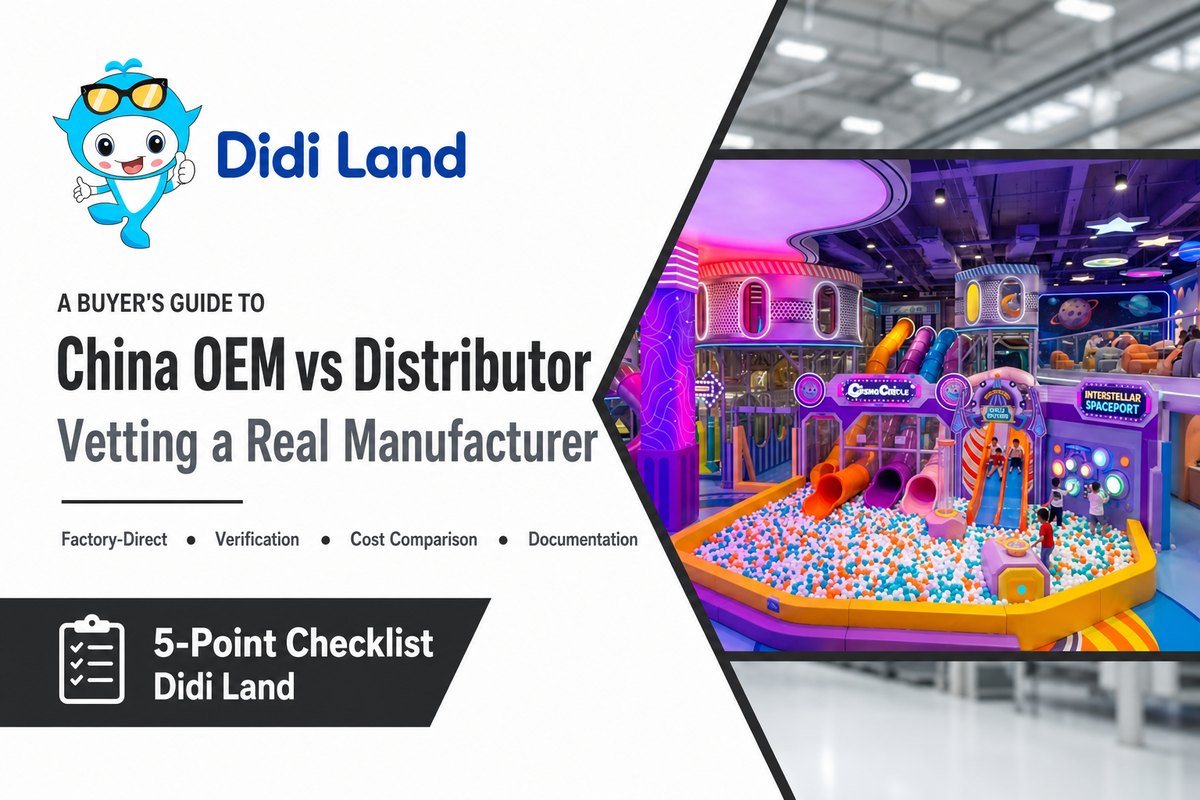
An indoor playground manufacturer is the company that owns the production line and builds the equipment itself, rather than reselling another factory’s output under its own name. You won’t just meet one such manufacturer while sourcing from China; searching “indoor playground manufacturer in China” or “manufacturer in China” turns up the same projects, and often the same product photos, quoted by both trading companies and repackaged-catalog distributors. Prices vary 2-3x between the three types of vendors, and differences in the depth of paperwork are even larger, but these gaps are only evident after a deposit is made.
Any indoor playground solution starts with the same three questions: Who owns the production line? What documentation can they produce for this range of commercial indoor playground equipment? And who picks up the phone if a part fails in 18 months? That’s how you choose between a factory-direct OEM, an unvetted China OEM, and a US/EU distributor. For an FEC build of medium size, a US/EU distributor charges $80-$140 per square meter, an unvetted China OEM charges $25-$45, and a documented factory-direct OEM such as Didi Land charges $30-$55 — the price gap tracks the amount of verification work each channel has already done for you.
Key Takeaways
- Price alone doesn’t tell you what kind of source you’re dealing with — an unvetted China OEM can beat a factory-direct OEM’s prices even when doing identical scope.
- It’s the buyer’s/importer’s responsibility under CPSC to comply, not only the manufacturer’s. Also, most consumer-product imports must include an electronic certificate filing with the CBP starting July 8, 2026.
- “astm certified” doesn’t exist as one thing: There are several standards that don’t overlap, like F1487 for public playgrounds, F1918 for soft-contained play, and F381 for trampolines.
- Most studies suggest distributor markup above factory-direct runs from 15% to 70% depending on vertical.
- Requesting a live video walk-through of the actual manufacturing floor is the most efficient way to determine if you’re talking to a factory or a relabeling trading company.
Quick Specs — Didi Land Factory-Direct Baseline
| Factory | 28,000 m², 300+ specialists, Guangzhou (since 2014) |
| Frame spec | Ø48 mm × 2.0-2.5 mm wall, hot-dip galvanized steel |
| Named cert standards | AS 4685, EN 1176, ASTM F381, CE, ISO 9001:2015 (full test-report PDFs) |
| Lead time (in-house) | 30-45 days, design lock to ready-to-ship |
| Warranty / spare parts | 24-month structural, 12-month electrical, 24-month spare-parts price hold |
Manufacturer, OEM, Distributor, or Trading Company — Which Supplier Are You Actually Talking To?
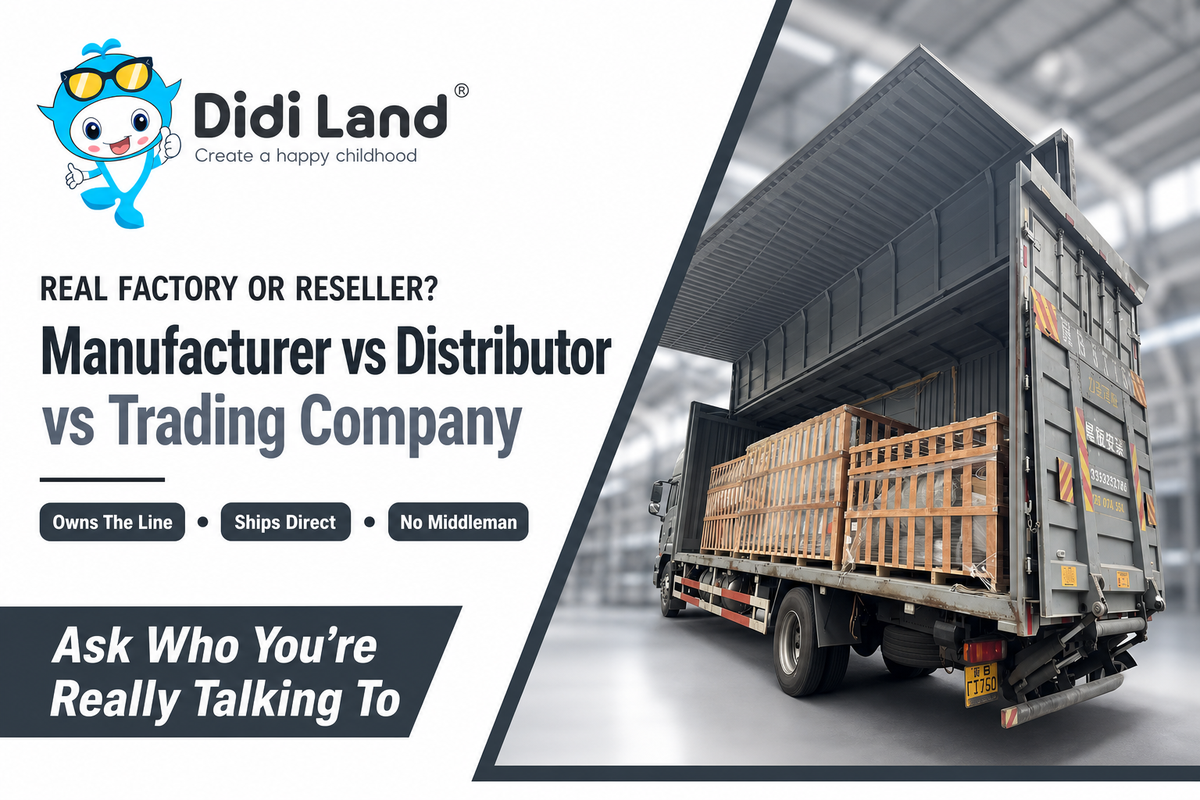
Manufacturers actually make your goods in the factory they own. Distributors and trading companies buy from other manufacturers that they don’t own and frequently can’t tell you who made the actual production run for your order. Ask any supplier this one question: “Can we take a live video tour of the production floor, mid-production, of our order?” Any actual manufacturer can; most relabeling companies can’t or will make excuses and reschedule.
This confusion is entirely deliberate. Factories, trading companies, and distributors all offer the same kind of product (“commercial indoor playground equipment”) with very similar pictures of it, because the raw steel and foam product does look alike throughout the industry. But who actually controls the bill of materials after you sign your Purchase Order makes all the difference. Manufacturers, like Didi Land, build and export everything — from jungle gyms, slides, and modular play structures to soft play systems, amusement equipment, trampoline park modules, and ninja courses — at their single factory in China. They can deliver any custom playground solution a family entertainment center, indoor entertainment venue, or shopping-mall entertainment center needs from a single equipment supplier. That solution can be indoor play areas, soft play structures and soft play areas, a foam pit, an indoor trampoline park module, or a full playground for kids build. A trading company, however, may bring in a number of sub-factories’ output to stuff into a single container – useful for small orders, but means no single vendor manages quality. Browsing a factory’s own indoor playground equipment catalog is a fast first filter — a real manufacturer’s range reads like one coherent product line, not a reshuffled grab-bag of other people’s SKUs.
“We tested four pipe-wall thicknesses against three years of installation data before we settled on the 2.0-2.5 mm Ø48 band as our floor. Anything below that creates wobble at the third platform tier, and customers feel it long before any inspector flags it. Ms. Cherry insists every quote we send specifies the floor, not the ceiling, so a buyer comparing us to a 1.6 mm offer can see what they are giving up.”
Engineering Team, Didi Land Guangzhou Factory
U.S. Customs and Border Protection’s supply-chain security guidance exists precisely because buyers can’t always see past the first name on the invoice. Finding a reliable indoor playground manufacturer among hundreds of Chinese factories, trading fronts, and self-styled “leading indoor playground” suppliers is exactly why this question matters. Search “indoor playground China” or “indoor playground equipment China” and the same handful of names resurface across playground equipment suppliers, commercial playground equipment manufacturers, and every indoor playground supplier directory — this is a real industry, not a niche corner of it, and a professional indoor playground manufacturer should be easy to distinguish from a reseller once you know what to check. For most buyers, this comes down to one quick call: Who am I talking to? If you can’t ask your supplier, “What gauge is the steel? What’s the foam density? What grade are the fasteners?” without the rep stammering, you’re likely speaking with a middleman, not a builder.
Didi Land vs Generic China OEM vs US/EU Distributor — Full Cost, Lead-Time & Documentation Comparison
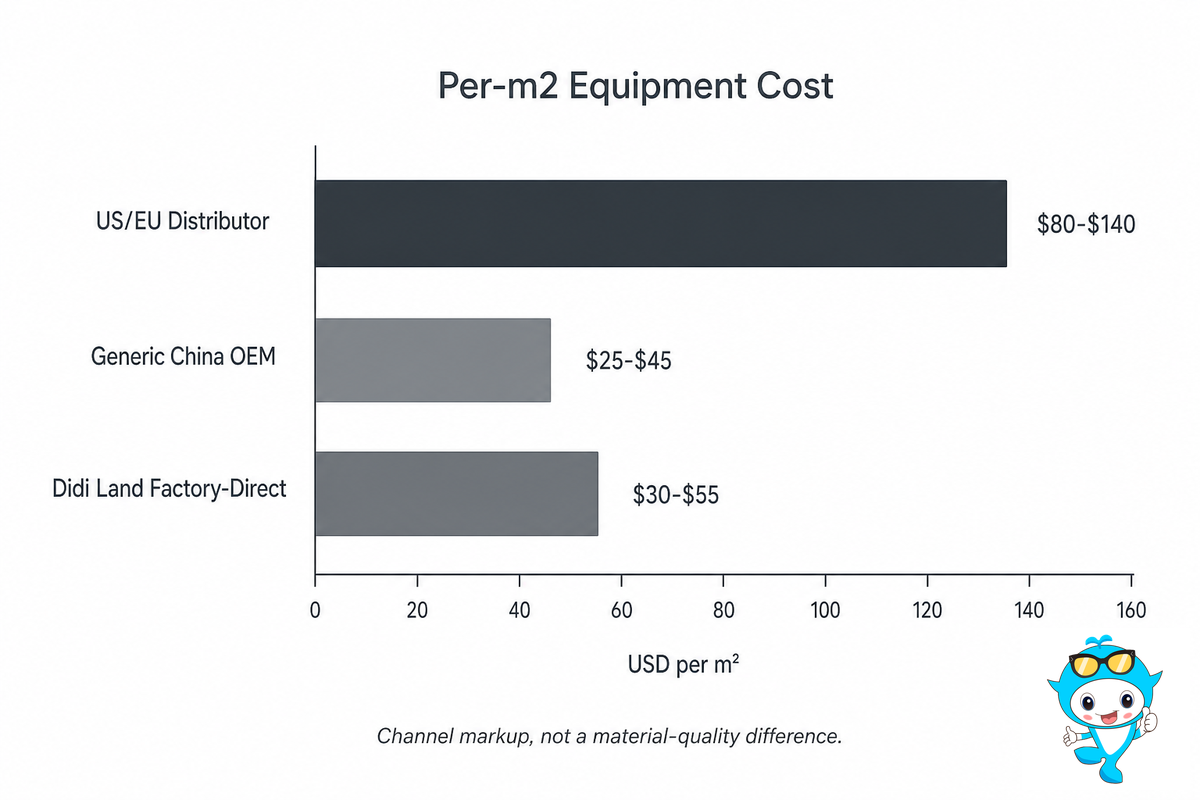
For a mid-sized family entertainment center (FEC) build, direct factory-from-China pricing is typically between $25-$55 per square meter. Identical specifications through a US or EU distributor cost between $80-$140 per square meter, a channel markup, not a difference in material quality itself. For a 250 m² project, the gap is around $16,900 for comparable specifications, excluding shipping and installation.
| Dimension | US/EU Distributor | Generic China OEM | Didi Land OEM |
|---|---|---|---|
| Per-m² cost (mid-FEC) | $80-$140 | $25-$45 | $30-$55 |
| Lead time (design lock to ship) | 60-90 days | 35-60 days | 30-45 days |
| Minimum order quantity | 1 set, often premium-tier gated | 1 set | 1 set, no premium gating |
| 3D design revisions | Charged, or capped at 2 | Sometimes free, limited | Free, unlimited |
| Cert standards documented | Logos only, no numbers | 1-3 named | 5 standards, full test reports |
| Test-report PDFs downloadable | No | Rare | Yes, per standard |
| DDP shipping option | Variable, often opaque | Rare | Optional, published band by region |
| Spare-parts price hold | None, or 90 days | None, typically | 24 months |
| Maintenance manual | Generic catalog | Translation-machine quality | Venue-specific, English-checked |
Source: Didi Land factory-direct and generic OEM figures are first-party published pricing; distributor pricing figures represent reported ranges as of 2026 and can fluctuate based on destination and container utilization.
What does the distributor margin go toward? Call it the 3-Layer Margin Stack: two separate analyses of sourcing costs suggest a 15-20% markup between manufacturer and distributor, with a further 20-40% additional margin between distributor and end customer. A third industry review of related equipment verticals places the total distributor markup in the range of 40-70% of factory-direct pricing. Using Didi’s factory-direct figures ($30-$55 per square meter, midpoint ~$42.50) for a 250 m² mid-FEC build, the equipment bill is around $10,625. Using distributor figures ($80-$140 per square meter, midpoint ~$110) for the same scope, the bill is around $27,500 — a $16,875 spread for the same total square meterage. These figures are broadly consistent with the cited markup studies but are intended as industry-context information, not audited figures specific to this equipment class — and none of it includes the total project cost once shipping, installation, and commercial playground equipment permitting under CPSC’s business guidance are added.
The markup itself isn’t the issue. Distributor pricing enables smaller minimum order quantities (MOQs) and the convenience of grouping playground equipment with other goods like POS systems, arcade games or seating within a single container, which may be a suitable option for a first, smaller order. Trouble arises when you purchase at distributor prices but expect to receive factory-direct documentation.
Why “Cheap” China OEM Quotes Get Expensive After Year One

For a similar advertised price, an unverified Chinese OEM may substitute three components that aren’t evident on paper: lower-gauge steel tubing, less-dense padding, and unlabeled fasteners. While each concession goes unnoticed on the quote or in the rendering, each significantly reduces the equipment’s lifespan.
Call it the 1.6mm Substitution: the most frequently encountered single switch is calling out a Ø48 mm frame under the headline figure while furtively swapping in 1.6 mm-wall tube in lieu of the 2.0-2.5 mm spec that had passed test, which creates platform flex at the third climbing step well within the first year of service, long before a routine inspection would catch it. Similar shifts show up in foam padding (50 kg/m³ instead of the 60-80 kg/m³ that supports commercial durability) and in fasteners with no grade marking, which prevents any confident replacement match later.
One Redditor with a decade of sourcing experience in China, who said they’d toured over 50 factories there, cut straight to the chase: most of what you’ll find listed as a “factory” on general B2B sites is a middleman level and a good way to identify this, according to that user, is “the 35% markup problem.” In other words, it looks like it’s priced direct from a manufacturer but the price already incorporates the cost of an intermediary reseller. In the meantime, a sourcing guide popular among new entrepreneurs offers another more subtle, yet arguably important, point: the lowest quoted price isn’t necessarily the worst; it’s just “unlabeled.” What the low quote has omitted from its bill — the warranty, the paperwork, the quality control, the response speed — that’s where the real danger lies.
✔ What a documented factory-direct quote includes
- Named material spec floor (gauge, density, fastener grade)
- Test-report PDFs matched to the specific standard and product
- Mill certificates traceable to the actual production batch
- A Children’s Product Certificate naming every required element, not a placeholder
⚠ What an unvetted quote often omits
- Named steel gauge or foam density (just “premium materials”)
- Test reports you can independently check against the standard’s scope
- Any commitment on spare-parts pricing after the sale
The 5-Point Factory Verification Checklist
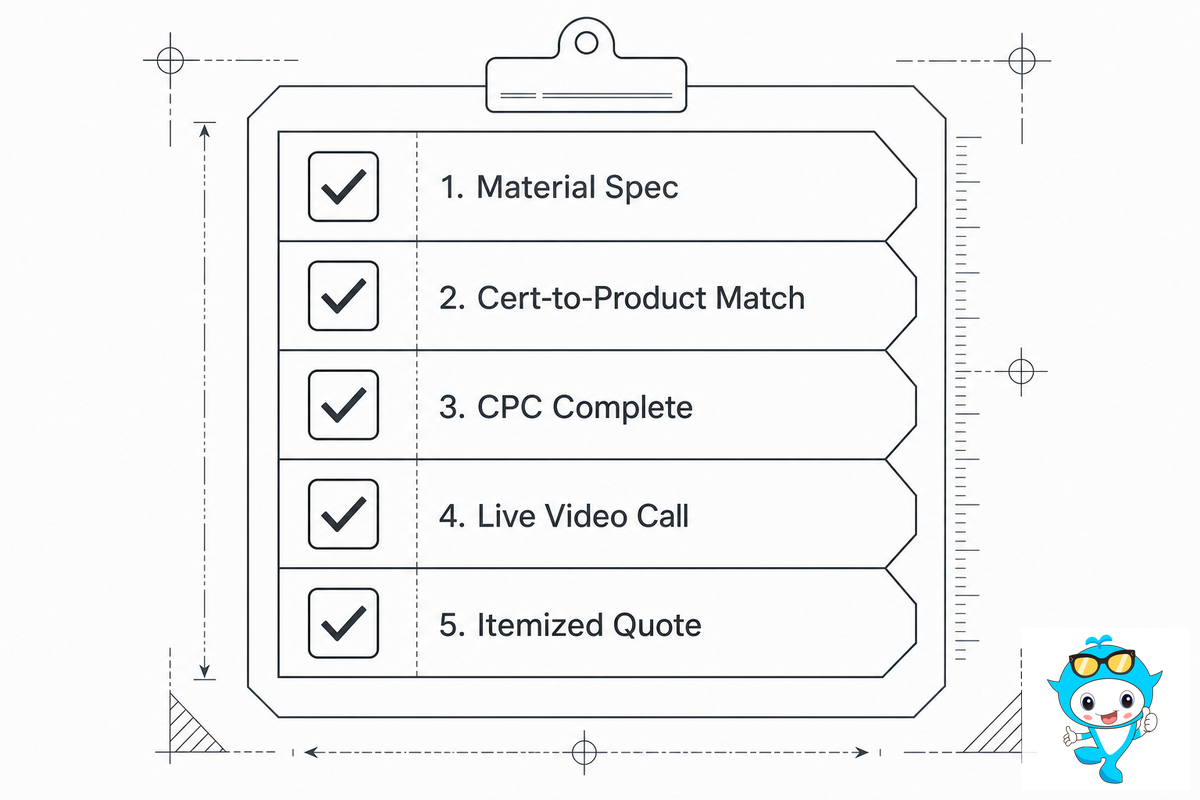
(Updated July 2026.) Any factory in China selling custom indoor playground equipment should be able to clear all five items below without hesitation. If you only have time for one round of diligence before a deposit, run it across five verifiable elements: material spec, a check that the safety standard matches the product, a check that the CPC is complete, a live production video call, and an itemized quotation. Most regulated US consumer-product imports now require electronic certificate filing with U.S. Customs and Border Protection effective July 8, 2026, so it’s an ideal time to firm up documentation habits regardless of how you buy — and to confirm the equipment supplier actually meets international safety standards for your specific market, not just a generic claim.
How do I verify whether an indoor playground supplier in China is a real factory?
Request live video of the existing production floor, actual production pictures with date relating to your purchase order number, any records of previous installation trials, or container loading photos. The real manufacturer will proudly display their steel cutting, welding, foam production, or their quality inspection procedures without any hesitation because that’s the day in their life.
That kind of open access is generally not possible on short-term notice for a trading company reselling products made by some unspecified sub-factory. Also verify the registered address of the playground factory — if no real production facility is listed anywhere, that alone is a strong signal you’re dealing with a reseller layer, not a genuine Chinese supplier of indoor playground equipment from China.
RFQ checklist — copy these into your quote request:
| Parameter | Recommended range | Why it matters | How to verify |
|---|---|---|---|
| Frame wall thickness | Ø48 mm × 2.0-2.5 mm, hot-dip galvanized | Below 2.0 mm creates platform wobble within 1-2 years | Request the mill certificate matching the stated gauge |
| Foam density | 60-80 kg/m³ EVA | Below 50 kg/m³ compresses and loses cushioning fast | Request the foam supplier’s datasheet, not just “high density” wording |
| Fastener grade | Grade 8.8, zinc-plated, stamped | Unstamped bolts can’t be matched for future replacement | Ask for a close-up photo of the head stamp on a sample batch |
| Cert-to-product match | Standard number matched to equipment type: F1487 (public playground) / F1918 (soft-contained play) / F381 (trampoline) / EN 1176 / AS 4685 | A generic “ASTM certified” claim can cite the wrong standard for your specific module — F1918 explicitly excludes public playground equipment, and F1487 doesn’t cover soft-contained systems | Ask which specific standard covers which specific module (see our full playground safety standards comparison), and request the matching test-report PDF |
| CPC completeness (US buyers) | All 7 CPSC-required elements present, incl. a named contact for test records | The buyer/importer carries compliance due-care responsibility, not just the factory | Email the named test-records contact listed on the certificate and confirm they respond |
| Quotation itemization | Equipment, design, production, packing, install, warranty listed separately | A lump-sum total hides which services are included vs billed later | Ask for a line-by-line quote, not a single headline number |
Treat a supplier who can’t find a matching mill cert, doesn’t know which specific standard applies to which module, or hesitates when asked to join a live video call as a deal-killer, not a negotiating point. Replacing a supplier before a deposit will delay your project by days; discovering you got substituted after the fact will cost you months.
Lead Time, DDP Shipping, and Installation Supervision — What Each Channel Actually Delivers
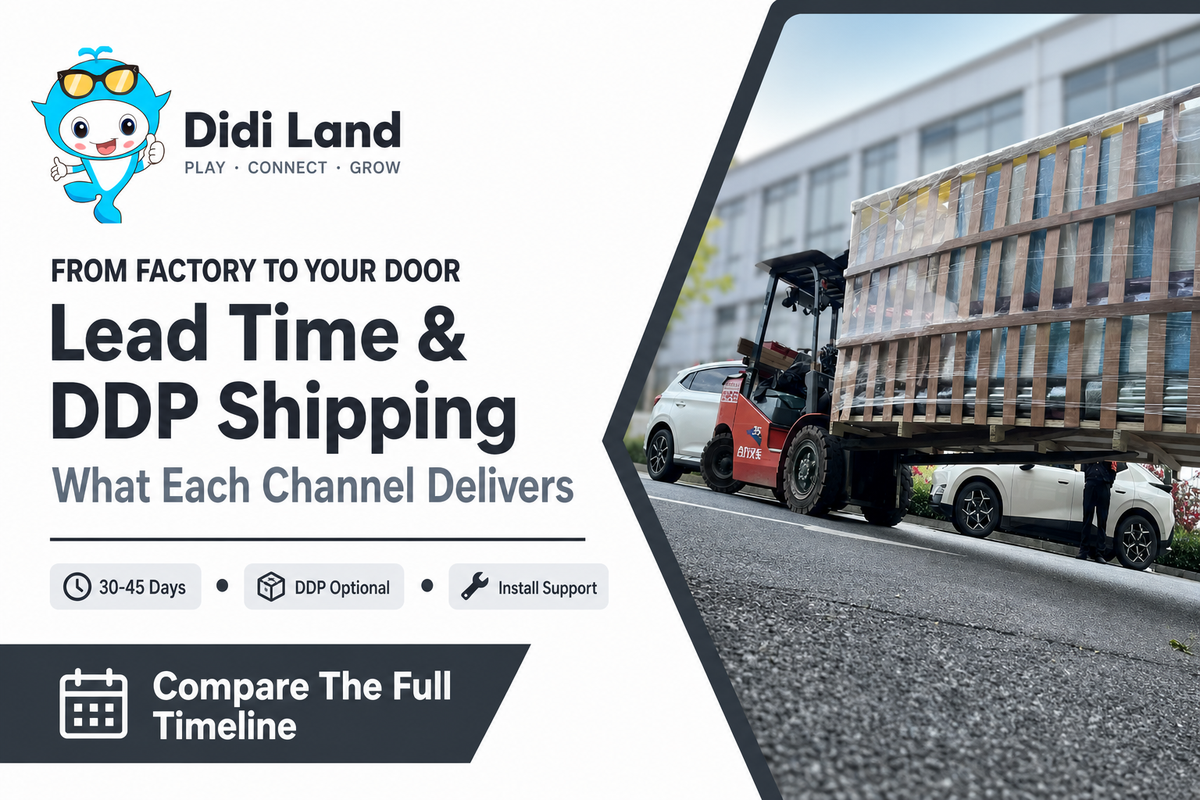
An in-house factory-direct lead time is 30-45 days from design lock to ready-to-ship, compared to 35-60 days for a generic OEM sourcing across sub-factories and 60-90 days for a distributor re-importing from China prior to sale. These times then stack: a distributor’s extra 30-45 days is in addition to the 25-35 days of ocean freight time all channels share.
The shipping term “DDP” (delivered duty paid) — the same customs-clearance handoff that CBP’s cargo security program is built around — where a factory offers it as a defined option, ranges from $4,000-$12,000 per container, depending on the destination and container utilization, whereas a distributor’s DDP-equivalent cost is typically wrapped into an opaque lump sum, the factory’s DDP price is broken out so it can be compared directly against a broker’s itemized estimate. Installation support follows the same transparency gap: factory-direct suppliers can quote a daily rate for an English-speaking supervisor up front, while generic OEMs and distributors more often use whichever local installers happen to be available in the local market that day, with quality varying project to project.
Warranty, Spare Parts, and Who Answers When Something Breaks
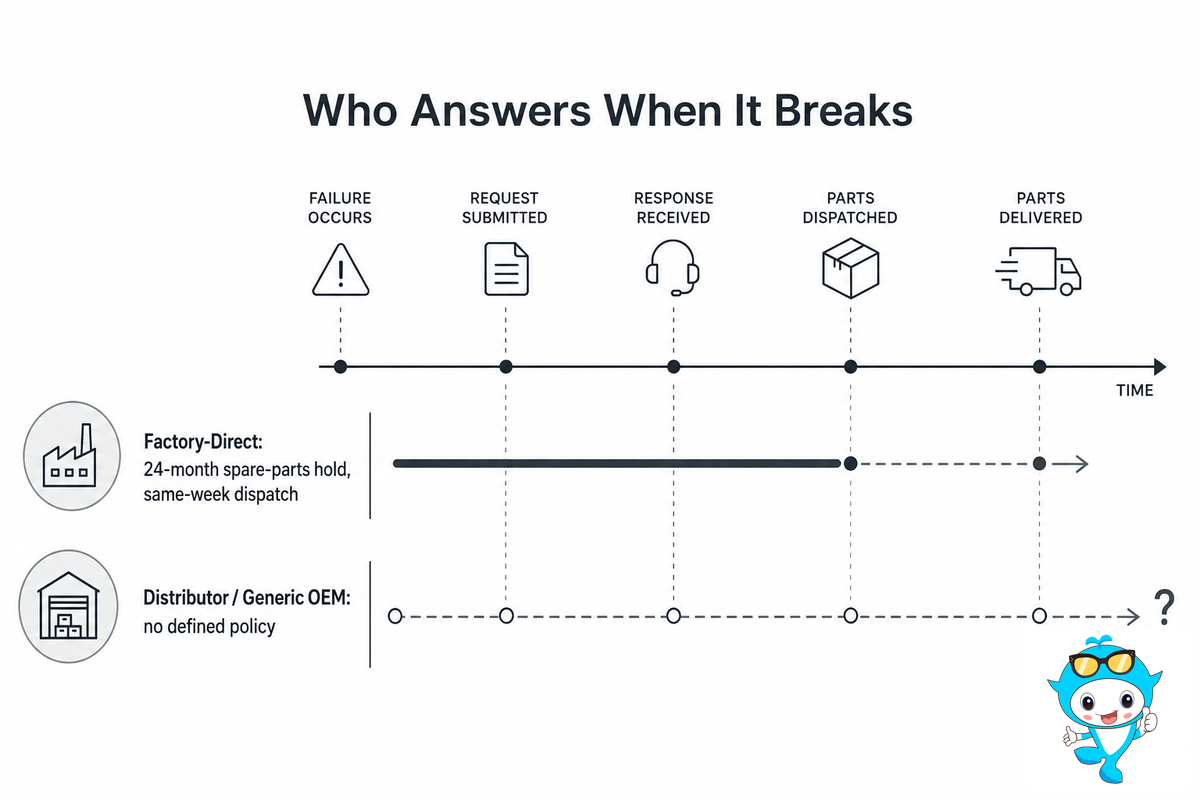
Who Answers When It Breaks is the question that separates these three channels once equipment is actually in daily use. Whether a panel crack or loose hinge in month 18 gets addressed within days or takes months often depends on which channel you bought from. Direct suppliers offering a 24-month spare-parts price hold and same-week dispatch on common items can usually fix a malfunction before the next major traffic event, whereas distributors and generic OEM companies with no specified spare-parts policy often can’t.
The root of these disparities is the combined effect of time-zone distance and a single communication point. When a supplier maintains just one point of contact with a 20-hour response time, what should be a week-long fix for a replacement part can balloon to a full booking cycle, long enough for a venue’s comment cards and reviews to document the issue. The value of a 24-month structural warranty and 12-month electrical warranty isn’t a written promise but an actual service provided by a team with both a named catalog of spares and 24/7 technical support — the kind of ongoing upkeep that regulators’ periodic playground safety handbook updates assume equipment owners can actually access.
Which Channel Fits Your Project? A Decision Framework by Order Size and Timeline

If you’ve a small, unbranded indoor playground project with ancillary non-playground equipment that you want shipped together, buy from a distributor; if you’ve a mid-size to large playground design and build where after-sales response and paperwork are important, buy direct from a manufacturer.
| Project profile | Recommended channel | Why |
|---|---|---|
| Small toddler corner or trial venue (30-100 m², first location) | Distributor acceptable | Low MOQ + bundling with other venue items outweighs the price premium at this scale |
| Mid-size FEC (100-400 m²), tight opening date | Vetted factory-direct OEM | 30-45 day lead time and named paperwork reduce schedule risk that a distributor can’t match |
| Multi-site rollout or franchise standard | Factory-direct OEM, single supplier | Consistent material spec across sites matters more than any single site’s price |
| Large flagship build (800+ m²), custom theming | Factory-direct OEM with on-site supervision | Installation complexity and after-sales stakes are highest here — paperwork gaps become expensive fastest |
| Order needs bundled non-playground equipment (arcade, POS, seating) | Distributor, by design | Consolidation is the distributor’s genuine structural advantage — not a workaround |
The exceptions are when you’re opening one pilot site under 100 m², when you’re combining various non-playground items in one shipment, or when you’re in a rush to receive product sooner than a factory’s production lead times allow, and are willing to sacrifice a thorough paper trail for a local stock supply. Otherwise, your gap in verified information — the same documentation gap CPSC’s playground equipment guidance asks buyers to close — increases in direct proportion to project size.
Frequently Asked Questions
Q: Who makes the indoor playground in China?
Several established Guangzhou and Wenzhou-based factories serve the international commercial market and drive most indoor playground equipment cost benchmarks, including direct manufacturers such as Didi Land.
Two hubs concentrate the industry — Wenzhou for standard soft play and structural frames, Guangzhou for higher-end electronics and custom finishing. Third-party “top 10 indoor playground manufacturers” roundups commonly name a mix of players in this space — Dream Garden playground, Dreamland Playground, and a long tail of smaller regional shops — alongside direct factories like Didi Land, but a listicle ranking is not the same as a verification. What separates a genuine factory from a reseller is not the city or the ranking, it’s whether the company can hand over mill certificates for the steel, produce a test-report PDF for each certification it claims, and publish a material spec floor rather than a vague “premium quality” range.
Q: What should be included in an indoor playground quotation?
A professional indoor playground quotation itemizes equipment cost, design scope, production scope, packing, installation responsibility, shipping terms, warranty, and spare-parts policy separately, line by line rather than as one lump sum.
A single lump-sum number hides which of those line items are included and which will be billed later as extras. Ask specifically whether the quote covers design revisions, on-site installation supervision, and a defined spare-parts price for the first 24 months — those three items account for most of the disputes that surface after a deposit is paid.
Q: Why choose a China indoor playground manufacturer instead of a local one?
Documented China factories generally offer lower factory-direct pricing, deeper theme customization, and in-house certification testing across multiple standards that many local assemblers simply outsource to third parties.
The trade-off is distance: overseas installation supervision and after-sales response depend entirely on the specific supplier’s support structure, which is exactly why the verification checklist above matters more with an overseas factory than with a local one you can visit in person. Inspecting a local assembler in a single afternoon is easier, but a documented China factory can usually match a broader materials spec floor and a lower per-square-meter build cost for the same design brief.
Q: How long does it take to manufacture a customized indoor playground?
A customized indoor playground factory-direct build usually takes 30-45 days from design lock to ready-to-ship, plus 25-35 days ocean freight and 5-15 days on-site installation.
Generic OEMs and distributors run longer, 35-90 days depending on the channel (see the comparison table above).
Q: What after-sales service should an indoor playground manufacturer provide?
After-sales service should include a defined spare-parts price hold, same-week dispatch on common parts, a venue-specific maintenance manual, and a 24/7 support line in your language.
Ask specifically how many time zones the support line spans and how many hours the average response takes — a supplier running a single email address with a 20-hour response loop will feel very different from one with a 24/7 WhatsApp line once equipment is actually in daily commercial use. Confirm whether the spare-parts price hold is 24 months or open-ended “as available,” since the second option means pricing can move whenever you actually need a part.
Q: What’s the minimum order quantity for a factory-direct China supplier?
Most documented factory-direct China suppliers accept a minimum order of one set for indoor playground equipment, with no premium-tier dollar gating attached to that first order.
That’s a real structural advantage over some distributors, who set higher effective minimums to justify their own overhead.
Q: Is it safe to pay a Chinese manufacturer before the equipment ships?
A standard, verifiable structure is a 30% deposit by T/T (Telegraphic Transfer) or L/C (Letter of Credit) with the remaining 70% due before shipment, and Alibaba Trade Assurance escrow is worth using for a first-time order.
T/T is a direct bank wire — irreversible once sent, so pay the deposit only after the itemized quotation and material spec are in writing. An L/C routes payment through both banks against shipping documents, which adds protection but also cost and paperwork; it’s more common on larger orders. Trade Assurance escrow holds your payment until you confirm the shipment matches the order, which is the lowest-friction protection for a first-time buyer working with a supplier they haven’t verified in person yet.
Q: Do OEM factories offer overseas installation supervision?
Many established factory-direct OEMs offer an English-speaking installation supervisor as an optional add-on for overseas installation, with a published day-rate confirmed in writing before the order ships.
Supervisors don’t replace your local installation crew — they monitor the crew’s work against the design specification and sign off on safety compliance before opening day. For projects above roughly 300 m², that oversight is usually worth the added day-rate, because the cost of a rework after opening is far higher than the cost of catching a misalignment during installation. Confirm what’s included: flights, accommodation, and daily rate should all be itemized before you commit, not bundled into a vague “supervision fee” line.
Why We Publish Our Verification Checklist
Transparency is rare in the indoor playground industry, and we published this comparison because one of these three avenues of distribution is precisely where we distribute. The fairest way to justify that channel is to lay our own numbers next to the alternatives, not just describe the alternatives in the abstract.
We used the same material specs, per-m² price range, DDP band, and warranty policy our sales team shares whenever a buyer wants a head-to-head comparison against a distributor or generic OEM — if you find any variation from our published pricing, let us know.
References & Sources
- Playground Equipment Business Guidance — U.S. Consumer Product Safety Commission
- Children’s Product Certificate — required elements and July 2026 eFiling notice — U.S. Consumer Product Safety Commission
- ASTM F1918-21 — Standard Safety Performance Specification for Soft Contained Play Equipment — ASTM International
- ASTM Publishes Revised Consumer Safety Performance Specification for Playground (F1487-25) — SGS
- Notice of Availability: Public Playground Safety Handbook Update — Federal Register
- Customs Trade Partnership Against Terrorism (C-TPAT) — U.S. Customs and Border Protection
Related Articles
- Top Indoor Playground Equipment Manufacturers — full ranked comparison
- AS 4685 vs EN 1176 vs ASTM F1487 — which standard applies to your export market
- Indoor Playground Equipment Buyer’s Spec Audit Guide — mill certificates line by line
- Are Indoor Playgrounds Profitable? Real ROI Math for FEC Owners
![Custom Dinosaur Playground Equipment [Design Guide]](https://didiplayarea.com/wp-content/uploads/2026/09/custom-dinosaur-playground-equipment-r2-featured-1-768x512.png)
![Custom Dinosaur Playground Equipment [Design Guide]](https://didiplayarea.com/wp-content/uploads/2026/09/custom-dinosaur-playground-equipment-r2-featured-1-150x150.png)