Get in Touch with Didi Land


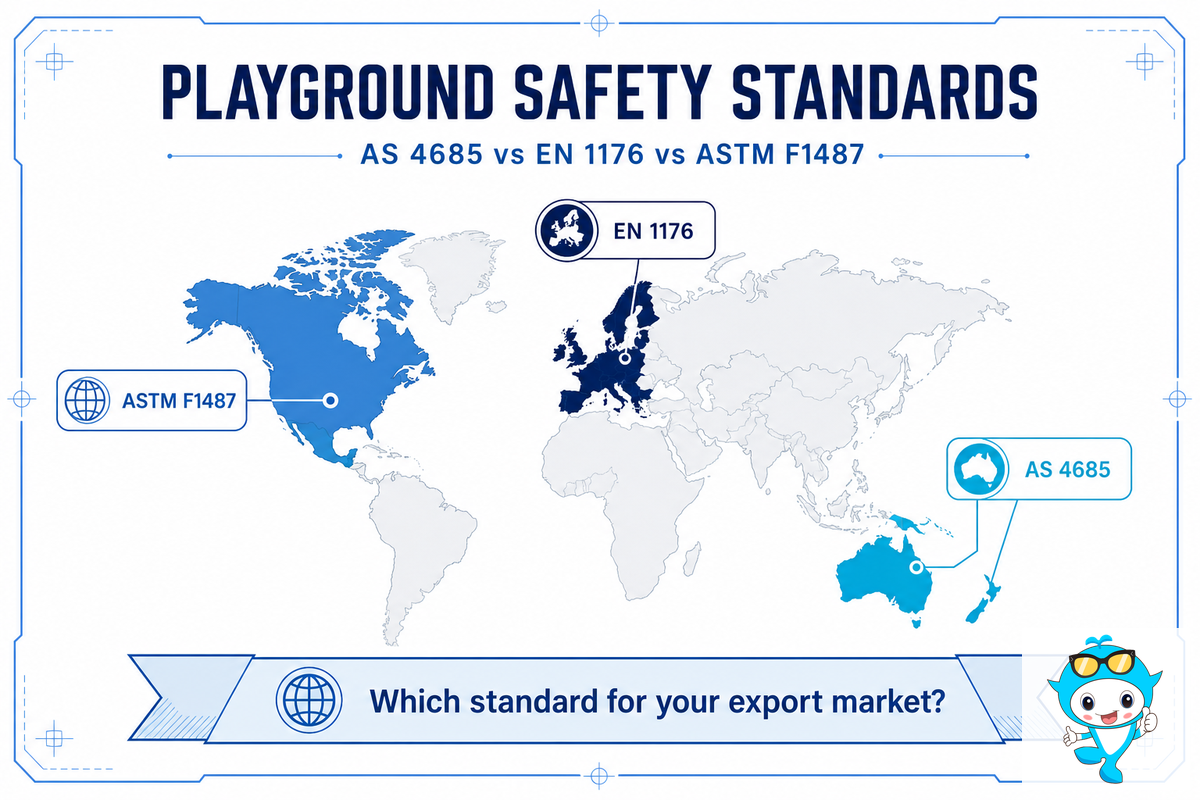
Playground safety standards are the dimensional, material, and installation rules that decide whether playground equipment can ship, install, and pass inspection in a given market. If you build, import or select playground equipment, three of them matter most because they determine whether your build can ever ship: AS 4685 (Australia and New Zealand), EN 1176 (Europe and the UK), and ASTM F1487 (the United States and Canada). Those same dangers – falls, impact, and head entrapment – but they are three completely different set of standards and the approval to one is not in most cases approved by the others. This report is constructed for the exporting buyer asking the question – What standards is my market asking for, and what’s the actual differences?
Updated June 2026.
Here is the short, surprising answer: the “metric” two-AS 4685 and EN 1176-are near matches with similar test methods, while ASTM F1487 is a different world (US imperial and uses different test “probes”). Thus the export decision is nearly always“EN/AS family vs. US ASTM family,” and only one.
Following below-with data based on the published documents, the latest CPSC standard revision to be published for 2025, and Didi Land’s 40+ global country shipments of certified equipment-is a look at those differences and overlaps.
Quick Specs: The Three Headline Playground Safety Standards
| Standard | Region | Body / Edition | Mandatory? |
|---|---|---|---|
| ASTM F1487-25 | US / Canada | ASTM International, 2025 | Voluntary (adopted by reference in many state codes; insurer/RFQ-driven) |
| EN 1176-1:2017+A1:2024 | EU / EEA / UK (as BS EN) | CEN, 2024 amendment | Mandatory via national regulation (no CE — see force section) |
| AS 4685.1:2021 | Australia / New Zealand | Standards Australia, 2021 | Mandatory (referenced by ACCC Consumer Goods regime) |
Outside the Table above is a pair of standard related to each one of the next sections: home equipment (ASTM F1148); and soft, contained indoor use (ASTM F1918 / EN 1176-10 / AS 4685.6); they are mentioned in the soft-play section below.
What AS 4685, EN 1176, and ASTM F1487 Actually Govern (and Where Each Applies)
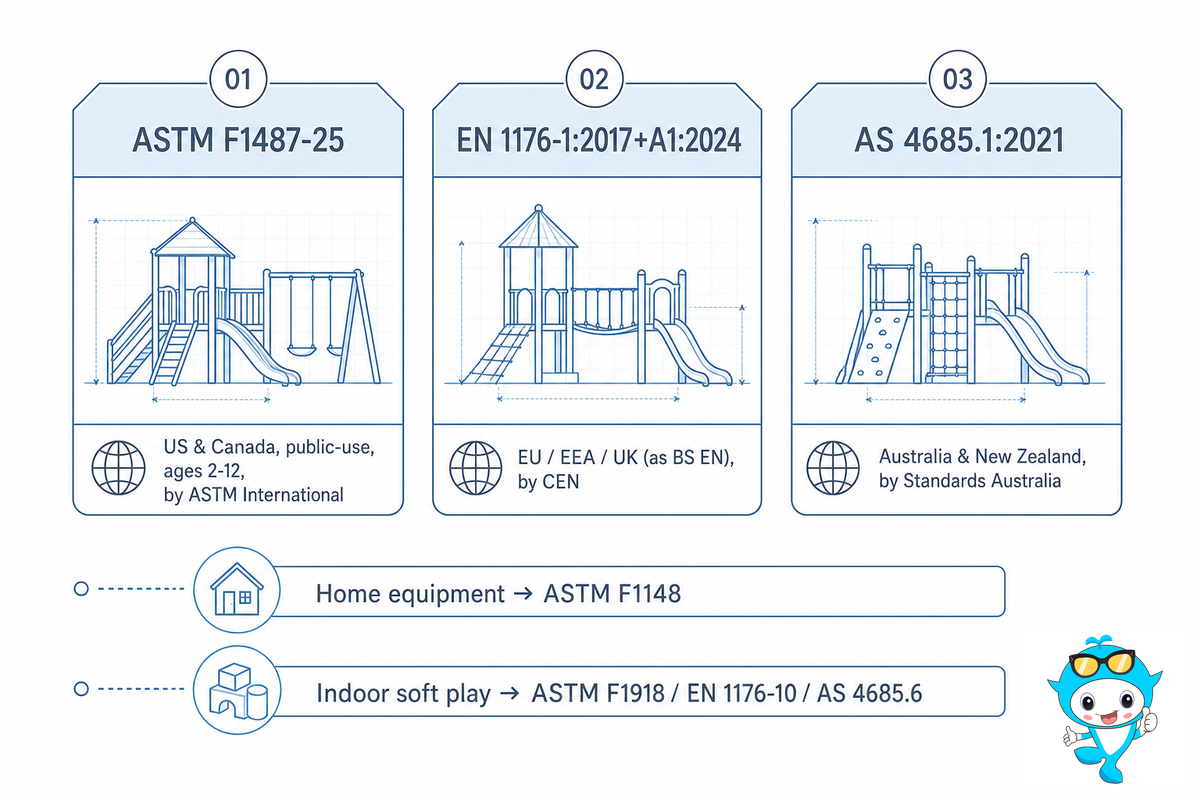
In short, all three are public-use playground equipment standards. ASTM F1487 is the benchmark in the United States and Canada, EN 1176 across the EU and UK, and AS 4685 in Australia and New Zealand. Each sets the structural, dimensional, and material rules for commercial climbers, slides, and frames — separate from home equipment and from indoor soft play.
They’re all public use playground equipment standards that establish safety and design requirements (including dimensions, structure, and performance) for individual play features – decks, swings, slides, climbers, barriers – in public spaces such as parks, schools, and malls, as well as places such as childcare centers and family fun zones. ASTM F1487 (for use by children ages 2-12) is the US and Canada standard created by ASTM International; it is adopted by the U.S. Consumer Product Safety Commission. EN 1176 (developed by CEN) is the European Standard for stationary public playground equipment across the EU and EEA member countries, including Great Britain (where it is implemented as BS EN 1176).
AS 4685 is the equivalent Australian/New Zealand standard from Standards Australia.
What is the ASTM standard for playgrounds?
ASTM F1487 is the main standard for public-use playground equipment in the US and Canada, written for children ages 2 to 12. It rarely travels alone: a compliant installation also pulls in ASTM F1292 for surfacing and, depending on the equipment, F1918, F2373, or F2088.
In the US, ASTM F1487 is the lead document in designing playground equipment used in public settings, but it never travels alone once a project goes to procurement. For a compliant US design, an importer will have F1292 (impact attenuation for ground cover), probably F2373 (equipment for children 6–23 months), sometimes F2088 (baby swings), sometimes F1918 (soft contained play), and they will need CPSC’s Public Playground Safety handbook to interpret all that. “ASTM compliant” is shorthand for a stack of standards, not a single document.
Here is what snares buyers: these standards govern commercial equipment, not your kids playground in the backyard (ASTM F1148) nor the indoor soft-contained play area. That residential OR soft-play product quote against a public playground quote is THE number one scope violation we find when new RFQ’s land.
Generic phrasing is where friction starts. A buyer who asks only for “national playground safety standards” or quotes loose “ASTM playground standards” on a school job can hit a wall when the destination wants something specific: US school playground safety regulations lean on the CPSC guidelines for playground equipment and ASTM F1292 playground surfacing, while a European site wants EN 1176. Picture a Gulf-region procurement manager sourcing a 600 m² mall play area who writes “international standards” on the RFQ, gets a quote citing CPSC playground equipment rules, and is then asked by the local authority for an EN 1176 certificate three weeks before opening. That scramble — re-testing a finished structure against a second rulebook on a live deadline — is exactly what precise sourcing prevents. Treating the playground safety rules as one global set is the most expensive mistake in this category, and in practice the most common one we see on incoming RFQs.
AS 4685 vs EN 1176 vs ASTM F1487: Where the Specs Actually Diverge
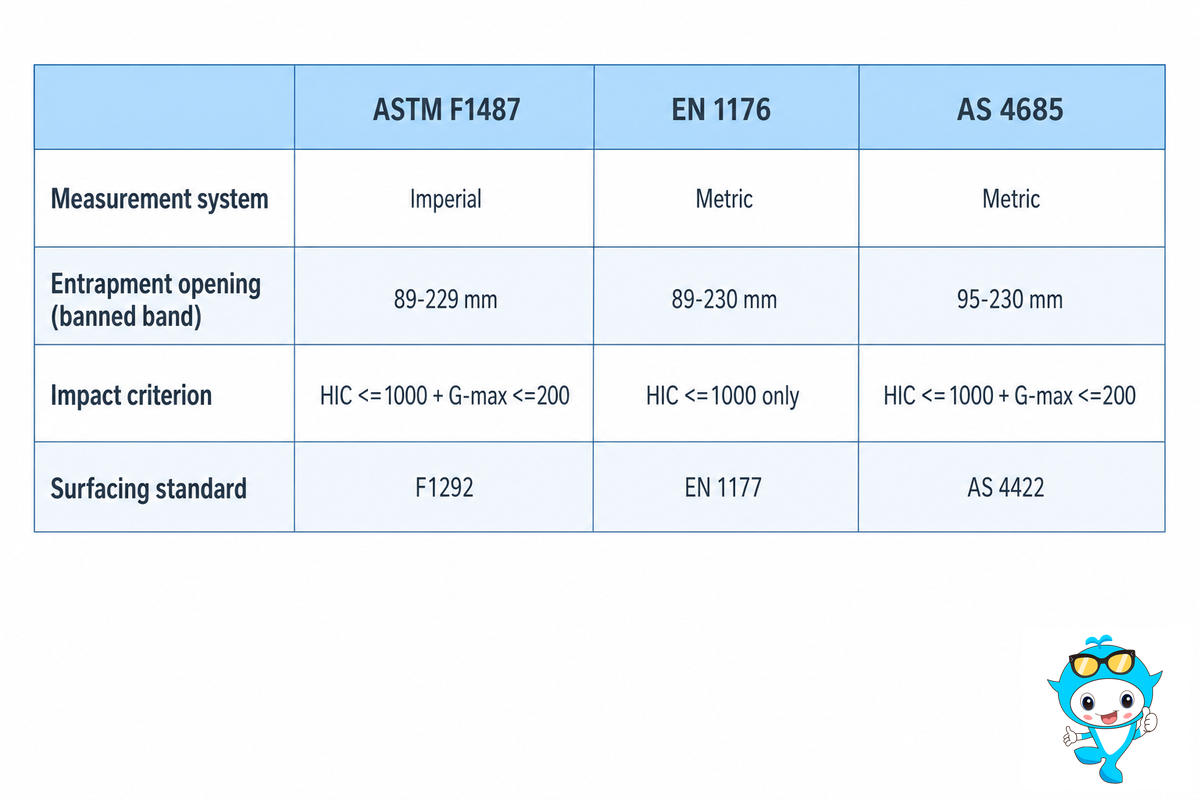
Here’s the revelation that change the perspective of the entire comparison: measured on raw data, the three standards differ far less on actuals than on reputations. That head-entrapment opening window sits at 89-230 mm in the US and the EU and 95-230 mm in Australia. Those differences are not a matter of millimeters; they’re in measurement systems, test probes, impact criteria, and the inspection ecosystem.
This table delineates the parameters that really make a difference to design or documentation differences across markets.
| Parameter category | ASTM F1487 (US/CA) | EN 1176 (EU/UK) | AS 4685 (AU/NZ) | What it means for your build |
|---|---|---|---|---|
| Measurement system | Imperial (inches) | Metric (mm) | Metric (mm) | EN/AS drawings transfer; US needs conversion + re-check |
| Head/torso entrapment opening | <3.5 in or >9 in (89–229 mm) | 89–230 mm | 95–230 mm | All three ban openings inside roughly 89–230 mm; design bounded openings <89 mm or >230 mm to clear every market |
| Test probes | ASTM probes A & B | EN gauges (per EN 1176-1) | AS gauges (per AS 4685.1) | ISO/TR 24666 catalogues the differences — same opening can pass one probe, fail another |
| Impact attenuation | HIC ≤1000 + G-max ≤200 | HIC ≤1000 (sole criterion) | HIC ≤1000 + G-max ≤200 | US/AU enforce a second G-max ceiling; pass both to be safe |
| Surfacing standard | ASTM F1292 (+F2075/F3012) | EN 1177:2018 | AS 4422:2016 | Surfacing is certified separately per market — rarely transfers |
| Age scope | 2–12 yr (public use) | to 14 yr, by equipment type | public use, by part | EN’s wider age band can demand extra fall protection |
| Inspector credential | NRPA CPSI (US) / CCPI (CA) | RPII (UK) + national bodies | CPSI-AU + state schemes | Acceptance inspection must use the local credential |
| Accessibility overlay | ADA / U.S. Access Board | EN 1176 + EN 17210 inclusive | AS inclusive-play guidance | Accessible-route + transfer requirements differ by market |
| Current edition | F1487-25 (2025) | 2017+A1:2024 | AS 4685.1:2021 | Each runs its own clock — see the outlook section |
Is ASTM F1487 the same as EN 1176?
No. They target the same hazards but belong to different systems: ASTM F1487 is imperial and adds a G-max ≤200 surface ceiling, while EN 1176 is metric and judges surfacing on HIC ≤1000 alone. A certificate to one is not accepted as proof of the other.
No – and the differences aren’t superficial. ASTM F1487 (the imperial version) is assessed with ASTM probes A & B and with G-max 200 surface plate. EN 1176 uses metric probe gauges and is judged solely on HIC 1000 (the metric threshold value).
They’ll be in agreement more often than not (as they assess different symptoms of similar hazards) but it doesn’t mean a structure built to one can be used to state conformance to the other – your probes and surfacing report must be to the correct standards (with their associated certified probe records), but more on this later! AS 4685 however – well this comes rather closer to EN 1176…
What Hazards Do All Three Standards Test For?
All three test the same core hazards: head and torso entrapment, protrusions and sharp points, pinch and crush points, fall height, and impact-absorbing surfacing. They diverge on measurement system and test probes, not on which dangers they guard against, which is why their outcomes usually agree.
While there are systemic differences in these 3 standards – AS 4685 (Australia), EN 1176 (European), ASTM F1487 (American) – they test identical core physical hazards. Knowing which test is stricter helps when you want to keep them all at front of your mind. Every one addresses 1: the design accommodates all ages.
That range goes from toddler, to younger kids, to grade school aged, and teen aged kids, etc. to 2: reduce the likelihood of 5 things that often result in ER: entanglements with a gap (the “no man’s land” zone that goes from 89 mm to 230 mm), “hookings” in protrusion hardware (no bolt ends stick out, S-hooks must remain closed, nothing’s sharp enough to poke out and snag clothing), pinch points (in moving mechanisms – a swing arm can catch a finger), sharp objects or burrs in the material, and height fall (anything over 30” of free fall height, for example needs a barrier, anything near 9’ needs multiple guardrails, and a much deeper cushion for falls. These standards also line up on areas like spacing on overhead bar that would be about 12” for preschoolers, material standards (durable, withstand weather, doesn’t rust, corrode, splinter), smooth finishes (no jagged edges), surface temperatures in hot and cold conditions,age labels, etc. as well as the “use zone.” a 6’ circle of clear space around everything (less for small items). But the use for us of this comparison chart is really practical: you know the whole world does these tests, so design all the equipment in your playground to conform to the single most rigorous standard listed here.
This will minimize potential certification delays and ensure your park meets a minimum standard throughout no matter where it gets sent for sale.
The hazard checks all three standards share
- ✔Head and torso entrapment — a completely bounded opening must sit outside roughly 9 inches and the 89–230 mm band so it cannot trap a child.
- ✔Protrusions and sharp points — no bolt ends that protrude, S-hooks kept closed, and edges smooth enough not to snag, to prevent the cuts that playground safety guidelines target.
- ✔Fall height and guardrails — any platform over 30 inches high needs a barrier, and a free fall near 9 feet needs guardrails plus deeper surfacing.
- ✔Overhead rung spacing — no greater than 12 inches apart for preschool-age children, measured in the direction of travel.
- ✔Use zone — a minimum of 6 feet of clear space around each piece of playground equipment.
- ✔Materials and surface — durable against weather and wear, and surfaces that will not burn skin in direct sun.
- ✔Age-appropriate signage — labels that keep kids and older youth on the structure that suits them.
Together these checks — plus a current playground surfacing certificate — make a build safer against the same potential hazards in every market, from US to Canadian and Australian sites. Treat this page as a resource when you build a playground for export, and carry the precise figures throughout the playground specification.
Surfacing: F1292 vs EN 1177 vs AS 4422
Impact-attenuating surfacing is where the injuries don’t actually happen -falls have been the leading cause of playground injuries, and US agencies have a long-standing history of around 200,000 emergency-department visits a year on children 14 and under for playground injuries. All three families claim the HIC 1000 limit, the limit on the structure’s critical-fall height, but three standards are applied, and it almost never passes from market to market, US F1292 (Standard Specification for Impact Attenuation of Surfacing Materials Within the Use Zone of Playground Equipment), plus ASTM F2075 (Standard Specification for Engineered Wood Fiber for Use as a Playground Safety Surface Under and Around Playground Equipment), F3012 for rubber; Europe’s EN 1177 and Australia’s AS 4422. Thickness is determined by the critical fall height; Canada’s CSA Z614 uses similar logic.
There is well-documented engineered design-patented impact-attenuating base layers such as in USPTO US9896808B2 and similar shock-absorbing coverings like in US6796096B1, EP2794257B1-exactly because field compliance to the HIC number is difficult, especially as a recreational site ages and a play area surface is crushed by a prior few seasons of activity.
📐 Engineering Note
Lab Certification Isn’t Field Certification. independent surfacing studies show that as much as 36% HIC variation exists between lab rated and in the field mounted surface on structures 9′ to 12′ in height. If either standard applies; ask that the purchase order reflect in-situ (after installation) impact testing – not just a factory drop test certification, – and ensure that the height of concern used to determine in situ HIC testing equals your highest reach able deck level.
Which Standard Does Your Destination Market Require? Standard-to-Market Routing
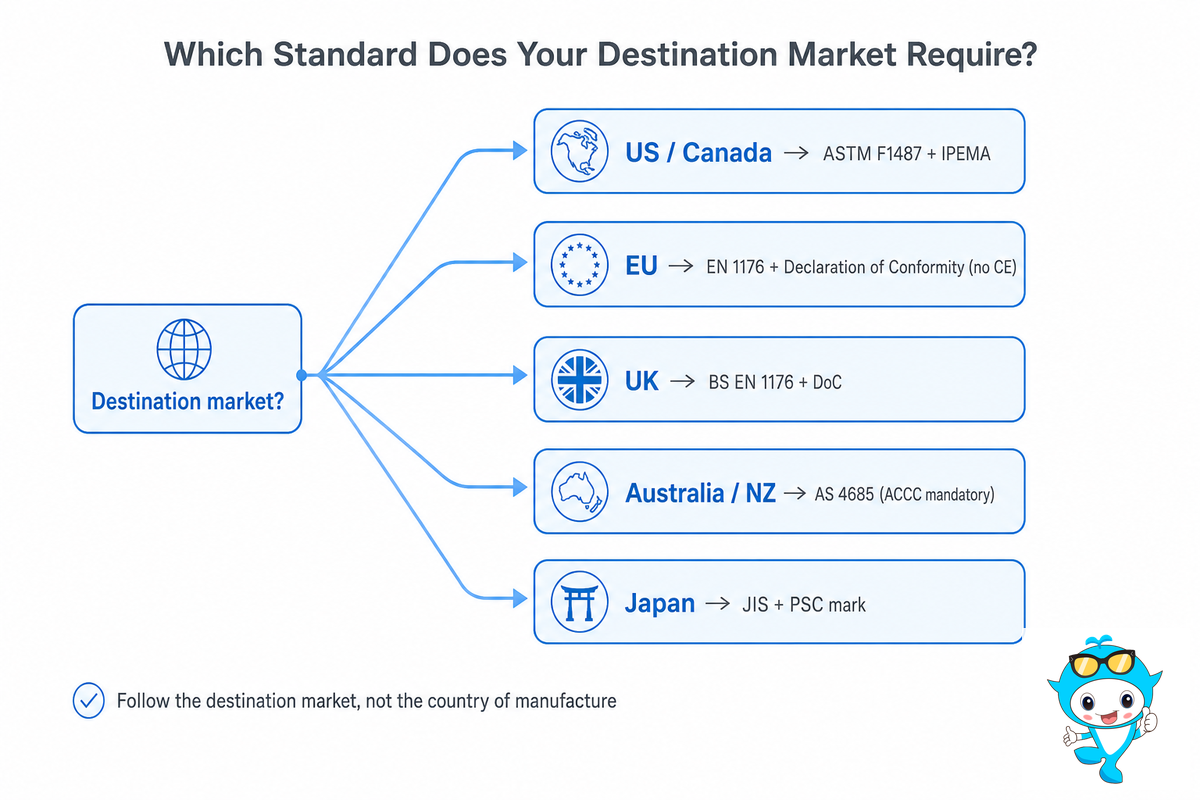
The standard follows the destination market, not the country of manufacture. Ship to the US or Canada and the equipment must meet ASTM F1487; the EU requires EN 1176; the UK requires BS EN 1176; Australia and New Zealand require AS 4685; Japan references JIS.
Which standard you use depends on the destination – not where the equipment was made. If you are going to sell in the US, ASTM F1487 applies, The EU needs EN 1176, UK BS EN 1176, Australia and New Zealand AS 4685 and so on (JIS in Japan is also applicable). ( A word of caution on the “CE”: permanently installed public playground equipment does not fall within the scope of EU directives on “toy safety” and is not “CE marked”-EN 1176 compliance is normally driven by individual countries and the “purchasing practices of those authorities”, discussed next. “Matching” of certificate by country of origin to country of export is what trips up importers during “acceptance inspection”. It’s in this routing table below: ” ).
| Destination market | Headline standard | Surfacing | Conformity mark | Force |
|---|---|---|---|---|
| United States | ASTM F1487-25 + CPSC handbook | ASTM F1292 | IPEMA (voluntary) | Voluntary + CPSIA federal |
| Canada | CSA Z614 (aligns ASTM) | CSA / ASTM F1292 | IPEMA / CCPI | Provincial mandate varies |
| EU / EEA | EN 1176-1 | EN 1177 | Manufacturer DoC to EN 1176 (no CE) | Mandatory (national law) |
| Germany / DACH | EN 1176 + GS supplement | EN 1177 | GS mark (TÜV, voluntary) | Mandatory + GS expected |
| United Kingdom | BS EN 1176 | BS EN 1177 | DoC to BS EN 1176 | Mandatory |
| Australia | AS 4685.1:2021 | AS 4422 | CPSI-AU acceptance | Mandatory (ACCC) |
| New Zealand | AS/NZS 4685 | AS/NZS 4422 | Local inspection | Mandatory |
| Japan | JIS (cross-refs EN 1176) | JIS | PSC Mark | Mandatory (PSC scope) |
| Middle East / ISO-aligned | EN 1176 (commonly specified) | EN 1177 | TÜV / SASO varies | Buyer/RFQ-driven |
Two patterns stand out. Number one is EN 1176 footprint (EN): it is big – all of Europe, United Kingdom, Japan (through association with EC and EN 1176 standards), large part of the Middle East as well as Australia (through standards alignment), are all on it or close to it. Number two ASTM F1487 standards are pretty much a lonely figure on the continent (in North America).
This means that an exporting product designed to EN 1176 standards has a much larger potential audience in the world that solely designed to ASTM F1487 standards. Use the country based certificate and standards check tool for finding the required certification.
In practice the failure looks like this: a distributor orders a structure built and certified in China to ASTM F1487 because the factory knows that standard best, then ships it to a council park in Manchester. At acceptance the inspector asks for the BS EN 1176 file, finds an ASTM report instead, and rejects the install — the certificate matched the country of manufacture, not the destination. Reading the routing table the other way around, destination first, is what keeps a project off that list.
Mandatory or Voluntary? The Mandatory-vs-Voluntary Force Split
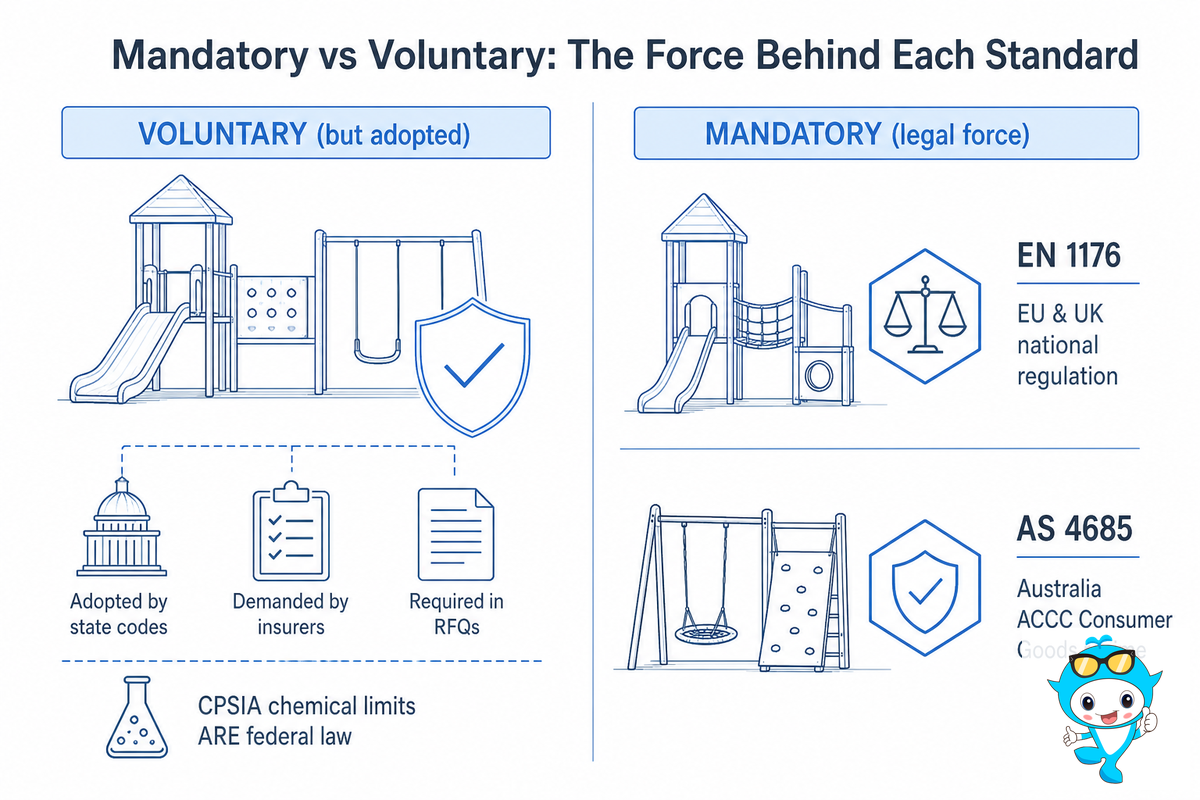
This is the question that determines your liability exposure, and it’s a question that divides the three standards. ASTM F1487 is voluntary – the CPSC even points this out as a voluntary standard. For the other two, EN 1176 and AS 4685 have legal force in their respective regions.
EN 1176 is a force through member-state national regulation and procurement policy, and AS 4685 falls under Australia’s Consumer Goods mandatory standards program, managed by the Australian Competition & Consumer Commission (ACCC). Be aware that there is a misunderstanding of what EN 1176 compliance signifies – there is no CE mark on permanently installed play equipment. Permanently installed public playground equipment has always been explicitly excluded from the EU Toy Safety Directive (2009/48/EC), so it should not have a CE Mark; compliance is declared in the Declaration of Conformity to EN 1176, along with the corresponding test report, while REACH covers material composition.
⚠️ Important — “voluntary” does not mean “optional”
Unfortunately, there is a misconception that voluntary ASTM means optional or skippable. In practice, due to adoption in state and city building codes, use in public bidding, and insurance requirements, any installation involving playground equipment for children in the US will likely be required to meet or demonstrate compliance with ASTM F1487, in addition to Federal requirements such as the lead standard (16 CFR 1303), and phthalates standard (16 CFR 1307).
In practice, your commitment to a specific standard comes into play at customs, and on the insurance renewal application, in addition to just on the inspection forms. For the EU and Australia, improper documentation could even stall shipment through customs.
In the U.S., although the container may be cleared through customs, the installer’s insurance or a municipal customer could ultimately reject the installation if ASTM / IPEMA required forms are absent — a less time-consuming but ultimately more expensive type of failure. In either event, documentation needs to be aligned with target market prior to containers clearing loading.
The Australia Question: What AS 4685 Demands That ASTM and EN Don’t
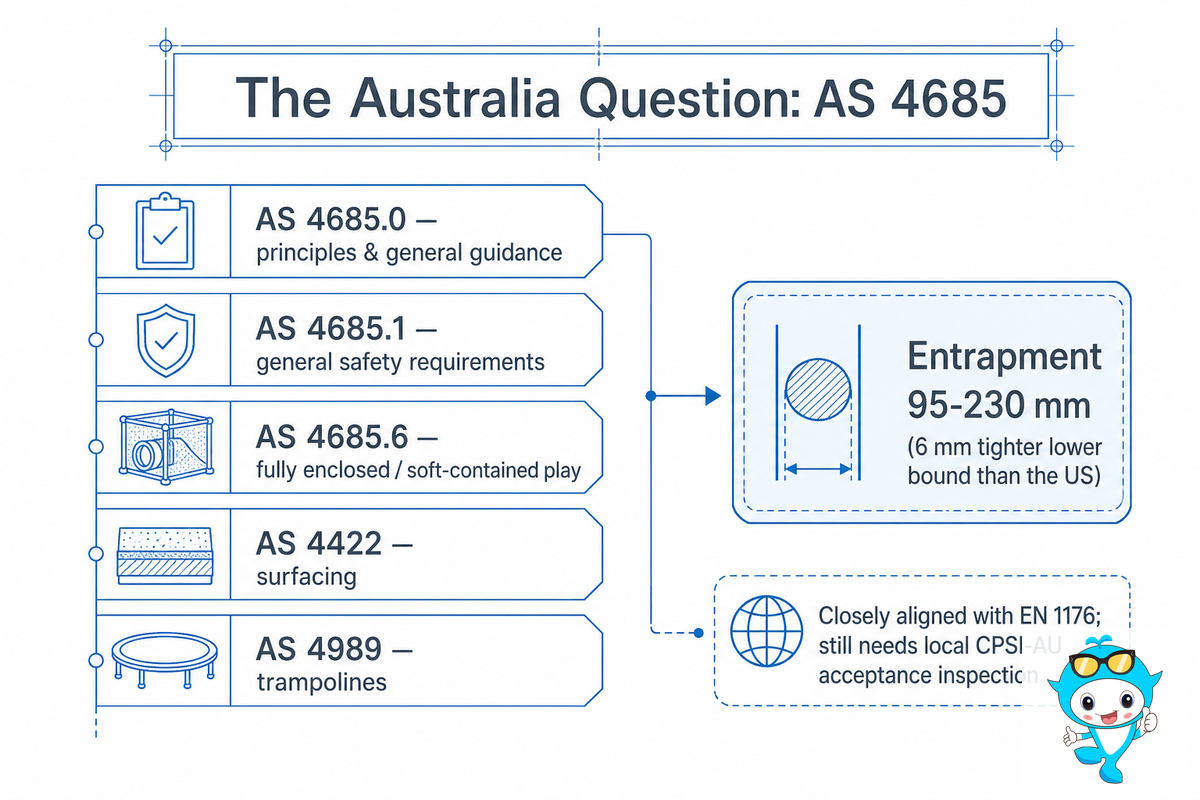
Many Australian clients inquire whether play structures that are ASTM or EN-compliant will be satisfactory in Australia. My honest answer is “closer in some ways for EN, but not nearly close enough for ASTM”. While Australia developed its standard AS 4685 in 2004 and most recently revised in 2021, it is in lock-step with the European EN 1176.
Which playground safety standard does Australia use?
Australia uses the AS 4685 series, with surfacing under AS 4422, made mandatory through the ACCC Consumer Goods regime. AS 4685 is closely aligned with Europe’s EN 1176, so EN-built equipment is most of the way there, but it still needs AS 4422 surfacing certification and a local acceptance inspection.
Australia operates under the AS 4685 series of standards which has parts AS 4685.0 (principles and general guidance), AS 4685.1:2021 (general safety requirements) plus equipment parts up to AS 4685.6 for fully enclosed/soft-contained play with surfacing under AS 4422 (and trampoline specific AS 4989). These standards are referenced via the ACCC Consumer Goods regime which has power over standards; so Australian compliance with this is mandatory rather than optional, unlike ASTM standards in the USA. For equipment made to ASTM, the main areas which differ under AS 4685 are: the metric size of entrapment openings (95mm-230mm – a 6mm reduction in the lower range compared with US limits) the AS 4422 approved surface and a local acceptance inspection by an independent, certified inspector (CPSI-AU, or on one of the state run schemes).
Simply sending the ASTM F1487 document won’t suffice here – although an EN 1176 document comes very close, you still need to submit an AS 4422 compliant surface test report, and book a local inspection.
Certification Marks and Conformity Routes by Market: IPEMA, CE, UKCA, GS/TÜV, PSC
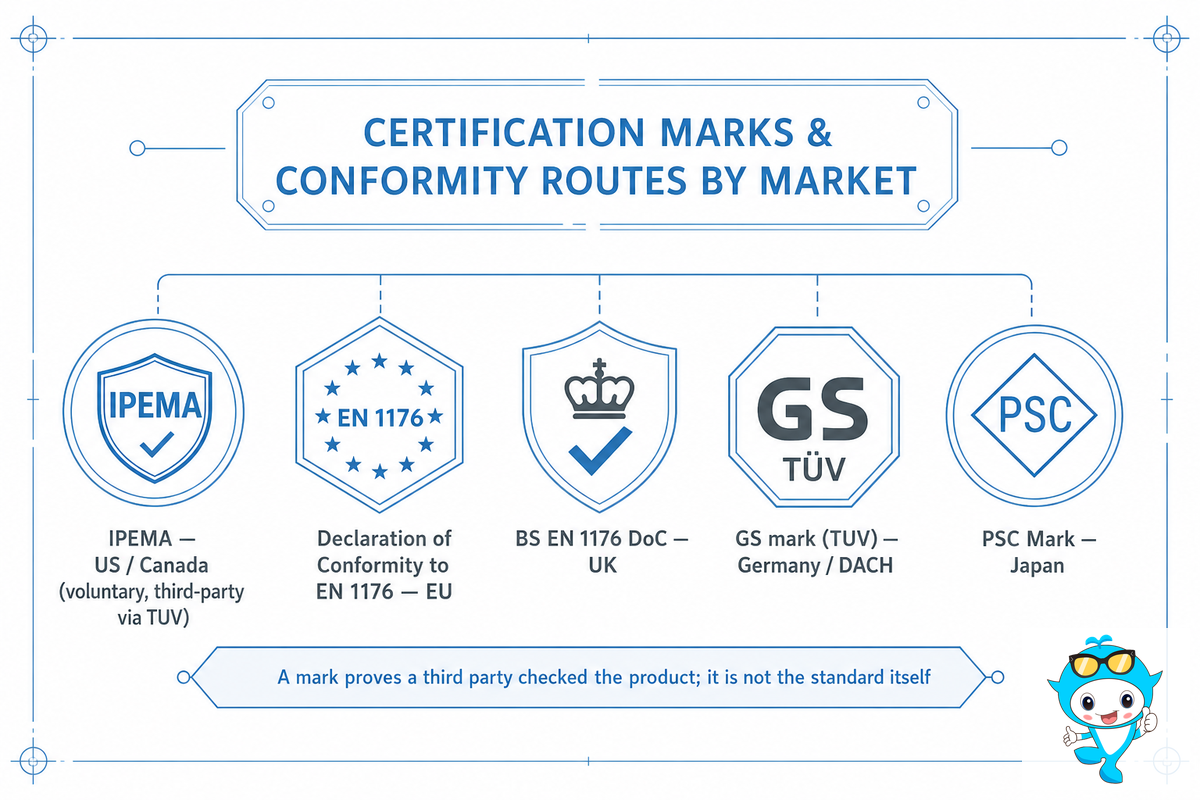
A standard and a mark aren’t the same thing. A standard is the rulebook; the mark is the proof that a third party checked your product against it.
Getting the mark right per market is where procurement actually happens.
- IPEMA (US / Canada) – voluntary third-party product certification for ASTM and CSA products certified by an accredited third-party laboratory. IPEMA seals cover the ASTM F1487 baseline, CSA Z614, F1292, F2075 (engineered wood fiber), and F3012 (loose-fill rubber).
- Declaration of Conformity to EN 1176 (EU / EEA) – Fixed public play equipment isn’t CE marked, but falls under national legislation that requires a declaration of conformity (DoC) supported by EN 1176 test report.
- BS EN 1176 conformity (United Kingdom) – Following Brexit the UK maintains BS EN 1176 with its own form of Declaration of Conformity.
- GS Mark / TÜV (Germany / DACH) – Buyers in Germany, Austria, and Switzerland are very often seeking to have a product bearing the German GS certification mark, not just an EN 1176 certificate.
- PSC Mark (Japan) – Japan also operates product safety certification and those play equipments falling under the PSC law need this. JIS has reference to EN 1176.
Getting multiple certificates (US & EU and possibly Asia or UK) is complex and costly to manage.
Including US and EU certifications could add 30% and 3 months to documentation costs. If a client require US inspection path we’ve a handy guide.
Designing One Structure to Clear Multiple Markets: The Multi-Market Design Envelope
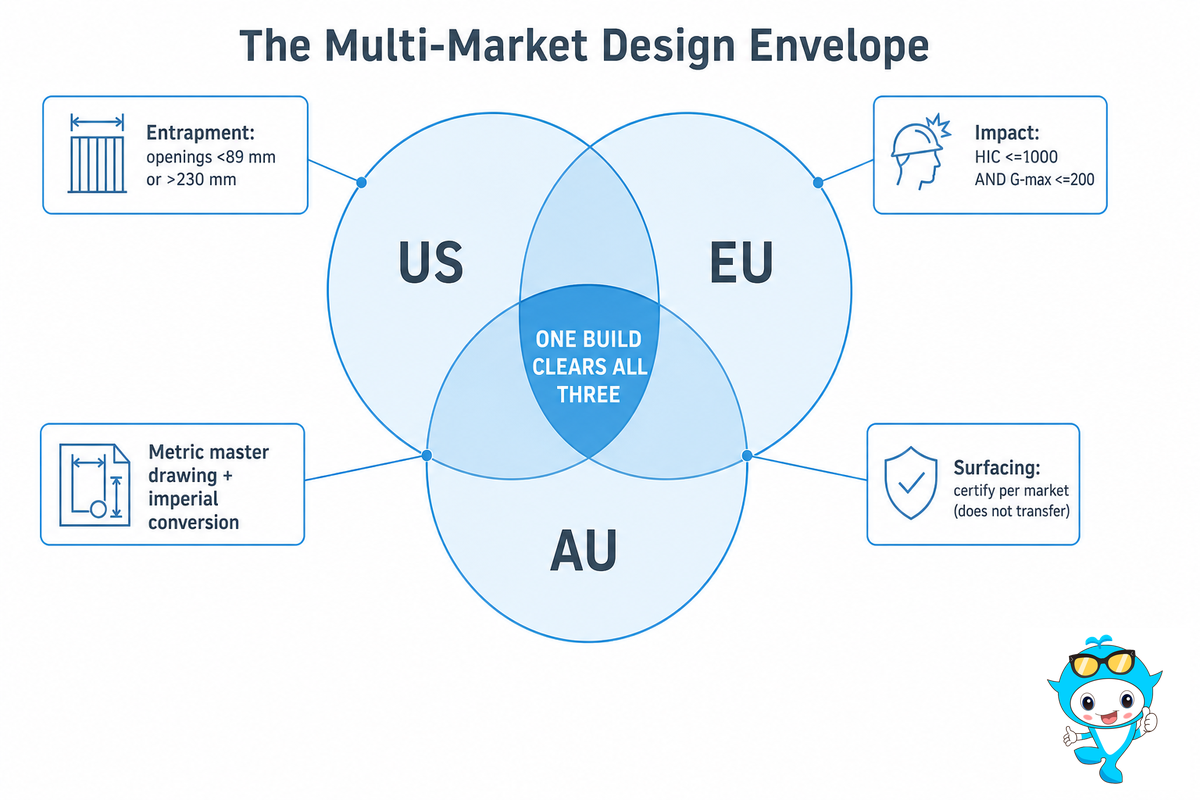
Fortunately, since the three main standards (ASTM, EN and AS) aim to protect against exactly the same hazards, they share significant common ground, and it’s rarely necessary to produce three different sets of products to conform.
This Multi-Market Design Envelope approach means designing a product that complies with the tightest figures across each standard and certifying in separate markets. This can help save significant time and money – although we’ll always need a specific compliance document for each region/market and any applicable locally required inspections and certifications must always be performed.
| Parameter | US | EU | AU | Safe design target |
|---|---|---|---|---|
| Entrapment opening (banned band) | 89–229 mm | 89–230 mm | 95–230 mm | Openings <89 mm or >230 mm (outside every band) |
| Impact criterion | HIC ≤1000 + G-max ≤200 | HIC ≤1000 | HIC ≤1000 + G-max ≤200 | HIC ≤1000 AND G-max ≤200 |
| Drawings | Imperial | Metric | Metric | Metric master + imperial conversion sheet |
| Surfacing | F1292 | EN 1177 | AS 4422 | Certify per market (does not transfer) |
This envelope covers the structure itself – the geometry of the frame, the dimensions of openings, guardrails, and height of falls. It does not cover the documentation – surfacing must always be tested to F1292, EN 1177 or AS 4422 respectively, and the mark of conformity is always market specific. For us, operating in over 40 markets, building to the metric standard as the base with US G-max/ASTM overlay documentation has proven efficient – one test, market specific document packs. Run it through our international compliance checker before taking a multi market design to locked order.
A concrete example from our own line: a climbing tower drawn to the 95 mm metric opening, the lower European free-fall height, and the US G-max ≤200 surface rule has shipped to a German Kita, an Australian council park, and a US daycare from a single tooling set — only the surfacing certificate and the conformity mark changed per destination. The one place the envelope does not stretch is the paperwork, which is why the per-market test reports still have to be issued one country at a time.
Indoor Soft Play Is a Separate Standard Set: ASTM F1918, EN 1176-10/-11, AS 4685.6
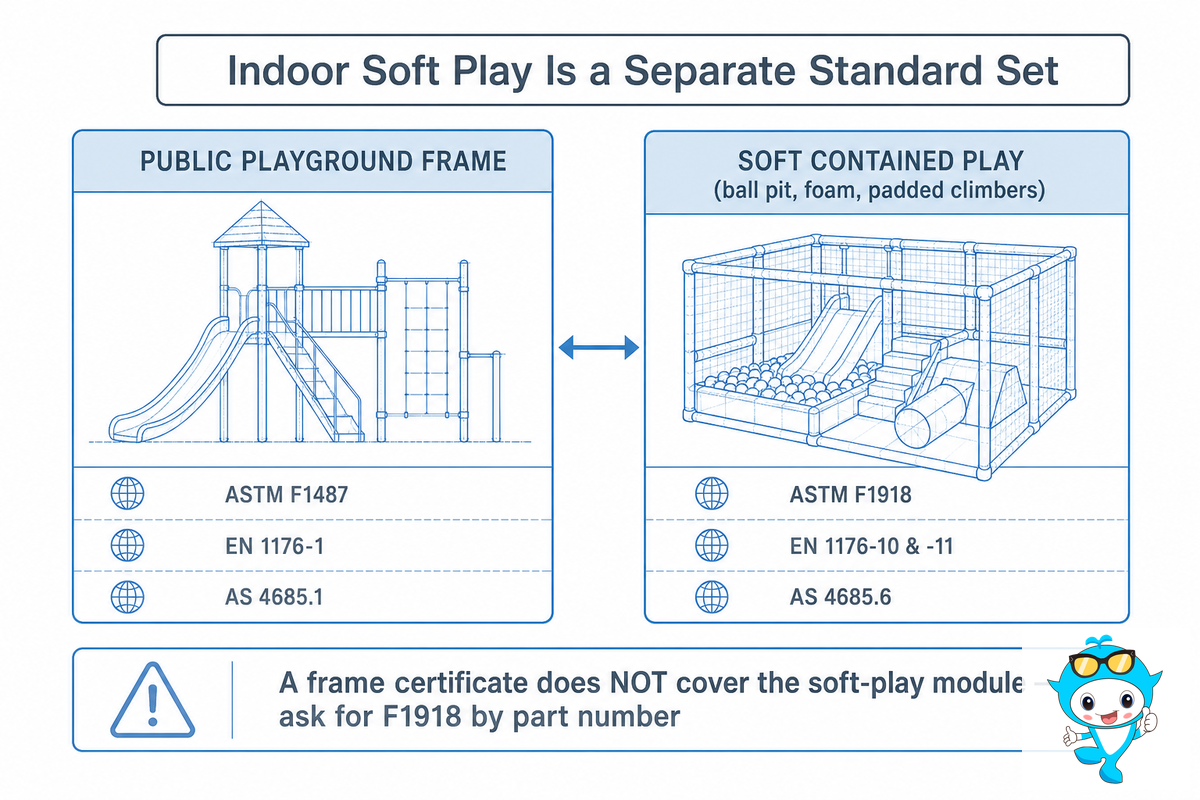
Should your system fall into a soft contained play arena – the world of ball pits, soft structured play modules and enclosed crawls – the standard described above is not the applicable set. Soft contained play sits under an entirely different umbrella; ASTM F1918 in the United States, EN 1176-10 and EN 1176-11 in Europe and AS 4685.6 in Australia.
⚠️ The most common compliance gap on a mixed order
Should a purchaser on the one purchase order buy an ASTM F1487 / EN 1176-1 / AS 4685.1 modular climbing unit alongside a soft contained play ball pit subject to ASTM F1918 / EN 1176-10 / AS 4685.6 , simply request a compliance certificate with only reference to “ASTM”, they will receive a certified frame and an unverified soft play structure. All of the time that we’ve seen in this market is a frame that passes certification but sits uncertified next to a softly enclosed ball pit with zero supporting documentation and a completely different liability profile. Insist on a soft play specific test certification, with a full part number listed.
This is everyday business, not a “gotcha”, for the indoor playgrounds manufacturer working overseas, not for the exotic edge-case. I demonstrate the F1487 versus F1918 distinctions clearly on a realistic composite structure within the indoor jungle gym buyer’s guide which I publish online and all our own range of soft play equipment is built and documented to the soft-contained-play (SCP) standards from the start.
What to Demand From Your Supplier, by Market: The Destination Document Set
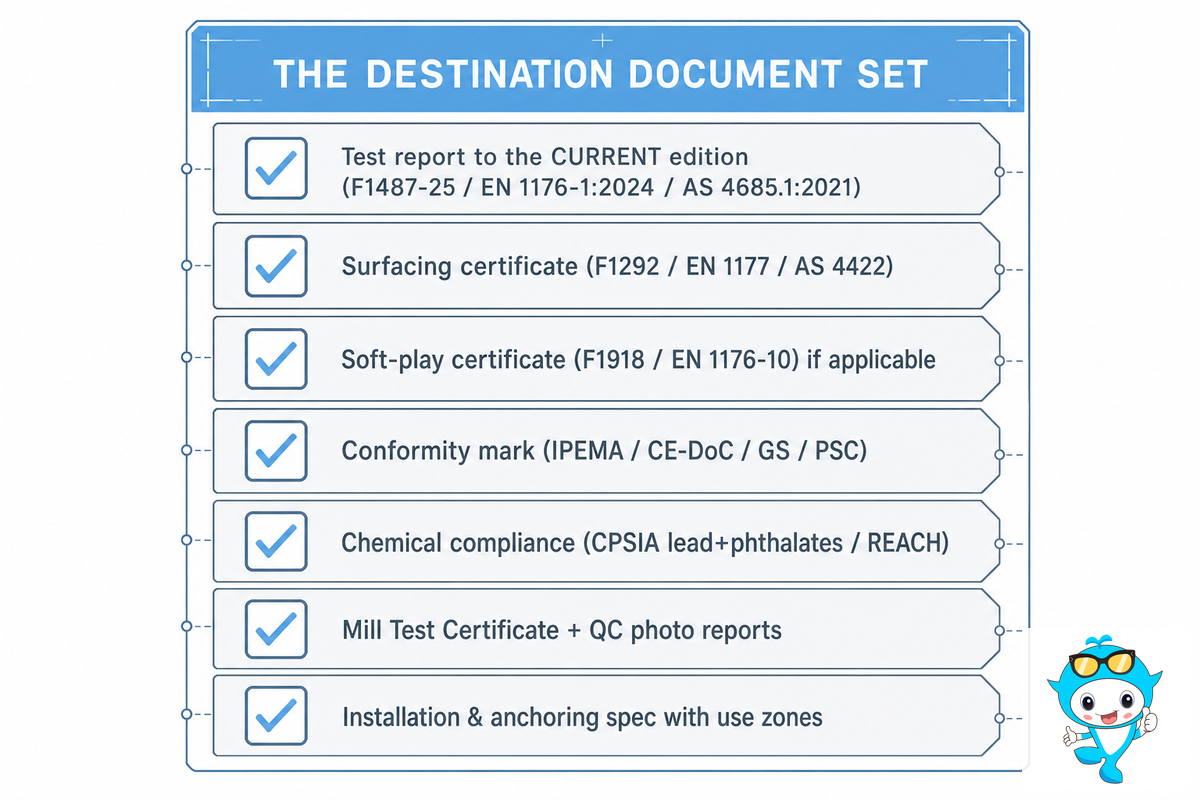
Compliance starts and finishes with the purchase order. You’ll want what I call a Destination Document Set: a concise list of documents required for each container prior to loading, customised by destination market. Always specify your requirement by document name, including edition numbers, in your PO, otherwise “ ASTM compliant ” means nothing by itself.
The Destination Document Set — require in the PO, by market
- Test Report for ASTM F1487-25, EN 1176-1:2017+A1:2024, AS 4685.1:2021 …(whichever relevant to your destination) Note: F1487-25 vs F1487-17, etc.. Always specify by edition.
- Surfacing certificate covering fall height under F1292/EN 1177/AS 4422, with specification of the critical fall height achieved and an in situ testing provision.
- Soft-play certificate to ASTM F1918 / EN 1176-10/-11 / AS 4685.6 for any enclosed structures or foam components.
- Conformity mark / declaration – US/CA IPEMA seal, European CE and Doc, UK UKCA, German GS mark, Japanese PSC mark etc.
- Chemical and materials certification to CPSIA for lead and phthalates in the US (mandatory) or equivalent REACH certificate in Europe.
- Mill Test Certificates and photo reports for frame, coatings and assemblies throughout the manufacturing process.
- Installation and anchoring specifications to the local market standard including use-zone diagrams.
If you’re a manufacturer with international customers, be sure that you’ve an information pack, per country, readily available for the end market. At Didi Land we supply equipment to over 40 countries, fully compliant with, or certified to, the destination-market requirements including an EN 1176-1soft-play installation for a kindergarten in France, an 1,500 m² family entertainment center installation in Mexico and an 800 m² mall installation in Malaysia – so we align this pack with country requirements before confirming the order. Our playground maintenance and inspection guide takes you through re-inspection after installation.
“When a buyer tells me ‘just make it certified,’ my first question is always ‘certified for which country?’ We have shipped the same climbing structure to the US, Germany, and Australia, same steel, same welds, but three different certificate packs and three different surfacing certificates. The factory that pretends one certificate covers the world is the factory that gets your container held at customs.”
Cherry, CEO & Co-Founder, Guangzhou Didi Land Amusement Equipment Co., Ltd.
The cost of skipping this set shows up at the port. We have seen an importer accept a “fully certified” 300 m² structure for a UK leisure centre only to find a gap — an ASTM report and no BS EN 1176 paperwork; the container then sat in a bonded warehouse for 11 days while a re-test was arranged, a delay that pushed the opening back close to a month. A buyer who lists each document by name and edition in the purchase order — rather than the words “fully certified” — almost never ends up in that warehouse.
2026 Outlook: How the 2025 CPSC Update and Recent EN/AS Revisions Affect Exporters
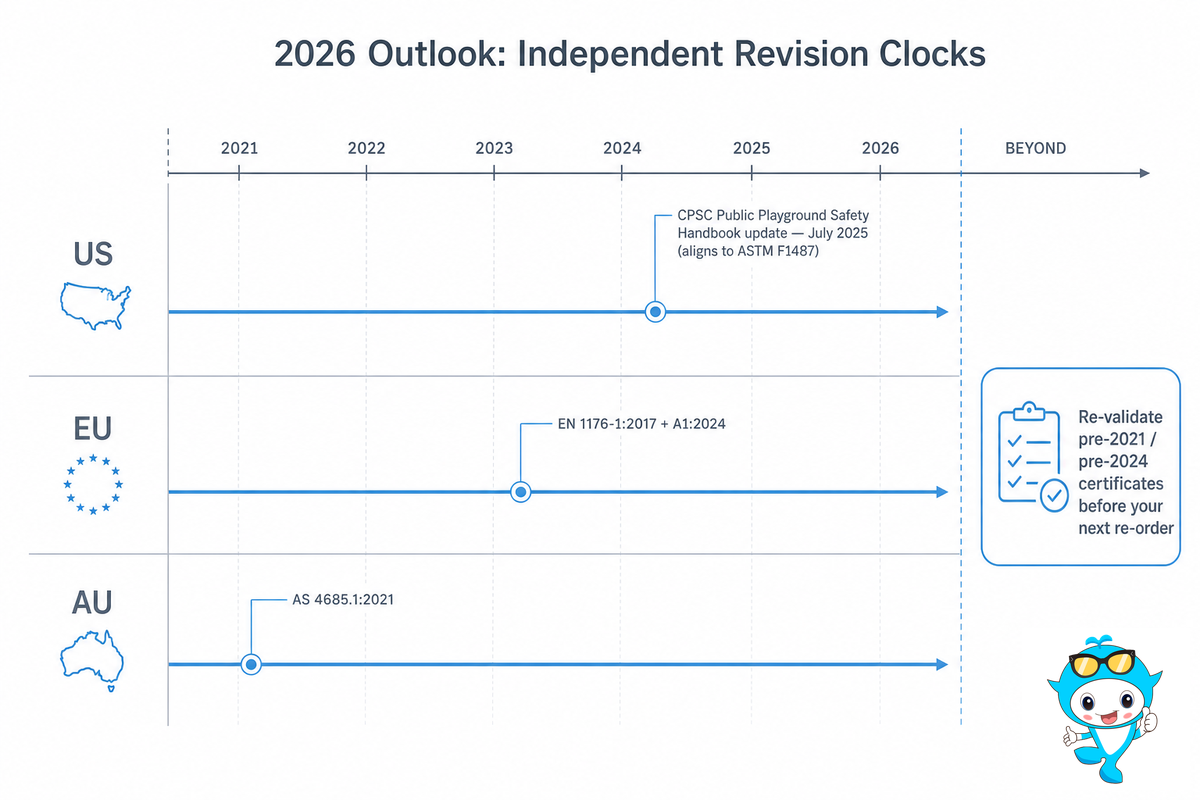
Even if global standards are theoretically “harmonizing” in their philosophy, the practical timing of their updates differs substantially. And it is that timing gap that creates real risk for any exporter or multi-market developer. This year’s main driver comes into focus on July 30, 2025, when the CPSC published a wide-ranging update to its Public Playground Safety Handbook(Federal Register Notice 2025-15374). Key changes pull U.S. standards on signage and labeling, surfacing, and chemical use into greater alignment with ASTM F1487, while also adopting an IPEMA recommendation that narrows the allowable definition for partially bounded openings below 24 inches. Even at the industry level of analysis of the 2025 guide lines, there’s increased emphasis on surface shock absorption performance-even though the established HIC 1000 and G-max 200 ceilings persist, the examination on as-installed surfacing is growing.
And why is this more than a nuance, even in a world of “harmonization”? The EU (EN 1176-1:2017+A1:2024) and Australia (AS 4685.1:2021) update their respective standards independently, separate from any changes in the U.S. So, if your installed equipment was certified under a pre-2021 AS revision or pre-2024 EN amendment, it could be in quiet violation in a given export market while seemingly “current” on paper. This “moving target” phenomenon is how inspectors refer to a playground that’s compliant at install but not in an audit’s “after the fact” inspection. For any exporter or multi-market owner, the real takeaway is straightforward: before reordering on a given product, or exploring a new market entry, specifically ask for a test report for the current standards revision of that specific country, and be sure to verify your surfacing requirements against the 2025 guidelines, rather than simply reusing a previous certificate. A second emerging trend is the development of inclusive and accessible play-in the U.S., the ADA standards have already influenced new federal guidance, while the EU now has EN 17210 and Australia the inclusive design guidance. Any design brieffiled for2026 needs to treat accessibility features and connections as a starting point. (The commercial market size figures provided in this report are purely as supplemental reference material and shouldn’t be interpreted as any sort of predictor of regulatory intent or market opportunity; the significant factor for customers purchasing play equipment remains timing.)
For an operator this turns into a concrete task in 2026: a mall play area certified to a 2019-era file and re-sold or re-located now should be re-checked against the current ASTM F1487-25, EN 1176-1:2017+A1:2024, or AS 4685.1:2021 edition for its market before the next inspection cycle. The structure may be physically fine; it is the paperwork that has aged. Asking the original supplier for a current-edition test report — and a fresh surfacing test — is the cheap insurance against a renewal-day surprise.
Frequently Asked Questions
Q: What are the safety standards for playgrounds?
View Answer
ASTM F1487 (United States & Canada, for ages 2-12), EN 1176 (EU & UK as BS EN 1176), AS 4685 (Australia & NZ). Each goes with a surfacing standard: ASTM F1292, EN 1177, AS 4422. The three secondary sets are residential (ASTM F1148) and indoor soft contained play (ASTM F1918 / EN 1176-10/-11 / AS 4685.6). You must ensure you follow the standards that applies to your intended market.
Q: Is ASTM F1487 the same as EN 1176?
View Answer
They test the same hazardous impacts, but they’re part of distinct legal/standards frame works: ASTM F1487 (imperial) tests the structure against HIC 1000 and surface impacts with G-max 200 under ASTM gauges A & B; EN 1176 (metric) tests the structure under HIC 1000 with no top limit on surface G-max, under EN gauges. They generally come to the same conclusion on risk but cannot use each other’s certificates for proving compliance, meaning you’d need to retest & recertify against the destination standard if your product meets the other one. AS 4685 is highly aligned to EN 1176.
Q: Which playground safety standard does Australia use?
View Answer
The standards governing playground design are AS 4685.0 (General) & AS 4685.1 (Equipment) in Australia, with AS 4685.6 covering indoor soft contained playgrounds; AS 4422 is for surfacings. The system is linked through Australia’s Consumer Goods legislation managed by the ACCC, meaning it’s mandatory in law. Because Australia’s standards are closely aligned with European’s BS EN 1176, an EN 1176-built structure is likely to be most of the way there but requires separateAS4685-compliance testing for AS standards (incl. specific entrapment windows), and state/regional acceptance inspections (CPSI-AU).
Q: Are playground safety standards mandatory?
View Answer
It differs based on destination market. In the US, ASTM F1487 isn’t legally mandatory in federal law but is widely referenced in state codes and building rules, used as a guide line by insurers, and comes in tandem with a mandated federal code for children’s chemical exposure (CPSIA). EN 1176 (implemented nationally but not a CE mark on its own) & AS 4685 are legally mandatory, and you may be stopped by customs if your product lacks correct certification.
Q: What is ASTM F1292?
View Answer
Surfacing is specified under the relevant equipment standards too. ASTM F1292 defines accept able impacts for the US, mandating a HIC of 1000 and a maximum G-max of 200 up to the Critical Fall Height defined by the playground structure standard ASTM F1487. EN 1177 covers surfacings to the EU standard; AS 4422 covers Australia/NZ.
Q: What standard applies to indoor soft play?
View Answer
No, you’ll likely want a standard that specifically address this category for the relevant region: AS 4685.6 (Australia), EN 1176-10/-11 (Europe), or ASTM F1918 (US).
Q: What are the 5 S of playground safety?
View Answer
Many consider it within a ‘Site’ Safety ‘Matrix’ that lists Structure, Surfaces, Supervision, Surroundings, Standards. Your Purchase Order needs to contain whichever ‘Standards’ specification you decide upon, which will then point to which individual standard for Surface, Structure and Entrapment you will be testing to.
About This Standards Comparison
This comparison of AS 4685, EN 1176 and ASTM F1487 refers to standards publications, the July 2025 CPSC Public Playground Safety Handbook update, ISO/TR 24666 on national test probes, and Didi Land’s trove of proof-of-shipment for all of the playground and soft-play equipment we have exported to 40+ countries to date to meet destination-market standards, since 2014. Not for use as a substitute for the definitive play safety rules publication, but a buyer’s list of those rules, with a completion sign-off by a qualified inspector of the finished play area and its environs prior to opening (our documented risk management trail, above-and-beyond worthy for an inspector, and always up-to-the-minute as the standards evolve). Current editions as of June 2026, check for an live edition and conformity mark before ordering for a specific destination. Updated by Didi Land’s technical team, Guangzhou Didi Land Amusement Equipment Co., Ltd. We export several thousand destination-market accredited play units every year.
References & Sources
- Public Playground Safety Handbook (2025 update)U.S. Consumer Product Safety Commission
- Notice of Availability: Public Playground Safety Handbook Update (2025-15374)U.S. Federal Register
- ASTM F1487-25 Standard for Playground Equipment for Public UseASTM International
- EN 1176-1:2017+A1 Playground Equipment and SurfacingCEN
- AS 4685 Australian Standard for Playground SafetyStandards Australia
- ISO/TR 24666, Probes for playground equipment safetyInternational Organization for Standardization
- Toy Safety Directive 2009/48/ECEUR-Lex (European Union)
- IPEMA Third-Party Certification ProgramInternational Play Equipment Manufacturers Association
Related Articles
- Soft Play Equipment Safety Standards: 2026 Compliance Guidethe US compliance and CPSI-inspector deep dive
- Indoor Jungle Gym: Home vs Commercial Buyer’s GuideF1487 vs F1918 on a real mixed structure
- Soft Play Centre vs Indoor Playground: Operator’s Guide
- Indoor Playground Maintenance & Inspection Guide
- Indoor Playground for Family Entertainment Centers
Shipping playground equipment to more than one market? Get a destination-matched certificate pack before you order.
![Custom Dinosaur Playground Equipment [Design Guide]](https://didiplayarea.com/wp-content/uploads/2026/09/custom-dinosaur-playground-equipment-r2-featured-1-768x512.png)
![Custom Dinosaur Playground Equipment [Design Guide]](https://didiplayarea.com/wp-content/uploads/2026/09/custom-dinosaur-playground-equipment-r2-featured-1-150x150.png)