
Get in Touch with Didi Land

Feet to Meters Converter for Indoor Playground Planning

Updated August 2026
Feet to meters is a length-unit conversion: multiply the length in feet by exactly 0.3048. To convert meters back to feet, divide by 0.3048. Keep one source dimension as the controlling value, label any converted number as a reference, and don’t display more precision than the source measurement supports.
Foot to metre converter
Convert between foot and metre. The unit changes; the measured quantity does not.
Result
m
1 ft = 0.3048 m
For the international foot, 1 ft = exactly 0.3048 m.
How to Convert Feet to Meters
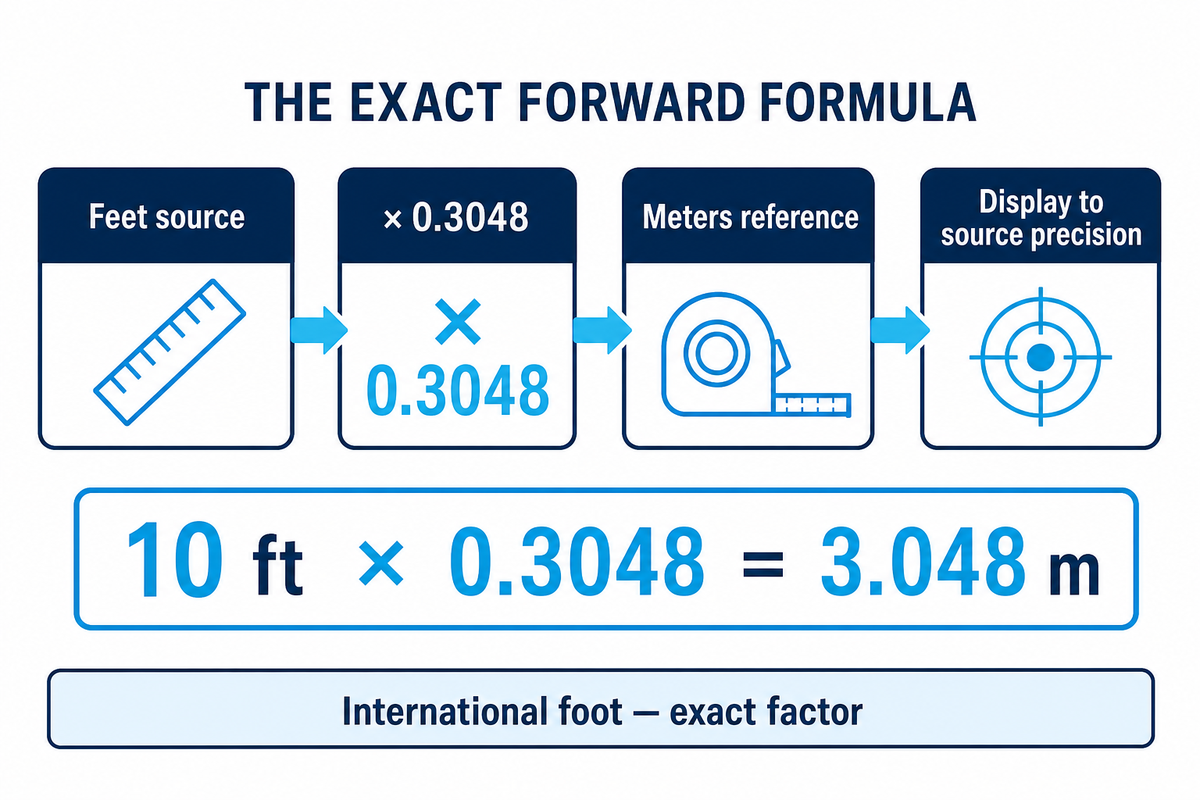
Multiply the number of feet by 0.3048. As a quick check, 10 ft × 0.3048 = 3.048 m. The factor is exact for the international foot, but the displayed result should still reflect the precision of the original measurement.
The formula is short:
A foot is a unit of length equal to 12 inches: 1 foot equals exactly 0.3048 meters, while 1 yard equals 3 feet.
Common lookups include 1 foot in meters, feet to meters height checks, and ceiling height feet to meters handoffs. The table below also covers 6 feet to meters, 12 feet to meters, and 40 feet to meters.
Foot-to-Meter Conversion Formula and Unit Context
NIST’s current conversion guidance records the 1959 definition of the international yard and states that one foot equals exactly 0.3048 m. Its symbol ft and the 12-inch relationship are the definitions this calculator applies. U.S. customary and imperial labels do not create different factors for the international foot.
The International Bureau of Weights and Measures’ SI Brochure identifies the metre, symbol m, as the SI base unit of length: the distance traveled by light in a vacuum during a specified time interval defines it. Historically, the metre was connected to one ten-millionth of the meridian from the equator to the north pole. That current definition, not the historical reference, governs length in the metric system.
Regional labels such as US customary, customary systems, Canada, UK, United Kingdom, or United States of America do not change this calculator’s formula only when the source unit is confirmed as the international foot. If a source uses a Greek, Roman, or another historical foot label, verify its definition before applying 0.3048. Whether feet measurement is commonly used or widely used in a particular record set, the input must still represent a length, and the source unit must remain visible.
For length conversions between different units or different systems, the forward conversion formula is value in meters = feet × 0.3048; vice versa, divide meters by 0.3048. An interactive converter can show an answer to two decimals or more, but display precision still comes from the source measurement.
To explore the meters formula in a spreadsheet, place the feet value in one cell and multiply it by 0.3048 in a separate metric-reference cell. Keep the original cell visible so the controlling value is never replaced by its conversion.
meters = feet × 0.3048forward conversion
1 ft = 0.3048 mexact international-foot relationship
10 ft = 3.048 mworked check
NIST’s current conversion table distinguishes the international foot from the legacy U.S. survey foot. For ordinary building and equipment dimensions, the calculator uses the international foot. If an inherited geospatial or survey file is old enough to use a different foot definition, confirm the source before conversion instead of assuming.
Is 3 feet equal to 1 meter?
No. Three feet equals exactly 0.9144 m. One meter is approximately 3.28084 ft. Treating 3 ft as 1 m can be useful for a rough mental estimate, but it creates a difference of 85.6 mm over 3 ft. That’s too large to carry into an equipment envelope or installation drawing without an explicit tolerance decision.
The exact factor and the source measurement have different jobs. The factor doesn’t add accuracy to a value measured with a rough tape, copied from a lease brochure, or rounded to the nearest foot. NIST’s Guide to the SI conversion appendix explains that a converted value shouldn’t imply more significant digits than the source supports.
Convert Meters Back to Feet
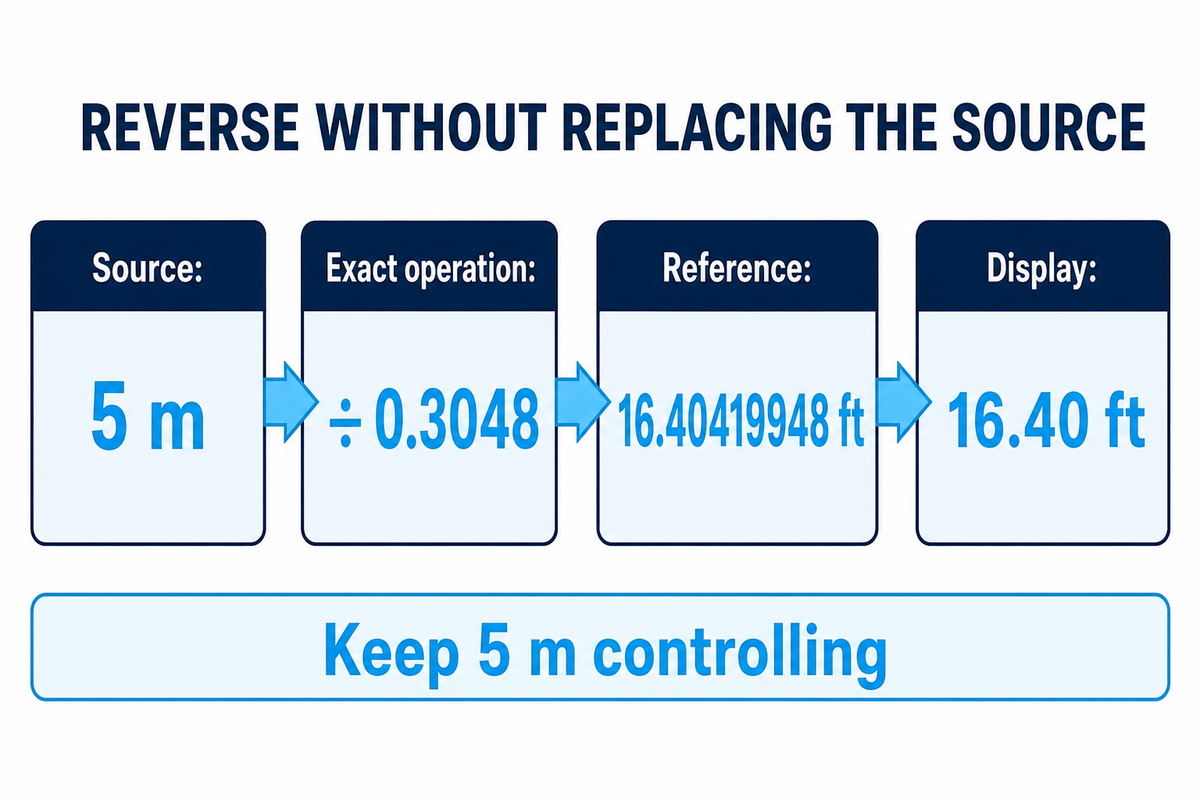
To convert meters to feet, divide by 0.3048. One meter equals approximately 3.280839895 ft. For example, 5 m ÷ 0.3048 = 16.40419948 ft, commonly shown as 16.40 ft when two decimals are justified.
The reverse calculation is useful when a supplier drawing is metric but a property team reviews dimensions in feet. Use the calculator’s Swap control, then keep the original metric value visible. Don’t overwrite 5 m with 16.40 ft and lose the fact that the metric dimension controls.
The same NIST relationship governs the reverse direction. In a supplier handoff, retain the metric source field, place the foot result in a separate reference field, and have the drawing owner identify which value controls before release.
| Check | Calculation | Result | What it proves |
|---|---|---|---|
| Forward | 12 ft × 0.3048 | 3.6576 m | Factor and decimal entry |
| Round trip | 3.6576 m ÷ 0.3048 | 12 ft | Arithmetic reversibility |
| Source check | Read original file | 12 ft controls | Which value has authority |
A round trip catches a mistyped factor or decimal. It doesn’t prove that the original dimension used the right datum, measured the lowest obstruction, or came from the current drawing revision. Arithmetic verification and project verification are separate tasks.
Common Feet-to-Meters Conversion Table
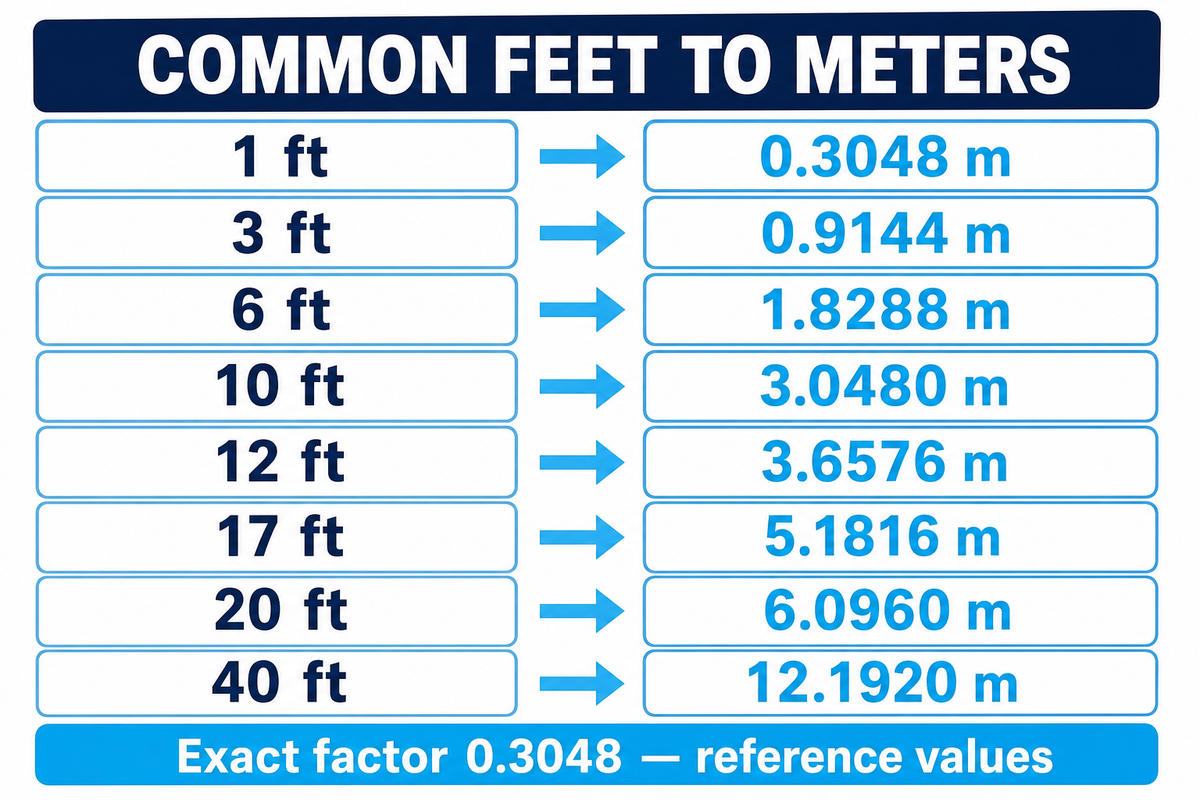
Use this table to check common lengths. Every meter value is calculated with the exact 0.3048 factor and shown to four decimal places where needed. The values are conversion references, not recommended ceiling heights, room spans, or equipment clearances.
The values derive from the international-foot definition in NIST’s conversion factors. They help a project coordinator spot a decimal or direction error before the number reaches a quotation, but the source drawing still governs geometry and tolerance.
| Feet (ft) | Meters (m) | Calculation check |
|---|---|---|
| 1 | 0.3048 | 1 × 0.3048 |
| 3 | 0.9144 | 3 × 0.3048 |
| 5 | 1.5240 | 5 × 0.3048 |
| 6 | 1.8288 | 6 × 0.3048 |
| 8 | 2.4384 | 8 × 0.3048 |
| 10 | 3.0480 | 10 × 0.3048 |
| 12 | 3.6576 | 12 × 0.3048 |
| 14 | 4.2672 | 14 × 0.3048 |
| 16 | 4.8768 | 16 × 0.3048 |
| 17 | 5.1816 | 17 × 0.3048 |
| 18 | 5.4864 | 18 × 0.3048 |
| 20 | 6.0960 | 20 × 0.3048 |
| 25 | 7.6200 | 25 × 0.3048 |
| 30 | 9.1440 | 30 × 0.3048 |
| 40 | 12.1920 | 40 × 0.3048 |
| 50 | 15.2400 | 50 × 0.3048 |
| 100 | 30.4800 | 100 × 0.3048 |
For a quick sanity check, 17 ft should be just over 5.18 m, while 40 ft should be just over 12.19 m. If a result differs by a factor of ten, inspect the decimal. If it differs by about 3.28, inspect the direction. If it uses square units, stop and use the area converter instead.
The table displays four decimals to expose the math. A released project document may need fewer decimals. Preserve the unrounded calculation in the working record, then apply the significant-digit and tolerance rules set by the controlling source and project team.
Convert Feet and Inches to Meters Without Losing the Inch
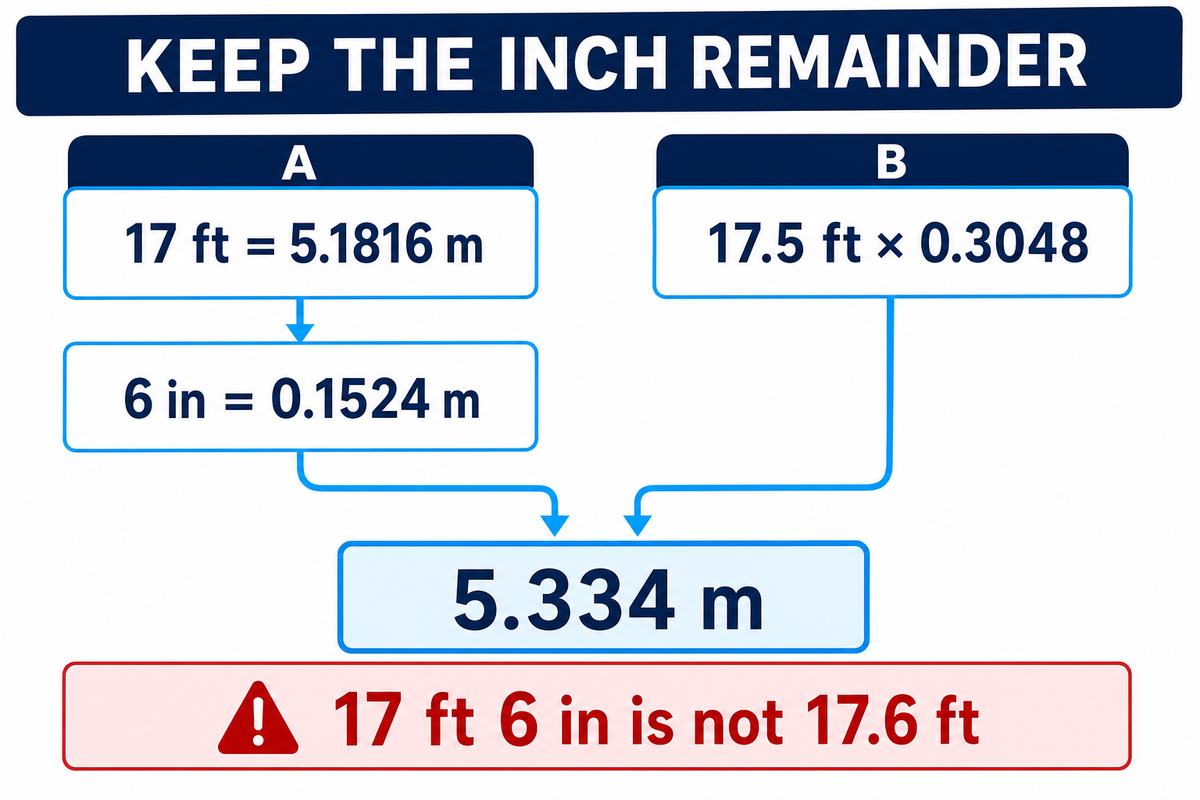
For a mixed dimension such as 17 ft 6 in, convert the inches to feet first or convert each part directly. Seventeen feet equals 5.1816 m, six inches equals 0.1524 m, and the total is 5.334 m.
- Write the source as two components: 17 ft and 6 in.
- Convert 17 ft using 17 × 0.3048 = 5.1816 m.
- Convert 6 in using 6 × 0.0254 = 0.1524 m.
- Add the unrounded results: 5.1816 + 0.1524 = 5.334 m.
You can also normalize first: 6 in ÷ 12 = 0.5 ft, so 17.5 ft × 0.3048 = 5.334 m. Both routes agree because one international inch is exactly 0.0254 m. The NIST foot relationship supplies the exact basis.
The common mistake is deleting the inch remainder or treating “17-6” as a decimal. In architectural notation, 17′-6″ means 17 feet 6 inches, not 17.6 feet. The latter equals 5.36448 m, a 30.48 mm difference from 17 ft 6 in. Preserve the notation before entering a decimal calculator.
For smaller fabricated dimensions, use the separate guide for small-part millimeter and inch checks. Keep each unit family in its own field rather than switching between millimeters, inches, feet, and meters repeatedly.
Put the Conversion in a Floor Plan, Spreadsheet, or Request for Quotation
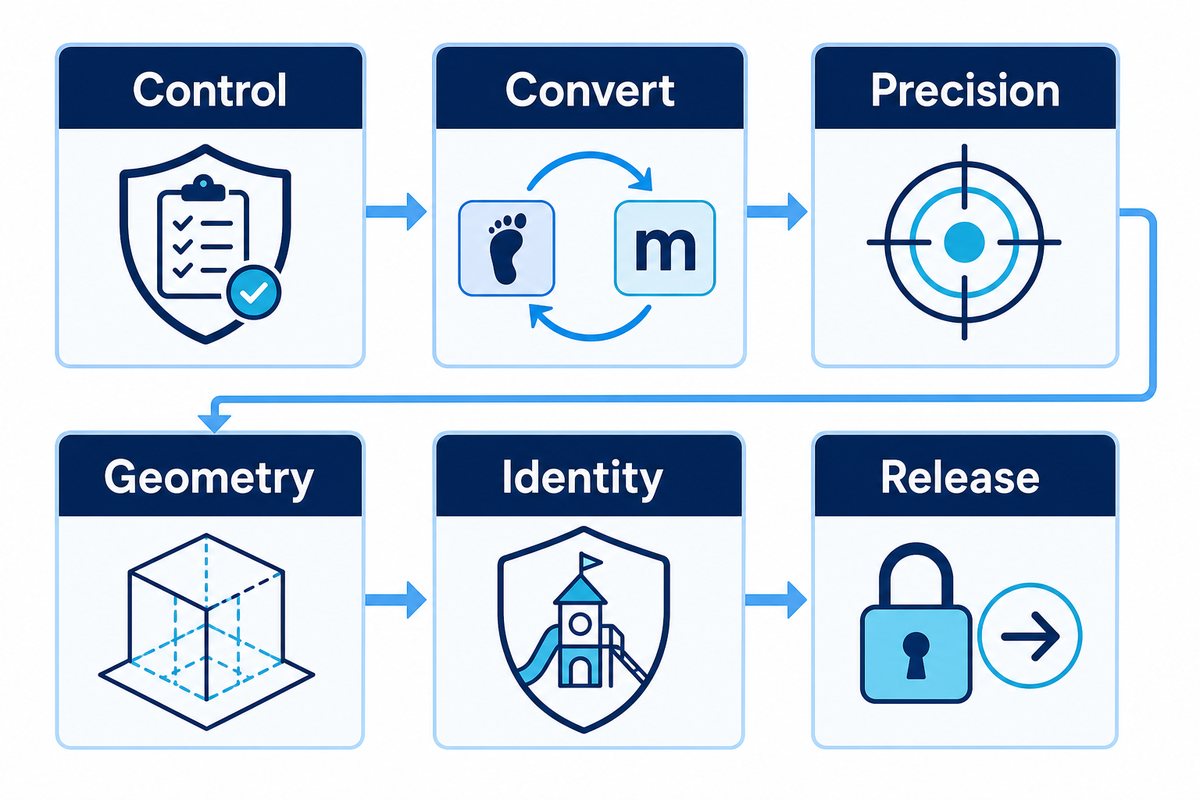
A dependable handoff names one controlling dimension. The converted value is informational unless the contract or drawing owner makes it controlling. Record the source value and unit, exact factor, justified display precision, datum, tolerance, file revision, and owner.
The Single-Authority Tie-Breaker
The Single-Authority Tie-Breaker answers one question: when the feet and meter values disagree, which source has authority? Check the governing contract or drawing owner, retain that source value, and recalculate the reference from it. A converted value can test arithmetic, but it does not gain an equal vote. Department of Defense metric guidance hosted by NIST says dual metric and inch-pound dimensions on drawings should be avoided; the practical lesson is to name one authority instead of letting two rounded values compete.
| Input cluster | Example | Conversion route | Handoff check |
|---|---|---|---|
| Whole feet | 17 ft | 17 × 0.3048 | Retain 17 ft as source |
| Decimal feet | 17.5 ft | 17.5 × 0.3048 | Confirm decimal notation |
| Feet and inches | 17 ft 6 in | Convert both components | Do not read 17-6 as 17.6 |
| Metric return | 5 m | 5 ÷ 0.3048 | Keep 5 m controlling |
| Ceiling record | 17 ft clear | Convert after naming datum | Identify lowest obstruction |
| Room sides | 40 ft × 25 ft | Convert each length separately | Preserve both source sides |
| Area value | 400 ft² | Use 0.09290304 | Do not use the length factor |
| Legacy survey file | Old geospatial data | Confirm foot definition first | Record the source standard |
| Rounded source | About 20 ft | Calculate without adding precision | Keep the qualifier visible |
- Control: identify the source unit and value that govern the requirement.
- Convert: calculate once with the exact factor; label the result “reference” unless formally adopted.
- Precision: display only the digits justified by the source measurement.
- Geometry: record the datum or reference plane and the project-specific tolerance.
- Identity: retain project, room or zone, file, revision, and responsible owner.
- Release: confirm that the contract, request for quotation, and issued drawing do not disagree about which value controls.
A sample row from such a handoff spreadsheet might look like: “Hall clear height | controls: 17 ft 6 in | reference: 5.334 m | datum: finished floor to lowest confirmed obstruction | source: FP-07 Rev C | tolerance: per project documents | owner: architect.” The structure implies context, but this example doesn’t prescribe universal clearance requirements or tolerances.
Didi Land’s own page showing where the source PDF enters its drawing sequence says the concept brief requests a floor-plan PDF and ceiling height in millimeters. Later stages list layout and engineering drawings. That’s a first-party statement about Didi Land’s process, not independent evidence that every supplier uses the same intake or drawing standard.
For a request for quotation, include the controlling source file rather than pasting only the converted number into an email. If the supplier needs metric, provide the metric reference and the original. If the contract adopts metric, have the drawing owner revise the controlling record instead of allowing both values to float without authority.
Check Ceiling Height, Equipment Envelope, and Service Clearance Separately
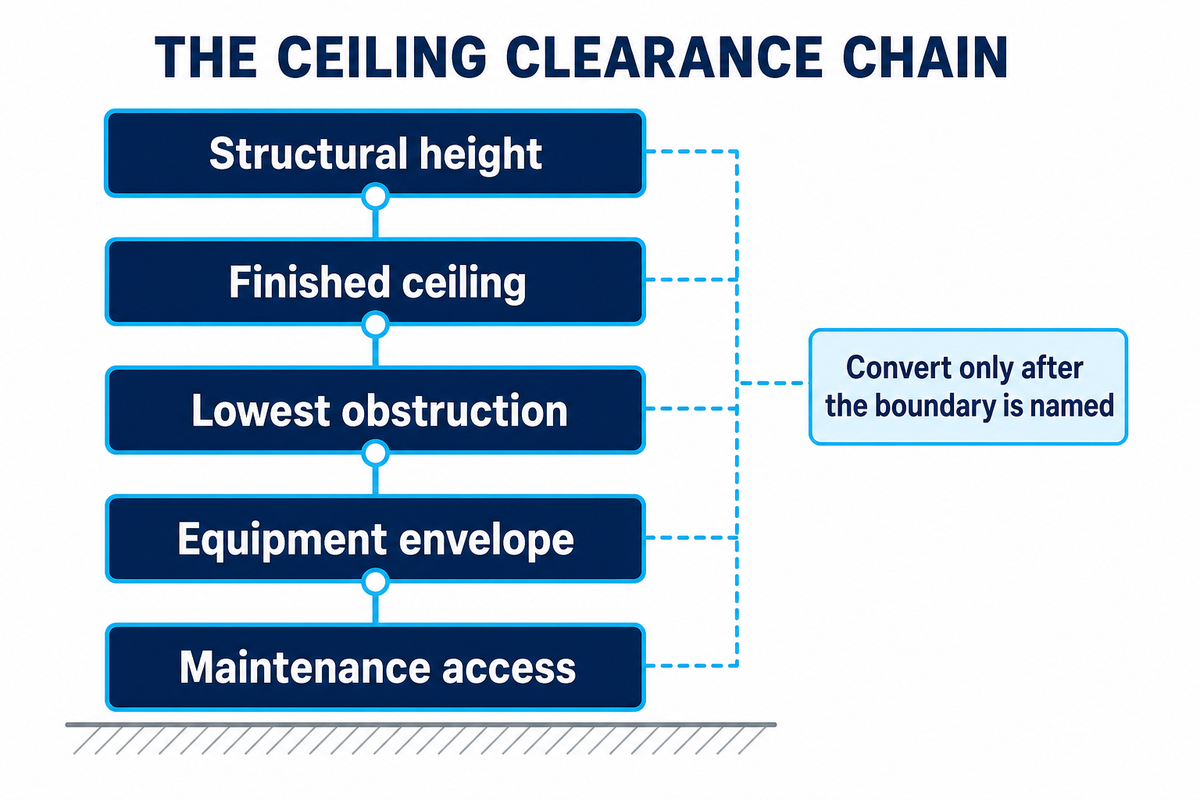
“Ceiling height” isn’t one universal boundary. Distinguish structural height, finished-ceiling height, the lowest obstruction, equipment envelope, accessible-route clearance, and maintenance access. Convert each value only after its datum and physical boundary are named.
The Ceiling Clearance Chain starts at the same floor datum and asks what the upper endpoint actually is:
| Dimension | Typical endpoint | Why conversion alone is insufficient |
|---|---|---|
| Structural height | underside of structure or roof datum | services may hang below it |
| Finished-ceiling height | visible ceiling plane | may hide obstructions or access zones |
| Lowest obstruction | duct, beam, sprinkler, light, or sign | location and authority must be confirmed |
| Equipment envelope | highest equipment limit | not the same as a route or service clearance |
| Maintenance access | space needed to inspect or service | depends on equipment and manufacturer instructions |
The U.S. Access Board play-area guide, for example, applies vertical-clearance requirements to defined accessible-route spaces rather than treating the entire venue as one height. ASTM’s F1918 scope separately addresses access and egress, equipment, areas outside equipment, and maintenance. These sources support the boundary principle; they don’t give this article permission to approve a particular project.
Send the source plan, reflected ceiling information if available, obstruction locations, equipment drawings, and the responsible team’s current requirements into the workflow for placing verified dimensions in a playground layout. A 17 ft value converted perfectly to 5.1816 m still fails if one party measured to structure and another measured to a lower duct.
Don’t borrow a generic “minimum” from a competitor page and treat it as a code rule. The usable answer depends on equipment design, site geometry, applicable standards, local requirements, fire protection, access, and the responsible professionals reviewing the project.
Feet-to-Meters Conversion Does Not Convert Square Feet
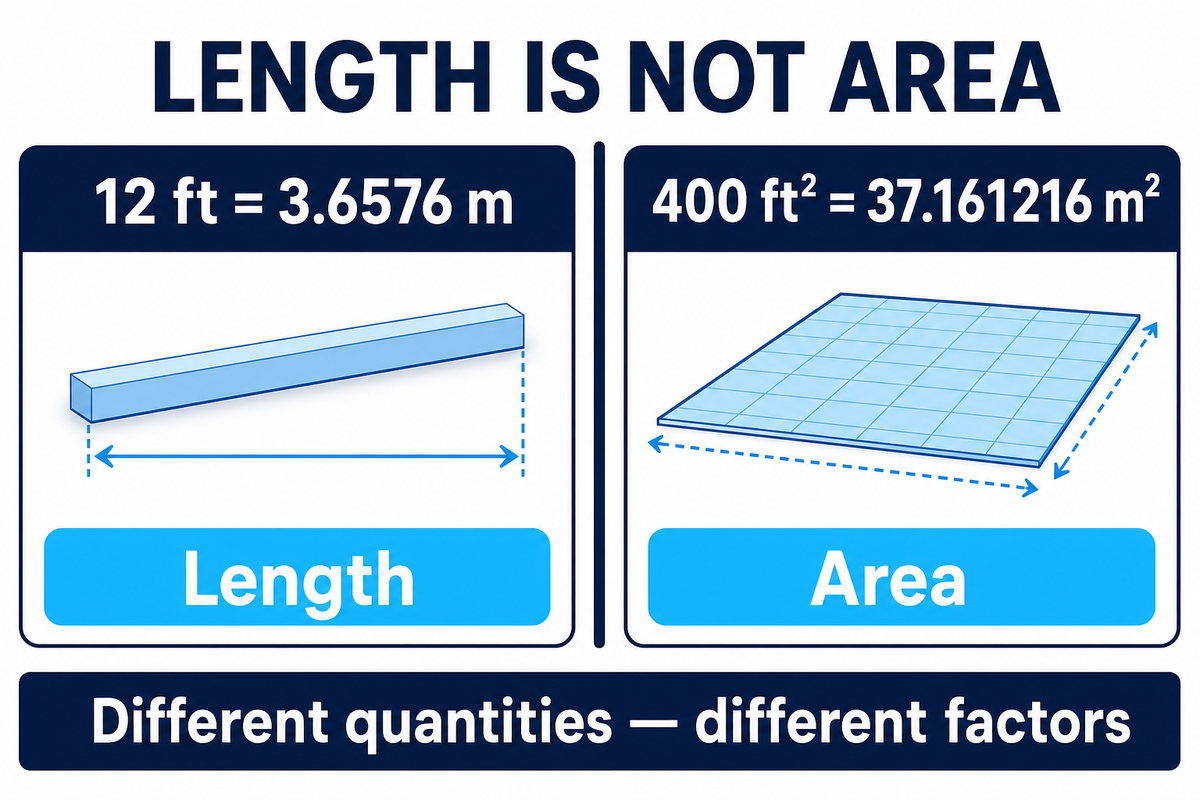
Feet and meters measure length. Square feet and square meters measure area. Never multiply square feet by 0.3048. Convert area with the squared factor 0.09290304, or use a dedicated area calculator.
Length
12 ft × 0.3048 = 3.6576 m. Units stay one-dimensional.
Area
400 ft² × 0.09290304 = 37.161216 m². The linear factor is squared.
This disambiguates the related question “square feet to meters,” mixing an area origin with a length answer. If you know a room’s length and width in feet, convert both dimensions or get the source area first. Never name a square-foot answer as meters.
With a rectangle, convert its length and width before multiplying, or convert the stated area in square meters with the area factor. This keeps a linear dimension from being mistaken for a two-dimensional quantity.
The existing square-foot-to-square-meter area converter is the site’s owner for area conversion. Keeping length and area on separate pages prevents two tools from competing for the same intent and reduces the chance of applying the wrong factor.
NIST’s revised table lists length and area as separate unit types. That’s the mathematical reason the factors differ. It’s also a practical file-control rule: every dimension column should carry its quantity and unit, not just a bare number.
Five Dimension-Handoff Mistakes to Catch Before Release

The Linear-Conversion Sanity Loop checks direction, feet-and-inches parsing, physical endpoints, factor magnitude, and a round trip back to the source. Each check is specific to a one-dimensional feet-to-meters handoff.
- Direction: multiply feet by 0.3048, but divide meters by 0.3048. Write the operator beside the source unit before calculating.
- Feet-and-inches parsing: read 17 ft 6 in as 17.5 ft, never 17.6 ft. Keep the original mixed notation beside the decimal input.
- Physical endpoints: name the lower and upper datum for a height or the two endpoints for a span. A correct number cannot repair an undefined measurement.
- Factor magnitude: a reversed conversion moves the magnitude in the wrong direction. Compare the result with a simple known value such as 10 ft = 3.048 m.
- Round trip: convert the reference value back to the source unit with unrounded working precision. It should reproduce the source value before the display is rounded.
For example, a coordinator who receives a 17 ft height in an email but a 5.20 m value in a spreadsheet should hold the handoff, identify the current source file, and resolve the controlling unit before the supplier sizes equipment against either number.
NASA’s Mars Climate Orbiter history documents the consequence of an English-unit and metric-unit handoff discrepancy. A playground quotation isn’t a spacecraft mission, and this article doesn’t convert that event into a risk rate. The narrower lesson is defensible: interfaces need explicit units, owners, and controlled revisions.
NASA’s configuration-management guidance reinforces unique identification, controlled baselines, and coordinated changes. For a project handoff, the practical equivalent is a current file name, revision, zone, controlling unit, responsible owner, and change record.
Before sending a request, pair the dimension record with equipment categories matched to the verified envelope and the source floor plan. If the intended equipment changes, recheck the height boundaries rather than copying the old converted result.
Frequently Asked Questions
Is 3 feet equal to 1 meter?
No. Three feet equals exactly 0.9144 m, while one meter is approximately 3.28084 ft. The “3 ft ≈ 1 m” shortcut is only a rough mental estimate. For a drawing, quotation, equipment envelope, or clearance check, use the exact 0.3048 factor and keep the source unit visible.
How tall is 6 feet in meters?
Six feet equals exactly 1.8288 m under the international-foot definition. A display of 1.83 m may be suitable when two decimals match the source precision. The same arithmetic answers a personal-height query, but it doesn’t establish any indoor-playground height, equipment, or clearance requirement.
What is 1 meter in feet?
One meter equals approximately 3.280839895 ft. Divide meters by 0.3048 or use the calculator’s Swap control. Keep the original meter value as the controlling source unless the responsible document owner formally adopts the converted foot value. A displayed result should not imply more precision than that source supports.
Is 200 feet 60 meters?
No. Two hundred feet equals 60.96 m, so 60 m is 0.96 m short. Keep the source value and label any rounded reference. In equipment or clearance records, resolve that difference before release because the values are not interchangeable project dimensions.
When should a converted drawing be rounded?
Keep the exact factor in the calculation, then round the displayed value to the precision justified by the source measurement and the project’s documented convention. Don’t invent a universal construction tolerance. Record the datum, tolerance, revision, and owner, and make clear whether the converted value is controlling or informational. Store the unrounded calculation in the working record, but show only justified digits on the released document. If the source changes, recompute from that source instead of from a rounded conversion.
References & Sources
- U.S. Survey Foot: Revised Unit Conversion Factors National Institute of Standards and Technology
- NIST Guide to the SI, Appendix B: Conversion Factors National Institute of Standards and Technology
- A Tale of Two Feet National Oceanic and Atmospheric Administration
- The International System of Units Brochure Bureau International des Poids et Mesures
- Guide to Play Areas U.S. Access Board
- Configuration Management NASA
SYS.00 // E-E-A-T Disclosure
Why I Write This
As the CEO and Co-Founder of a specialized manufacturing facility, my objective is to provide unvarnished, factory-direct technical insights into commercial indoor playground engineering, safety compliance, and project planning. I aim to bridge the information gap for global buyers seeking reliable structural and material data, ensuring you make informed, ROI-driven decisions without the marketing fluff.
About My Business
Guangzhou Didi Land Amusement Equipment Co., Ltd. (Brand: Didi Land) is a commercial indoor playground equipment manufacturer founded in 2014. Operating from Panyu, Guangzhou, China, we engineer, produce, and export commercial-grade play structures to over 40 countries worldwide. Our production lines strictly adhere to international safety frameworks, ensuring durability and safety for high-traffic environments.
Our Services
We provide end-to-end B2B commercial solutions: from custom 3D spatial design and OEM manufacturing to worldwide export logistics and compliance testing. Our focus is on empowering Family Entertainment Centers (FECs), shopping malls, kindergartens, and hospitality venues with reliable, high-capacity play infrastructure.
DATA_MATRIX // MANUFACTURER_PROFILE
Name:
Cherry
Role:
CEO & Co-Founder
Brand Name:
Didi Land
Company:
Guangzhou Didi Land Amusement Equipment Co., Ltd.
Location:
Guangzhou, Panyu, China
Founded:
2014
Products:
Indoor Playground Equipment, Soft Play Equipment, Themed Playground Design, FEC Play Zones, Trampoline Modules, Ninja / Obstacle Course Modules
Email:
conglizhang1@gmail.com
Phone:
+86 199 2587 9517
Website:
didiplayarea.com
COMPLIANCE & STANDARDS:
ASTM F1487 · ASTM F1918 · EN 1176 · CPSIA · CE · ISO 9001 · IPEMA
Contact Factory Direct
ASTM F1487 · ASTM F1918 · EN 1176 · CPSIA · CE · ISO 9001 · IPEMA
![Square Feet to Square Meters Calculator [Chart]](https://didiplayarea.com/wp-content/uploads/2026/08/square-feet-to-square-meters-indoor-playground-featured-768x512.png)

![Childrens Indoor Play Area Planning [Guide]](https://didiplayarea.com/wp-content/uploads/2026/08/childrens-indoor-play-area-featured-768x512.png)

Trending now