
Get in Touch with Didi Land

Convert Square Feet to Square Meters for Indoor Play Projects

![Square Feet to Square Meters Calculator [Chart]](https://didiplayarea.com/wp-content/uploads/2026/08/square-feet-to-square-meters-indoor-playground-featured.png)
Updated August 2026
Square feet to square meters is an area conversion, not a length conversion: multiply the area by exactly 0.09290304. To convert square meters back to square feet, divide by exactly 0.09290304, or multiply by approximately 10.7639104167097. Keep the source value and unit beside the converted result, and round only the displayed value—not the calculation.
Square foot to square metre converter
Convert between square foot and square metre. The unit changes; the measured quantity does not.
Result
m²
1 ft² = 0.0929 m²
Enter 0 or more — a negative value is not a valid reading for this quantity.
This entry is ambiguous. Use a comma only as the decimal mark, for example 1,5, and do not type thousands separators.
For the international foot, 1 ft² = 0.09290304 m². This factor appears in the NIST Handbook 44 units-of-area table.
How to Convert Square Feet to Square Meters
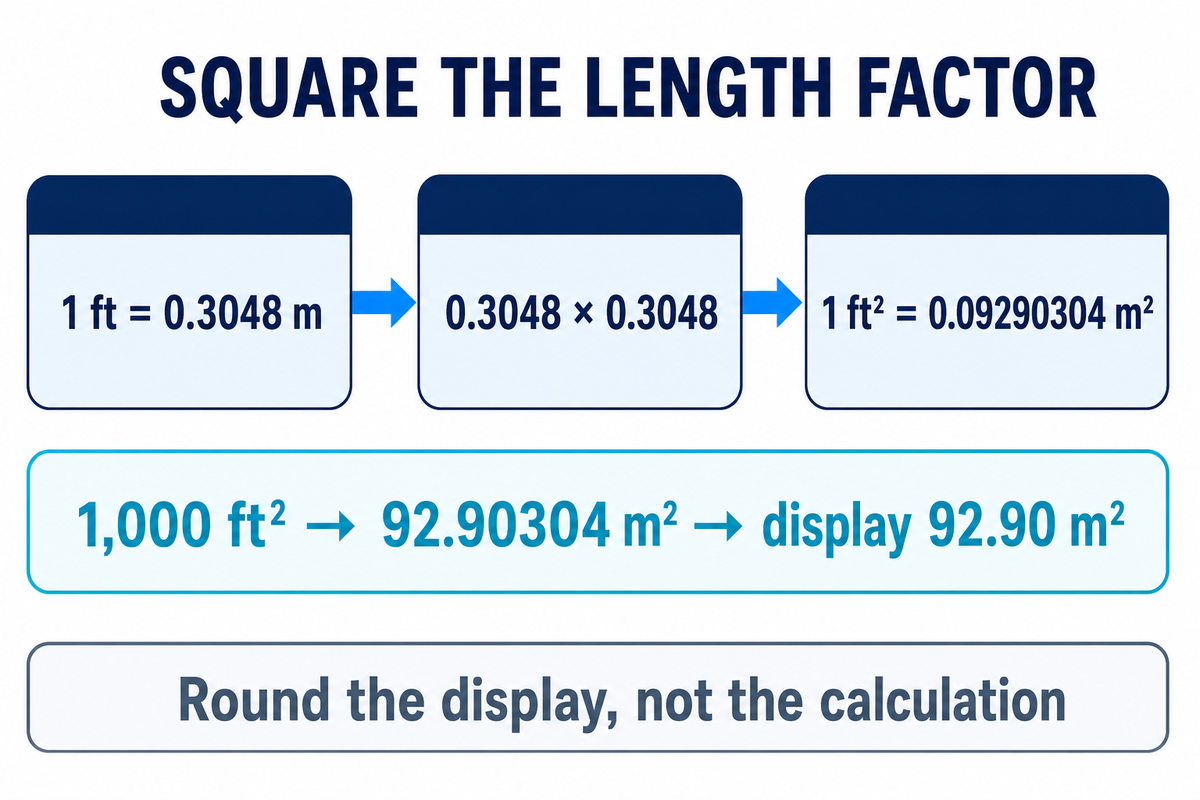
Multiply the number of square feet by 0.09290304. For example, 1,000 ft² × 0.09290304 = 92.90304 m². Keep the full factor during calculation, then choose a sensible display such as 92.90 m². The extra digits in the factor do not make an estimated floor area more accurate.
The factor comes from area, not from a memorized calculator result. NIST identifies the international foot as exactly 0.3048 metre. One square foot is the area of a square measuring one foot on each side, so its metric area is:
0.3048 mexact length of 1 international foot
0.3048²square the length factor for area
0.09290304 m²exact area of 1 square foot
This squared-unit logic is the important part. Multiplying square feet by 0.3048 would mix an area with a linear factor and produce the wrong quantity. In the same way, converting a 20 ft by 20 ft room is not “20 × 0.09290304.” First calculate the source area: 20 × 20 = 400 ft². Then convert 400 ft² to 37.161216 m².
How do you convert square feet into square meters?
- Confirm that the source number is an area in ft², not a length in ft.
- Multiply the unrounded source area by 0.09290304.
- Keep the source value and unit on the same record.
- Round only the displayed metric result to the precision the source measurement supports.
A measured room recorded as 1,000 ft² may justify “92.90 m²,” but it does not justify claiming the room was measured to 0.00001 m². Exact conversion and measurement certainty are different things.
Convert Square Meters Back to Square Feet
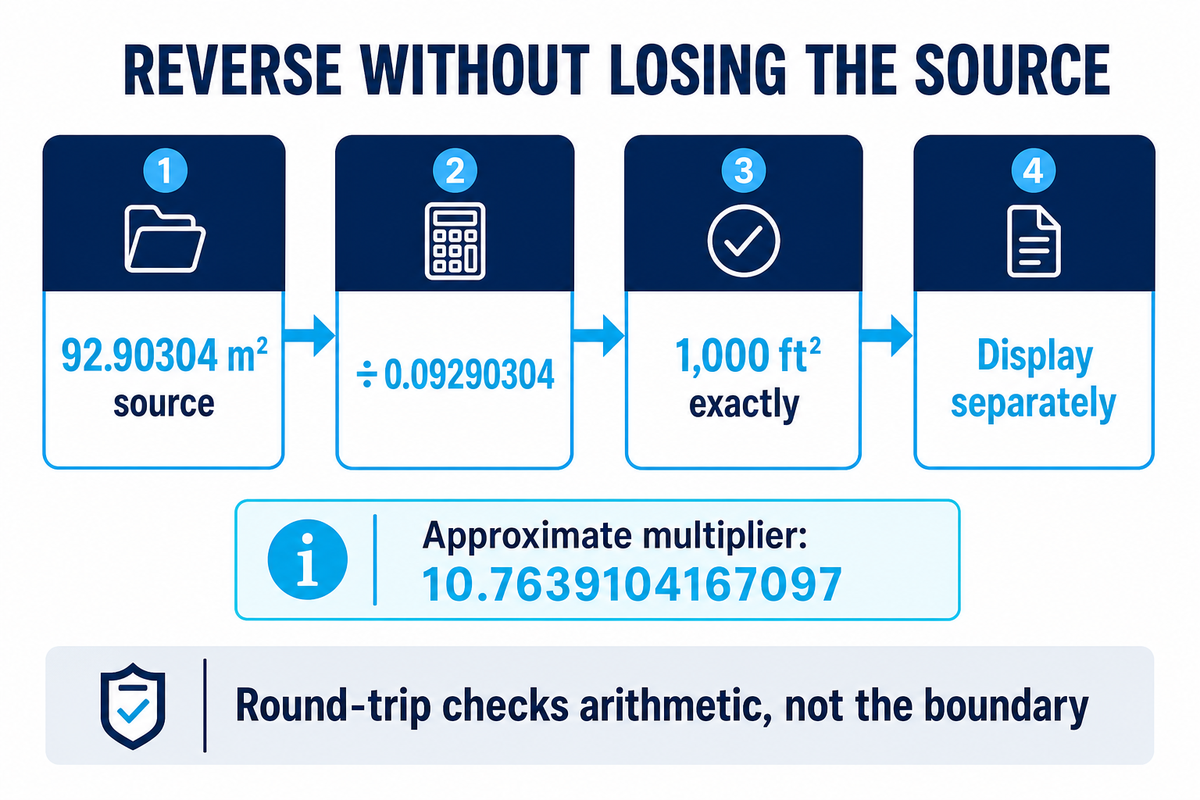
To convert square meters to square feet, divide by exactly 0.09290304, or multiply by approximately 10.7639104167097. For example, 100 m² becomes approximately 1,076.39104167097 ft², commonly displayed as 1,076.39 ft². In the calculator, use Swap to reverse the direction without overwriting the metric source value.
The displayed reverse multiplier is a rounded decimal approximation of the reciprocal of 0.09290304. Round-trip checking can catch a mistyped factor or misplaced decimal. Convert 92.90304 m² back to square feet:
92.90304 ÷ 0.09290304 = 1,000 ft² exactly.
Round-trip checking tests the arithmetic. It does not prove that the original 1,000 ft² used the right walls, exclusions, or measurement convention. That distinction matters when a United States reviewer receives a metric room schedule or when an overseas supplier receives a floor plan prepared in square feet.
How to calculate sq ft from sq m?
Divide m² by 0.09290304, or multiply by the approximate reverse factor 10.7639104167097. Keep the metric source in its own field, store the calculated square feet in a separate field, and label the chosen number of decimals. If a spreadsheet gives a different result, check whether it used 10.764, rounded the input first, or confused square metres with linear metres.
The common mistake is treating a rounded display as a new source value; because the underlying 0.09290304 ft²-to-m² factor is exact, store the unrounded calculation and treat the display as a reference.
ft², sq ft, sqft, m², sq m, and sqm Mean Area
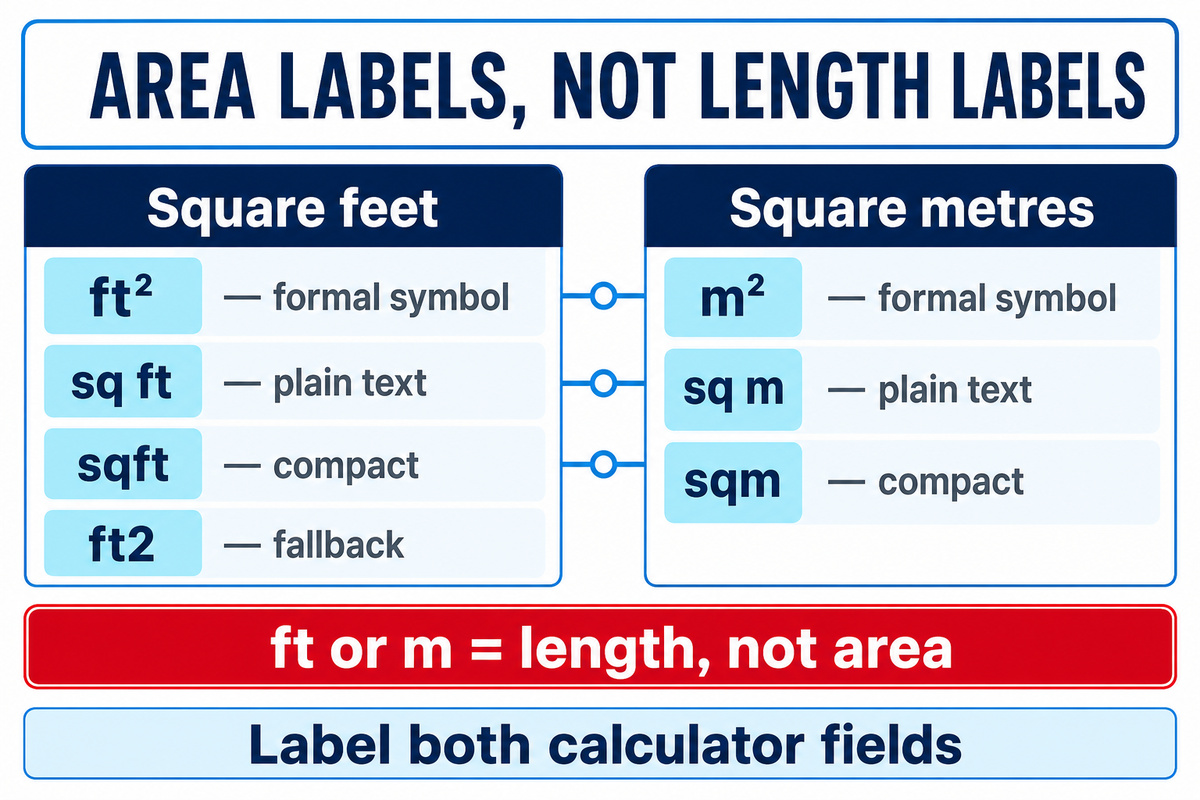
ft², sq ft, and sqft are common ways to write square feet; m², sq m, and sqm refer to square metres. Each is a unit of area. In the metric system, the square metre is the standard unit used to measure area. Bare “ft” or “m” labels indicate length and can’t replace a squared unit on a floor-area schedule.
| Label type | Notation | Meaning | Handoff note or limitation |
|---|---|---|---|
| Formal imperial-area symbol | ft² | square feet | Preferred when superscript formatting is available. |
| Spelled abbreviation | sq ft | square feet | Clear in schedules and plain text. |
| Compact abbreviation | sqft | square feet | Readable, but use one house style consistently. |
| Plain-text symbol | ft2 | square feet | Acceptable only when superscript is unavailable; define it once. |
| Formal metric-area symbol | m² | square metres | Preferred formal metric notation. |
| Spelled abbreviation | sq m | square metres | Clear in plain-text schedules. |
| Compact abbreviation | sqm | square metres | Common shorthand; define the column unit. |
| Length-only unit | ft or m | linear feet or metres | Not an area label; do not substitute it for ft² or m². |
| Dimension pair | 20 ft × 20 ft | two linear dimensions | Calculate 400 ft² before applying the area factor. |
The symbol is not decoration. “1,500 ft” could describe a route length; “1,500 ft²” describes a two-dimensional area. Quotations can travel through sales, design, procurement, production, and installation, so the quantity must remain unambiguous after the original sender is no longer in the conversation.
Ambiguous labels create a handoff risk in an RFQ: the NIST area table uses squared units because ft and m name lengths, while ft² and m² name areas.
Search boxes often accept plain-text queries such as “sqft to sqm,” “sq ft to sq m,” or “m2 to sq ft”; these shorthand forms do not change the factor. The square feet to square meters calculator should label both fields, while a generic square meters calculator may leave the conversion direction unclear.
Unit-Language Notes for Calculator Results
“1 square feet” is incorrect because feet is plural. 1 square foot is defined as the area of a square with sides of 1 foot, a unit of length equal to 0.3048 meters or 12 inches, so the area contains 144 square inches. The labels “1 square meter” and “meters squared” refer to a unit of area derived from the metre in the International System of Units. One square metre is the area of a square with sides of one metre; an area of 1 m² can have other dimensions. The square foot is a customary unit commonly used in the United States for floor area; the description “mainly used in the United States” refers to usage, not the factor, and land measurement units such as acres are separate. A conversion calculator applies one factor to each value: the square meter conversion of 1 ft² is exactly 0.09290304 m², so 0.0929 square meters is only a rounded display. To find the number of square meters for multiple rooms, add the unrounded values; preserve every fraction or fractional result until the final display.
Conversion Table and Worked Floor-Area Examples
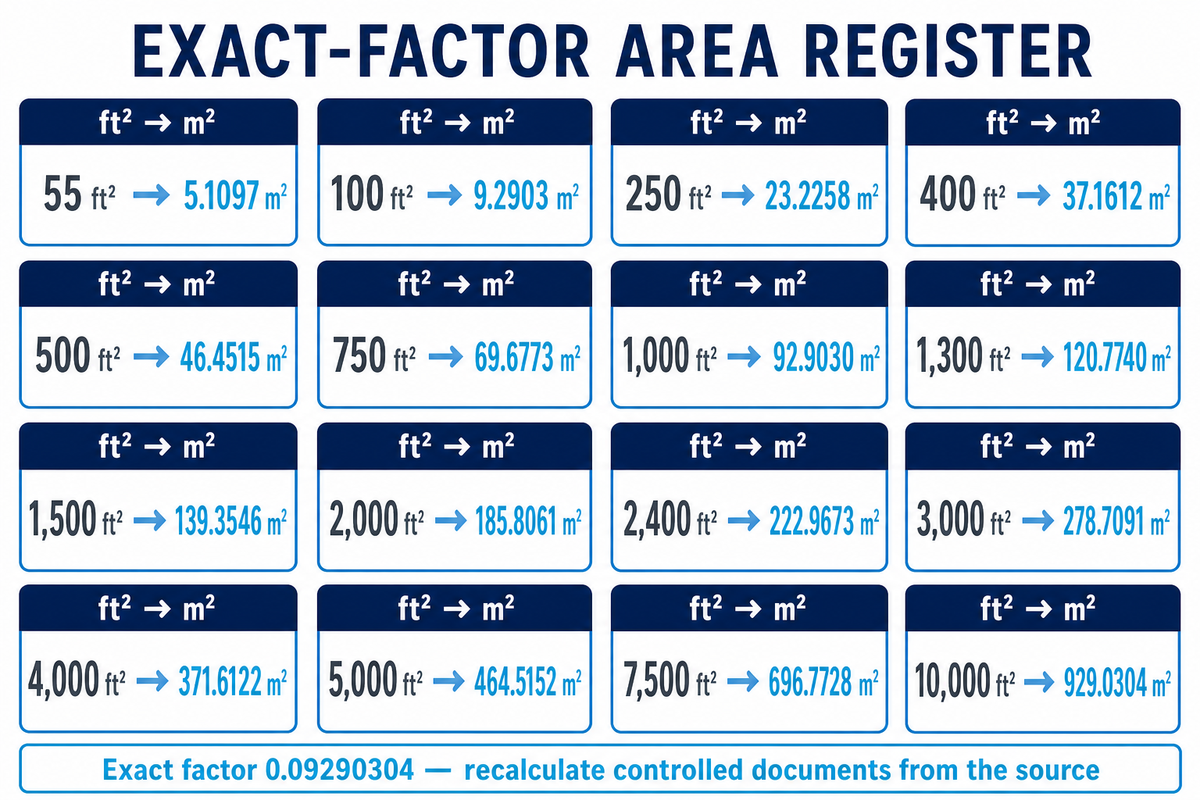
Below are tables for quick reference to some common floor areas. Every metric entry below has been calculated using 0.09290304 and displayed to four decimal places. These are a guide only, not an indication of any area’s suitability for a particular venue type, capacity, or fit-out.
The Exact-Factor Area Register
| Square feet (ft²) | Square metres (m²) | Calculation check |
|---|---|---|
| 55 | 5.1097 | 55 × 0.09290304 |
| 100 | 9.2903 | 100 × 0.09290304 |
| 250 | 23.2258 | 250 × 0.09290304 |
| 400 | 37.1612 | 20 ft × 20 ft first |
| 500 | 46.4515 | 500 × 0.09290304 |
| 750 | 69.6773 | 750 × 0.09290304 |
| 1,000 | 92.9030 | 1,000 × 0.09290304 |
| 1,300 | 120.7740 | 1,300 × 0.09290304 |
| 1,500 | 139.3546 | 1,500 × 0.09290304 |
| 2,000 | 185.8061 | 2,000 × 0.09290304 |
| 2,400 | 222.9673 | 2,400 × 0.09290304 |
| 3,000 | 278.7091 | 3,000 × 0.09290304 |
| 4,000 | 371.6122 | 4,000 × 0.09290304 |
| 5,000 | 464.5152 | 5,000 × 0.09290304 |
| 7,500 | 696.7728 | 7,500 × 0.09290304 |
| 10,000 | 929.0304 | 10,000 × 0.09290304 |
For another arithmetic check, start in metric. An area of 55 m² converts to about 592.0151 ft², while 680 m² converts to about 7,319.4591 ft². These values demonstrate the reverse factor; they are not venue-size recommendations. The areas alone do not reveal the shape, ceiling, columns, access, or equipment mix.
If several room areas must be added, retain the unrounded converted values or, better, add all source areas first and convert the total once. Adding individually rounded displays can create a small reconciliation difference between the room schedule and the total.
Reference tables reduce transcription mistakes but create a rounding risk if displayed rows are treated as source data; because the NIST factor is exact, recalculate from the original value for every controlled document.
Put the Conversion in Excel, an RFQ, or a Room Schedule
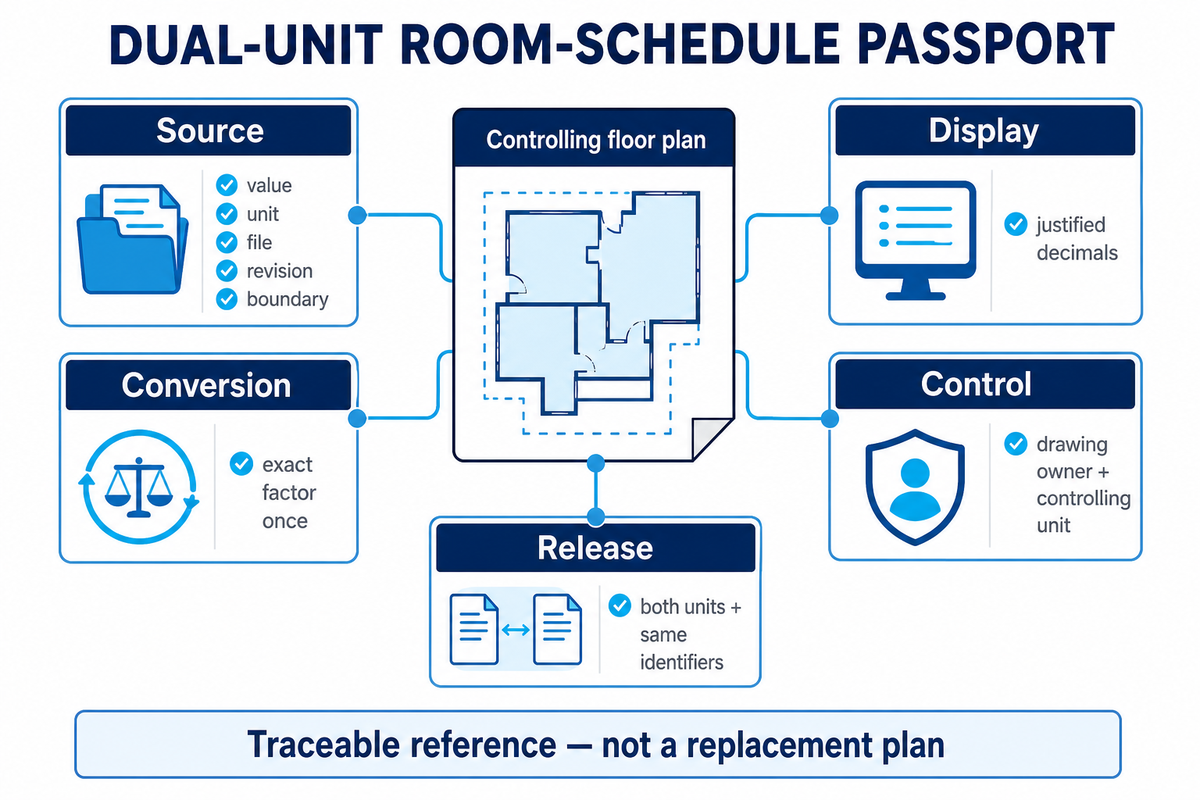
If you need to know how to convert square feet to square meters in Excel, use =A2*0.09290304 when cell A2 contains square feet. For the reverse, use =B2/0.09290304. A reliable handoff keeps source value, source unit, boundary, source precision, converted reference, display precision, revision, and owner in separate fields.
The Dual-Unit Room-Schedule Passport
This article’s Dual-Unit Room-Schedule Passport turns a calculator result into a traceable project reference without replacing the controlling floor plan.
- Record the source: original area, unit, file, revision, measurement boundary, and source precision.
- Apply the conversion: use the registered exact factor once and keep full precision through intermediate calculations.
- Set the display: choose a justified number of decimals and label the result as a converted reference.
- Name the control: identify the drawing owner and the source unit that resolves a conflict.
- Complete the release: issue both values with the same project, zone, room, and revision identifiers.
A useful room-schedule row might read: “Active play zone | Source: 2,400 ft² | Boundary: inside finished walls, exclusions listed | Source file: FP-07 Rev C | Converted reference: 222.97 m² | Display: 2 decimals | Owner: architect.” That row is far more useful than “222.97” copied into an email.
Didi Land’s floor-plan and ceiling-height intake asks for a floor-plan PDF during the concept brief. That is evidence of Didi’s published workflow, not a universal measurement standard. If a buyer sends both units, keeping the source plan and revision visible helps the supplier ask the right question instead of silently choosing one number.
For a request for quotation, include the source plan, the area boundary, both units, and a short note such as “metric value is a calculated reference; source plan in ft² controls.” If the metric schedule controls instead, reverse that sentence. The key is not which unit wins; it is that the document owner decides and records it.
Calculate the Source Area Before You Convert It
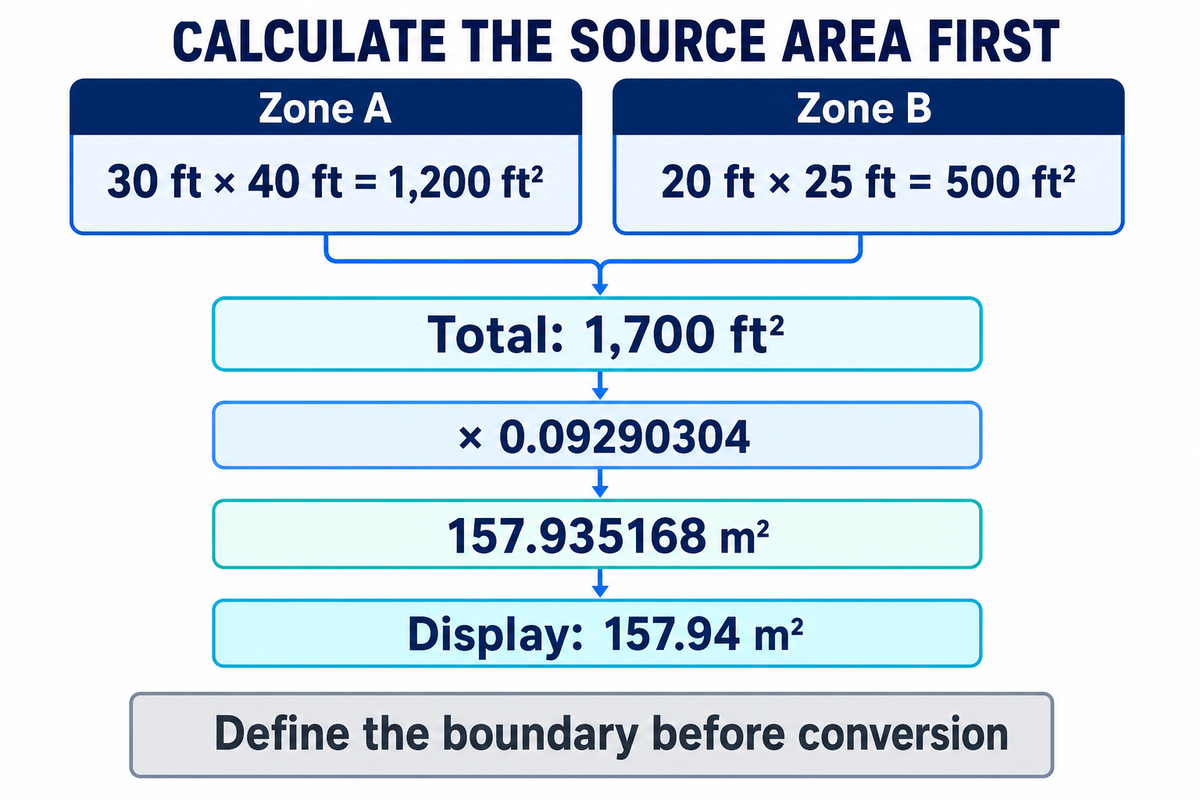
A correct conversion cannot repair a wrong source area. Calculate rectangles as length × width, add separate zones from unrounded values, and state what is included or excluded. For irregular rooms, use the approved floor plan or survey method rather than guessing from the gross building footprint.
Consider two rectangular zones: 30 ft × 40 ft and 20 ft × 25 ft. Their source areas are 1,200 ft² and 500 ft². Add them to obtain 1,700 ft², then convert once:
1,700 ft² × 0.09290304 = 157.935168 m², displayed as 157.94 m² if two decimals are justified.
The arithmetic is easy; the boundary is not. Building-area references distinguish gross, net, usable, rentable, and other concepts because they include different walls, shafts, corridors, service rooms, or accessory areas. The correct label depends on the governing standard, jurisdiction, property type, and task. Do not present one informal definition as universal.
Before conversion, write down:
- the drawing or survey that owns the source number;
- the measurement convention or a plain-language boundary;
- whether walls, columns, voids, stairs, service rooms, and shared circulation are included;
- whether the area is measured, estimated, traced, or copied from a lease document;
- the revision date and person responsible for clarification.
For venue planning, connect the area record to Didi Land’s venue-layout workflow. A 2,000 ft² rectangle, an L-shaped 2,000 ft² room, and two disconnected rooms totalling 2,000 ft² have the same area and different design possibilities.
What Area Conversion Can and Cannot Tell an Indoor Playground Buyer
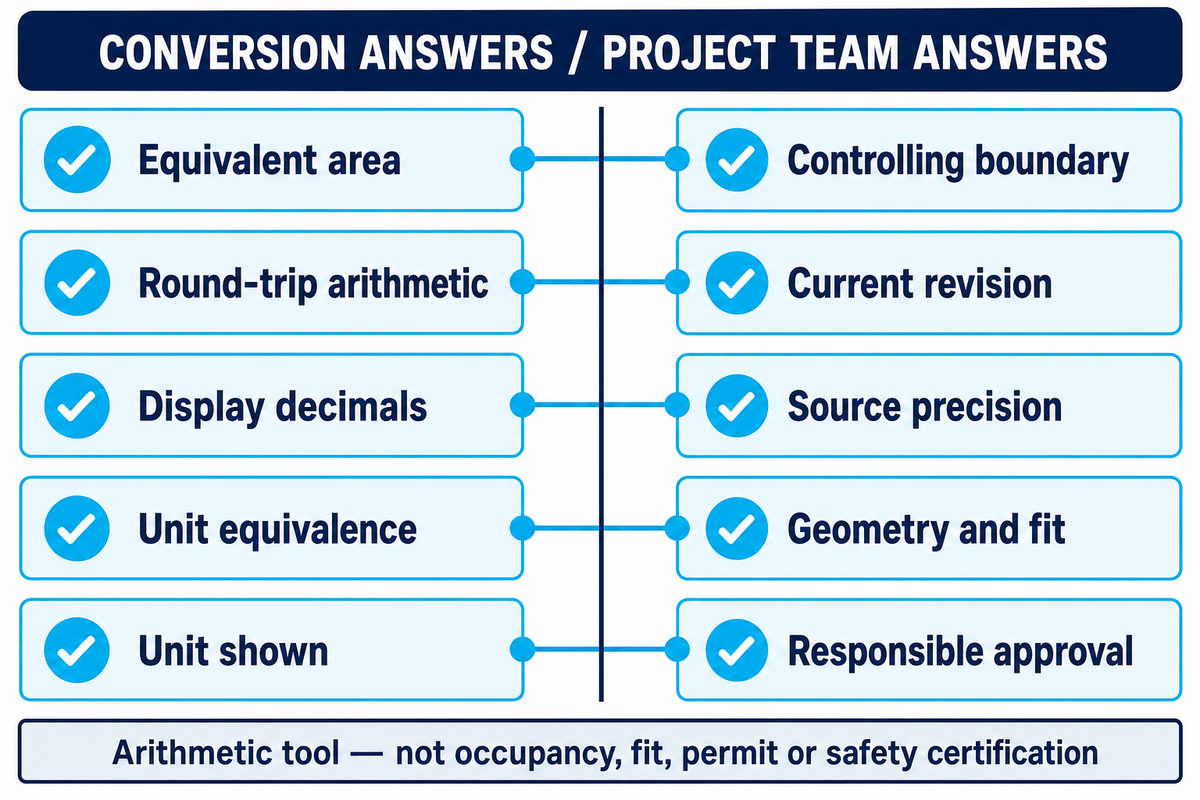
Area conversion tells you the equivalent numeric area in another unit. It does not, by itself, determine occupancy, play-zone allocation, equipment fit, accessibility, egress, structural suitability, or code compliance. Specific rules may use area as one input, so check the governing requirement separately.
| Conversion answers | Project team must answer |
|---|---|
| What is 2,400 ft² in m²? | Which 2,400 ft² boundary controls? |
| Does the reverse calculation return the source? | Is the source revision current? |
| How many decimals are displayed? | What precision does the source measurement justify? |
| Are both values mathematically equivalent? | Do shape, columns, ceiling, routes, clearances, and equipment envelope work? |
| Which unit is shown? | Which architect, engineer, authority, or drawing owner approves the decision? |
Didi Land’s public process asks for a floor-plan PDF at the concept-brief stage and lists layout and engineering drawings among later deliverables. A converted floor area can support discussion at the brief stage, while later drawings and responsible reviews address geometry and project conditions. Browse commercial indoor playground equipment only after keeping that distinction clear.
The practical boundary is simple: the calculator is an arithmetic tool. It is not an occupancy calculator, equipment-fit simulator, permit review, or safety certification. If an area threshold appears in a local rule, use the rule’s own definitions, exceptions, edition, and responsible authority—not this article—to determine its effect.
Five Mistakes That Change an Area Handoff
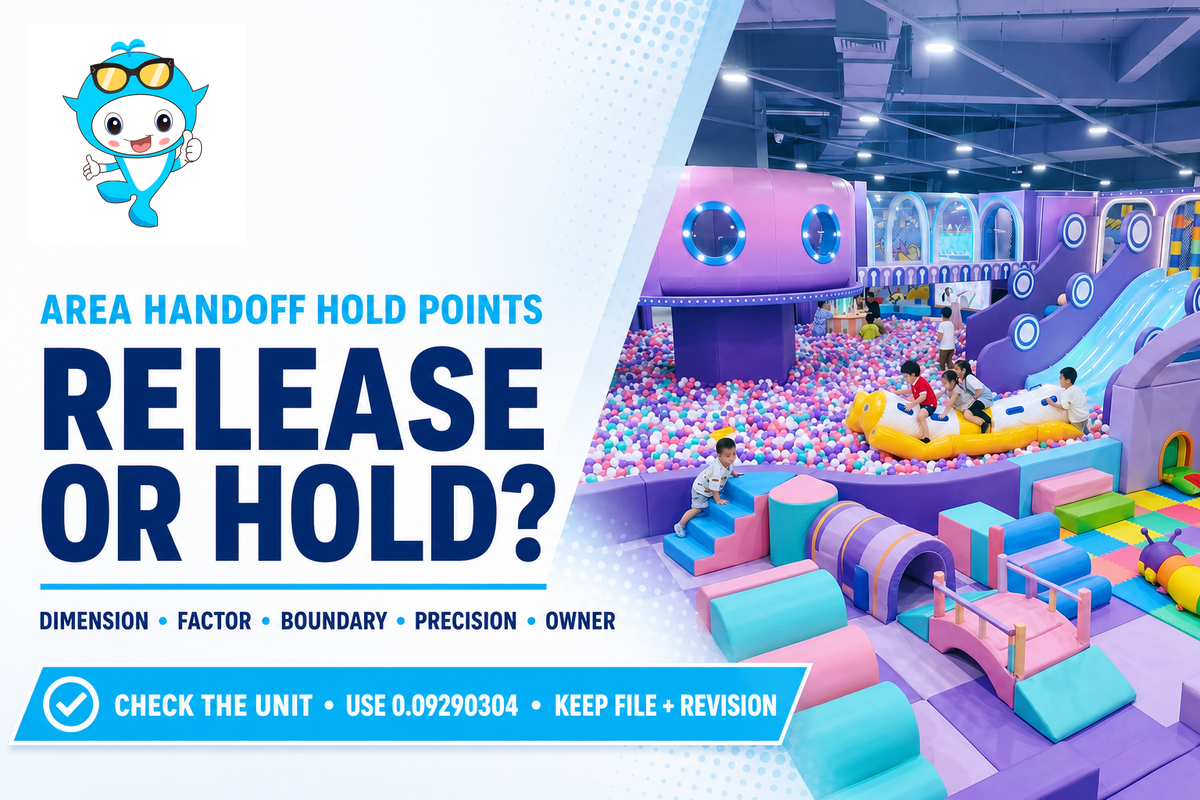
These practical area-handoff hold points are intended to catch dimension, factor, boundary, precision, and ownership errors before a converted area enters a quotation or drawing. Hold the number if any one of those five checks is unresolved.
Area Handoff Hold Points
Release
Area unit confirmed; exact factor used; source boundary named; display precision justified; source file and owner recorded.
Hold
Bare feet/metres; linear factor applied to area; unknown gross/usable basis; copied rounded result; revision or owner missing.
- Wrong dimension: multiplying ft² by 0.3048 treats area as length. Check that both source and result carry squared units.
- Rounded factor: using 0.093 may be acceptable for mental estimation and creates avoidable drift in a controlled table. Use 0.09290304 internally.
- Undefined boundary: gross, net, usable, and rentable values aren’t interchangeable. Name the boundary or controlling convention.
- False precision: a calculator can display many decimals even when the source was an estimate. Match the display to source certainty and intended use.
- Orphaned result: a converted number without file, revision, room, and owner can be copied into the wrong project context. Release both units together.
One last test is recomputation. Repeat the operation starting with one known value, change direction, and see if the round trip matches the original number. If creating a table by hand, test a small number, a large number, and a number including decimal values. Then verify the total row count and units before publication.
For a purchasing handoff, pair the area record with an equipment buyer checklist. When a dimension rather than an area needs translation, use the separate millimetre-to-inch dimension converter; do not mix the two factors.
Frequently Asked Questions
How much square feet is one square meter?
One square metre equals approximately 10.7639104167 square feet. Use the calculator’s Swap control or divide m² by exactly 0.09290304. Keep the original metric area beside the converted reference, because rounding the square-foot display does not change the source. For example, 50 m² becomes about 538.20 ft² when shown to two decimals. That reverse result can populate a dual-unit room schedule, but it does not change the original metric boundary, source precision, floor-plan revision, or the document owner responsible for approval.
What is 20×20 feet in square meters?
A 20 ft by 20 ft rectangle has an area of 400 ft². Multiply 400 by 0.09290304 to obtain 37.161216 m², commonly displayed as 37.16 m². Do not convert “20” as if it were already an area; first multiply length by width. The result states area only, not usable layout or capacity.
How do you convert square feet into square meters?
Multiply square feet by 0.09290304. Keep the full factor in the calculation, round only the displayed metric value, and retain both the source and converted units. A reliable handoff also identifies the floor-plan revision, area boundary, source precision, and owner so the result cannot be mistaken for a new measurement.
Is square feet to meters the same conversion?
No. Square feet measures area, while metres measures length. The valid area conversion is ft² to m². If you have a length in feet, convert it to metres with the linear factor 0.3048. If you have floor area, use 0.09290304.
How many square meters is 1,000 square feet?
One thousand square feet equals exactly 92.90304 square metres under the international-foot definition. A practical display is often 92.90 m², but the correct number of decimals depends on the source. Keep “1,000 ft² source” beside the result and state whether the source is gross, net, usable, measured, or estimated.
Can converted area determine indoor playground capacity?
No. Converted area is one numeric input. Capacity and functional fit may depend on the governing area definition, room geometry, age zones, equipment envelope, accessible routes, egress, columns, ceiling constraints, local requirements, and operating model. The calculator cannot select the applicable rule or confirm its conditions. Use the conversion for a dual-unit brief, then have the responsible designer, authority, and supplier review the current floor plan, code edition, intended use, equipment drawings, and project documents.
References & Sources
- Handbook 44 — 2026 Appendix C: General Tables of Units of Measurement National Institute of Standards and Technology
- U.S. Survey Foot: Revised Unit Conversion Factors National Institute of Standards and Technology
- Unit Conversion National Institute of Standards and Technology
- SI Units — Length National Institute of Standards and Technology
- Building Area Square Footage Calculations Archtoolbox
SYS.00 // E-E-A-T Disclosure
Why I Write This
As the CEO and Co-Founder of a specialized manufacturing facility, my objective is to provide unvarnished, factory-direct technical insights into commercial indoor playground engineering, safety compliance, and project planning. I aim to bridge the information gap for global buyers seeking reliable structural and material data, ensuring you make informed, ROI-driven decisions without the marketing fluff.
About My Business
Guangzhou Didi Land Amusement Equipment Co., Ltd. (Brand: Didi Land) is a commercial indoor playground equipment manufacturer founded in 2014. Operating from Panyu, Guangzhou, China, we engineer, produce, and export commercial-grade play structures to over 40 countries worldwide. Our production lines strictly adhere to international safety frameworks, ensuring durability and safety for high-traffic environments.
Our Services
We provide end-to-end B2B commercial solutions: from custom 3D spatial design and OEM manufacturing to worldwide export logistics and compliance testing. Our focus is on empowering Family Entertainment Centers (FECs), shopping malls, kindergartens, and hospitality venues with reliable, high-capacity play infrastructure.
DATA_MATRIX // MANUFACTURER_PROFILE
Name:
Cherry
Role:
CEO & Co-Founder
Brand Name:
Didi Land
Company:
Guangzhou Didi Land Amusement Equipment Co., Ltd.
Location:
Guangzhou, Panyu, China
Founded:
2014
Products:
Indoor Playground Equipment, Soft Play Equipment, Themed Playground Design, FEC Play Zones, Trampoline Modules, Ninja / Obstacle Course Modules
Email:
conglizhang1@gmail.com
Phone:
+86 199 2587 9517
Website:
didiplayarea.com
COMPLIANCE & STANDARDS:
ASTM F1487 · ASTM F1918 · EN 1176 · CPSIA · CE · ISO 9001 · IPEMA
Contact Factory Direct
ASTM F1487 · ASTM F1918 · EN 1176 · CPSIA · CE · ISO 9001 · IPEMA

![Custom Dinosaur Playground Equipment [Design Guide]](https://didiplayarea.com/wp-content/uploads/2026/09/custom-dinosaur-playground-equipment-r2-featured-1-768x512.png)


![Custom Dinosaur Playground Equipment [Design Guide]](https://didiplayarea.com/wp-content/uploads/2026/09/custom-dinosaur-playground-equipment-r2-featured-1-150x150.png)