Get in Touch with Didi Land


Updated July 2026
When importing or exporting indoor playground equipment across borders, the only number that matters is the one determining your actual profit, not the one representing the equipment’s manufacturing cost. In addition to shipping costs, insurance and customs processing, import duty on indoor playground equipment is applied to arrive at a landed cost that’s typically 10 to 100+ % above the factory price, depending on the country of origin, the HS code, and the country to which you’re importing. HS Code 9506.99 is the tariff classification that covers almost all commercial indoor playground and soft play equipment. Here, we decode that code, compare how tariffs apply across five markets, and hand you a formula so you can estimate the landed cost yourself.
Quick Specs
| US HTS Subheading | 9506.99.6080 |
| Base MFN Duty Rate | 4% ad valorem (per CBP ruling N320207) |
| China-Origin Section 301 Add-On | Base List 4A rate: 7.5% (via Chapter 99 subheading 9903.88.15) — check current status before every PO |
| Section 232 Steel/Aluminum Exposure | Not yet designated for playground/amusement equipment as of late 2025 — status is actively under review |
| Markets Compared | United States, European Union, Canada, Mexico, Australia |
| Latest Policy Event | Executive Order 14389 (Feb 20, 2026) ended certain IEEPA-based reciprocal tariffs — Section 301/232 unaffected |
What HS Code Covers Indoor Playground Equipment? (9506.99 Explained)
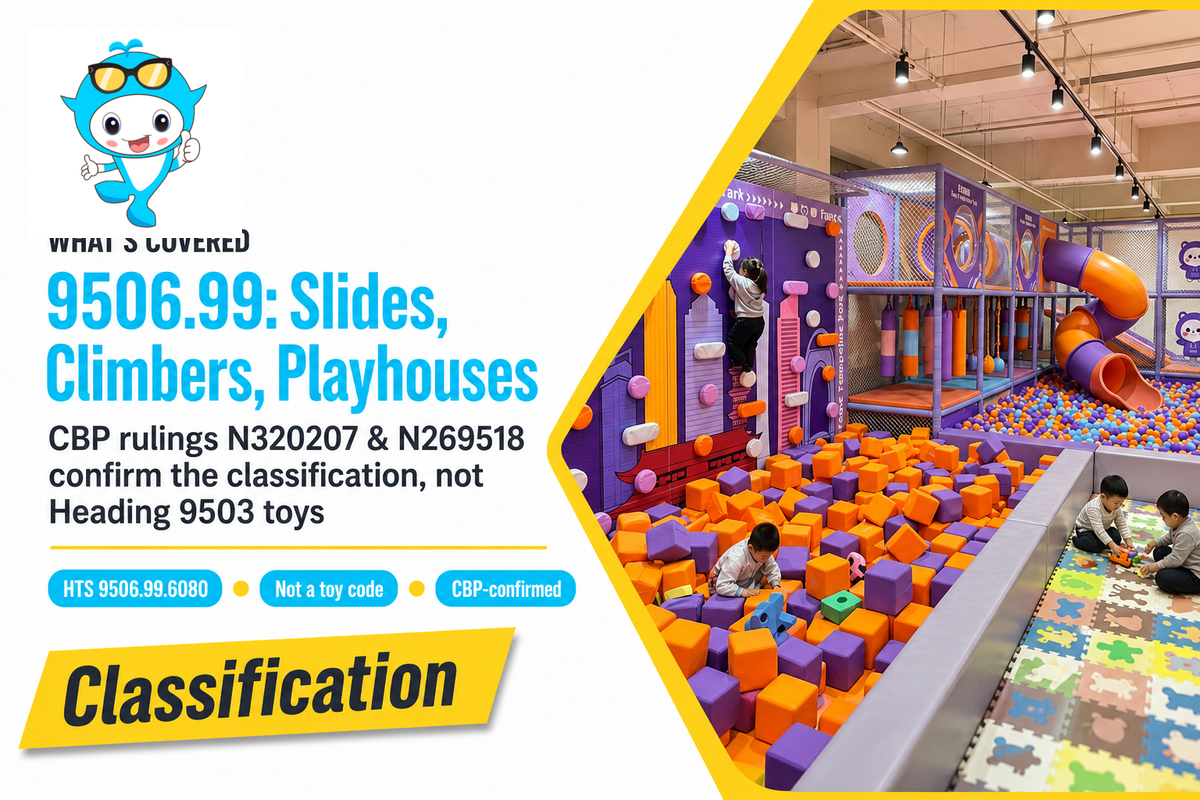
Under the Harmonized Tariff Schedule (HTS), commercial indoor playground equipment — the type found in kids’ gyms, daycare centers, and family entertainment centers — is classifiable in Heading 9506, almost always Subheading 9506.99 in the United States, breaking down further to 9506.99.6080 at the 10-digit level. This classification is a firm conclusion derived from binding rulings issued by U.S. Customs and Border Protection.
Getting this wrong is not a paperwork risk you can shrug off: an application-level classification mistake structurally exposes you to back-duty demands up to 1 year after the container has already cleared, because the reason CBP audits retroactively is that duty is owed at the legally correct rate regardless of what was declared at entry. Didi Land has navigated this exact process across 40+ export countries.
For example, U.S. Customs and Border Protection (CBP) issued ruling N320207 in July 2021, classifying two different children’s playhouses (one featuring a slide and another not) in Subheading 9506.99.6080 after an importer had requested a tariff classification ruling. In support of its classification decision, CBP cited the Harmonized System’s Explanatory Note 95.06(B)(12), which states that this heading includes equipment of the kind used in children’s playgrounds (slides, see-saws, giant strides and swings). Critically, CBP expressly rejected classification in heading 9503, as toys of heading 9503, on the grounds that similar items of play equipment are distinguished by their extensive construction: the subject play equipment was found to be principally used in playgrounds, not designed solely for use as a toy. Another ruling, N269518, reached a similar conclusion specifically on play equipment, citing the applicable subheading and the current Harmonized Tariff Schedule.
In practice, as long as your play structure has been built to support multiple children participating in repeated, physically vigorous play (and isn’t a decorative novelty), the proper classification will almost certainly be 9506.99, whether your equipment is made primarily of wood, plastic, metal, or some other combination of materials. What’s most important for classification is the product’s design and intended use, not the raw materials it contains. That explains why Heading 9506’s full text — “articles and equipment for general physical exercise, gymnastics, athletics, other sports… or outdoor games” — is used for other recreational equipment besides indoor play structures, such as trampoline parks, and also for outdoor playground equipment: the CBP rulings referenced above dealt with classifying a playhouse “designed for the outdoor use of children.”
📐 Engineering Note
While the HS classification is international at the 6-digit level (950699), country-specific classifications begin at the 8- and 10-digit level. A quick search reveal that the EU’s TARIC system also uses code 9506999000 for the same “articles and equipment for general physical exercise…not elsewhere specified” catch-all, while India’s GST/HSN uses an 8-digit variation (95069990). Don’t assume that your U.S. HTS suffix is sufficient to populate your declaration with another country’s customs.
What is the HS Code 9506390000?
You might also encounter this adjacent code (9506.39) in supplier documentation or freight forwarder quotes, but it’s a distinct classification: other golf equipment, not playground apparatus. If your supplier lists a 9506.39 code for playground equipment, it’s likely an erroneous copy-paste classification rather than a valid alternative.
Section 301 China Tariffs: Current Rates and the 2026 Policy Reset
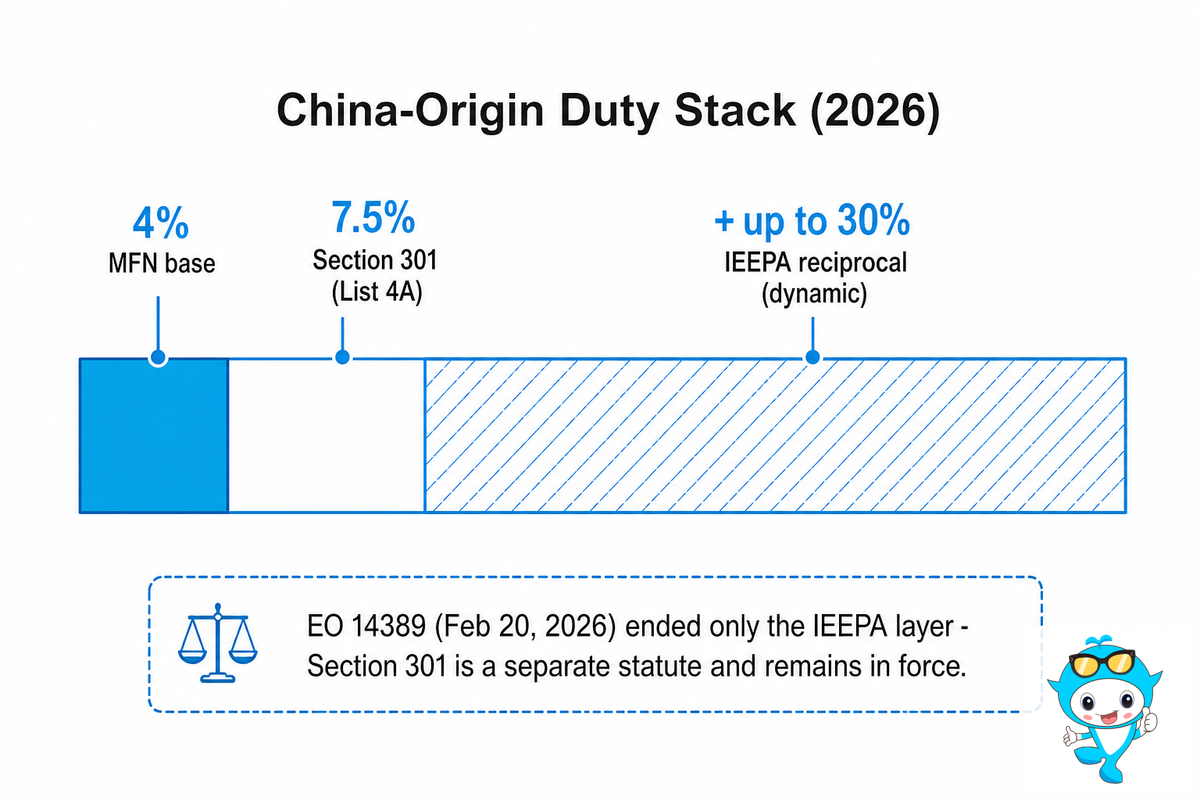
If you’re sourcing your indoor playground equipment from China – and you’re very likely doing so, given the massive proportion of the global indoor playground supplier base located there – the U.S. Trade Act of 1974, Section 301, adds a second layer of duties on top of the 4% MFN base rate. CBP Ruling N320207 plainly states how this works: “Articles of China under classification 9506.99.6080 are subject to an additional 7.5 percent ad valorem rate of duty. These additional duties are reported under subheading 9903.88.15 of Chapter 99 of the Harmonized Tariff Schedule of the United States (HTSUS) and were first applied as the original ‘List 4A’ rate, effective September 24, 2018 and reduced to 7.5 percent on February 14, 2020.”
Here’s the point where most competitor guides and calculators go terribly wrong. Section 301 duties are NOT the only or even the largest duty layer on Chinese goods currently. There’s a completely separate legal mechanism: the IEEPA reciprocal tariff, which has been imposed under the International Emergency Economic Powers Act and adds an additional rate to goods of China substantially greater than, and much more volatile than, the Section 301 tariffs. By October 2025, that IEEPA-based tariff rate on China totaled 30%, according to IAAPA’s tariff tracker, and it stacks on top of the Section 301 duties.
“IEEPA tariffs on China currently total 30 percent, but can be much higher depending on whether the specific product category is subject to ‘Section 301’ tariffs.”
IAAPA, Global Trade and Tariff Updates (Oct 29, 2025)
On February 20, 2026, Executive Order 14389, “Ending Certain Tariff Actions,” mandated the termination of the collection of certain additional ad valorem duties previously imposed under IEEPA. This is true and important – but the takeaway could be misunderstood. The EO specifically targets certain reciprocal-tariff actions imposed under IEEPA; it doesn’t affect the Section 301 (which is an entirely separate statute) or the Section 232 tariffs (discussed next). Any manufacturer who takes this announcement at face value and assumes the 4% MFN + 7.5% List 4A duty rates no longer apply is in for an ugly customs bill.
⚠️ Important
Small business forum thread, what can happen if you don’t check: one importer noted how the combined rate on their China-origin indoor playground had become 145%, or over double the actual price they paid for the equipment-because they’d quoted their customer based on an older rate they recalled from months earlier. It isn’t the tariff that’s high, it’s relying on memory over double-checking the current rate that’s the danger.
What are the current import duty rates?
There’s no single fixed number — that’s the point of this section. As of this writing, China 9506.99.6080 goods carry a 4% base MFN rate, a 7.5% Section 301 List 4A duty, and a dynamic IEEPA component (30% as of late 2025). Check the current combined rate on USITC’s HTS search page or CBP’s IEEPA FAQ before every PO.
Steel-Frame Equipment and Section 232: The Tariff Layer Most Guides Miss
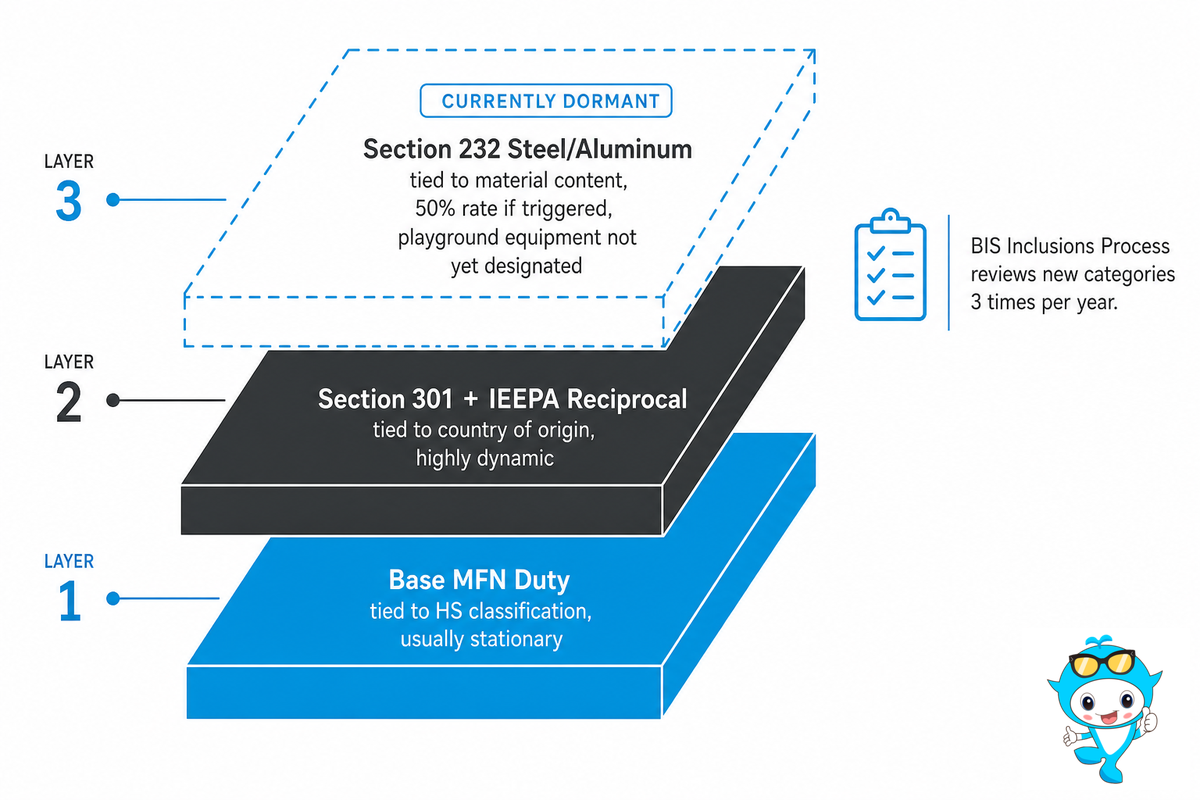
Commercial indoor playground structures, are overwhelmingly built on steel tubing. Soft play, climbing structures etc all rely on steel to deliver required strength to meet commercial-duty cycles.
This gives rise to a question almost all the “how to import” articles skip: what about a separate tariff for the steel used in your structure under section 232 of the Trade Expansion Act of 1962, on top of everything else?
Here at Didi Land, our 12,000 square meter Guangzhou plant produces our own steel tubing for its cutting and bending processes, with robotic welding systems forming our play and climbing structures’ steel frameworks. That capability at the factory level offer a perspective that few trading-company re-sellers possess: we analyze the HS classification down to the component level (not just finished-goods classification) because we’ve intimate knowledge of how much of a given structure is steel.
Section 232 tariffs on steel and aluminum (currently 50%, raised from an original 25% in mid-2025) apply not only to the base materials but a list of derivative products incorporating steel and aluminum. The Bureau of Industry and Security (BIS), a division of the U.S. Department of Commerce, runs a formal Inclusions Process for new product designations and exclusions; three times per year it opens comment periods during which any interested party can request a new category be added or removed.
Here’s the key insight for buyers: playground and amusement equipment haven’t been designated as a section 232 derivative product to date, although according to recent industry trade-association assessments, the situation is “fluid,” given the inclusion process is still active, and anyone could submit an inclusion petition at the next cycle.
This is the exact type of additional variable that can arise with as little as a few months of warning, catching a buyer off-guard if they didn’t price out their landed costs prior to the inclusion date.
50%
Current Section 232 steel/aluminum rate (mid-2025 proclamation)
3x/yr
BIS Inclusions Process filing windows that could add new derivative categories
Steel content is also part of a different supplier-vetting question that’s important before you even get to the customs stage: does the playground manufacturer you’re using own its steel fabrication shop or do they sub out tube cutting and welding? A given SKU’s steel content percentage is more readily confirmed if the playground factory has internal quality control over both fire-retardant foam sourcing and the welding of steel tubes, rather than if the factory itself is a trading company and doesn’t. That affects both your Section 232 questions and the accuracy of your HS classification, and it’s true whether you’re sourcing a standard indoor soft playground kit, an indoor jungle gym, a themed indoor playground design, or trampoline park equipment that an equipment trampoline park operator orders in bulk. Any trampoline park contractor sourcing from China faces the same issues covered here. It’s worth raising with any indoor playground factory before purchase, and certainly before playground installation begins. There are plenty of trading-company resellers in this equipment industry, and a direct relationship with the factory itself is worth verifying.
Presenting The 3-Layer Tariff Stack. Let’s break down the landed cost exposure for China-origin steel-framed playground equipment as three entirely independent layers that move and shift on their own: (1) the base MFN duty (tied to the HS classification and usually stationary), (2) the Section 301 origin-based and IEEPA reciprocal layer (tied to country-of-origin trade policy and extremely dynamic), and (3) the Section 232 material-based layer (tied to what it’s made of, currently dormant for this category, but easily resurrected). Treating all three as a single rate is by far the biggest oversimplification in this calculation.
Import Tariff Rates by Country: US, EU, Canada, Mexico, Australia Compared
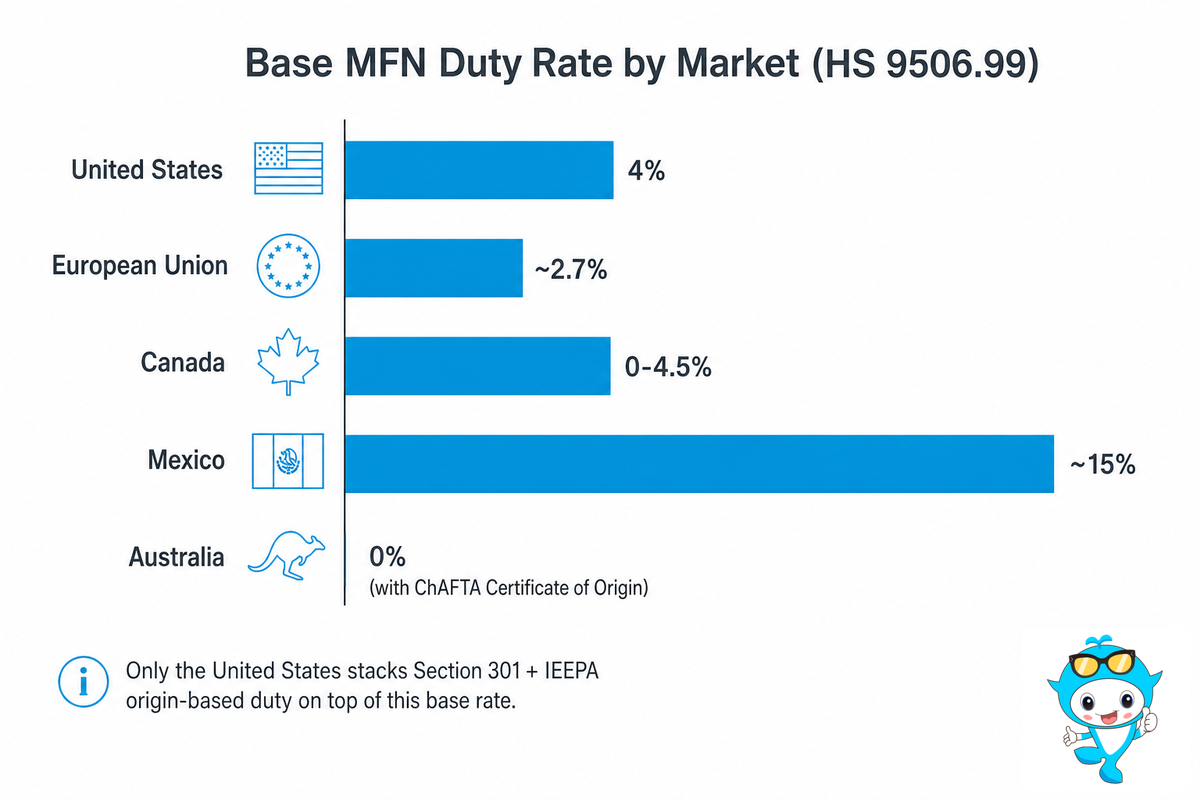
As we’ve said above, the precise landed effective rate of China goods varies by a few points every couple of months (see Outlook below), the comparison that matter more over the long haul and in more durable comparison points is the framework mechanism of each country, not an exact single point percentage that will likely be inaccurate by the time you’re reading this. The table below shows the basic structure of how each country will levy a duty on HS 9506.99-class product sourced from China as of the middle of the calendar year 2026, please check with your customs broker for up to the minute exact numbers, or verify the US base rate directly at USITC’s HTS search before you rely on the table below.
| Market | Base MFN Duty | China-Origin Add-On | Import VAT/GST |
|---|---|---|---|
| United States | 4% (9506.99.6080) | Section 301 (7.5% List 4A base) + variable IEEPA reciprocal layer | No federal VAT; state sales tax varies |
| European Union | ~2.7% (TARIC 9506999000, verify per member state) | Subject to any EU-specific trade-remedy actions in force at time of entry | National import VAT (e.g., Germany 19%, Spain 21%) |
| Canada | 0-4.5% range depending on tariff treatment | Check current CBSA surtax status for Chinese-origin goods | GST/HST per province |
| Mexico | ~15% general rate | USMCA-qualifying North American origin can exempt IEEPA-style surtaxes (see Sourcing Alternatives section) | IVA ~16% |
| Australia | 0% for goods with a valid ChAFTA Certificate of Origin | n/a under ChAFTA preferential treatment | GST 10% |
The risk of ignoring these country-level differences in practice is a hidden budget gap: a US buyer and an EU buyer sourcing the identical container from the same factory Didi Land ships from can end up with landed costs 10%+ apart, simply because the origin-based duty stack applies to one and not the other across these five countries. There are two key items that are noteworthy here. One is that Australia’s 0% duty under ChAFTA only applies if you can prove your Chinese supplier actually possesses an Australian-China Certificate of Origin for that particular order, and if not you’ll be subject to Australia’s standard non-preferential MFN duty rate for the classification of your product (regardless of Chinese origin). Second, the United States is the only market in our table that stacks its origin-based duty (Section 301 and IEEPA reciprocal) on top of the base MFN rate. That’s why U.S. landed costs for Chinese-origin goods swing the most wildly of the five markets compared here.
How to Calculate True Landed Cost (Formula + Worked Example)
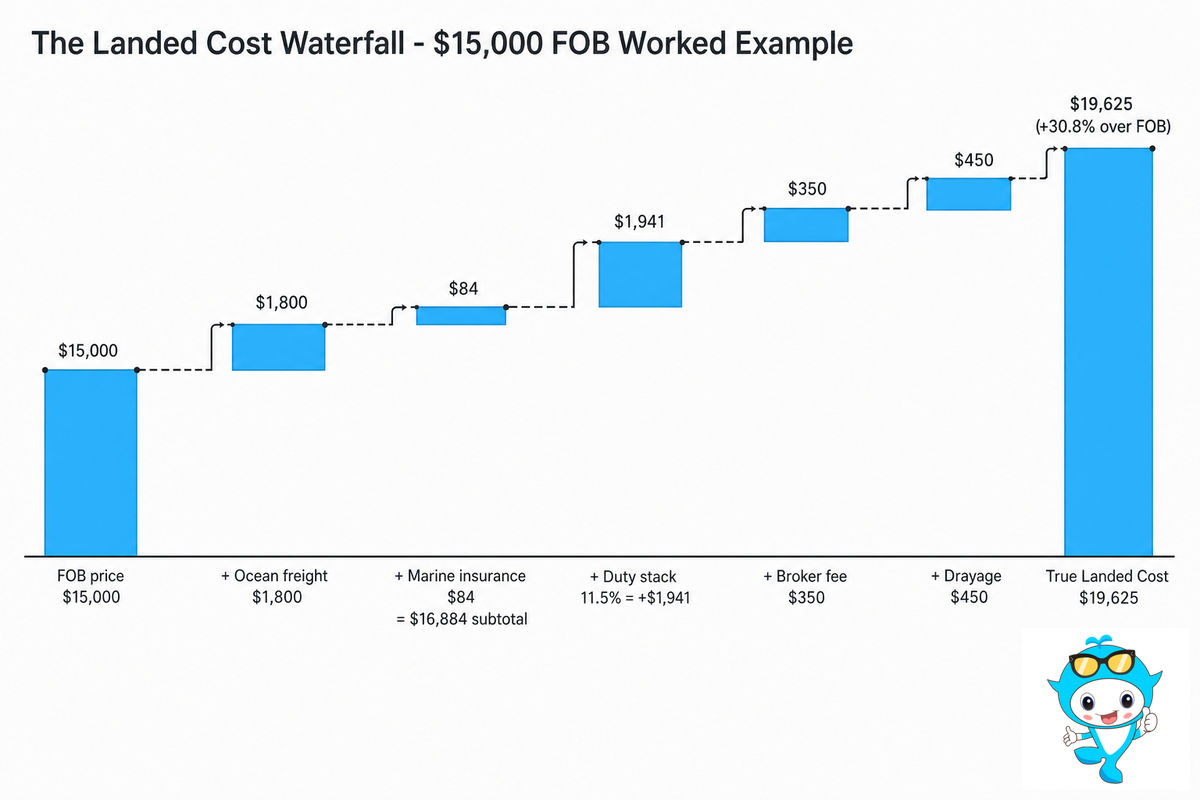
“Landed Cost” – the number that will make it into your profit and loss, not the “FOB” quote that your supplier sent you over, Landed Cost is the full cost of the equipment from the factory floor, through customs, all the way into your facility, ready for installation.
Presenting The Landed Cost Waterfall. It takes six individual steps.
- 1. First, we take the FOB (Free on Board) or EXW price – which is simply the equipment’s price ex-factory before it even leaves China.
- 2. Add international ocean freight (per container, not per piece – your shipping costs divided among the pieces in your order).
- 3. Add marine cargo insurance.
- 4. Multiply that subtotal by (1 + your duty stack %); these are the base MFN duty rate + any Section 301 duties (if applicable) + any Section 232 duties (if applicable) + any Section 301 reciprocal duties based on IEEPA.
- 5. Add customs clearance / broker fees.
- 6. Add the destination handling / drayage to your facility.
Worked example: Let’s assume we’re buying a playground soft-play set out of China for an FOB Ningbo $15,000 price and we want to ship a full container to the U.S.:
| Line Item | Amount |
|---|---|
| FOB price | $15,000 |
| Ocean freight (container share) | +$1,800 |
| Marine insurance (~0.5%) | +$84 |
| Subtotal before duty | $16,884 |
| Duty stack applied: 4% base + 7.5% Section 301 (illustrative — verify current IEEPA add-on separately) | +$1,941 (11.5%) |
| Customs clearance / broker fee | +$350 |
| Destination drayage/handling | +$450 |
| True landed cost | $19,625 (+30.8% over FOB) |
You can see the example 11.5% duty is only covering the base MFN + the Section 301 List 4A – it doesn’t include the reciprocal IEEPA portion which, at its height under Section 301, ran as high as 30%+ – check out the discussion on that in Section 301 above. Run this worksheet with your supplier’s current FOB quote and the HTS rate that you get from USITC’s HTS search page – don’t use these illustrative numbers!
💡 Pro Tip
I always ask my suppliers for pricing on an FOB basis even if I ultimately want them to provide a delivered duty paid (DDP) price. An FOB price makes clear all the individual elements of the landed cost – a bundled DDP price simply embeds the duty stack in the price, making it tough to double check against the correct duty at the time you next place an order.
Customs Clearance in Practice: Courier Fees, Brokers, and When You Need One
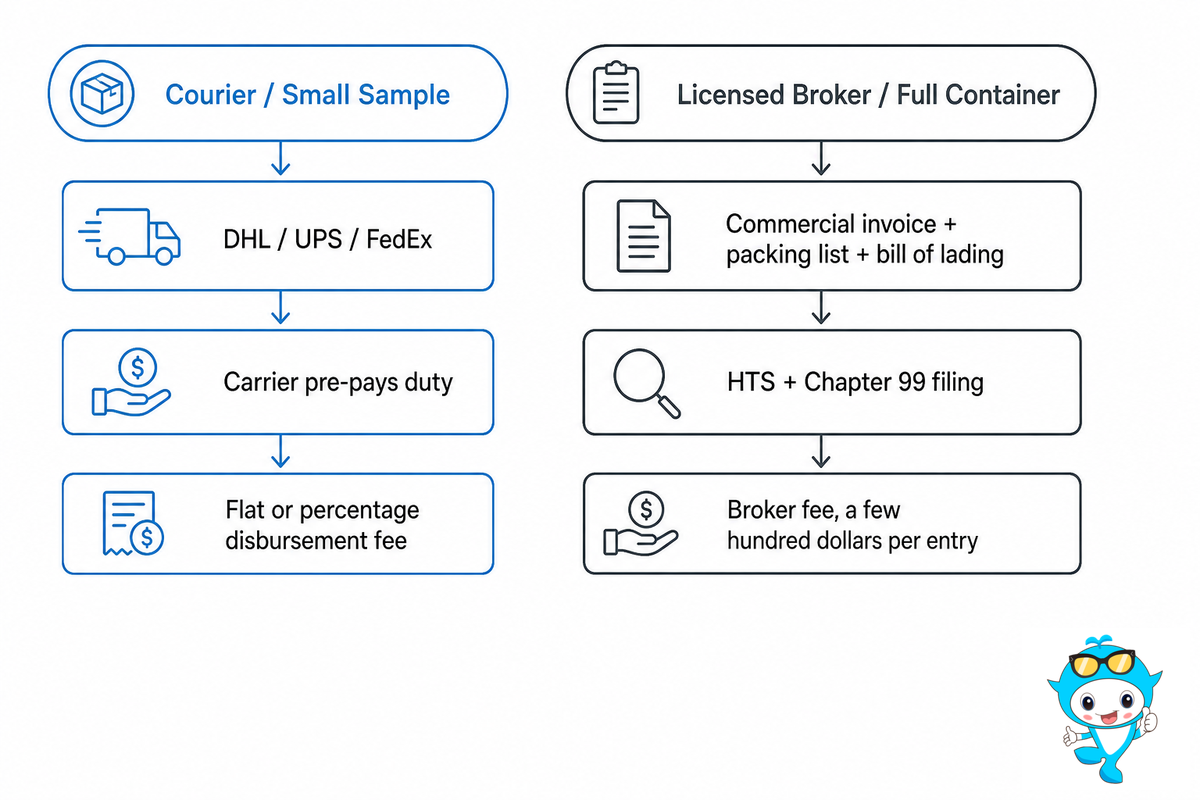
If you’re wondering how to calculate USA import duty and customs duty clearance costs together, start here: a licensed customs broker is all but mandatory for full container shipments – for example, you need one of these either in China or in the US. The documentation (commercial invoice, packing list, bill of lading, certificate of origin, proper HTS/Chapter 99 designation per CBP’s own filing guidance) required to clear the container is extensive, and an error can mean delays and daily storage charges. For sample or smaller shipments that are coming in by air via DHL, UPS, FedEx etc., the carrier typically serves as a local customs broker by default and pre-pays the duty and then adds a fee, often a flat or percentage-based amount, to the shipment – the other elements are standard import and export procedures that aren’t playground specific, but given that sea freight transit times can run 25-40 days from one port to the other, any new customs regulations change will impact shipments that are already en-route, one more argument for placing an order only after checking the current rate, not the one from your last purchase.
Do I need a customs broker to import playground equipment?
For a full container of commercial goods, almost certainly yes: a broker’s fee (a few hundred dollars per entry) is small next to the cost of a bad HTS code or forgotten Chapter 99 designation, which can trigger a hold, audit, or duty bill later. For a single-item air courier shipment, the carrier’s default clearance is usually enough — just confirm upfront whether their “disbursement fee” is flat or duty-percentage based, since that matters a lot on high-duty goods.
✔ Courier / Small Sample
- Faster, simpler paperwork
- Carrier advances duty + charges disbursement fee
- Good for 1-2 sample units, prototypes
⚠ Licensed Broker / Full Container
- Handles multi-page HTS/Chapter 99 declarations
- Manages bonded-facility and demurrage risk
- Required in practice for commercial-volume orders
Sourcing Alternatives: Can USMCA or Other Routes Reduce Your Tariff Exposure?
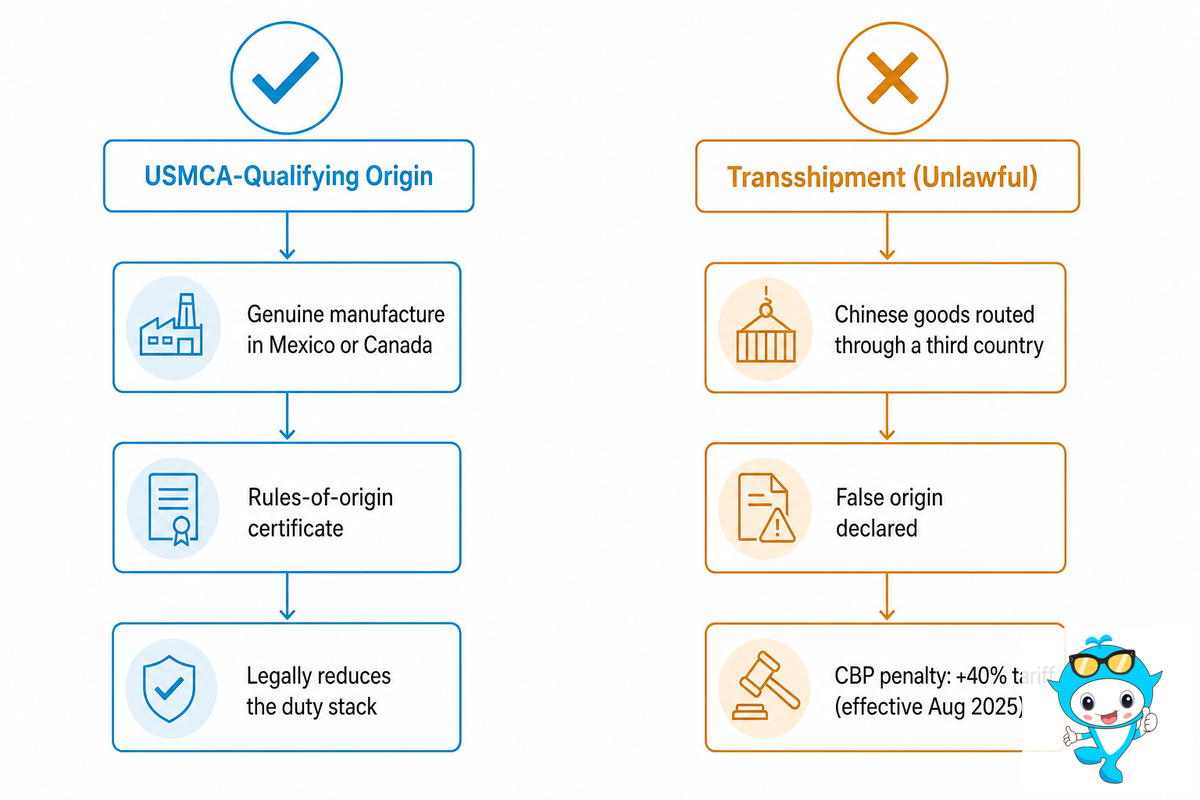
Sourcing from — or routing through — a different country can legitimately reduce this duty stack, but only in one specific way, and there’s an illegal shortcut that looks similar on paper and is not the same thing at all.
One legitimate option is equipment genuinely manufactured in Mexico or Canada and certified compliant with USMCA rules of origin — a USMCA country of origin certificate confirming substantial transformation happened there, not just final packaging. That’s a usable path if you’ve, or can build, manufacturing capacity in North America.
An unlawful alternative also exists-routing Chinese goods through another country and falsely declaring a different origin, or claiming the goods were “substantially transformed” when they weren’t. This is known as transshipment, and U.S. Customs and Border Protection has become increasingly aggressive in targeting it specifically. The agency’s updated rules-set to take effect in August 2025-allow CBP to add a 40% penalty tariff on goods determined to have been transshipped to avoid paying duties-in addition to the underlying duty itself.
This doesn’t get detected every time, but “not every time” carries a far different risk than “avoided correctly.” Per CBP’s own trade remedies guidance, misrepresenting a product’s country of origin to circumvent tariffs is treated as a customs violation, not an ambiguous gray area.
Classification Risk: What Happens If Your HS Code Is Wrong
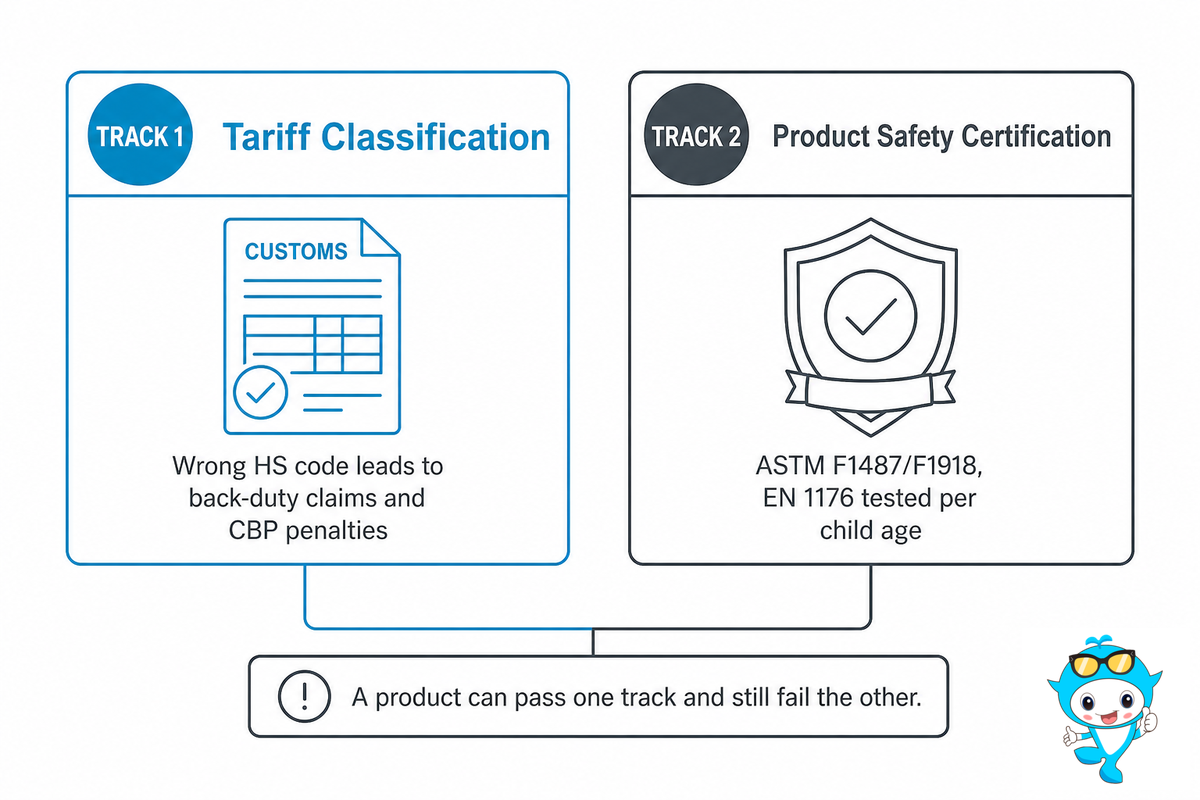
This isn’t some paper exercise, it’s the No.1 cause of unexpected cost. Wrong-code declarations routinely cause delays at customs, back-duty claims, or, in serious cases, a CBP penalty, because what counts as a “wrong” code (even to CBP, per CBP rulings) very quickly isn’t a matter of interpretation once the physical structure and function is measured up to the Explanatory Notes.
Keep in mind this is a separate stream from product safety standard compliance and playground safety compliance (ASTM F1487/F1918, EN 1176 – all of which detail tests per child age and how a product is used), so a product shipped in the right category can still be held at port if the safety paperwork is missing, and a safety-certified product could still result in import duty back-duties if it wasn’t put in the right category for tariffs. It’s worth checking both, no matter if you’re importing one climbing structure for indoor use or bulk soft-play equipment and indoor play areas products that a trampoline park may be importing, safety standards typically specify test methods by children ages, which is a separate compliance track from import duties classification.
Fortunately, there’s a way to avoid this blind guessing act. The same binding ruling mechanism that produced N320207 and N269518 is also available directly. Any importer can submit a request with a description and photographs of their product, and an appointed National Import Specialist will issue a binding ruling you can then cite on all subsequent entries of the identical product. It only costs you your time to put the request together and your risk is eliminated.
2026 Outlook: Why Playground Equipment Tariff Policy Keeps Shifting
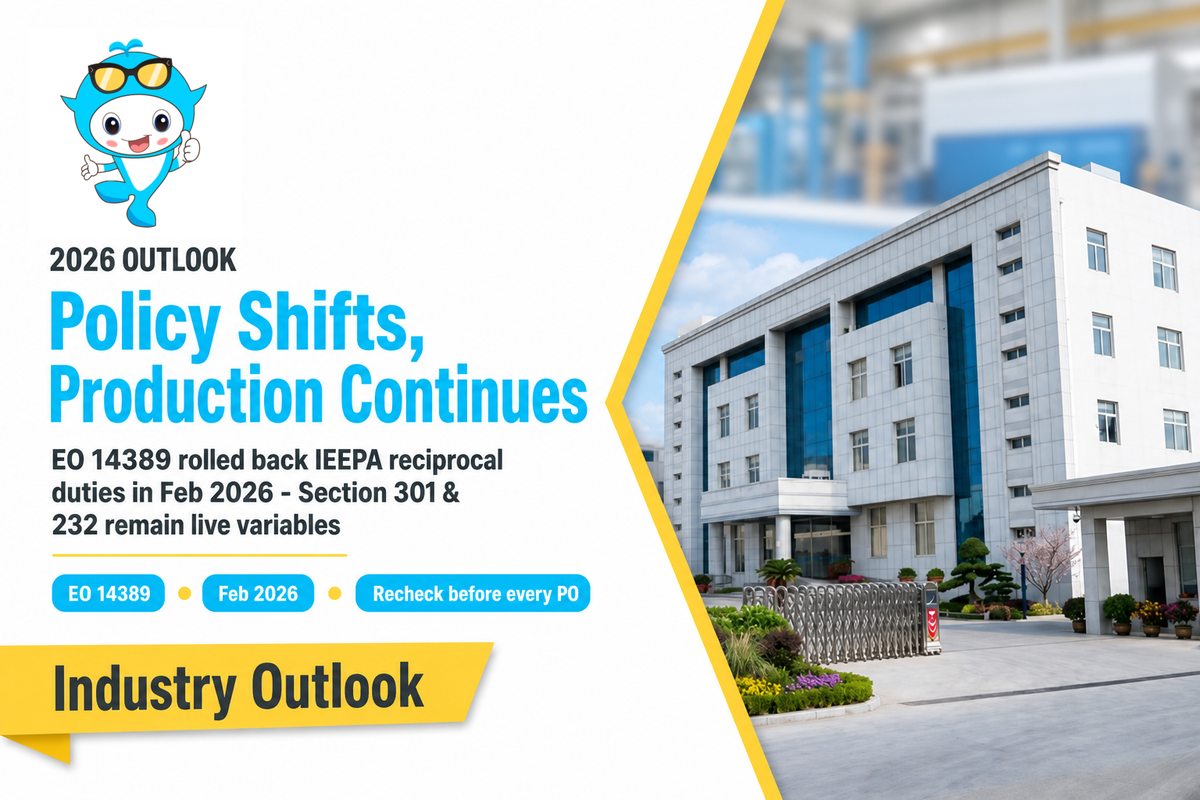
Over the last approximately 18 months, the actual China-origin duty on this equipment category has bounced around from close to 4% on the lower end, up to triple digits combined at points, and back down following February 2026’s Executive Order 14389 partial roll-back. Searches on this niche’s specific terms follow this arc, with search volumes on terms like “section 301 tariffs” having peaked at about 2.75x in February 2026, when EO 14389 was signed, before flattening at still-elevated levels, and searches on more generic “tariff rates by country” falling consistently as more importers start tracking specific policy names (301, 232, IEEPA) instead of country tables.
In practice, this is the gap that catches importers off guard: an application submitted the week before a policy shift can face a materially different bill than one submitted the week after, purely because of timing, not because anything about the shipment itself changed. In other words, this is an event-driven rather than a slow-trend/seasonal policy environment. Landed-cost estimations have shelf lives on the order of weeks, not fiscal years. It’s not those who mess up the calculation who get caught out; it’s those who fail to redo the calculation before placing every purchase order. Bookmark the USITC HTS search page and USTR’s Section 301 tariff-actions page, and check both before placing your next order.
Frequently Asked Questions
Q: What are the current import duty rates for indoor playground equipment?
View Answer
There’s no fixed answer — that’s the point of this guide. US-bound, China-origin equipment under HTS 9506.99.6080 carries a 4% base MFN rate plus a 7.5% Section 301 List 4A duty, plus a variable and more volatile IEEPA reciprocal duty that has ranged widely over the past 18 months. Always re-verify the current combined rate at the USITC HTS Search before issuing a purchase order — don’t rely on a supplier quote from a prior shipment.
Q: Do I need a customs broker to import playground equipment?
View Answer
For a full container of commercial goods, yes — the HTS and Chapter 99 documentation gets involved enough that a licensed customs broker’s fee pays for itself in most cases. For a single sample via air courier, the carrier’s own clearance service is usually sufficient, though confirm whether their disbursement fee is flat or duty-percentage-based first.
Q: FOB or CIF, which shipping term should I request from my supplier?
View Answer
FOB (Free On Board) gives you control of the ocean freight and insurance costs after your goods pass through Chinese export customs, so you’re intimately familiar with each item on your landed cost sheet. CIF (Cost, Insurance, Freight) includes freight and insurance within the price of the product and while convenient for novice importers, makes it harder to ensure you’re getting a reasonable rate. More experienced importers typically shift to FOB once they develop relationships with reliable freight forwarders.
Q: What documents are needed to import indoor playground equipment?
View Answer
Commercial invoice, packing list, bill of lading, and, for preferential tariff treatment, a certificate of origin, are the minimum required. You’ll need to provide your customs broker or freight forwarder with the correct HTS classification and, if the goods originate from China, the associated Chapter 99 subheading declared with the main HTS classification code.
Q: Does routing through a different country actually avoid the tariff?
View Answer
Only if genuine manufacturing happens there. Simple re-routing is transshipment, and CBP can add a 40% penalty tariff on top of the original duty if it’s caught.
Q: Is HS Code 9506.99 the same in every country?
View Answer
Only the first six digits of the HTS code are harmonized across the world under the WCO classification. Any digits beyond the sixth are country-specific, and will be unique for different countries. The United States uses 9506.99.6080, for example, and Europe’s TARIC system uses 9506999000, although many countries will have their own 8-digit classifications. Don’t rely on just the 6-digit HTS stem code!
References & Sources
- CBP Ruling N320207 — U.S. Customs and Border Protection
- CBP Ruling N269518 — U.S. Customs and Border Protection
- Harmonized Tariff Schedule Search — U.S. International Trade Commission
- IEEPA FAQ — U.S. Customs and Border Protection
- Executive Order 14389, Ending Certain Tariff Actions — The White House
- Ending Certain Tariff Actions — Federal Register
- Section 301 List 4A Rate History — Federal Register
- Section 232 Steel and Aluminum Tariff Inclusions Process — Federal Register
- Global Trade and Tariff Updates — IAAPA (International Association of Amusement Parks and Attractions)
- New Reciprocal Tariff Rates and Transshipment Enforcement — Snell & Wilmer
Why We Write This
Since 2014, Didi Land has shipped commercial indoor and soft play playground equipment — steel pipes, structural components, and all — to over 40 countries, quoting FOB, CIF, and DDP trade terms almost daily. This guide reflects the HTS classification, landed-cost, and sourcing questions our export team fields most from mall developers, FEC owners, and distributors sourcing from China for the first time — getting these numbers right is often the line between profitability and loss on a new venue.
Would you prefer a lower-risk, first step? Ask our team to review your current HS code or request our landed cost calculator spreadsheet — think of it as a simple HTS code lookup plus a worksheet for the formula above.
Didi Land designs and manufactures commercial indoor play and soft play playground equipment for shopping malls, family entertainment centers, and several other commercial indoor playground equipment applications across shopping malls, FECs, and hospitality venues. Our team has shipped products to over 40 countries since 2014.
![Custom Dinosaur Playground Equipment [Design Guide]](https://didiplayarea.com/wp-content/uploads/2026/09/custom-dinosaur-playground-equipment-r2-featured-1-768x512.png)
![Custom Dinosaur Playground Equipment [Design Guide]](https://didiplayarea.com/wp-content/uploads/2026/09/custom-dinosaur-playground-equipment-r2-featured-1-150x150.png)