Get in Touch with Didi Land


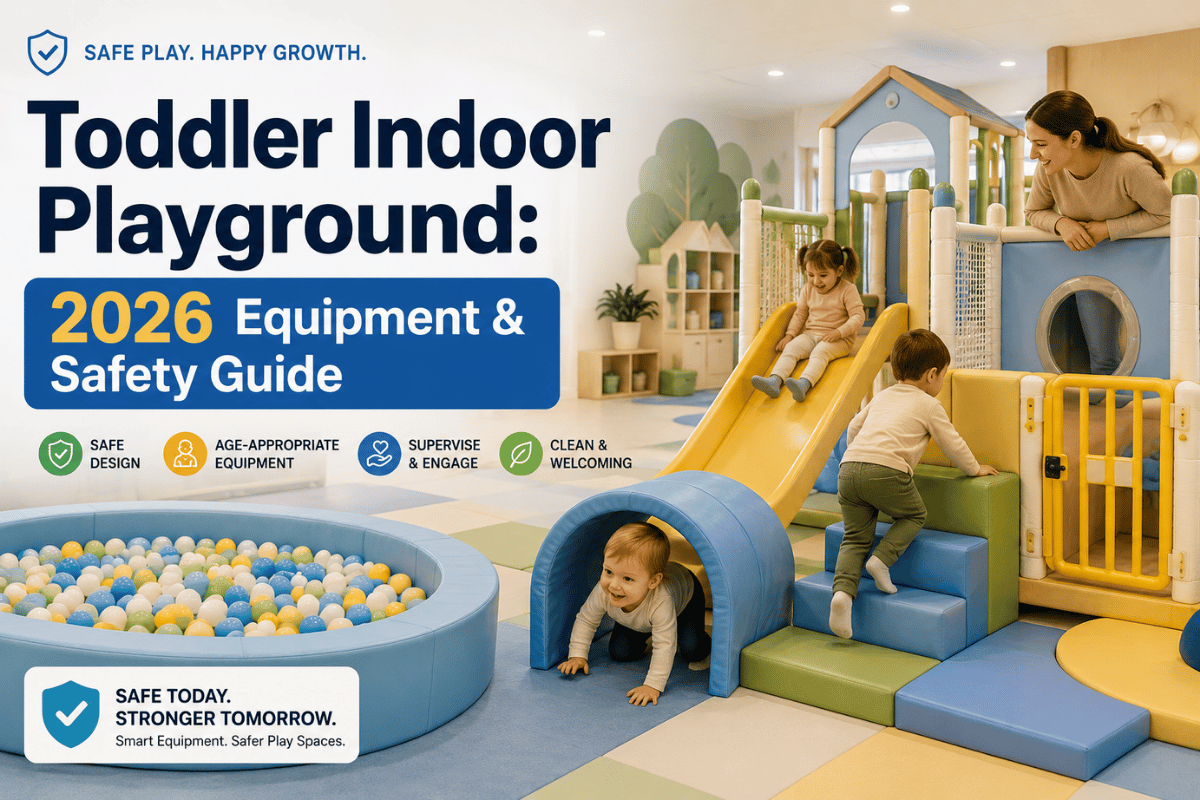
If you are a venue operator launching a toddler focused indoor playspace, then the decisions you make on opening day determine whether your business will last through the 18 month mark. This primer addresses the regulatory baseline, the equipment specs, the four profit-generating revenue streams, and the 2026 design trends operators are testing now with toddler zones.
Quick Specs: Toddler Indoor Playground Baseline
| Age band covered | 6 months to 3 years (CPSC toddler subcategory) |
| Minimum profitable toddler-only zone | 600 sqft (industry baseline per IAAPA FEC operators) |
| Max platform height (24-³6 months) | 36 in (per ASTM F1487 use-zone rule) |
| Ball pit depth ceiling | 40 in (CPSC fall-protection guidance for under-3) |
| General liability insurance floor | $1M coverage, $1,500-3,000 annual premium typical |
| Mandatory compliance stack | ASTM F1487 + F1918 + EN 1176 (EU) + IPEMA + CPSIA + ADA Title III |
What Counts as a “Toddler” Indoor Playground? Age Bands, Safety Mandates, and Business Boundaries
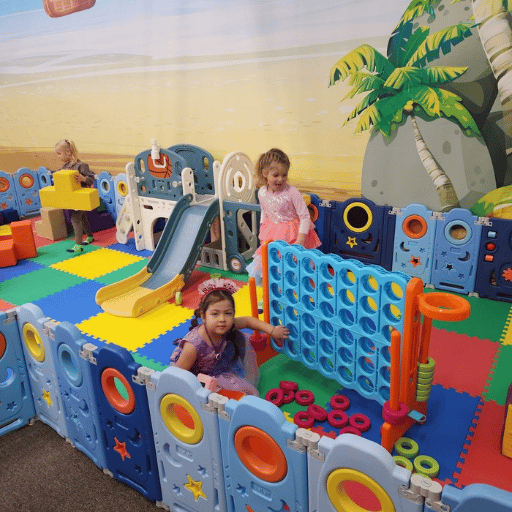
A toddler indoor playground is a commercial play area built just for kids between around 6 months to 3 years, where every dimension of every device, surfacing spec, and supervision sight line is designed for the motor capacity and fall-death risk profile of that age group. It is not a scaled-down 5-12 yr zone. The CPSC Public Playground Safety Handbook (2025 revision) recognizes toddler equipment as its own class of design, at reduced fall heights, narrower handhold spacing, and stricter use-zone clearance than school-ages.
Four design requirements differentiate a true toddler zone from a cheap down-scaled kid zone: (1) maximum platform height into 12 grooved-shoes high (=12″ platform default) or less, (2) all soft-fall surfacing rated for 100% of the toddler zone footprint (not 60%); (3) physical separation from older kid energy through barrier walls 36 inches tall; and (4) parent sight-line distance no more than 25 feet from any equipment so that supervision becomes constant, not reactive.
Business constraint to a B2B venue: what makes the toddler zone different from a mixed-age zone, is also what makes your business different. To get that every-day weekday traffic, where busy parents come dwell for a leaselong time, spend more on your cafe, and rent out every first- and second-year birthday party, separate out the toddler zone as its own profit-center, not part of the complex.
The Toddler 0-3-Year Age Capability Ladder — Crawlers, New Walkers, and Movers
Operators make their single largest equipment design mistake by treating “0-3 yr” as a one-sized group. According to the Motor Skill Age Capability Ladder shown in this chart, there is more age, motor ability, and fall-height variation within the 0-3 window than between 0-3 and 4-12. This is why the toddler 0-3 Age Capability Ladder separates equipment into three tiers of motor skill groups, each with its own fall-height limit and handhold space guidelines, based on ASTM F1487 use-zone rules.
| Motor Stage | Age Range | Equipment Fit | Max Platform Height |
|---|---|---|---|
| Crawlers | 6-12 months | Sensory floor pads, low-rise crawl tunnels (max 18 in interior height), tactile wall panels, mirror corners | 12 in (1 ft) |
| New Walkers | 12-24 months | Low slides (24 in max), foam climbing cubes (12-18 in tall), shallow ball pits (24 in depth), push-walker toys | 24 in (2 ft) |
| Movers | 24-36 months | 3-4 ft soft climbers, first-time ball pits (up to 40 in depth), wedge slides, role-play stations | 36 in (3 ft) |
Each motor stage’s height limit follows roughly 0.75 times the shoulder height of the upper-age user, mirroring the discussion in the 2025 ASTM F15.29 subcommittee meeting log, which is tightening fall-height clarifications for enclosed toddler structures.
📐 Engineering Note
No mixing of motor stages will ruin a toddler zone faster than allowing the highest motor-capable label to set the fall height ceiling. A 12-month old crawler in with 30-month olds means every single piece of equipment must be 12 inches high, completely destroying the 30-month olds’ engagement. The hardened barrier separation between Crawlers and New Walkers/Movers (a 36″ mesh wall works fine) creates a whole other toddler box: dull 2-year-olds and neurotic 6-month olds.
Soft Play Module Anatomy Map for Indoor Playgrounds — 8 Core Modules + Foam Density Reference
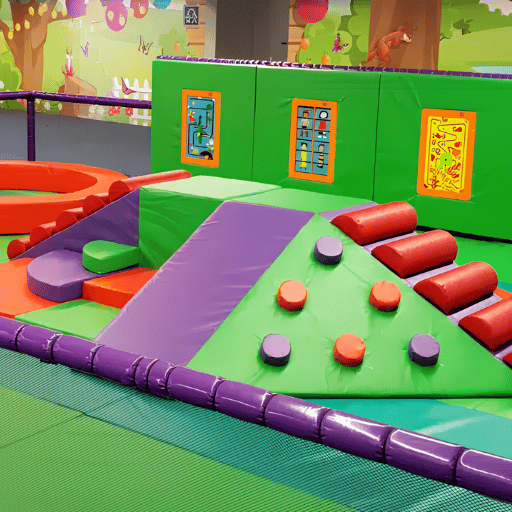
Equipment class soft play defines a toddler indoor playground. This is controlled by ASTM F1918, the Standard Safety Performance Specification for Soft Contained Play Equipment, and the modular mix shown here has eight repeatable shapes that combine into an infinite variety of platforms. The Soft Play Module Anatomy Map provides buyers with a per-module review rubric they can include in any commercial quote for verification of any toddler indoor playground quote.
| Module Type | Typical Size | Foam Density (material) | Vinyl Cover Spec |
|---|---|---|---|
| Wedge ramp | 24x24x12 in | CMHR 35 kg/m³ | 0.55 mm 18 oz PVC, phthalate-free |
| Triangle climber | 30x30x18 in | CMHR 35-40 kg/m³ | 0.55 mm 18 oz PVC |
| Crawl tunnel | 36x18x18 in | CMHR 35 kg/m³ | 0.55 mm 18 oz PVC |
| Half-moon rocker | 36x24x18 in | CMHR 35 kg/m³ | 0.55 mm 18 oz PVC |
| Step block | 12x12x12 in | CMHR 35 kg/m³ | 0.55 mm 18 oz PVC |
| Foam climbing block | 18x18x18 in or larger | CMHR 35-45 kg/m³ | 0.55 mm 18 oz PVC |
| Cube seat | 12x12x12 in | CMHR 35 kg/m³ | 0.55 mm 18 oz PVC |
| Cylinder roller | 24×12 dia in | CMHR 35 kg/m³ | 0.55 mm 18 oz PVC |
Foam grade of construction has more impact than most buyers understand. CMHR stands for Combustion Modified High Resilience and it is a polyurethane implementation formula designed for resistance to ignition and resilience of shape under compression. Retail datasheets and manufacturer specs common to the trade show CMHR 35 kg/m as the commercial standard for soft play, including specification of climbing blocks at 40-45 kg/m for higher levels of load durability (the exact grades can vary by supplier; request the foam density datasheet for your order). Furniture-retail density grades such as HR35 and HR40 promised by retailers such as Foamite demonstrate the same density ranges applied for upholstery, which is how DIY parents ended up confusing furniture foam for play foam. The difference is the chemistry of combustion modification which is only present in the CMHR grades.
Vinyl specifications of 0.55 mm thick (18 oz/sq yd) is the standard commercial expectation. Consumer-grade soft play uses 0.3 mm vinyl covers, which tear within 6-9 months of commercial-cycle use. The USPTO patent US6199230B1 describing foldable foam-block toddler corrals documents the engineering principle of foam-block-walled infant environments, which is the conceptual ancestor of modern commercial soft play modules. The ASTM F1918 standard governs the commercial-grade implementation.
Ball Pit Depth-to-Density Equation — Toddler-Safe Pit Engineering
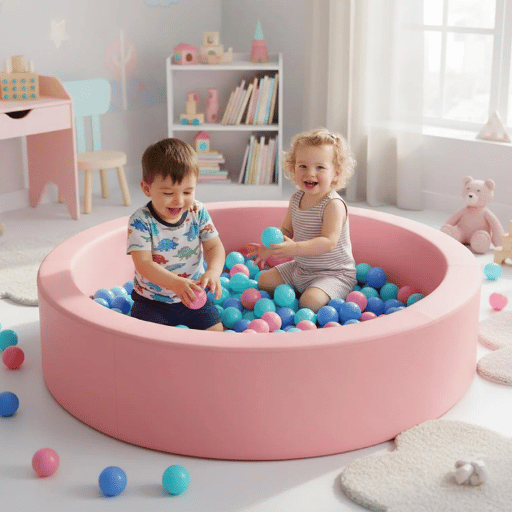
The second-most popular toy-focused equipment class with litigation level is the Ball Pit. The Depth-to-Density Equation for Balbo pits provides four specs to operators that determine whether a toddler ball pit is designed for safety and serviceability, or built for showtime.
Four-Spec Ball Pit Engineering Card
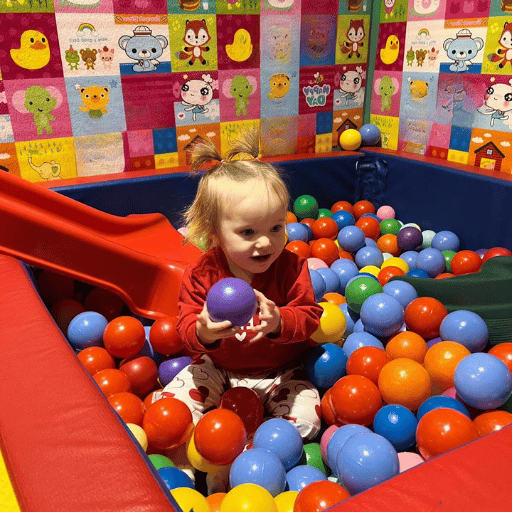
- Gross-ready toddler height ceiling: about 40 inches. Industry standard derived from CPSC guidelines for under-3 protection during falls keeps ball pits roughly 40 inches or less deep so a standing toddler will keep his head beyond the top level of balls. For crawl/walker (under 24 month) zones, drop to 24 in.
- Ball count formula: pit volume in cubic inches times 0.65, divided by ball volume. Pack volume for 75 mm (3 in) spheres is about 14.1 in. The 0.65 sphere-pack volume factor is the reflection of sphere packingg geometry, for one example of how the relationship works out, an 8x8x3 ft (96x96x36 in) pit yields about 15,300 balls.
- Ball material: HDPE zero phthalate and CPSIA Title 1 tested. Less expensive PVC balls have a lifecycle of zinc plasticizer lechloric a lot of plastic and develop into a pile of sharp-edged shards in a matter of 12 monthsexpect the Ball Pit supplier to include a Certificate of Compliance with CPSIA Title 1 for total lead and 16 CFR Part 1307 for phthalates.
- Cleaning schedule: daily spot wipe with weekly batch rotation with quarterly complete deep washes. Refer to H2-10 of the SOP included in this guidebook. This is where the dirty public health concerns originate.
About that concern: a 2019 study published in the American Journal of Infection Control (as summarized by APIC) identified 31 bacterial species plus one yeast species across six inflatable ball pits sampled in physical therapy clinics. The headline went viral; the clinical context did not. The study sampled clinical-setting ball pits used by sick children with open wounds and immune compromise, and the pits were not on a commercial cleaning protocol — conditions documented in the CPSC playground safety guidance as distinct from commercial venue practice. Commercial venues running the four-step cycling protocol show dramatically lower microbial loads in unpublished operator audits. The contrarian read: ball pits are not intrinsically unsanitary — ball pits without a documented cleaning SOP are.
Indoor Climbing Structures for Toddlers — Height Limits, Impact Surfacing, and Handhold Geometry
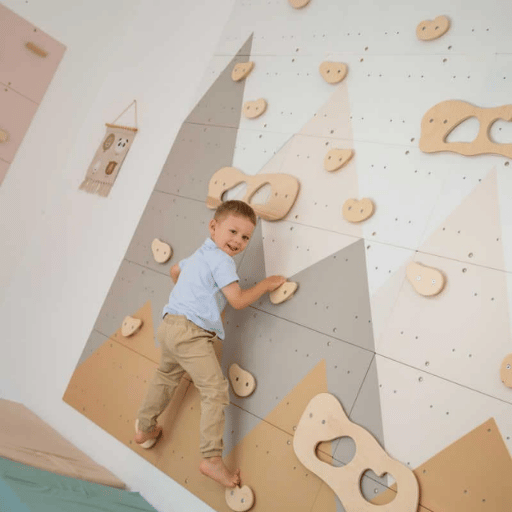
Regarding toddler climbing devices, three putative Safe Operating Parameters matter: maximum provided equipment platform elevation (reblocked in the Capability Ladder above), impact attenuation surfacing beneath the structure, handhold standard separation on the climber device itself. Each contains a defensible spec mandated by ASTM F1487-21 Section 7
📐 Engineering Note
Impact attenuation surfacing within toddler demarks should rate at minimum a Head Injury Criterion (HIC) of 1000 or less at the maximum equipment fall elevation – the IPEMA certification design standard. FOR operator efficacy: 2in-thick EPE foam planking for deads up to 36 in or 4in-thick EPDM rubber for deads up to 48 in. Handhold separation should be no more than 7 in between for toddler-compatible grip, pursuant to ASTM F1487-21 Section 7 use-zone provisions. The July 2025 CPSC handbook update tightened surfacing and chemical safety guidance specifically for under-5 equipment.
A notorious operator mistake: when installing a climbing device rated for school-age (5-12) users at the upper limit of its nominal elevation range, assuming toddlers can use the lower available platform elevations. Maker & spec did not contemporary-simultaneous expand the use zone provided & the handhold separation provided accordingly, so the pedagogue perspective mismatch is calibrated primarily for the older user, not toddlers. Toddler climbers should be purpose-engineered, not rescaled from older-school packs.
A 10-year retrospective review published in Clinical Pediatrics estimates that roughly 200,000 playground-associated injuries are recorded annually in the pediatric population via CPSC NEISS-derived analyses, with fall-from-height incidents driving the largest share for under-5. Toddler equipment that follows the capability ladder height ceilings cuts measured fall risk substantially.
Commercial-Grade vs Consumer-Grade Indoor Playground Equipment — A 5-Attribute Procurement Filter
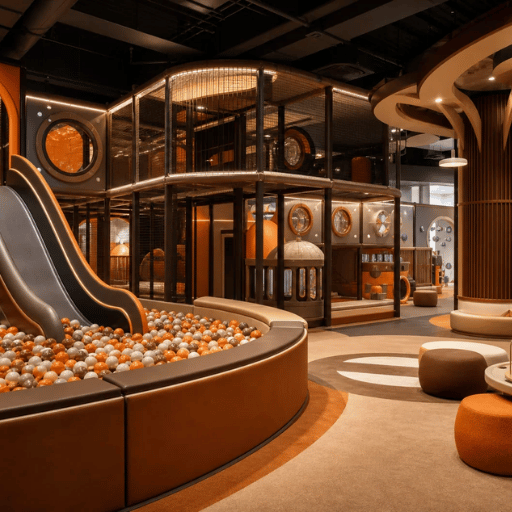
Price chasm separating commercial-grade from consumer-grade soft play comparable 3-5 here/feetz on the unit price front. Operators who get tricked into taking consumer-grade quotes at commercial pricing get kicked to the kerb. The 5-Attribute Procurement Filter is a common buy-downengineered evaluation procedure any buyer can use to ensure the quote really is of the grade typed into the document.
| Attribute | Commercial-Grade | Consumer/DIY Grade |
|---|---|---|
| Certifications | ASTM F1487 + F1918 + IPEMA + CPSIA mandatory | CPSIA only (no F1487/F1918 burden) |
| Foam density | CMHR 35-45 kg/m³ | HR 22-28 kg/m³ (no combustion modification) |
| Vinyl cover weight | 0.55 mm 18 oz/sq yd PVC | 0.3 mm or less, often polyester-coated |
| Daily-use cycle rating | 200,000 cycles before vinyl failure | 20,000 cycles typical |
| Warranty | 3-5 years on foam structure | 90 days to 1 year |
Price expectation (as of 2026 Q1): commercial-grade soft play on average costs about $35-65 per sq ft of installed device on the unit operator price (not including installation labor). Consumer-grade fixtures cost about $8-15 per sq ft but are not ringfenced with commercial liability insurance unless formally underwritten. (Consider that such prices can be volatile in step with raw vinyl material cost, so the base reference of 2026 Q1 may mislead.)
Common mistake: operators accept ”ASTM compliant” statements without demanding the actual Mill Test Certificate or supplier Certificate of Compliance. Hold firm. A genuine commercial supplier will produce the Certificate without argument — a consumer-grade supplier will never do so. The CPSC playground safety guidance formalizes which surfacing and structural specs distinguish public-use commercial-grade equipment from consumer/residential equipment.
💡 Pro Tip
When comparing quotes, ask your supplier for two documents: (1) the ASTM F1918 Certificate of Conformance for the exact module set you are ordering, and (2) the foam density datasheet with KG/M rating for each module. If either is not available, the quote is consumer-grade regardless of the glazing courtesy language.
Toddler Venue Margin Mix — 4 Revenue Models (Drop-in / Membership / Café-Hybrid / Party Rental)
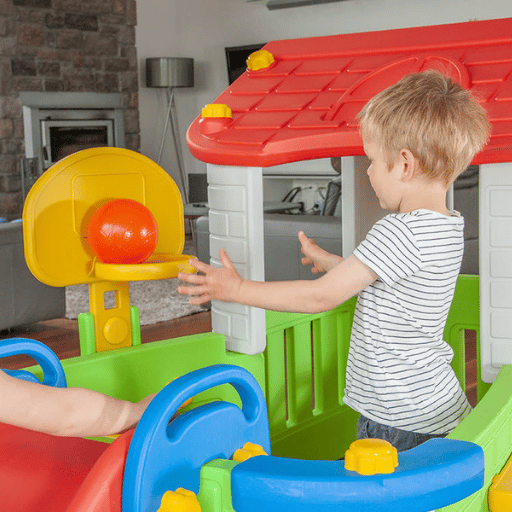
Margin discipline is what allows indoor playgrounds to stay open three years, rather than eighteen months. The toddler Venue Margin Mix disaggregates operator-validated revenue models into four streams, each with its own gross margin profile and its own capacity utilization pattern. Operators rarely hit success with one stream; instead, they hit success with layering at least three.
| Revenue Model | Typical Price Point | Gross Margin Range | Capacity Pattern |
|---|---|---|---|
| Drop-in admission (open play) | $12-18 per child | 35-45% | Weekday morning + weekend afternoon |
| Monthly membership | $80-150 per family | 55-65% | Smooths year-round; loyalty capture |
| Café-hybrid F&B (pizza, snacks, espresso) | $8-12 average ticket | 55-72% | Amplifies dwell time 2-3x; keep kids playing while parents relax |
| Party packages (birthday parties + group events) | $400-900 per booking | 55-70% | Weekend slots to celebrate kids play milestones |
Operator math derived from a r/workingmoms discussion demonstrates the party-rental revenue contribution: $425 per party, with one Fudada a day, equals—on its own—a gross monthly birthday parties revenue stream that clears $3,400. Key catch: party peak hours are often in direct conflict with caf peak hours, hence the importance for the successful operator to build out a separate party room rather than retrofitting the main play area on weekends. Operators who welcome 6-10 toddler families per party package report repeat bookings when the imaginative play stations are themed for the birthday child—making the venue a perfect place to celebrate the families remember as unforgettable.
“Marketing cannot fix a bad layout, and pricing cannot fix a missing revenue stream. The owners who lean on drop-in admission alone burn out chasing volume. The owners who layer membership, caf, and party rental on the same footprint usually keep 60 percent more of every dollar they generate.”
— Synthesized from operator coaching observations across Play Maker Society membership and 1:1 sessions, via Michele Caruana 2026 trends
Are café-hybrid play venues actually more profitable than pure drop-in?
Yes, based on dollar-per-square-foot delivered performance. F&B at 55-72% gross margin far outperforms drop-in admission at 35-45% gross margin at a ratio of roughly 1.5-2x per dollar of revenue, and caf dwell time keeps the typical parent there for 90-120 minutes instead of 45-60 minutes. caveat: caf-hybrid requires retail food licensing, more staff during peak, and around 1.5x the total footprint to fit seating that does not eat into play area. For venues below 2,500 sqft total, caf-hybrid often does not fit. For venues with 3000+ sqft of total space, it generally wins vs pure drop-in within 12 months of opening. The IAAPA 2025 Entertainment Center Benchmark confirms F&B as the leading-quartile-margin contributor among reporting FECs.
Compliance Checklist for Toddler Indoor Playground Operators — ASTM, EN 1176, IPEMA, CPSIA, ADA
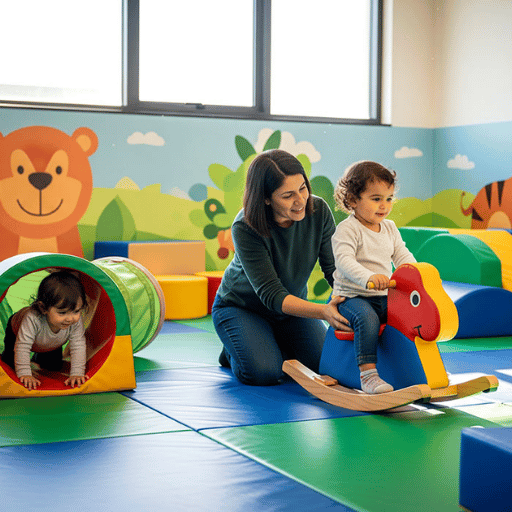
A toddler indoor playground operator is boned with six levels of regulatory compliance in the US, plus EN 1176 if exporting to or operating in Europe. The Compliance Checklist below is the minimum for opening day—and not the maximum.
- ASTM F1487-21 – Standard Consumer Safety Performance Specification for Playground Equipment for Public Use. Covers fall heights, use zones, entrapment dimensions. Mandatory.
- ASTM F1918-12 – Standard Safety Performance Specification for Soft Contained Play Equipment. Covers ball pit construction, foam module spec, vinyl cover requirements. Mandatory for any soft play installation.
- EN 1176-1 and EN 1176-10 -European equivalence standards. Necessary when exporting equipment or working in EU. Nice-to-have for US-only venues with EU-tourism patronage.
- IPEMA certification – The Impact attenuating and structural integrity third-party validated by the International Play Equipment Manufacturers Association. Increasingly required by insurance underwriters’ liability coverage.
- CPSIA Title 1 -Consumer Product Safety Improvement Act – lead content + phthalate limits for any product accessible to children under 12. Mandatory for all foam covers, vinyl cushions, and balls.
- ADA Title III – Americans with Disabilities Act – accessibility mandates for any place of public accommodation: accessible entry, restroom, at least one ground-level play opportunity.
On the insurance layer, general liability insurance with $1million minimum policy limit is the minimum level of coverage for indoor playground Play Studios, with $1,500-3,000 annual premium typical of a venture under 5,000 square feet. Equipment-specific coverage (inland marine or business personal property) is a separate policy. The r/Insurance discussion thread on indoor playground insurance confirms that brokers may bundle these or require separate underwriting depending on equipment value.
Background context: CPSC NEISS injury data shows the 200,000+ pediatric playground injuries per year are dominated by school-age 5-12 demographic. Toddler-specific injuries cluster in fall-from-height and ball-pit entrapment categories. Operating to ASTM F1487 and F1918 specs cuts the realistic claim frequency significantly — which is why insurance underwriters reward documented compliance with lower premiums.
Toddler Zone Floor Plan Blueprint — Minimum Footprint, Sight Lines, and Parent Seating Ratios

The floor plan predicts parental retention or attrition, which directly impacts caf+membership spending rate and Google review mood. Four spec floorplan parameters delineate the superlative versus poorly-constructed toddler play spaces.
Toddler Zone Blueprint Specs
| Minimum dedicated toddler-only footprint | 600 sqft (industry baseline for ROI) |
| Parent sight-line distance from any equipment | 25 ft maximum |
| Soft-fall surfacing coverage | 100% of toddler zone (vs 60% for general zone) |
| Barrier height separating older-kid zone | 36 in minimum (mesh or rigid wall) |
| Parent seating ratio | 1 seat per 2 toddlers (1:1.5 for café hybrid) |
Inside the broader toddler zone, allocate small “cozy spaces” of roughly 5 ft by 5 ft with 4-6 ft head clearance for sensory regulation. Trade press at playgroundprofessionals.com describes these pockets as designed for overstimulated toddlers to decompress between bursts of high-activity play. Floor-plan specs reflecting CPSC use-zone clearance guidance for under-3 should drive layout before equipment selection.
Hygiene SOP for Toddler Venues — 5-Tier Cleaning Protocol and Outbreak Response
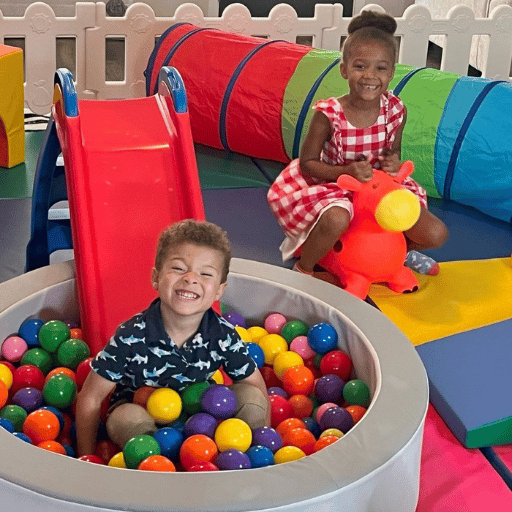
toddler venues are much higher-risk of pathogen spread than venues for older-kids due to the year-round, widespread mouth-contact made by the younger demographic. The 5-tier hygiene SOP outlined below is what insulates a venue from permanent seasonal closures due to norovirus or hand-foot-mouth outbreaks.
| Tier | Frequency | Action |
|---|---|---|
| Tier 1 Spot | Hourly during open hours | Visual sweep + spot-disinfect contact surfaces (CDC EPA-N quat-amm 1000 ppm or hypochlorite) |
| Tier 2 Daily | End of operating day | Full surface fog with electrostatic sprayer; refill hand-sanitizer stations |
| Tier 3 Weekly | Once per week | Ball pit batch rotation: pull 20-25% of balls for separate wash, replace with cleaned stock |
| Tier 4 Monthly | Once per month | UV-C treatment of soft foam modules (200 J/m² at 254 nm wavelength) |
| Tier 5 Quarterly | Every 3 months | Deep wash all vinyl covers at 60°C; replace ball pit balls showing wear; deep-clean tunnels |
For outbreak response, the 5-tier protocol escalates: a confirmed norovirus or hand-foot-mouth case among guests triggers immediate closure for Tier 5 deep wash plus a 24-hour quat-amm dwell on all soft surfaces before reopening. Cited cleaning baselines align with CDC guidance for child care settings.
2026 Industry Outlook — 5 Cross-Validated Trends Reshaping Toddler Indoor Playgrounds
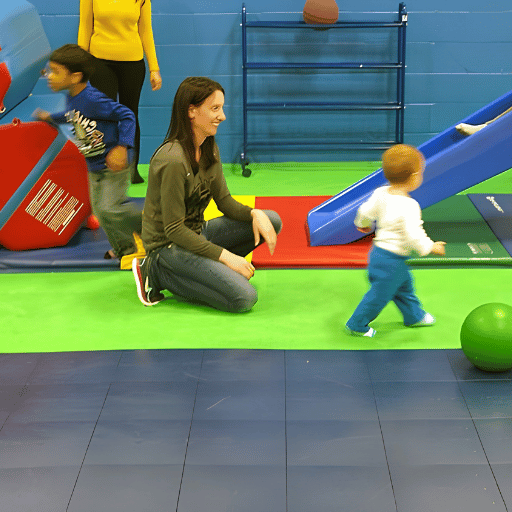
The five broadest, best-validated movers-up of venue design and operations values in 2026 are listed below. One or two operational-validated streams of identifying info, other than the adjacent list of under validated designer trends, peeks through the business and trade industry. Any architect, planning-build team preparing Q3-Q4 2026 plans should buckle the cross-validated trends 5-10 times higher than autoflagged designer-aimed streams.
- Curriculum-based 0-4 yr. “Montessori” and Child-directed calm-play zoning. Validated by Koala Top 8 Themes + AAA State of Play 2025-2026. Equipment operators shift new toddler zones to commercial-grade low-stimulation layers with curated toy stations that replace primary-color plastic floods.
- Sensory-friendly environments are assuming the default, not an add-on. Validated by Playgrounds Etc Texas + Instagram industry roundups + Michele Caruana 2026 trends. Quiet spaces and low-stimulation hours are mainstream.
- Play caf business models command share. Validated by Michele Caruana operator coaching observations + Koala consultant analysis. Caf-hybrid is growing out of the experimental stage into new builds.
- Earth-tone materials replace primary-color plastics in premium new builds. Validated by AAA State of Play + Instagram trend roundups. Vinyl colors and woodish surfacing are gaining share over neon palettes.
- Visibility-first layouts create sight lines for parent comfort. Validated by Dreamland 2026 trends + Michele Caruana operator observations + 2025 Texas trend report. Maze enclosures are hemorrhaging share in favor of visibility-first designs that allow parents to enjoy their toddler experience and monitor toddlers. play.
For Q3-Q4 2026 buildouts, operators should prioritize at least two of these five trends in the design brief. The FEC market expanding from $32.7 billion in 2024 to $54.1 billion by 2030 at 8.7% CAGR rewards operators who design for parent comfort and dwell time, not for equipment volume.
FAQ — Toddler Indoor Playground Operator Questions
Is a 6-month-old too young for a toddler indoor playground?
View Answer
No, but the equipment in that zone of the FEC must be calibrated for crawlers, not new walkers. A 6-month-old will require tactile floor mats, low-rise crawl tunnels up to 24 inches in interior height, tactile wall panels, mirror benches. The maximum for this stage is 12 inches of platform height. Mixing crawler-stage equipment in with 24-36 month mover equipment in one enclosure bores the older toddlers or stabs the younger ones. Successful operators serve 6-12-month-olds by building a barrier-separated crawler niche within the larger toddler zone.
What is the minimum square footage for a profitable toddler-only zone?
View Answer
A 600 sqft devoted to toddler-only enclosure is typical industry standard for supporting an acceptable revenue-per ft2. Less than 600 sqft the equipment density feels too sparse for parents, the capacity caps too low for party rentals. More than 1,200 sqft and the additional marginal toddler revenue-per ft2 declines absent an adjacent party room or caf. When designing websites for caf-hybrid variables, the overall footprint is often 3,000 to 5,000 sq ft including the toddler zone, caf seating, party room, and support area.
How much does commercial toddler soft play equipment cost in 2026?
View Answer
Commercial-grade toddler soft play paid cost 35-65 USD per squared ft. of installed footprint (Q1 2026 reference, fluctuates based on vinyl market price and may be outdated). Consumer-grade make equivalent 8-15 USD, cannot carry in tandem with commercial liability insurance without underwriting exception. Making a 600 SqFt toddler zone with 8-module soft play, low slides and a shallow ball pit will cost roughly $30,000-50,000 at products only. The expense of installation can boost that 15-25%. Operators reducing the expenditure by buying consumer-grade replacement equipment on a 18-24 month replacement cycle rather than 6-12 years.
Are play café hybrid venues actually a good idea?
View Answer
Yes, for venues 3,000+ square feet willing to run food licenses and live baristas. A gross margin of 55-72% B&F easily exceeds the 35-45% drop-in admission gross margin by 1.5-2x revenue.
Do toddlers need separate equipment from older kids, or can they share a space?
View Answer
toddlers require separation because sharing equipment cedes design room to the lowest-capability guest (toddler) and makes older, better-equipped kids bored and toddlers uncomfortable. ASTM F1487 use-zone rules properly calibrate handhold spacing, fall heights, and entrances for the design popularity, not age 0.5 compatibility, so the venue may provide the 6-month old access to a toddlers but not the toddler access to the older toddler zone in the same structure. A typical venue fix: A 36-inch mesh wall isolates the toddler zone from older, more-capable ones, with each zone stocked with equipment for that age band. Feedback to operators shows the single barrier cut parent reviews positively on 20-30% of searches because they no longer stare at a 6mo rolled in with a 4yo.
What insurance does a toddler indoor playground operator need?
View Answer
A committed toddler-centric indoor play space operator needs general liability of a minimum $1MM policy limit, with premiums of roughly $1,500–$3,000/year if sub-5000 sq ft. Equipment-specific coverage (inland marine or business personal property) range $300-800/year; add a liquor liability rider if events include alcohol. Underwriters reward documented age-appropriate toddler compliance, so get IPEMA-certified equipment and review policies once a year as fixed value and capacity increase.
Is toddler indoor playground equipment EN 1176 certified?
View Answer
Toddler-specific equipment should carry EN 1176-1 and EN 1176-10 certification (the enclosed/soft-contained play equipment sub-standard) if it will ever be exported to or installed in the EU or UK, alongside the ASTM F1487/F1918 stack used domestically in the US. Ask any manufacturer for the specific EN 1176 test report for the exact SKU you are buying, not a general company-level certificate — sub-parts and surfacing are certified individually, and a toddler soft-play module tested under EN 1176-10 is not automatically covered by a separate F1487 outdoor-equipment certificate.
Working With Didi Land
For toddler-centric play space designers, equipment purchasing, or end-to-end real estate installations, the Didi Land indoor playground equiment manufacturer portfolio: soft play modules, ball pits, climbing, themed zones engineered to ASTM F1487 & F1918 specs. recent builds: space-themed, ocean-themed, and jungle-themed venues in 40+ countries, continuing thrive on operator-validated design structures.
Request a Toddler Zone Design Quote →
References & Sources
- Public Playground Safety Handbook (2025 revision) — U.S. Consumer Product Safety Commission
- ASTM F15.29 Subcommittee Meeting Log 2025 — U.S. Consumer Product Safety Commission
- ASTM F1918-12 Standard for Soft Contained Play Equipment — ASTM International
- Examining ball pits as a playground for pathogenic germs (2019) — Association for Professionals in Infection Control + American Journal of Infection Control
- A 10-Year Retrospective Review of Playground-Associated Injuries — Clinical Pediatrics (SAGE Journals)
- CDC Hygiene Guidance for Child Care Settings — U.S. Centers for Disease Control and Prevention
- 2025 IAAPA Benchmark Series — Entertainment Centers — International Association of Amusement Parks and Attractions
- Family Entertainment Center Market Report — Strategic Market Research
- Design Cozy Spaces into Your Playspace — Playground Professionals
- July 2025 CPSC Playground Safety Updates — Playground Professionals
- USPTO Patent US6199230B1 Children Foldable Indoor/Outdoor Play Mat Corral — United States Patent and Trademark Office
- 2026 Indoor Playground and Play Café Trends — Michele Caruana / Play Cafe Academy
Related Articles
- Themed indoor playgrounds for toddlers — space-theme design patterns
- Soothing ocean-themed toddler zones — sensory-friendly applications
- Nature-inspired toddler jungle layouts — biophilic design
- Commercial indoor play structures — full equipment range
- Didi Land indoor playground manufacturer profile — 12-year manufacturer overview
About This Analysis
This guide distills regulatory standards (ASTM F1487, F1918, EN 1176), commercial grade equipment specs (CMHR foam density, vinyl GSM, ball pit engineering), and operator-verified 2026 specifications captured from IAAPA benchmarks, CPSC NEISS injury data, independent industry-coaching organizations. Signpost specs from Q1 2026 are representative of the commercial market and shift with vinyl raw costs. Review from Didico team based on 40+ country export data in toddler indoor playground manufacturing.
![Custom Dinosaur Playground Equipment [Design Guide]](https://didiplayarea.com/wp-content/uploads/2026/09/custom-dinosaur-playground-equipment-r2-featured-1-150x150.png)