Get in Touch with Didi Land


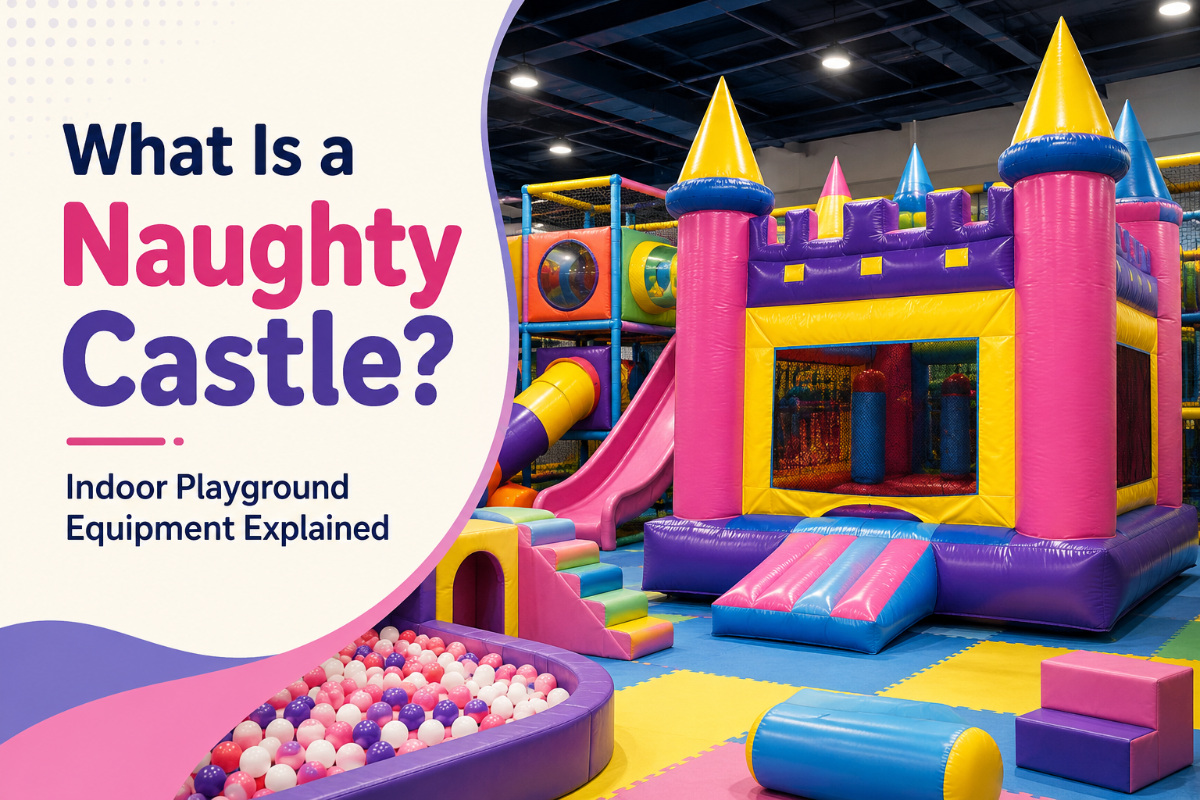
A naughty castle indoor playground is a modular soft-play structure designed for commercial indoor venues – a steel-framed, foam-padded, multi-level play environment that mixes slides, ball pits, climbers, trampolines, and theme decoration in a single enclosed footprint. The phrase originated in China-based soft-play manufacturing, and now spreads through world-wide B2B export channels as the dominant generic designator for indoor kid’s amusements in family entertainment complexes, kindergartens, shopping centers, and family-themed restaurants. This brief explains what it actually is, what it contains, which safety standards apply (with a surprisingly non-obvious correction most suppliers overlook), how much it costs, and where the industry is headed in 2026.
Quick Specs — Naughty Castle Indoor Playground
| Type | Modular indoor soft-contained play structure |
| Typical footprint | 50–700+ square meters (small / medium / large tiers) |
| Target age | 2–12 years (ages 0–3 and 4–12 zoned separately) |
| Core modules | Slides, ball pit / ball pool, climbers, trampolines, foam pit, ninja course, climbing wall |
| Applicable standards | ASTM F1918-12 (US), EN 1176-10:2023 (EU), AS 4685 (AU), IPEMA, TÜV |
| B2B FOB price | ~$50–$199 per square meter (Q1 2026 marketplace data) |
What Is a Naughty Castle? (Quick Definition)
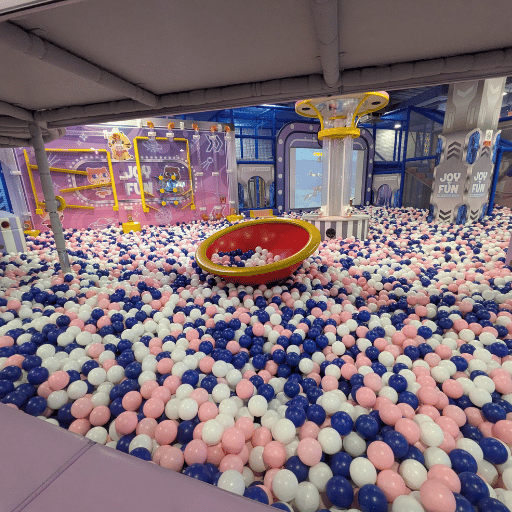
A naughty castle is a commercial soft-play built from soft, cushioned game modules linked into a multi-level activity zone. Children climb, crawl, slide, bounce, and plunge into ball pools throughout an enclosed space that spans from a 50-square-meter small play-centre to a 700-square-meter themed amusement attraction. Whereas out-of-doors public playgrounds – which are fastened to the earth and dominated by cattle-fencing and high-pressure laminate – a naughty castle is designed as a soft-built, indoor play environment.
Inside each naughty castle is built around a galvanised steel-tube frame dressed in PE foam padding, finished with PVC fabric in bright colour schemes. Children move between platforms by means of tunnels, padded climbers, rope bridges, and ninja-course obstacles. The main feature is full padding – every reachable surface inside the play area has some impact-attenuating material, which places the equipment category within the officially-determined classification of soft-contained play equipment.
Clients who purchase naughty castles include family entertainment centres, kindergartens, child-care locations, hotels and restaurants with childrens’ sections, and shopping center play grounds. The indoor playground equipment category is the wider product family, and the naughty castle is its most common configuration.
Why It’s Called a “Naughty Castle” (And What Else It’s Called)
Trade catalogues started employing this phrase within the 1990s-2000s, originated by the China- based manufactures of indoor soft play equipment. the Mandarin language term is 淘气堡 (táoqìbǎo) — meaning “naughty fort” or “naughty stronghold”. As the trade guides translated the phrase into our native tongue, “naughty castle” became synonymous, standard trade-usage. Presently the same item is marketed under a handful of other name-labels depending on market and user-base: indoor soft play, indoor soft playground, soft play indoor playground, playground indoor, indoor amusement structure, kids soft playground, or simply kids’ indoor playground.
One common buyer mistake is confusing a naughty castle with a bouncy castle. They are two entirely different categories.
| Category | Construction | Typical setting | Permanence |
|---|---|---|---|
| Naughty castle / indoor soft play | Steel frame + PE foam + PVC fabric (soft-contained) | Indoor commercial venues (FEC, mall, kindergarten) | Permanent installation |
| Soft play (modular) | Same — “soft play” is the broader category | Indoor | Permanent |
| Indoor playground (general) | Includes naughty castles plus jungle gyms, trampoline parks, ninja courses | Indoor | Permanent |
| Bouncy castle | Inflatable PVC + electric blower (air-supported) | Outdoor parties, fairs, rentals | Temporary / portable |
Is a Naughty Castle the Same as a Soft Play?
“soft play” is the generic term, and “naughty castle” is the most common installation inside of it. All naughty castles are soft-play equipment but not all soft-play products are naughty castles. Stand-alone soft play equipment range — foam blocks, ball pools, padded climbers — can ship as separate units without the multi-purpose max-level enclosed structure of a naughty castle. When attendees request a “soft play indoor playground” or “indoor soft play area” they are usually referencing a naughty castle even if they do not submit to the trade name. Please consider these labels as overlapping but not interchangeable: specification information varies, and the safety standard applied depends on whether the structure is fully enclosed or modular soft play.
What’s Inside a Naughty Castle? (Components & Modules)
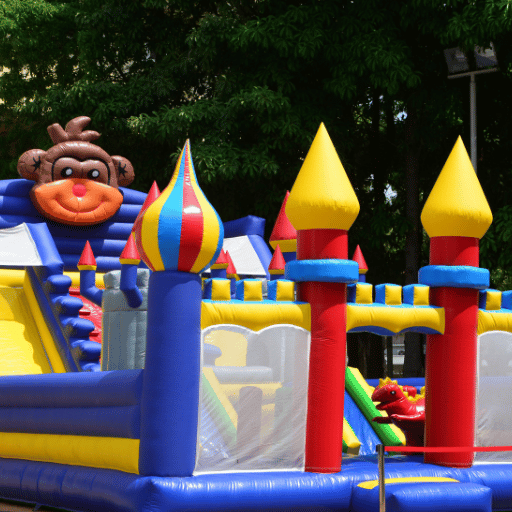
Here is a component checklist that covers modules appearing across most B2B configurations. A small indoor naughty castle (under 100 m²) will incorporate five or six of these; a flagship installation includes every category and adds themed amusement equipment on a scale nearing an amusement park sub-zone.
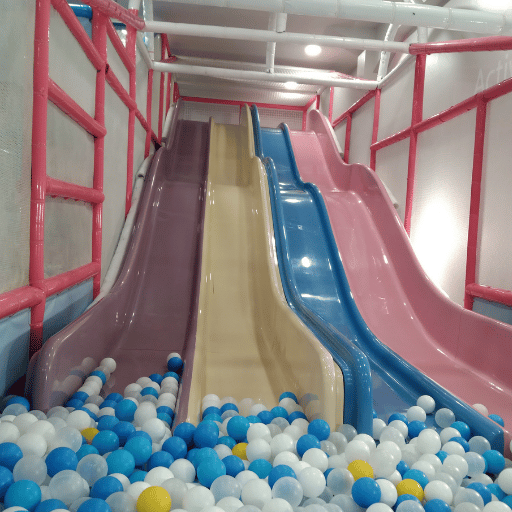
- Slides—straight, spiral, wave, tube slides. Drop heights are adjusted for age zones.
- Ball pit / pool—typically 8 cm hollow polyethene balls; depths range from 30 to 60 cm.
- Trampoline modules — small ground-interred bouncers integrated into the play setup (distinct from complete trampoline parks).
- Climbing wall—the padded vertical or inclined wall equipped with hand and foot grips.
- Ninja course / obstacle course—what is often called a ninja course includes staff-cleared rope bridges, balance pads, swinging loups.
- Tube slides and tube passageways- level connectors and ball pools.
- Foam pit and foam blocks—soft things broken-up childlanding zones, open-ended freeplay.
- Rope course—balloon nets, rope ladders, suspended ropescourses.
- Dodgeball or dunk-basketball court—small size field playing area for larger children.
- ✔Themed scenery and play houses — castle towers, pirate ships, animal sculptures.
📐 Engineering Note — Module Allocation
Allocation proportions are not codified, but field-based facilities allocate use approximately as: 30% climbing devices, 25% slides, 20%ball pit, 25% open/quiet themed spaces. Use this as an initial foundation – the best allocation depends on kin-co space ceilings, targeted age constituents and whether the play area is operated on programmed tracks (requirings a more open kin-co space form-factor) or unprogrammed (supported by larger form-factor systems).
Most catalogs split layouts into three size tiers. The indoor jungle gym equipment family fits inside the medium and large tiers below, while small builds rely on simpler indoor play structures range:
| Size tier | Footprint | Typical modules |
|---|---|---|
| Small | <100 m² | Single-level structure, 1–2 slides, 1 ball pool, basic climbers |
| Medium | 100–300 m² | 2 levels, 3–4 slides, larger ball pool, ninja course, themed scenery |
| Large | 300–700+ m² | 2–3 levels, 5+ slides, deep ball pool, trampoline zone, climbing wall, full theming, party rooms |
Castle-Themed Variations: Rainbow, Ocean, Jungle & Beyond

“Naughty castle” is simply a generic designator of center, although B2B vendors assign like themes that transform the photogenic impact of the space, loathes the precise client bank, and determine branding for the play structure domain. Search statistics for the closest-themed variants are expanding – for example, “rainbow castle indoor playground” yields around 4,400 monthly US-based searches with regulatory vacillation, growing by double-digits each year. Industry participants directing terms pick them parallel the institution’s genesis identity (a gabby-gummy-hallmark business offers confectionary association; a marine-adjacent FEC supports aquatic symbolism) over permitting the play shop style metamorphosis to operate without the specific theme.
| Theme | Visual signature | Best fit |
|---|---|---|
| Rainbow | Saturated multi-color cushions, rainbow gradient slides | Mall-based FEC, broad audience |
| Ocean | Blue palette, fish and coral scenery, wave slides | Aquariums, beach resorts, coastal restaurants |
| Jungle | Green / brown, animal sculptures, vine climbers | Zoos, theme parks, eco-themed brands |
| Candy | Pastel pink / cream, lollipop and cupcake props | Birthday-party venues, dessert cafés |
| Space | Dark navy, planet props, rocket-shaped structures | Science museums, STEM-leaning kindergartens |
Themed designs almost always run as a custom-design contract with the manufacturer, not an off-the-shelf SKU. Operators eager for a clean theme should expect 2-3 rounds of design iterations before installation – see Didi’s themed indoor playground designs portfolio for the scope of theming common in the export market.
Who Buys Naughty Castles? Application Venues & Audiences

Naughty castles are a B2B (business-to-business) product – buyers are almost always venue operators and not parents. Five venue types dominate the 2026 demand: family entertainment centers, kindergartens and preschool/day-care, shopping malls, hotels and restaurants with play areas, and dedicated children’s theme parks.
| Venue | Recommended footprint | Primary age range |
|---|---|---|
| Family entertainment center (FEC) | 300–700+ m² | 2–12 (peak benefit ages 2–7) |
| Kindergarten / preschool | 80–250 m² | 2–6 |
| Shopping mall play area | 150–400 m² | 2–10 |
| Restaurant / hotel kids’ zone | 50–150 m² | 2–8 |
| Children’s theme park | 500–2000+ m² | 2–12 |
Industry players mention that two thirds of repeat visitation concerns in mall and FEC environments arise from one design mistake: there is no good place to sit and watch. Indoor play centers are designed for children to expel excess energy, not to give Mom and Dad a break, but long-term successful operators incorporate adjoining benches allowing supervisor-to-play visibility.
Ceiling height is the second silent constraint: venues left with children larger than five years old need more headroom for climbing features, while venues for toddlers use the lower clear height of retrofit retail space. Kindergarten and FEC play zones under 11 ft (3.4 m) clear height, as well as toddler-focused zones, are only under 12 ft (3.7 m). Kindergarten kids’ plays are designed for 12 ft (3.7 m) clear height.
What Is the Typical Age Range for a Naughty Castle?
Most commercial naughty castles target ages 2 through 12 (the standard range of the ASTM F1487 and EN 1176 public playground standards). Properly made venues separate two age ranges: a 0-3 years zone, with small balls, short towers, and low drop heights, and a 4-12 years zone, with long, tall slides, ninja-course elements, and multi-level climbers. Failure to separate two age zones results in frustration and injury for 3-8 years olds with a developmental gap that wide.
Safety Standards: ASTM F1918, EN 1176-10, AS 4685 & IPEMA
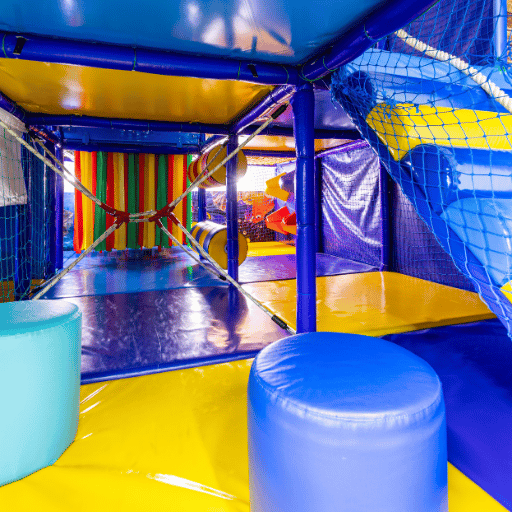
The section addresses a minor but noteworthy industry confusion. Many supplier’s claim ASTM F1487 certification for their indoor naughty castles. According to ASTM itself, F1487-21 explicitly excludes Soft contained play equipment. ASTM F1918-12, Standard Safety Performance Specification for Soft Contained Play Equipment, is the ASTM standard that matches a naughty castle in the US.
| Standard | Region | Scope |
|---|---|---|
| ASTM F1918-12 | United States | Soft-contained play equipment — the actual indoor naughty-castle scope |
| ASTM F1487-21 | United States | Public-use outdoor equipment (ages 2–12). Reference standard for use-zone, fall-height, and access-zone principles, but excludes soft-contained play. |
| ASTM F1292-22 | United States | Impact-attenuation surfacing within the use zone |
| EN 1176-10:2023 | European Union | Fully enclosed play equipment, indoor and outdoor, children up to 14 years |
| EN 1176-1:2017 | European Union | General playground equipment safety. Excludes soft-play areas — refer to Part 10 for indoor naughty castles. |
| AS 4685 | Australia / New Zealand | Playground equipment safety, includes parts addressing impact attenuation and indoor structures |
| IPEMA / TÜV | Global | Third-party certification bodies that test against the standards above |
📐 Engineering Note — Fall Height Reference Numbers
For outdoor comparison (ASTM F1487-21 / CPSC Public Playground Safety Handbook), the maximum fall height in protective surfacing is 72 in (1.83 m) for the 5-12 range, 60 in (1.52 m) for the 2-5 range, and less than 32 in (0.81 m) for kids under 2. ASTM F1487 also defines openings into climbable zones as 1.75 inches wide unless the opening is less than 1 inch high, to ensure hands and feet can’t grip the opening exterior. F1918 sets similar use-zone and access-control standards as applied to soft contained zones.
Four-Layer Naughty Castle Safety Stack
Simply having an ASTM certification does not guarantee that a play structure is safe. Think of safety as a hierarchy:
- Standards layer – ASTM F1918-12, EN 1176-10:2023, AS 4685, IPEMA / TÜV third-party verification
- Materials layer – anti-crack PVC fabric, anti-UV foam, fire resistive padding, lead-free coating
- Installation layer – anchoring, fall height verification on installed envelope, access-zone management on perimeter
- Operations & Maintenance layer – daily walk throughs, monthly fastener checks, periodic foam and fabric replacement
A supplier that scores high on layer 1 but cannot describe layers 2, 3 and 4 has only solved the easy part
Sourcing a Naughty Castle: Cost, MOQ & Manufacturer Selection
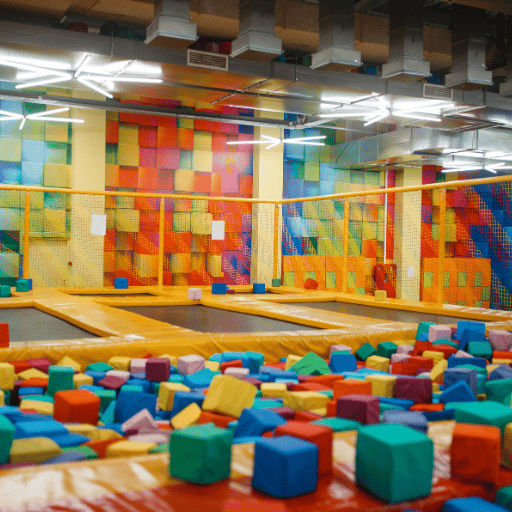
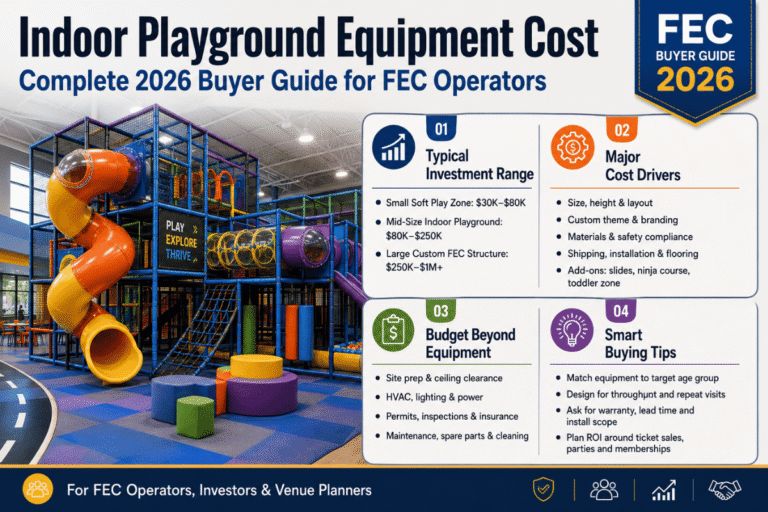
At Q1 2026 B2B FOB pricing on naughty castle indoor playground equipment ran approximately $50-$199/m2 alone, based on active listings on Made-in-China and Alibaba (pricing notes – the global metal and PVC commoditization cycle drives the floor). Orders were available in quantitiest as small as 10 meters even for entry-tier suppliers and as large as 100 meters for mid-tier factories. Yes, the price per square meter depends on footprint – large projects of 500-plus meters bid below the smaller-project rate as design, freight and steel framing are amortized across more area
$50–$150
Per m² (basic, MOQ 10–50 m²)
$120–$199
Per m² (themed, custom design)
5–20 days
Production lead time
25–45 days
Ocean freight (China to North America / Europe)
The choice of supplier is even more important than the rate per m2. Here’s a fact check on a 10-question grid that identifies a legitimate factory from a trading company and a top-quality supplier from a marketplace listing:
10-Question Naughty Castle Manufacturer Selection Checklist
- What standard certifications does your prospective supplier currently hold — ASTM F1918, EN 1176-10:2023, AS 4685, IPEMA, TÜV — and what are the certificate expiry dates?
- Do they supply a Bill of Materials with foam density in kg/m, PVC fabric gauge and steel post wall thickness?
- What’s the warranty period in years and does it extend to the padding and netting or is it only the steel frames?
- Can they provide CAD or 3D site planning prior to payment for deposit? Is the design fee separate from the final purchase?
- What’s the minimum order quantity? Is just one “one-off” custom themed unit acceptable?
- What’s production lead time separate from ocean freight lead time?
- Will the vendor ship you installers or just freight and drawings?
- What’s the time horizon for after-sales replacement parts (time to ship)?
- Are the reference projects in my country or region- installation photographs, end-users, completion dates- available?
- Does the vendor have modular expansion models- where you can expand outward without repurchasing original (hypothetically) could you build onto existing frame?
If you’re feeling a little iffy about questions 1, 2 or 9, find a new vendor. Here is a complete set of questions and motivations for 3rd-party-quality standards verification. For full-scope guidance on the broader product family, see the commercial indoor playground equipment line catalog.
“The most common error made by operators is to start with price per meter squared when sourcing for indoor playground equipment, and not to know what standards the seller building to. For instance, a naughty castle price with ASTM F1487 certification prompts an immediate reaction—wrong scope. You have to ask for ASTM F1918 explicitly.”
— Reviewed by the Didi engineering team, soft-contained play certification practice
What’s Changing in 2026: Naughty Castle Industry Outlook
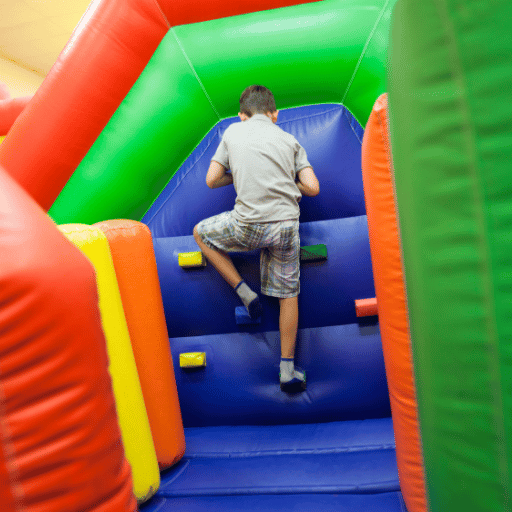
Indoor amusements and family entertainment center venues are one of the world’s fastest growing 2026 children’s commercial categories. Grand View Research (US-based, but global scope) values the 2025 indoor amusement center market at $54.73 billion — projecting growth to $121.54 billion by 2033 at a 10.9% CAGR — while Allied Market Research (US-based, but country-specific) tracks the US FEC market specifically, projecting growth from $5.25 billion in 2024 to $10.55 billion in 2034 at an 8.1% CAGR. DataForSEO (search-volume data) confirms the demand pull on the buying side: “childrens indoor playground” up 41% year over year and “soft play indoor playground” up 34% in same window.
Three threads are reshaping what operators specify in 2026:
- Multi-sensory and inclusive design. Textured walls, musical floors, calming light zones and dedicated sensory rooms are moving from boutique features to baseline expectations – driven partly by autism-friendly programming and partly by the entry of universal-design buyers into the FEC market.
- Modular expansion clauses. Operators bidding 2026 contracts increasingly require modular frame design so the play envelope can grow with traffic. The cost of buying expansion-ready upfront is small; the cost of replacing a fixed frame at year three is large.
- Standalone-FEC shift. Mall-based play areas remain meaningful in mature markets, but US and EU growth is concentrating in standalone FECs and hybrid food-and-play venues. This shifts naughty-castle specifications toward larger footprints (300-700 m), longer slides, and themed scenery designed for social-media-driven repeat visits.
Operators planning 2026 capital projects should lock supplier capacity in Q1-Q2 (lead times widen mid-year), demand modular expansion clauses in the contract, and pre-spec a sensory-friendly zone option even if it is not built in phase one.
Frequently Asked Questions
What is the typical age range for a naughty castle?
View Answer
Most commercial naughty castles target ages 2 through 12. Well-designed venues physically separate a toddler zone (ages 0-3) from a main zone (ages 4-12) so that fall heights, slide angles and obstacle complexity match the developmental stage.
How long does it take to manufacture a custom naughty castle?
View Answer
Production runs 5 to 20 days depending on complexity, theme customization and factory order book. Ocean freight to North America or Europe adds another 25 to 45 days. A signed contract in January usually lands as a usable installation in March or April.
What ceiling height do I need for a naughty castle installation?
View Answer
Toddler-only builds fit in 2.8-3.5 m clear ceilings. Multi-level structures for ages 4-12 need 3.5-5 m of clear height. Tall climbing towers and ninja courses can require 5+ m.
What’s the difference between a naughty castle and a trampoline park?
View Answer
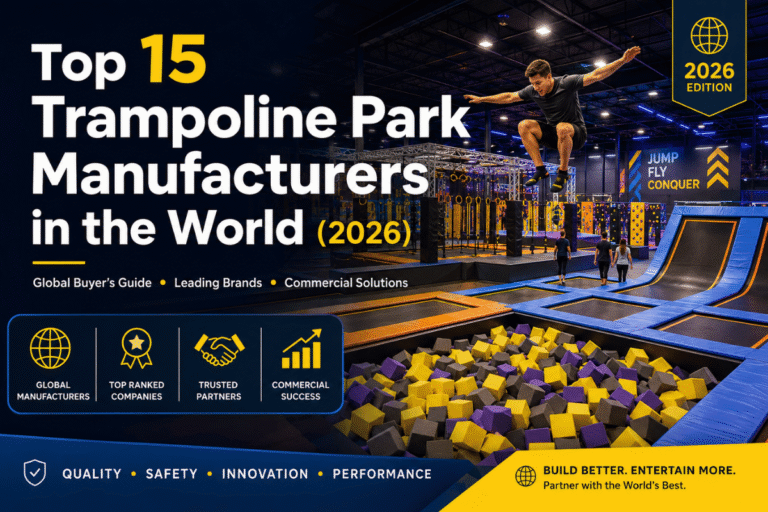
A naughty castle is a soft-contained play structure with mostly walking and climbing surfaces – small integrated trampolines are one module among many. A trampoline park is a sport venue dominated by interconnected trampolines for jumping and aerial play. The two are governed by different ASTM standards (F1918 versus F2970) and target different age and skill profiles.
How do I choose a location for a naughty castle business?
View Answer
Operators screen four parameters: foot-traffic density of families with children aged 2-10, ceiling height of the available shell, floor load rating (a deep ball pit plus daily peak occupancy is a real load), and parking convenience. Footprint over 200 m argues for standalone or anchor-mall placement; smaller builds fit comfortably in restaurant or hotel kid-zone settings.
What’s a realistic starting budget for an indoor naughty castle?
View Answer
Equipment only is $50-$199 /m2 FOB-China in early 2026. The 100 m build approximately reaching $5,000-$20,000 for the structure. Add ocean freight, customs, installation, theming upgrades, surfacing, venue fit-out and the small commercial naughty castle project budget hits between $25,000, $80,000. Large 500+ m flagship installations can clear $200,000.
Browse Didi’s Indoor Playground Equipment Line →
About This Guide
This explainer was assembled to help clarify the specification, scope, component, applicable standard, and 2026 pricing context for the naughty castle indoor playground category. Standards sourced from ASTM, ANSI, BSI/CEN, and CPSC public sources, market from Grand View Research, Allied Market Research, and Research and Markets, and B2B price from public Made-in-China and Alibaba marketplace listings as of Q1 2026; reviewed by the Didi engineering team Didi specializes in designing and manufacturing custom indoor playground equipment for 600+ projects in 40+ countries since 2014, and is certified to ASTM F1918, EN 1176-10, AS 4685, and IPEMA standards.
References & Sources
- Keeping Playgrounds Safe and Fun — ASTM International (Oct 2025)
- ASTM F1918-12: Standard Safety Performance Specification for Soft Contained Play Equipment — ANSI Webstore
- ASTM F1487-21: Playground Equipment for Public Use Standard — The ANSI Blog
- Public Playground Safety Handbook (Pub #325) – U.S. Consumer Product Safety Commission
- EN 1176-10:2023 Playground Equipment — Fully Enclosed Play Equipment — CEN / iTeh Standards
- Indoor Amusement Center Market Industry Report 2033 – Grand View Research
- U.S. Family/Indoor Entertainment Centers Market – Allied Market Research
- Family/Indoor Entertainment Centers Market Report 2026 – Research and Markets


![Custom Dinosaur Playground Equipment [Design Guide]](https://didiplayarea.com/wp-content/uploads/2026/09/custom-dinosaur-playground-equipment-r2-featured-1-150x150.png)