Get in Touch with Didi Land


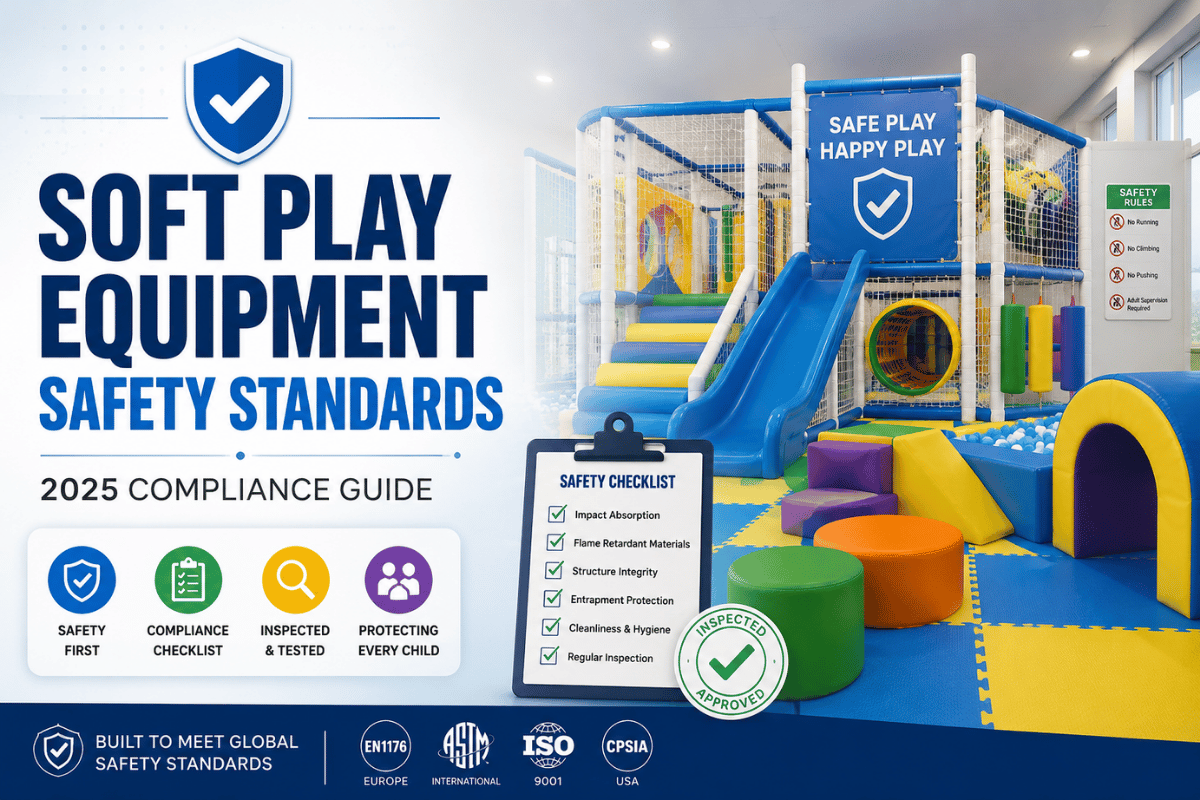
soft play equipment safety standards are the dimensional, material, and installation regulations dictating if your indoor structure can ship, get installed, pass inspection and remain usable: On June 2025 ASTM published F1487-25, and on July 30 the U.S. Consumer Product Safety Commission issued the 2025 edition of its Public Playground Safety Handbook— the first time both anchors of US playground compliance refreshed in the same year since 2017. If your hardware was approved to F1487-21 or the out-of-date 2010 CPSC handbook, some of your documentation is already obsolete.
This explainer breaks down what each standard really mandates at the clause level, where federal legislation (CPSIA, ADA) takes precedence over ASTM voluntary consensus standards, how 6 national benchmarks cite each other, and what the 2025 update brought to the table.
Quick Specs: Six Standards That Govern Soft Play Equipment
| Standard | Scope | Jurisdiction | 2025 status | Force |
|---|---|---|---|---|
| ASTM F1487-25 | Public playground equipment, ages 2-12 | US national consensus | Revised Jun 2025 (from F1487-21) | Voluntary |
| ASTM F1918-22 | Soft-contained commercial play equipment (indoor) | US national consensus | Current (2022 edition) | Voluntary |
| ASTM F1292-22 | Surfacing impact attenuation (HIC + G-max) | US national consensus | Current (2022 edition) | Voluntary |
| EN 1176-1:2017+A1:2023 + EN 1176-10:2023 | European general + fully-enclosed play equipment | EU + UK (BSI), 27 CEN member states | A1:2023 amendment + Part 10 2023 release | Voluntary; CE marking pathway via EN harmonized |
| CPSC Public Playground Safety Handbook 2025 | Federal guidance + recommended practice | US federal | Released Jul 30, 2025 (15 sections updated) | Guidance; not regulation but cited in tort |
| CPSIA 2008 + ADA 1990 (2010 Standards) | Federal: lead/phthalate limits + accessible design | US federal law (binding) | CPSIA codified 15 USC 2056b; ADA 2010 Standards in force | Mandatory (federal law, enforced by CPSC + DOJ) |
The 4 Standard Families That Govern Soft Play Equipment
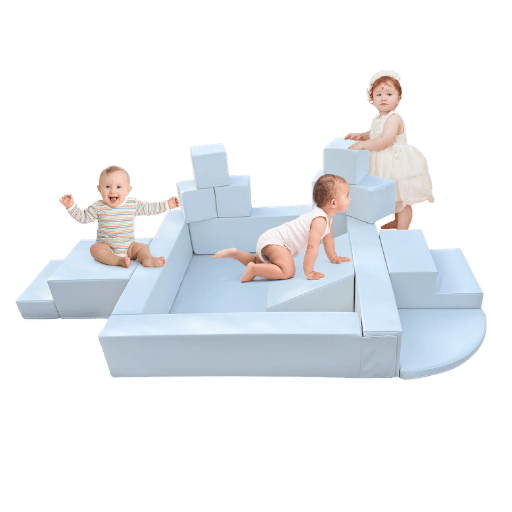
Most operators lump “ASTM” into one block, yet the soft play industry lives at the crossroads of four separate standard families, each with different cover ages, different writing bodies and varying weight in law. Read in sequence this is what controls the equipment in your space indoor play.
1.) ASTM consumer-safety performance specifications are voluntary consensus standards published by ASTM International committee F15.29 (playground equipment for Public Use) and covering the three items that pertain to soft play F1487-25 (public-use equipment, mostly outdoor but applicable to non-soft-contained indoor structures), F1918-22 (soft-contained commercial equipment -i.e. this one explicitly addresses indoor soft play attractions, ball pits, foam climbers, padded tunnels), and F1292-22 (impact attenuation for surfacing underneath any of the preceding). ASTM standards are voluntary in the legal sense but serve as the de facto standard of care in product-liability litigation, as the spec floor in all but a handful of US municipal RFPs (see for example Texas HB 4127 mandating ASTM compliance for publicly funded playgrounds).
2. CPSC Public Playground Safety Handbook is federally mandated guidance, not federally mandated regulation. The federal agency’s 2025 edition of the CPSC invokes the agency’s preferred-practice guidance in fifteen chapters, refreshed about every 5-8 years.
In the CPSC handbook itself, the agency describes the connection: “Some states and local jurisdictions may adopt compliance with this handbook and/or ASTM voluntary standards.” In states that choose adoption by reference, the handbook is required, but in states that do not it remains the document the insurer and tort attorney treat as the operators duty.
3. CPSIA 2008 – the Consumer Product Safety Improvement Act, codified at 15 USC 2056b – is federal law. CPSIA Section 101 establishes two different limits on the amount of lead in children’s products which operators confuse: 100 ppm across the entire product (total lead), and 90 ppm in particular in the coating or paint of children’s products.
The content of six regulated phthalates in the plastics of PVC constituents is capped at 0.1 % (1,000 ppm). Unlike ASTM, this is not an advisory – non-compliance authorizes CPSC recall and civil sanctions.
4. ADA 1990 + 2010 ADA Standards – Title III of the ADA, augmented with the 2010 ADA Standards for Accessible Design Sections 240 and 1008, prohibit public accommodations and commercial facilities from having inaccessible play areas. Section 1008.2 defines accessible-route requirements for ground-level and suspended play elements, and 240.2.1 identify scoping ratios (proportion of components to be within the accessible route out of total component count on site).
What is the ASTM standard for indoor playgrounds?
Narrow answer: ASTM F1918 controls soft-contained commercial play equipment, the tree that categorizes standard indoor soft play amusements- (the block-like foam structures, ball pits, foam-padded climbers, fully-enclosed tunnel systems).
The latest edition is F1918-22, authored under ASTM’s customer safety execution criteria approach. indoor playgrounds that contain traditional swinging slide hardware (as opposed to soft-contained) also cite F1487-25 (the ASTM playground equipment specification, current through June 2025). Impact absorption standards for any surfacing under the equipment are handled in F1292-22.
In practice an indoor soft play facility references all three concurrently: F1918 for the soft-contained modules, F1487 where traditional hardware is installed, and F1292 for the floor catching a fall.
US Federal Layer: What CPSIA 2008 and ADA 1990 Actually Require
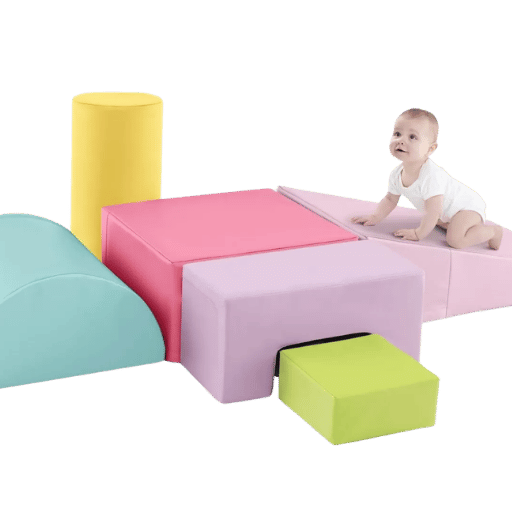
Except for most operators who stop reading here when it mentions the small print, federal law is where the underwriters and CPSC forensic investigators begin. The two binding federal regulations that overlay any soft play equipment provision in the United States of America are CPSIA 2008 and the 2010 ADA Standards. Neither are optional.
Neither has a waiver clause for indoor commercial play..
CPSIA 2008 — Lead, Phthalates, Third-Party Testing
Congress passed the Consumer Product Safety Improvement Act of 2008 in reaction to the lead-based paint toy recall disaster of 2007. It governs each and every product made primarily for children twelve years or younger, which captures nearly all soft play equipment. Three provisions of CPSIA are most significant for operators purchasing or receiving equipment.
📐 Engineering Note: CPSIA Limits That Apply to Soft Play
- Total lead content: 100 ppm max in any accessible part of children’s product (CPSIA 101(a)).
- Surface coating lead: 90 ppm maximum in paint or surface finish (an older limit retained in addition to the 101(a) total-lead restriction).
- Phrenatales: 0.1% (1,000 ppm) max for six regulated phthalates (DEHP, DBP, BBP, DINP, DIDP, DnOP) in plasticized PVC or accessible plastic children’s product parts (CPSIA 108).
- Third-party testing: Children’s product certificates must be generated by testing completed at CPSC-accredited laboratories (16 CFR Part 1107).
- Tracking labels: Permanent identifying markings on product and package (CPSIA 103) – date, lot, manufacturer code.
Operational praxeon is for operators to require the manufacturer’s children’s-product certificate prior to acceptance of delivery. Every certificate must reference the testing laboratory, specify the specific tests performed, and include the test reports. Operators generally accept products with CE marks or generic “compliant” stickers, neither of which supercedes the CPSIA children’s-product certificate.
CPSC retains recall authority and the agency’s enforcement history through 2024 verifies it has acted against children’s product imports without valid certificates..
Another common misconception is that the voluntary ASTM compliance and mandatory CPSIA compliance are interchangeable. They are not. A soft play module could wear an IPEMA stamp (showing ASTM F1918 compliance) and still not be compliant with CPSIA if the soft vinyl skin contained a phthalate over the 0.1% level. Both certificates need to be accompanying the equipment.
ADA 2010 Standards — Sections 240 and 1008
Title III of the Americans with Disabilities Act covers public accommodations and commercial facilities, including indoor soft play attractions open to the general public. The 2010 ADA Standards for Accessible Design establish two scoping rules and a set of technical requirements for play components.
Section 240 establishes the scoping: at every play area, ground level play components shall be provided on an accessible route and at least one of each ground level component (slide, climber, panel, swing, spinner, etc.) shall be connected. Elevated play components are scoped separately- and sites with 20 or more elevated components shall connect at least 25 percent of those elevated components on an accessible route, with at least three different component types.
Section 1008.2 establishes the technical requirements for accessible-route surface (solid, stable, slip-resistant per ASTM F1951), transfer-system geometry (transfer platform 11-18 inches above the surface, transfer steps in 8-inch increments), and clear space requirements at each accessible play component (30 inches by 48 inches minimum). The operator’s practical inspection trigger is the transfer system geometry- any child using a mobility device being unable to transfer from a wheelchair onto the equipment using a compliant transfer station makes the play area ADA incompatible regardless of whether or not another accommodation is provided.
Six-Country Standards Crosswalk (Clause-Level)
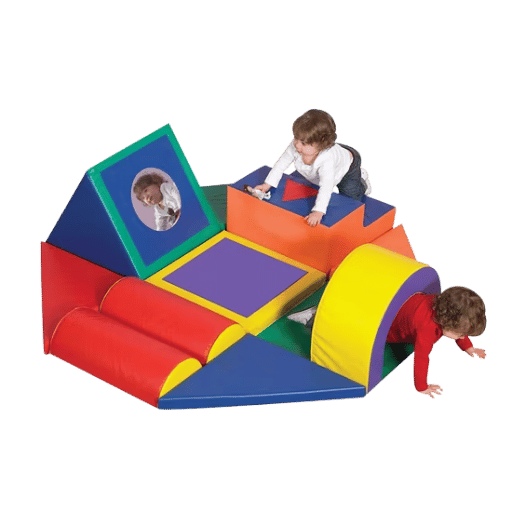
Operators sourcing equipment from foreign sources or exporting equipment from Chinese or American mills encounter parallel national standards (US side referenced via CPSC.gov Voluntary Standards index). The Six-Country Standards Crosswalk below maps the key dimensions across the main jurisdictions our industry ships into. This is not a bare checkbox lookup; it is a clause level reference for the rule against which specification is written.
| Dimension | US (ASTM) | EU (EN) | UK (BS EN) | CA (CSA) | AU/NZ | JP (JIS) |
|---|---|---|---|---|---|---|
| Headline standard | F1487-25 + F1918-22 | EN 1176-1:2017+A1:2023 | BS EN 1176-1:2017+A1:2023 | CSA Z614-20 | AS 4685.1:2021 | JIS S 0014 |
| Fully enclosed indoor | F1918-22 (soft-contained) | EN 1176-10:2023 | BS EN 1176-10:2023 | CSA Z614-20 §6 | AS 4685.6:2021 | Cross-references EN 1176 |
| Surfacing standard | F1292-22 | EN 1177:2018 | BS EN 1177:2018 | CAN/CSA-Z614-20 §11 | AS 4422:2016 | JIS S 0014 |
| Entrapment opening | <3.5 in or >9 in (F1487 §6.2) | <89 mm or >230 mm (EN 1176-1 §4.2.7) | Same as EN | Same as ASTM | <95 mm or >230 mm (AS 4685.1 §4.6) | Cross-references EN range |
| Impact attenuation HIC | HIC ≤ 1000 | HIC ≤ 1000 (EN 1177) | Same | HIC ≤ 1000 | HIC ≤ 1000 (AS 4422) | Cross-references EN |
| G-max ceiling | G-max ≤ 200 | No separate G-max (HIC is sole criterion) | Same as EN | G-max ≤ 200 | G-max ≤ 200 | Same as EN |
| Inspector certification | NRPA CPSI | RPII (UK) + national bodies | RPII Annual + Operational Inspections | CCPI (Canadian Certified Playground Inspector) | CPSI-AU + state schemes | No national inspector credential |
| Federal/legal overlay | CPSIA 2008 + ADA 1990 | REACH + Toy Safety Directive 2009/48/EC | UKCA mark + REACH-UK | Provincial regs + Canada Consumer Product Safety Act | Consumer Goods Mandatory Standards | PSC Mark + Consumer Product Safety Act |
Three themes emerge from the crosswalk. First and foremost, the entrapment opening rules diverge enough (US 3.5-9 in vs EU 89-230 mm vs AU 95-230 mm) that an item designed within one rule-set’s jurisdiction will pass within a second but can run short by 5-15 mm in the other. Second, the US is singular in using a dual-criteria impact-attenuation evaluation (HIC plus G-max); EN-dense authorities accept HIC alone. Third, overlapping federal/eparchy overlays ascend independently from the technical playground norm. CPSIA limits are in place merely in the US; REACH chemical limitations are just available in the EU-28 and the UK only; the CSA syllabus runs through eparchy legislation as opposed to a federated consumer-produce law.
What are the EN 1176 standards?
EN 1176 constitutes the European playground equipment standards series, compiled by CEN Technical Committee TC 136 and accepted by all of the 27 CEN member nations. The series is separated into 11 parts with generalized to very specific equipment range categorizations: Part 1 (general safety requirements) was last revised in 2017 with a 2023 amendment (EN 1176-1:2017+A1:2023; the current version); Parts 2 through 11 address specific equipment (swings, slides, runways, carousels, rocking equipment, three-dimensional climbing structures, ropes courses, cableways, other climbing structures, and the 2023 revised Part 10 for fully enclosed play equipment). EN 1176 is an addendum to EN 1177:2018, the impact attenuation spec. Equipment purchased into EU markets commonly receives CE marking from a notified body such as TV or SGS through ASTM testing; the CE mark over play equipment reflects conformity to the EU Toy Safety Directive, not EN 1176.
IPEMA Certification: 5-Step Process and Supplier Verification
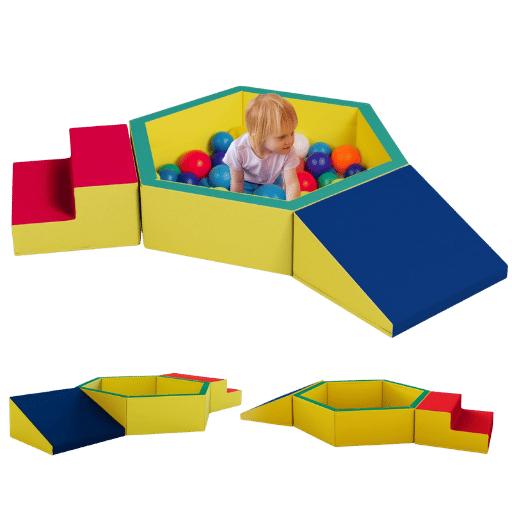
IPEMA (International Play Equipment Manufacturers Association) administers a third-party certification scheme for F1487 (play equipment) and F1292 (surfacing). A third-party label or seal affixed to a product or surfacing is the clearest sign that US-market operators and retailers have managed to purchase a product tested for conformance to those standards from a good, accredited lab such as TV Rheinland, SGS, or Bureau Veritas. The certification scheme proceeds through five steps, from the perspective of the manufacturer; operators, installers, or others only see the conclusion, but understanding the process can help validate a vendor’s assertion.
- Specification + application submission – the manufacturer submits a form identifying the spec (F1292, F1487, or F2223 in the case of swing-set-residential), testing specs, and design specs.
- Third-party testing – manufacturer enlistment of an approved testing lab to perform the relevant physical/materials tests.
- Report submission – lab send the results directly to IPEMA; manufacturer has no access or rights.
- IPEMA review + inclusion in database – IPEMA confirms identification and inclusion in the publicly available database of certified equipment at IPEMA.org; the manufacturer may use the IPEMA seal on marketing collateral.
- Re-validation every year – the manufacturer must receive subsequent reaffirmation, usually every year, but when an updated version of the spec (e.g. transitioning from F1487-21 to F1487-25 in 2025), re-testing within the published window is required.
Validating operator-operator certification with each new purchase is the related goal of the IPEMA Database. Barring an IPEMA validation or an equivalent third-party test report from a CPSC-accredited party, a manufacturer statement of “ASTM-tested” has no standing in CPSC or tort action. Reported operator experience suggests requesting the “test report” and not just the “certificate” from the testing provider is a good filter for identifying vendors with good documentation.
CPSI Inspector: Who, How to Find, and How to Become One
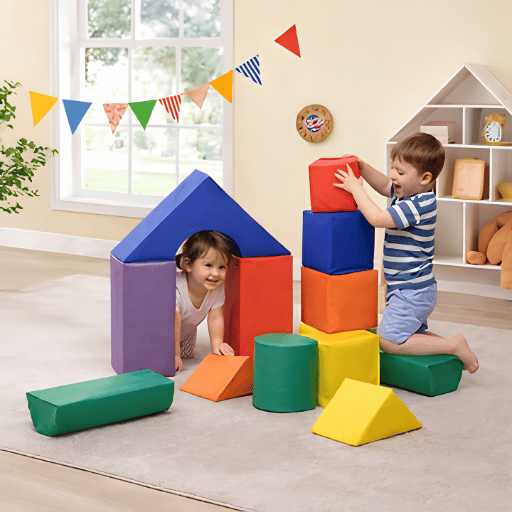
NRPA – the National Recreation and Park Association – administers the playground safety Inspector credential. CPSI is the dominant US inspector credential and is increasingly cited in commercial-FEC insurance underwriting and municipal RFPs. Its exam tests for identifying hazard, ASTM standards application, CPSC handbook practices, and inspection methodology. Having a camera roll for the program’s structure lets operators hire a CPSI for episodic audits or learn the credential in-house.
| CPSI program parameter | Detail |
|---|---|
| Administering body | National Recreation and Park Association (NRPA) |
| Eligibility | Age 18 minimum, high-school diploma or equivalent |
| Examination structure | 100 questions (95 scored + 5 unscored pre-test) |
| Certification term | 3 years |
| Renewal options | Re-sit the exam, or 2.0 CEUs in playground safety during the certification cycle (per Maryland RPA program, July 2026 onward) |
| Study materials | Online prep course (separate fee) + Course Manual + Field Guide (sold separately) |
| Equivalent credentials | RPII (UK), CCPI (Canada), CPSI-AU (Australia) — see the Six-Country Crosswalk above |
How do I find a certified playground safety inspector?
NRPA doesn’t have a public-facing inspector directory like some certifying bodies do; CPSI candidates and credential holders are listed in the NRPA member system but not in a consumer-searchable map. The three practical routes to find a CPSI are First, request a list from your state parks and recreation association; most maintain one for member operators (Maryland RPA’s CPSI list publishes one of the most usable state lists). Second, request a list from your insurance carrier; commercial-FEC insurers commonly maintain inspector lists tied to policy discounts. Third, IPSI, LLC (playground safety Is No accident) maintains a roster of independent contractor CPSIs. Industry practitioners often share that CPSI credentials became an underwriting requirement for some commercial soft play insurance lines after 2020.
Field Inspection Audit Trail: 4-Tier Cadence
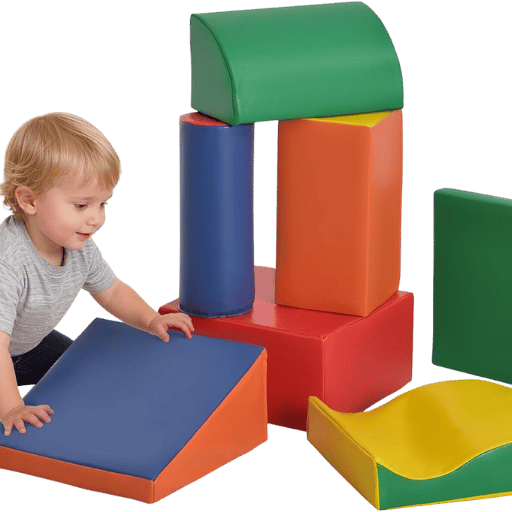
Inspection frequency for soft play equipment isn’t a single date but a layered audit trail with four levels, each level owned by a different operator role and enforcing different documentation. The 4-Tier Cadence below is the common framework among practitioners in recreational facilities, FEC operators, and municipal parks, and the format CPSC‘s 2025 Public Playground Safety Handbook bolsters through its enlarged maintenance and inspection sections (sections 1.5 and 5 in the 2025 edition).
| Tier | Frequency | Who performs | What gets checked | Documentation |
|---|---|---|---|---|
| Tier 1 Daily | Open + close each operating day | Floor staff (trained) | Visual scan: visible damage, foreign objects in ball pits, anchor bolt visibility, surface debris, missing pads | Daily checklist log (3-5 minute walkthrough) |
| Tier 2 Weekly | Once per operating week | Lead staff or operations manager | Routine inspection: fastener torque check on accessible bolts, padding wear, vinyl-skin tears, slide-bottom landing material, ball-pit ball count and cleanliness | Weekly report; trending damage logged |
| Tier 3 Quarterly | Every 90 days | CPSI or trained internal inspector | Detailed inspection: entrapment-gauge testing, fall-zone clearance measurement, surface impact-attenuation spot tests, sub-floor anchoring, EN 1176-10:2023 fully-enclosed equipment netting tension | Photo-documented inspection report; corrective actions tracked |
| Tier 4 Annual Audit | Once per year | Independent CPSI or third-party lab | Full-coverage compliance audit: ASTM F1918-22 and F1487-25 conformity review, surface attenuation drop test per F1292-22, CPSIA documentation chain audit, ADA Section 1008 verification | Formal audit report retained for 7 years (insurance/litigation defense) |
IPSI’s (playground safety Is No accident) inspection form, now in its 6th edition and rechristened “playground Safety Compliance Inspection and Assessment Form,” is the prevalent template most CPSIs use for Tier 3 and Tier 4 records. Its function is to track non-conformance items at 3 severity levels (life-threatening, hazard, non-compliance), give due priority to rectification, and create a defensible record. Industry practitioners identify that the difference between a Tier 3 internal inspection and a Tier 4 third-party audit is the scope of discovery in the lawsuit – internal inspection creates ongoing duty of care; third-party audit creates independence and is more difficult for plaintiff counsel to dismiss as self-interested.
Impact Attenuation: How Surfacing Meets ASTM F1292
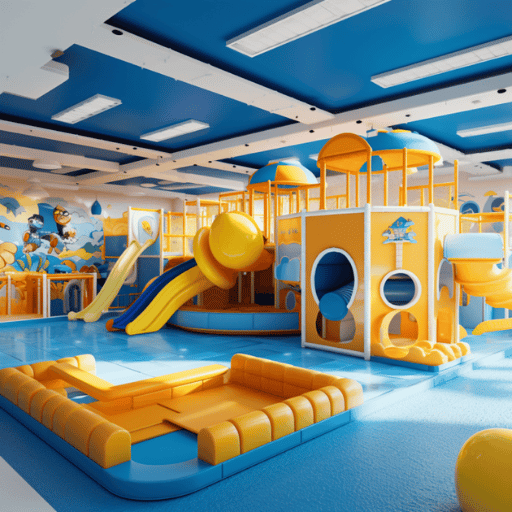
Impact attenuation is where soft play standards become quantifiable: how much energy the surface absorbs when a child falls off a specified height. ASTM F1292-22 establishes the test method and the 2 pass-fail thresholds. EN 1177:2018 applies the same head-injury criterion but a different protocol. Both collide at a Critical Height value – the maximum height from which a tested surface remains in compliance at the head-injury threshold.
📐 Engineering Note: ASTM F1292-22 Pass-Fail Thresholds
- HIC (Head Injury Criterion): 1000 – a calculated index of impact deceleration and duration of impact; threshold of 1000 is associated with about an 18% chance of a life-threatening head injury in adult-occupant biomechanics models. Children’s head injury thresholds are believed to be lower, which argues for surfacing often specified well below the ceiling.
- G-max: 200 (max. platform deceleration happening during the impact in “g’s”). F1292 establishes a G-max limit in addition to HIC; EN 1177 has G-max as a bit of a running partner with HIC and no longer exists.
- Standard testing: F1292-22 drop tests are performed at 25 C and at a test temperature representative of the installed environment. Critical Height is reported as the greatest fall height passing both conditions.
Operator-specific translation is published in CPSC‘s 2025 Public Playground Safety Handbook Table 2 (surfacing condition vs maximum fall height). The 2025 edition revised this table to better include loose-fill chemical safety considerations and reorganize the recommended-materials section (per Federal Register Notice 2025-15374). The headline relationships in the practical context are as follows.
| Surface material | Typical depth for 6 ft fall | Strengths | Limitations |
|---|---|---|---|
| Engineered wood fiber (EWF) — IPEMA certified | 9 in compacted | Low capex, accessible after compaction | Requires regular top-up; chemistry now scrutinized under 2025 Handbook |
| Poured-in-place rubber (PIP) | 3.5 in | Accessible, low maintenance | High capex; subject to UV degradation outdoors |
| Rubber tile | 2.5-4 in (varies by manufacturer) | Most-used in indoor soft play; replaceable in panels | Performance varies by manufacturer — IPEMA certificate per product |
| Foam padding (soft-contained interior) | Manufacturer-specified per F1918-22 | Engineered to F1918 envelope | Replace on visible damage; foam memory loss over time |
Two operator-specified notes are associated with this table. First, the depths listed are for typical maximum fall heights; the IPEMA-certified product datasheet is governing – assuming very slight material variation, Critical Height can vary 1 or 2 inches. Second, the 2025 CPSC Handbook is consistent with the American Society for Testing Materials E2002 semantics, but also incorporates explicit chemical-safety considerations in its loose-fill surfacing recommendations, incorporating EWF chemical formulation specs into scope.
Hazard Catalog: Top NEISS-Cited Injury Patterns
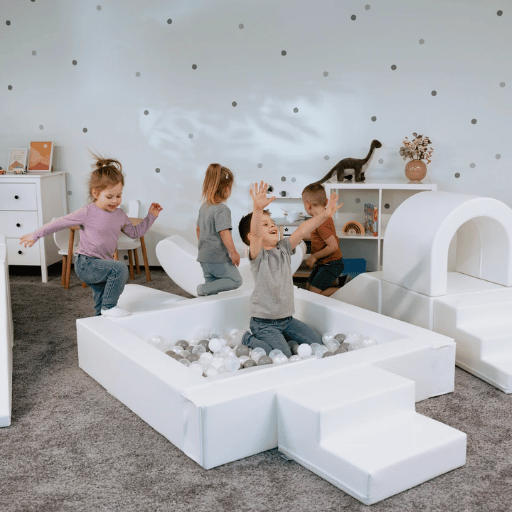
NATIONAL ELECTRONIC INJURY SURVEILLANCE SYSTEM is the database that aggregates emergency-room treated injuries by negligent participant category; playground equipment effects are reported regularly in CPSC‘s annual NEISS Data Highlights reports. Cross-checked with the dimensional and mechanical specs in ASTM F1487, F1918 and F1292, the headline hazards compress into a convenient log. Which appears as below with the specifications and standards design parameters used to prevent each.
| Hazard pattern | Mechanism | ASTM/CPSC prevention spec |
|---|---|---|
| Falls onto inadequate surfacing | Roughly 75% of playground-related ED visits per NEISS aggregates | F1292-22 HIC ≤1000 + G-max ≤200; CPSC Handbook 2025 surfacing-depth table |
| Head and neck entrapment | Openings sized so a torso can pass but head cannot withdraw | F1487 §6.2: openings must be either <3.5 in or >9 in to fail-safe |
| Finger or limb entrapment | Tapered openings that allow insertion but trap on withdrawal | Probe gauges per F1487 §6 detail; gap continuity rules |
| Protrusion impalement / clothing entanglement | Bolts or projections catch clothing or skin | F1487 protrusion rule: 0.118 in (3 mm) maximum protrusion from a slide hood; bolt-end recess requirement |
| Crush, shear, pinch points | Closing gaps in moving or articulating equipment | F1487 crush-point rule: gap ≥0.625 in (16 mm) in any closing position |
| Age-inappropriate equipment access | Toddler attempts on equipment sized for school-age | F1487 + F1918 age-grading; CPSC Handbook 2025 expanded age-separated-zone guidance |
| Sharp edges and points | Manufacturing burrs, vinyl skin tears, exposed framework | F1487 §6 edge rules; CPSC handbook visual inspection items |
| Slip and trip on access route | Discontinuous surface, hardware lying on travel path | 2025 CPSC Handbook trip-hazard prevention section (new in 2025 update) |
No dimension is arbitrary; each links to a precise clause in F1487 or F1918, hence the calibrated gauges (entrapping probes and torso probes) used in the previous section. To the contrary, operators generally judge that visual inspection can suffice in catching entrapment hazards; as hard to eyeball dimensions as they are (3.5 inches versus 4 inches on the smaller side, 8.5 inches versus 9 on the larger side), they are inadequate.
Use Zones and Anchoring: Geometry From ASTM F1487 §4.10
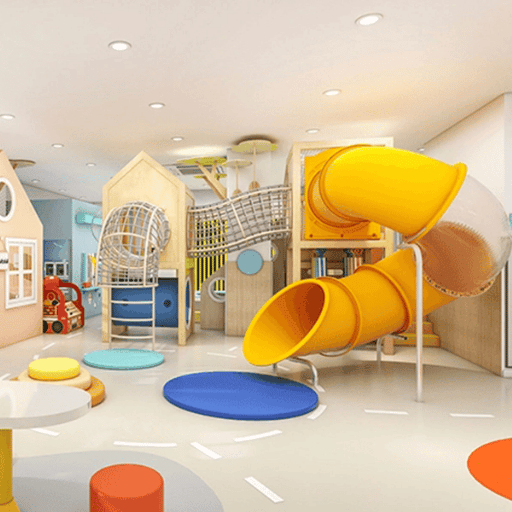
Impact zone is the space surrounding the equipment in which an infracting falling occupant could land. ASTM F1487 4.10 defines the geometric minimums – CPSC Public Playground Safety Handbook 2025 illustrates them in 5.2 with diagrams. Every piece of equipment in a play situation must have a clearance ring scaled to maximum fall height with no obstructions, equipment, walls, columns, or platforms within the ring.
The minimums for all non-swing play equipment are: a 6-foot use zone, meaning 6 feet in each direction from the equipment position in which an occupant could fall. In use zone limits for swings, the front and rear of each swing must have a 2x extension of the pivot-to-seat length of the swing, meaning a 7-foot swing set has a use zone projecting out approximately 14 feet from the pivot point in front and back of the seat; in integrated play equipment with structures connected at under 30 inches maximum entry height, use zones can overlap just so long as both structures are under 30 inches. Use zones also must be fully covered by Impact-Attenuating Surface – in practical terms, a 6-foot use zone on a piece of equipment with a 6-foot fall height needs surfacing that passes F1292 at 6 feet in every direction all across that 6-foot circle.
Indoor softplay installations adopt the following rules for floor-bolted anchors. Wall-anchored or floor-bolted lashings are required to pass the imposed load of F1918-22 for soft contained equipment, details typically concluding to anchor bolts of grade 5 or above minimum, cast-in according to manufacturers specification with the surrounding floor tested to F1292 at projected fall height. outdoor playgrounds uses the same principle with concrete footings, with embedment recommended according to CPSC Handbook 3.3
Equipment Banned by Standards: 8 Retirements That Reshaped Modern Playgrounds

Below are 8 retired playground equipment elements that most operators still noticed at the disintegrating flank of child hood. Each quit using as the 1980-2025 evolution of the modern ASTM and CPSC plate was discontinuous. The “banned” label is informal, the standards don’t specify individual equipment model names approved.
Instead, they demand hazard proportions – cutpoints on entrapments face sizes, heights of falls, hold peak deceleration – that old Gear couldn’t be retrofitted to meet. The equipment was discontinued as de facto extinct rather than de jure banned.
| Equipment | Phased out | Why | Compliant replacement |
|---|---|---|---|
| Witch’s hat (cone roundabout) | 1980s onward | Children fell through the open frame; uncontrolled spin speed exceeded G-max | Modern speed-limited roundabouts with enclosed deck and F1487-compliant railings |
| Merry-go-round (traditional) | 1990s onward | Centrifugal hazard; falls from spinning deck; pinch points at deck-to-ground gap | Inclusive carousels with speed regulators and enclosed seating |
| Tetherball | 2000s onward (most US schools) | Ball-strike injuries; pole impact when ball wrapping shortened the lanyard suddenly | Soft contact sports panels and interactive activity walls |
| Tire swing (single hung) | Pre-1990 in most public sites | Entrapment risk inside the tire opening; chemical concerns with rubber compounds | Group swings or modern bucket seats compliant with F1487 §8 |
| Metal slide (high-mass aluminum) | 2000s onward | Surface temperature in direct sun produced burn injuries; clothing entanglement at slide hood | Plastic or composite slides with hooded entries per F1487 §7 |
| Animal seesaw (spring rocker) | 1990s onward | Pinch points at spring base; rider-position changes producing falls | Spring-isolated rockers with shrouded spring per F1487 §13 |
| Chain-link climber (open-mesh) | 1990s onward | Open mesh size frequently in the 3.5-9 inch entrapment range | Modern climbing nets with regulated opening size per F1487 §6.2 |
| CCA-treated wooden equipment | EPA phase-out completed 2003 | Arsenic leaching from chromated copper arsenate pressure treatment | ACQ-treated lumber, recycled plastic lumber, or steel-framed structures |
There is one same trend for each of the 8 retirements: a hazard criterion show up on the baseline, legacy equipment failed using this criteria and vendors did not bother to produce hazard uncompliant configurations to bring into compliance. CPSC 2025 handbook support this criteria-based logic explicitly: instead of referencing a list of obsolete models, “swinging elements that do not comply with ASTM F1487 criteria for use zones, materials, or hazard mitigation” bAre shown. This can be used by the inheriting operator as retire or retrofit screening list:
2025 Standards Refresh Brief: 4 Revisions That Reset the Baseline
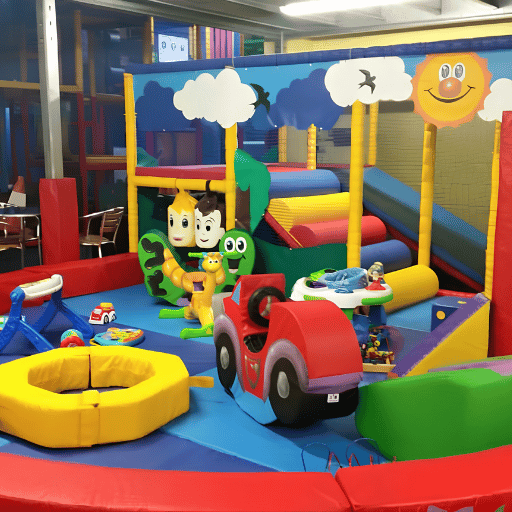
The 2025 calendar year took four key references in parallel. Inventories included to the previous versions will continue to be held in compliance under nearly all State procurement regulations until the new inspection cycle, but resubmissions, such as new orders, new manufacture, and new RFP responses written in 2026 and coming after will be evaluated over the 2025 baseline. Our 2025 Standards Refresh Brief is that operator-facing recap of what changed and what to do.
| Refresh | Date | Source / authoritative reference | Operator action |
|---|---|---|---|
| ASTM F1487-25 (revision of F1487-21) | Jun 2025 | SGS Safeguards 09/2025; ASTM Subcommittee F15.29 | New procurement spec floor; IPEMA certified products re-test within IPEMA grace window |
| CPSC Public Playground Safety Handbook 2025 | Jul 30, 2025 | Federal Register 2025-15374; CPSC direct publication | 15 sections updated — signage, supervisor awareness, surfacing chemistry, fall-height table, age-zone separation |
| EN 1176-10:2023 (fully enclosed play equipment) | 2023 (DIN translation 2024) | CEN Technical Committee TC 136; iteh.ai catalog | Indoor soft play in EU markets re-specified against Part 10 rather than older general Part 1 framework |
| EN 1176-1:2017+A1:2023 (general amendment) | 2023 | CEN; BS EN 1176-1:2017+A1:2023 via BSI | Amendment 1 layered on the 2017 general framework — re-read alongside Part 10:2023 for full EU compliance |
In conjunction with the four formal refreshes above there are two industry signals also to be noted from this same outlook. Firstly, the smart-sensor complianceTSN’ – the smart playground safety sensor market is forecast to rise from $1.38 billion in 2025 to $4.57 billion in 2035 (SNS Insider) indicating sensor-based occupancy impact detection, and age-zone enforcement will see tighter first-tier procurement specifications in the next 5-7 years. Secondly, the Hariil Haz9 handbook 2025’s direct chemical-safmat overlay on loose-fill surfacing materials indicates an intensification of EPA,OSHA,agencies’ scrutiny on EWF chemistry through the next regulatory cycle.
Operators designing 2026-8 construction will need to specify materials with a PCB-free-proven independent chemical analysis AND the IPEMA F1292 attenuation certification.
In June 2025, ASTM International published 3 updates to the consumer safety performance specification for playground equipment that are intended for public use and strengthen safety standards across multiple play settings.
— SGS Safeguards 09/2025, on ASTM F1487-25
Frequently Asked Questions
Q: What is the ASTM standard for indoor playgrounds?
View Answer
Indoor playgrounds with soft-contained play features refer to ASTM F1918-22 (current edition), the consumer safety performance specification for soft-contained commercial play equipment. Indoor playgrounds that also include traditional swing-and-slide hardware refer to ASTM F1487-25 (revised June 2025) for the public use elements. Surfacing under either standard is addressed by ASTM F1292-22 for impact attenuation. A complete indoor playground specification usually references all three plus the federal overlay (CPSIA 2008 for materials and ADA 2010 Standards Section 1008 for accessibility) — five documents that together define a compliant indoor soft play installation in the US.
Q: What are the EN 1176 standards?
View Answer
EN 1176are the European playground equipment standards series, developed by CEN Technical Committee TC 136 with the universal input adopted by all 27 CEN member countries. It is subdivided into 11 parts for successive delineations of equipment categories. Part 1 (common safety principles) was last updated in 2017 with an Amendment 1 in 2023, developed as en 1176-1:2017+A1:2023. Parts 2 though 11 address swings, slides, tunnels, carousels, rocking items, three-dimensional climbing structures, ropes courses, cableways, and the 2023 Part 10 demonstratingthe fully-enclosed play equipment—the usual soft play indoor category. EN 1177:2018 is the parallel surfacing standard.
Q: What are the 7 basic safety rules of playground use?
View Answer
Seven frequent playground safety guide lines appearing at CPSC and parks-association educational sessions: (1) supervise children appropriate to age; (2) check equipment surfaces for heat or damage before use; (3) follow signage directing age-appropriate equipment; (4) remove drawstrings and dangling cords from children’s clothing; (5) keep surfacing material at correct depth around equipment; (6) report damage or hazards immediately to staff; (7) follow posted capacity limits. These align with the supervisor-awareness content delivered in the CPSC 2025 Handbook.
Q: What are the 5 S of playground safety?
View Answer
A 5 S framework identified by the National Program for playground safety at uni addresses supervision, Surfacing, Spacing (use zones), Sizing (appropriate equipment), and Sanitation. This refresher course for playground safety providers functions primarily as an operator cognitive aid and maps loosely to individual clauses ofastm F1487and the CPSC Handbook.
Q: What rules and regulations apply to soft play areas in the US?
View Answer
Indoor soft play areas in the US are managed within the three-way Uion of voluntary standards (F1918-22, F1487-25, F1292-22), federal guidance (CPSC Public Playground Safety Handbook 2025), and enforceable federal law (CPSIA 2008 limits on lead and phthalates; ADA 2010 Standards Sections 240 and 1008). State and local regulations commonly refer ASTM standards.
Q: Why must soft play spaces meet specific safety standards?
View Answer
Adherence to the playground safety standard set diminishes the risk of NEISS-indicated injuries and provides the duty-of-care protection that insurers, regulators, and tort attorneys regard a default operator obligation. Beyond legal liability, compliance typifies the trust parents and guardians confer when selecting a location.
Q: How do I stay up to date with playground safety standards changes?
View Answer
Five tracking channels encompass the proactive update flow (1) subscribe to notification of ASTM Subcommittee F15.29 work item proposals (changes to F1487 plus neighboring standards); (2) track CPSC publication alerts (notices like Federal Register for Public Playground Safety Handbook updates including the 2025-15374 announcement ahead of the 2025 handbook release); (3) follow IPEMA newsletter for certification pathway updates (ASTM republishing a base standard that affected suppliers); (4) subscribe to NRPA CPSI continuing education bulletins; and (5) track industry trade press (meaning playground Professionals or Playground Guardian of the world with characterplay = plain English summaries of what transpired). For all US, EU, and Asia players procuring equipment, watch CEN TC 136 plus country-equivalent committees.
References & Sources
- Public Playground Safety Handbook 2025 — U.S. Consumer Product Safety Commission
- ASTM F1487 Standard Consumer Safety Performance Specification for Playground Equipment for Public Use — ASTM International
- ASTM F1292-22 Standard Specification for Impact Attenuation of Surfacing — ASTM International
- The Consumer Product Safety Improvement Act — U.S. Consumer Product Safety Commission
- 2010 ADA Standards for Accessible Design — U.S. Department of Justice
- Certified Playground Safety Inspector (CPSI) Certification — National Recreation and Park Association
- Guidelines, Standards and Best Practices — National Program for Playground Safety, University of Northern Iowa
- National Electronic Injury Surveillance System (NEISS) Injury Data — U.S. Consumer Product Safety Commission
- ASTM Publishes Revised Consumer Safety Performance Specification for Playground (Safeguards 09/2025) — SGS
- Notice of Availability: Public Playground Safety Handbook Update — Federal Register 2025-15374
- EN 1176-10:2023 Playground Safety — Fully Enclosed Play Equipment — CEN Technical Committee TC 136
- International Play Equipment Manufacturers Association (IPEMA) — IPEMA certification database
About This Compliance Reference
This soft play equipment safety standards note relies on the 2025 editions of the CPSC Public Playground Safety Handbook and ASTM F1487-25, the 2022 editions of F1918 and F1292, the EN 1176-10:2023 and EN 1176-1:2017+A1:2023 European standards, and the 2010 ADA Standards Section 1008. Reviewed by Didi Land’s engineering team—a commercial indoor playground and soft play equipment maker with 12 years factory production experience whose equipment goes to operators in over 40 markets. The equipment shipped is tested against ASTM F1918, F1487, EN 1176, and IPEMA-equivalent third-party programs; this guide conjoins our buying and inspection site, field experience, and the public standards record.
Related Articles
- indoor playground equipment manufacturer — Didi Land production portfolio, 4 product lines and 40-country deployment
- space theme indoor playground design — themed indoor playground series with ASTM F1918-compliant soft-contained modules
- commercial indoor play structures buying guide — 7-by-6 Decision Matrix for indoor play structure procurement
- compliant soft play equipment from a certified manufacturer — Didi Land soft-contained product family