Get in Touch with Didi Land


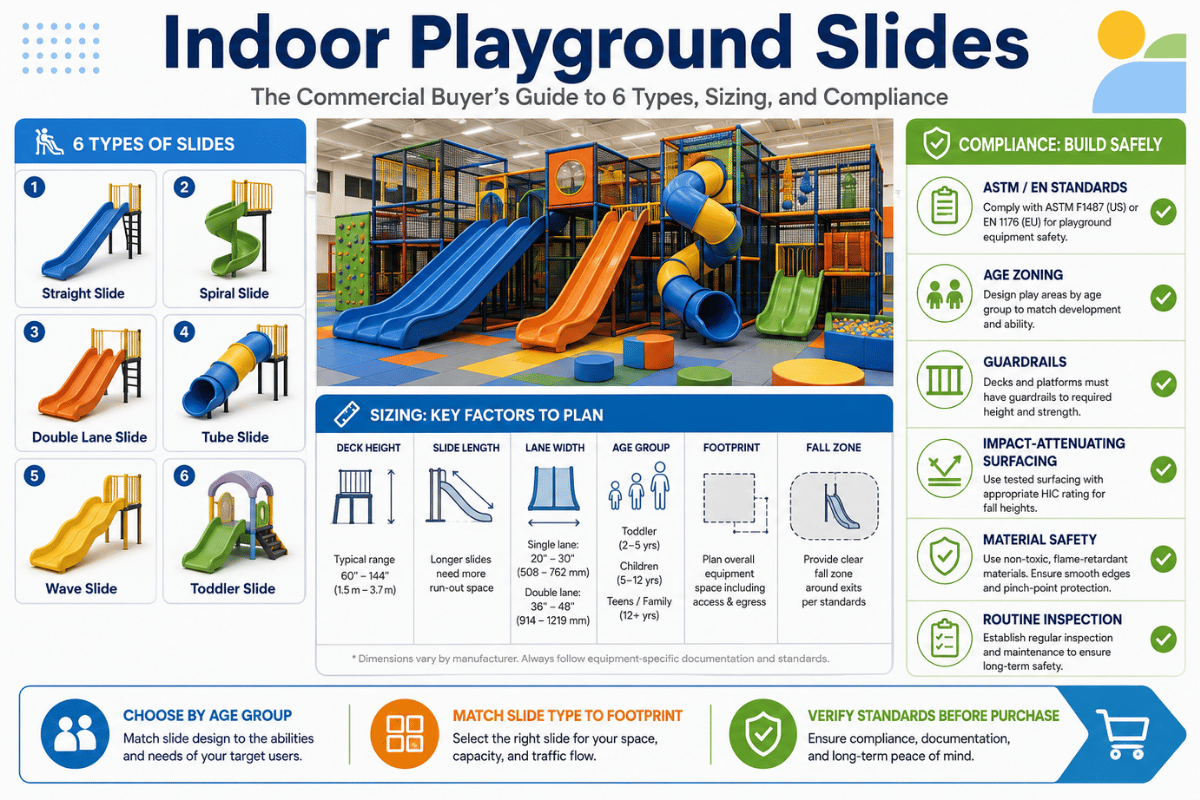
Indoor playground slides are the single most photographed feature inside any family entertainment center, mall play zone, or kindergarten activity room – and the single most over-bought category of equipment category when commercial buyers buy from residential-grade catalogs. Here is a primer separating commercial indoor playground slides from home indoor slides along si× a×es (load rating, daily cycle count, certification, lifecycle, layout footprint, and FOB pricing), walking through the six core type families, and surfacing the ASTM F1487-26 and EN 1177:2018+A1:2023 changes most likely to bite a 2026 procurement decision.
Quick Specs
| Slide Type Families | Spiral / Tube (Enclosed) / Wave / Open Bed / Straight / Themed Custom |
| Height Range | 6 ft – 12 ft (commercial); 3 ft – 5 ft (toddler) |
| Age Bands Served | 12 mo – 23 mo / 2 – 5 yr / 5 – 12 yr / mixed-age zones |
| Common Materials | PE rotomolded, GFRP (fiberglass), ABS, stainless steel (structural) |
| Compliance Stack | ASTM F1487-26 + ASTM F1292-22 + EN 1176-1:2017 + EN 1177:2018+A1:2023 + IPEMA + CPSIA |
| Cycle Rating (Commercial) | 200 – 500 slides/day per unit (high-traffic FEC) |
| Typical FOB Price | $1,500 – $6,800 (single unit; custom-themed adds 30–60%) |
What Counts as an Indoor Playground Slide (Commercial vs Residential)
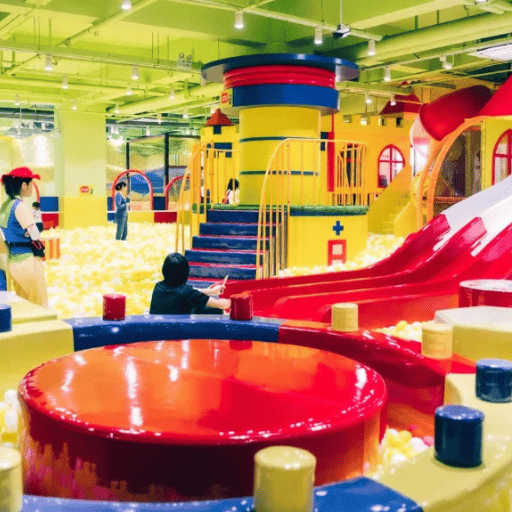
An indoor playground slide for commercial use must be structurally designed to carry 200-500 sliding cycles per day across a mix of weights and impact angles; an indoor slide intended for residential usage is rated for roughly 10-30 cycles per week across one family. The difference is not merely visual — it shapes the load rating, surface chemistry, certification path, and warranty coverage the buyer should be given. The U.S. Consumer Product Safety Commission’s Public Playground Safety Handbook is the primary regulatory reference distinguishing the two categories in the U.S. market.
U.S. search traffic for this phrase uncovers three competitor groups: residential install pages (Avenlur, Smart Playrooms, Amazon product listing) appealing to parents who buy a residential-grade plastic slide for the home; commercial planning pages (Softplay.com, Nextlevelparks.com, Proplaygrounds.com) appealing to family-entertainment-center operators; and facilities-as-products marketing like Urban Air’s Indoor Slide Park catering to customer venues. This guide is written for the second category — operators purchasing or con-sulting on commercial indoor playground slides.
| Dimension | Commercial Indoor Playground Slide | Residential Indoor Slide |
|---|---|---|
| Daily Cycle Rating | 200 – 500 slides/day | 10 – 30 slides/week |
| User Weight Range | 30 – 150 lb mixed | 25 – 75 lb single child |
| Required Standards | ASTM F1487-26, EN 1176-1, IPEMA, CPSIA | CPSIA + voluntary ASTM F963 (toys) |
| Material Spec | UV-stabilized PE rotomolded, GFRP, or stainless | Injection-molded plastic or wood |
| Typical Lifespan | 8 – 15 yr in heavy commercial use | 3 – 5 yr family use |
| Unit Price | $1,500 – $6,800 FOB | $80 – $400 retail |
A family-entertainment-center-use commercial slide installed into a 12-hour-a-day FEC will experience surface cracks, color washout, and other weak-point fatigue within 12-18 months – an inconvenient cost trap not reflected in the RFQ’s itemized costs. The reverse is equally true – designing a low-traffic kindergarten around a commercial-grade slide will result in paying for about 35-55% more capacity than the space actually needs.
The 6 Commercial Slide Types — Anatomy Cheat Sheet
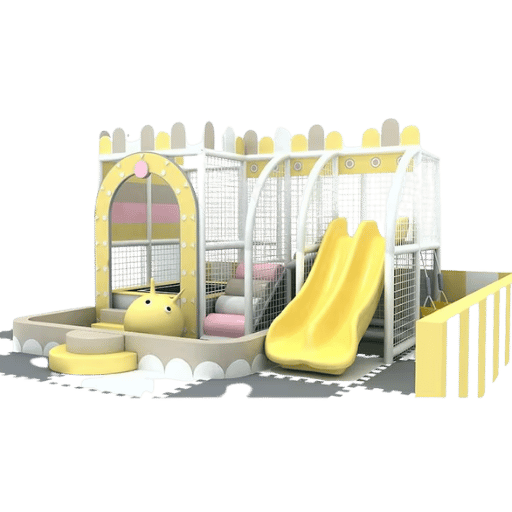
The six core categories shown are built off a cross-reference of commercial catalog pages (Soft Play, Next Level Parks, Pro Playgrounds, Iplayco) and the ASTM F-1487 categories (which professionally document use zone designs for U.S. commercial parks). It is worth noting the industry has struggled to standardize the matrix – Soft Play markets seven categories (adding Hump and Combo Spiral), Next Level markets six (including Multiple Lane). The following taxonomy is more grounded in physical anatomy than industry catchphrases.
The 5-Type Slide Anatomy Cheat Sheet
Each row maps the slide’s physical anatomy to the most-appropriate age group, ideal venue type, and typical cycle rating. Use this if you do not have a brand in mind, but you have a given foot print and age profile at the client venue.
| Type | Anatomy | Best Age | Best Venue | Cycles/Day |
|---|---|---|---|---|
| Open Bed | Single flat sliding plane, open sides | 2 – 12 yr | Mall, kindergarten | 300 – 500 |
| Wave | Multi-bump bedway, parallel lanes | 3 – 10 yr | FEC, theme park | 250 – 450 |
| Straight (Hump/Banister) | Linear with single drop | 2 – 12 yr | Any commercial venue | 300 – 500 |
| Spiral | Helical 180–540° rotation | 5 – 12 yr | FEC, trampoline park | 200 – 400 |
| Tube (Enclosed) | Fully enclosed tunnel, straight or curved | 5 – 12 yr | FEC with supervision strategy | 200 – 400 |
| Themed Custom | Any anatomy + bespoke styling | Match base type | Brand-led FEC, theme park | Match base type |
| Curved (L / J Shape) | Single 90–180° bend, open or partial wall | 3 – 10 yr | Mall, mid-range FEC | 250 – 450 |
| Combo Spiral (Double Helix) | Two intertwined spirals, parallel descent | 5 – 12 yr | FEC, family entertainment chain | 200 – 400 |
| Multi-Lane Racing | 3–6 parallel straight or wave lanes | 5 – 12 yr | Trampoline park, FEC | 300 – 500 |
⚠️ The Tube Slide Supervision Paradox
Tube (enclosed) slides tend to make buyers feel safer because the rider is contained — but the U.S. Consumer Product Safety Commission directly notes in the Public Playground Safety Handbook §5.7 that “supervisors should be aware of children using tube slides since the children are not always” visible. A tube slide trades visual containment for supervision visibility. If the staff-to-zone ratio dips below 1:25, the safer configuration is the open bed or wave slide.
Compare two different types of slides, the spiral slide and banister slide. The $1,000 spiral slide is enclosed and goes out to the side. The straight banister slide can be as little as $250. The spiral slide exits on different ASTM F-1487 numbers than the banister slide because of the slope and enclosed nature of its run-out zone:
— Playground Professionals, “What Makes a Great Play Structure”
What is the best age for an indoor slide?
The shortest defensible answer to the question “how much” is…the slide is appropriate to the child’s development, not just age in years. For example, a 36-month-old with vigorous gross-motor coordination can use a 6-ft open bed straight slide; a 5-year-old with developmental delay would be much better off on a toddler bed. Because the ASTM F1487 age bands – toddler (6-23 mo), preschool (2-5 yr), school-age (5-12 yr) – define design parameters, not user group assignments, choosing the best toddler slide for a 2-4 yr old (a toddler bed) can rarely be justified on safety grounds.
Age-Band Adaptation — Toddler vs Preschool vs School-Age

Playground slide injury data inform the age-band design choices. A peer-reviewed analysis in Playground slide-related injuries in preschool children (PMC NIH, NEISS national sampling) documented over 350,000 children aged 5 and under treated for slide-related injuries from 2002 to 2015 — most involving falls from the side or impact at exit. A 10-year retrospective in Clinical Pediatrics detailed the pattern: infants (12-23 mo) suffered most injuries on swings, but preschool children (23.1%) and elementary-age children (28.1%) peaked on slides.
Implication for a commercial purchaser: the 5-12 yr age band has the highest absolute number of slide-related injuries, while the 12-23 mo toddler band carries the highest slide-related injury severity. The design response takes two degrees of freedom: height and exit Geometry:
| Slide-Type × Age-Band Adaptation Grid | Toddler (12–23 mo) | Preschool (2–5 yr) | School-Age (5–12 yr) |
|---|---|---|---|
| Max Recommended Height | ~36 in (per CPSC handbook) | ~48 in | 8 – 12 ft |
| Slope | ≤ 24° | 28 – 32° | 28 – 32° (avg) |
| Best Type Match | Open bed straight | Open bed, wave | Spiral, tube, wave (multi-lane) |
| Exit Region Detail | Flat run-out 11 in min | Flat run-out 11 in min | Flat run-out + side barriers |
| Avoid | Tube/enclosed types | Spiral with > 360° | Toddler-bed dimensions |
ASTM F1487-26 tightens run-out geometry, surfacing performance, and gap requirements for the toddler and preschool brackets, according to industry analyses of the 2026 revision. Vendors quoting against pre-2024 designs without explicit F1487-26 declaration should be considered non-compliant for a 2026 procurement.
Sizing the Slide — Height, Slope, and Critical Fall Height
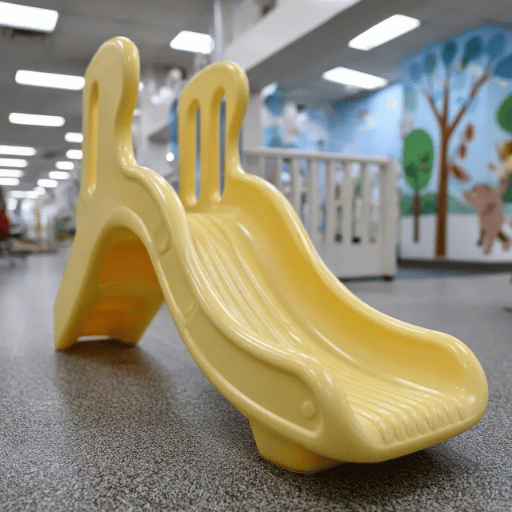
Three numbers govern the slide’s physical envelope: deck height, slope, and Critical Fall Height (CFH). Deck height is the maximum platform height; slope determines acceleration; CFH is the calculated height of a child’s sudden head impact acceptable for the Surfacing’s impact mitigating properties. CFH is not a slide property – it is a slide+sufacing system property:
📐 Engineering Note: How CFH is Calculated
Critical Fall Height equals the maximum theoretical free-fall height for which the surfacing material has been tested to keep a child’s head impact below the 1000-HIC (Head Injury Criterion) threshold. The American standard ASTM F1292-22 and the European standard EN 1177:2018+A1:2023 describe the test methods. CPSC surfacing depth tables — published in the Public Playground Safety Handbook §2.5 — give the practical depths: for an 8-ft deck height the surfacing must have a tested CFH ≥ 8 ft (unitary rubber PIP, engineered wood fiber at 12-in depth, or rubber mulch at 6-in depth). Loose-fill sand below 9-in depth will not pass; thin EVA foam tiles rated ≤ 4-ft CFH will not pass.
Height-to-Slope Selection Tree
Follow the tree until one branch hits your venue.
- Toddler-only (12-35 mo) 3-5 ft deck height, 24 slope, open bed, 11-in flat exit, surfacing CFH 4 ft (any 2-in EVA-tile mat or engineered foam works).
- Preschool (2-5 yr) 5-7 ft deck height, 28 slope, open bed or shallow wave, exit run-out 11 in, surfacing CFH 6 ft (engineered wood fiber 6 in or rubber tile).
- School-age (5-12 yr), standard 8 ft deck, 30 slope, open bed/wave/short spiral, run-out + barrier, surfacing CFH 8 ft (PIP rubber or EWF 12 in).
- School-age, thrill-focused FEC 10-12 ft deck, 30-32 slope, full spiral (360-540) or tube, supervised exit lane, surfacing CFH 12 ft (PIP only). Confirm with ASTM F1487-26 guidance on maximum.
It is a common intuition that “more height = more thrill = better attraction,” but empirical experience contradicts this: the PlaygroundEquipment.com survey on slide heights shows 20-30% lower throughput with 12 ft decks versus 8 ft decks because longer climbs draw out supervision queues. For most FECs the revenue-maximizing height is 8 ft with a 360° spiral element, not 12 ft straight.
Material Selection — PE Rotomolded vs GFRP vs Stainless Steel
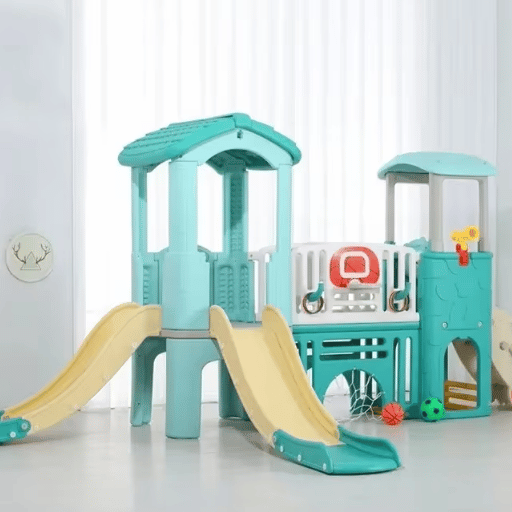
Four materials dominate commercial indoor slide manufacturing: rotomolded polyethylene (PE), glass-reinforced plastic (GFRP fiberglass), acrylonitrile butadiene styrene (ABS) injection-molded sections, and stainless steel (usually structural not sliding surface). Industry sources often cite rotomolded PE as lowest unit cost and GFRP as highest, but lifecycle calculations in some operating contexts invert the conclusion.
| Material | Typical Lifespan | UV Tolerance (Indoor) | Surface Repair Cost | Relative Unit Price |
|---|---|---|---|---|
| PE Rotomolded | 8 – 12 yr commercial | Moderate (skylight risk) | Replace section | 1.0× baseline |
| GFRP / Fiberglass | 12 – 15 yr commercial | High | Gel-coat re-laminate | 1.4 – 1.8× |
| ABS Injection | 6 – 10 yr commercial | Low (yellowing) | Section swap | 0.8 – 1.1× |
| Stainless Steel (304) | 20+ yr structural | Excellent | Buff/polish | 1.8 – 2.5× |
Material-Application Crossover Threshold
Lifecycle cost rule that inverts PE GFRP:
- Below 300 cycles/day & below 8 ft height rotomolded PE is champion for upfront + lifecycle.
- Between 300-450 cycles/day and 8-10 ft heights rotomolded PE or GFRP are both usable; venue thermal control is tiebreaker (indoor mall thermal-stable = PE; mixed-use adaptive = GFRP).
- Above 450 cycles/day OR 10+ ft height OR skylight exposure GFRP is victorious for 12-15 year lifecycle even 1.4-1.8 upfront. PE requires mid-life replace-guts section that erases acquisition savings.
Stainless steel sliding surfaces tend to be used in theme-park-grade installs where the visual premium funds the additional cost; in a typical FEC, stainless appears as structural framing, climb handles, or ladder rungs — not the slide bed itself. Material lead-content limits for any equipment marketed to children under 12 are also bound by the CPSC CPSIA lead and phthalate regulations, applying across all four material classes above.
From the Didi Land factory floor
Rotomolded PVC 9′ slide in our DDPS spiral-slide family (in 6 ft / 9 ft / 12 ft deck heights) has been the most prevalent export SKU since 2021, making up the lion’s share of installations in 40+ destination nations. Rest of family: 12 ft feeds destination FEC operators with 10,000+ sq ft in its soil; 6 ft toddler-tier is sold predominantly to Southeast Asian kinder and ECEC chains.
Compliance — ASTM F1487-26, EN 1176, IPEMA, and CPSIA
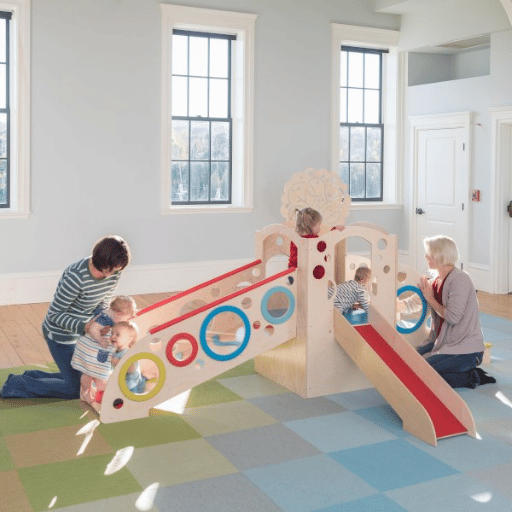
Four standards govern commercial indoor playground slides in U.S. and EU markets. ASTM F1487-26 (the 2026 revision of the U.S. Standard Consumer Safety Performance Specification for Playground Equipment for Public Use) is the headline change driving 2026 procurement: industry coverage indicates the revision broadens fall-zone planning, surfacing performance verification, and gap dimension rules relative to the 2021 edition. EN 1176-1:2017 remains the European equipment standard; EN 1177:2018+A1:2023 governs impact-attenuating surfacing across the EU. The CPSC Public Playground Safety Handbook functions as the U.S. government’s plain-language synthesis of these requirements and is the document buyers should keep at hand during procurement reviews.
| Standard | Scope | 2026 Status | Market Mandate |
|---|---|---|---|
| ASTM F1487-26 | Equipment performance | 2026 revision in effect | Public installations, US |
| ASTM F1292-22 | Surfacing impact attenuation | Current | Pairs with F1487 |
| EN 1176-1:2017 | Equipment general | Current (amendments pending) | EU mandatory |
| EN 1177:2018+A1:2023 | Surfacing test methods | Current (2023 amendment) | EU mandatory |
| IPEMA Certification | Third-party F1487/F1292 verification | Voluntary mark | US procurement preference |
| CPSIA | Lead/phthalates in children’s products | Current | US mandatory if marketed for ≤ 12 yr |
Are indoor playground slides good for sensory and motor development?
Yes, and the developmental story runs in the vestibular and proprioceptive streams-the body’s confirmation of head position and limb position with respect to gravity. The-repeat climb-slide-recover pattern mobilizes the vestibular apparatus: this is one reason therapists include slide play in sensory integration therapy. For the purchaser, this means two roll-over implications: it supports implementation of a slide as a main component (not a “luxury”) during early-childhood experiences, and it supports slide type mixing in a facility for the reason of variety in sensory types in the playing bodies.
Layout Integration — Slide Plus Ball Pit, Climber, and Supervision Sightlines
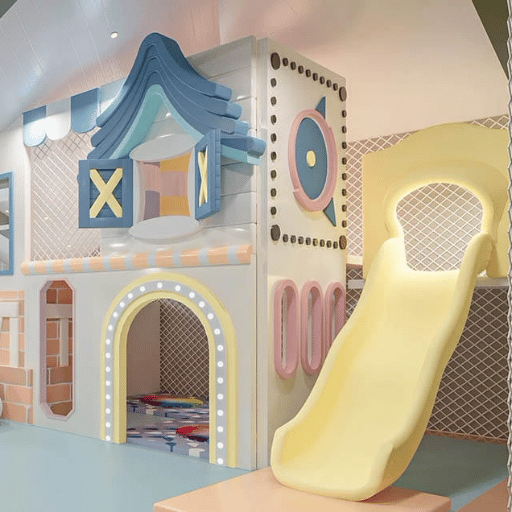
The single most-cited operator mistake on Reddit’s r/smallbusiness threads about indoor playgrounds is over-estimating the rent and square footage the business can afford — followed by under-utilizing the leased space. The slide’s placement within a venue shape determines the answer to both. The supervision-zone diagrams in the CPSC Public Playground Safety Handbook §3 are the most useful free reference for laying out slide use zones around adjacent equipment. A short integration playbook:
- Reserve a slide use-requirement of 4’/above the exit edge plus the slide height (a 9′-long slide needs 13′ visible before the exit; similar in EN 1176).
- Position the climb way so supervision desk has a line of sight through the climb ladder plus the exit lane-this non-negotiable for tubular/enclosed slides.
- If the slide arrives into a ball-pit, adhere to the optimum 18′-24 in pit depth (generally for school age; 14 in for early), and replenishment by volume weekly-at depletion was the most frequent audit failure.
- Avoid placing seating directly under high-noise slide-exit zones; the Soft Play design-mistakes guide calls this out as a top operator regret.
- Is down any columns or structural bracing-ensure all level-overall oversight staff coverage at signed floor plan, not installed.
Procurement — FOB Pricing, MOQ, and Lead Times
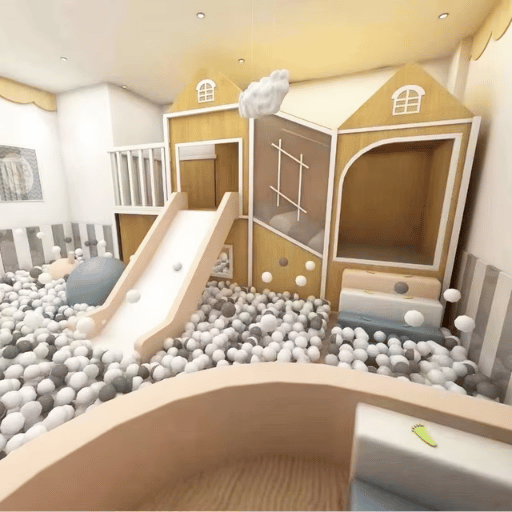
Industry-typical FOB values for commercial indoor playground slides ranges in the $1,500-$6,800 USD / slide market, with 3 decision factors causing the spread: modality complexity (open slope/bed low; spiral and tube high), material class (PE at the low end of the spectrum, GFRP at the range-end $6,800BD $1,500-20-80%,and finish tolerance (themed paintwork with custom architecture add approximately 30-60%). Most Chinese suppliers minimum order quantity in the industry is exactly 1 complete slide unit, and shipping load-fidelity in a 40ft high cube container is generally 4-8 slides (some times used in group projects for new FECs).
Commercial Slide Procurement Checklist
- Confirm the F1487-26+ F1292 labeling in the selling agent’s product datasheet- not just “ASTM compliant” but the actual version year.
- May I see IPEMA certificate number (or similar EU third-party-certified test report)? The absence of a certificate is a major warning sign no matter how much room it is used as Russian stock in negotiations.
- Request material declaration should be: PE/GFRP/ABS grade, virgin-resin percentage, and UV-stabilization additive; cross-reference against your CFH calculation.
- Lock the lead time tier: 60-day expedited (cost premium), 90-day standard, 120-day deep-customization. No open-ended timelines on FEC builds where the venue lease has a fixed move-in date.
Industry FEC capex breakdowns place slides at roughly 8-15% of the total equipment line, depending on the slide-to-soft-play ratio. The Family/Indoor Entertainment Centers Market Report places the global FEC market at $45.61 billion in 2026, projected to reach $76.68 billion by 2030 at a 13.9% CAGR. Procurement decisions for slides also intersect with the CPSC recall database — buyers conducting vendor due diligence should query the recall list against the specific manufacturer name before placing an order; a recall history within the past 36 months is a material red flag.
How much does a commercial indoor playground slide cost?
For a 9-ft PE rotomolded straight or wave slide expect $1,500 – $2,800 FOB China; a 9-ft GFRP spiral expect $3,200 – $4,800 FOB, for a fully themed custom unit with brand artwork and custom geometry $4,500 – $6,800 FOB with mold-tooling fees if the geometryis genuinely net-new. DDP (delivered duty paid) to U.S. ports typically adds 18-28% depending on lane and tariff status. Domestic U.S. manufacturers typically list MSRP at 1.5-2.2 the equivalent Chinese FOB including shipping – so the lane decision is typically just about lead time after-sales support, and project complexity not headline price.
The 2026–2028 Outlook — Themed, Modular, and FEC-Integrated
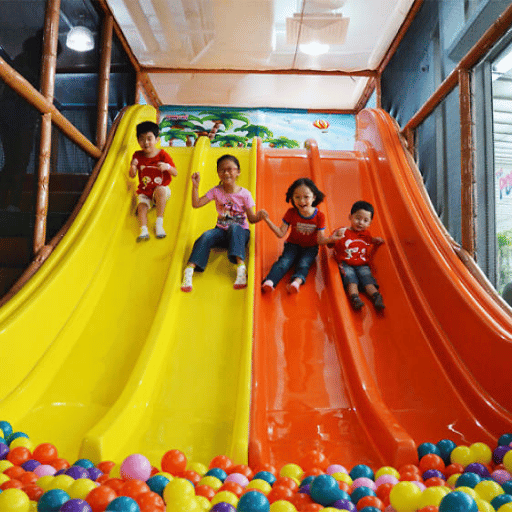
Three industry signals are aligning on slides as a 2026-2028 procurement category. First, the FEC market itself is in a sustained expansion cycle- Global Market Insights reported the FEC market at $28.2B in 2023 with a projected 10.5% CAGR through 2032, while researchandmarkets.com places the broader family/indoor entertainment segment at $45.61B in 2026 with a 13.9% CAGR. The substantive driver is post-pandemic recovery in venue-based family attractions combined with franchise expansion from Kids Empire, Urban Air, and Sky Zone.
Second, modular installation is becoming an explicit buyer preference. 2026 trade coverage of modular designs documents plug-and-play component systems that install in weeks, rather than months – a shift that compresses construction-loan amortization and allows venues to meet seasonal demand peaks (back-to-school, holiday season) by reconfiguring rather than rebuilding.
Third, the ASTM F1487-26 (2026 revision) is restructuring the procurement vetting checklist. Vendors quoting against F1487-21 (the 2021 edition) without explicit 2026-compliance language should be treated as legacy stock — acceptable for low-budget kindergarten or church installations, but disqualifying for FEC tenders that will be re-inspected against the new fall-zone, surfacing, and gap specifications. The CPSC public recall feed is the most practical 2026-2028 monitoring tool for tracking which slide models and manufacturers come under inspection scrutiny as the revised standard rolls out.
Action for 2026 buyers: If your venue’s grand opening is after Q2 2026, the procurement RFQ should explicitly demand F1487-26 compliance, EN 1177:2018+A1:2023 surfacing certification (for EU-bound exports), and material datasheets stating PE grade and UV-stabilization tier. Slides purchased to pre-revision specifications will pass inspection and sell into the secondary FEC market two to three years from now at a discount, but not at full value.
Twelve years and forty-some countries later:the lesson we keep relearning is that the slide is never the most expensive thing the operator buys – but it is almost always the thing snapped first when the venue opens. Spec it for cycle rating, supervision, and the default year: then you get the rest of the equipment schedule.]
— Cherry, Founder & CEO, Didi Land Amusement Equipment
FAQ
Q: What’s the best slide type for a 1,200 sqft FEC?
View Answer
One 8-ft school-age is dozen, or about 2/3 of one 130-180 sqft performance footprint (including use zone) including the style considerations for ADAA, VPA, and 8-ft deck height plus the other equipment mix. Add one toddler open-bed if user age split suggests, near the soft play entrance. Forego a tube/enclosed slide unless the venue expects sub-35′-square-ft zones-to-supervise ratio (hint:its cheap on seating and staffing to keep the flows separate). Base age randomization on real visitors, not vendor recommendations.
Q: Can I install a commercial spiral slide in a kindergarten?
View Answer
A 5-ft spiral with ~180 degress of rotation can be specified for a preschool k8 (2-5 yr), but a 360-graphics and greater is operationally designed for the 5-12 yr school-age band and dimensionally incompatible with many preschool zones. For compliance, the deck height is the showstopper: standard ASTM F1487-26 caps the preschool maximum deck height at about 124?cm 4ft. Pre-K and elementary-age extended programs can use a 6-8 ft spiral if the surfacing would require CFH to match the corresponding specs.
Q: How long do PE rotomolded slides last in heavy commercial use?
View Answer
In the commercial 200-500 cycles/day surfacing band, rotomolded PE slides average 8-12 years of service before leaving the surface skin healthy enough to consider section replacement or abrasive prep. If the venue keeps the interior climate stable, avoids UV exposure through skylights, and performs routine inspections and care per the manufacturer’s instructions, the upper bound of lifespan can stretch toward 12 years. Skylight exposure will accelerate fade out to the 6-8 year range even if the structure remains intact.
Q: Are softer landing surfaces worth the cost premium?
View Answer
Re: commercial deck heights 8 ft.. Yes- the cost delta between a 4-ft CFH foam tile and a 10-ft CFH poured-in-place rubber surface is real but small relative to the injury exposure mitigated.
Q: What’s changing in ASTM F1487-26 for 2026 procurement?
View Answer
The major shifts in the updated F1487-26 ASTM standards (according to industry reporting of the 2026 update) are expanded fall-zone planning around relatively flat surfaces and equipment edges, stricter testing requirements for surfacing durability, and reformulated tolerances (the dimensional spaces between equipment parts that are designed to prevent head, limb, and neck entrapment). The update also reiterates clarifications around the new categories of dynamic and interactive equipment. As a 2026 buyer, that means three quick-cost checks when talking for RFQ: confirm explicit F1487-26 adoption language (not just “ASTM compliant), require an updated test report dated 2025 or 2026, and check the surfacing CFH against the new performance test procedure.
Q: Can indoor slides help with motor-skills development?
View Answer
Climb – slip – descend – run-out – resolve: yes – climbing the ladder uses gross motor skills, the slide reinforces vestibular processing, and the run out teaches balance. Pediatric occupational therapy routinely uses slides in sensory integration for norm as well as atypical children.
Q: Why are slides especially good for toddlers?
View Answer
With a 12-35 mo child, the low-height open-bed slide provides much needed vestibular input {via vestibulospinal pathways} during the period of neuropath waypoint proliferation. The entire climb- slide- recover child confianza stimulus loop is a reinforcement of experience in voluntary control.
References & Sources
- Public Playground Safety Handbook — U.S. Consumer Product Safety Commission
- Playground slide-related injuries in preschool children — PubMed Central / NIH, NEISS national sampling
- A 10-Year Retrospective Review of Playground-Associated Injuries — Clinical Pediatrics (SAGE Journals)
- EN 1177:2018+A1:2023 — Impact Attenuating Playground Surfacing — European Committee for Standardization (CEN)
- Playground Injuries — Canadian Public Health Association
- Member of the Family — ASTM Use Zones for Slide Variants — Playground Professionals
- What Makes a Great Play Structure — Playground Professionals
- Family/Indoor Entertainment Centers Market Report 2026 — Research and Markets
- Family Entertainment Center Market Size, Industry Analysis 2032 — Global Market Insights
Related Articles
- Didi Land — Indoor Playground Equipment Manufacturer — overview of the four product lines and 11 sub-categories that include slides as one component.
- Indoor Play Structures: 7×6 Decision Matrix — companion piece on the broader play structure category that integrates slides.
- Ocean Theme Indoor Playground — themed configuration where wave slides operate as the visual anchor.
- Space Theme Indoor Playground — themed application showcasing tube slides with custom artwork.
- Jungle Theme Indoor Playground — modular themed pillar where spiral slides serve as the central thrill element.
- Candy Theme Indoor Playground — bright-color theme often paired with open-bed and wave slides.
About This Analysis
This comprehensive guide cross examines CPSC and NIH peer reviewed slide-injury research, ASTM F1487-26 industry coverage, EN 1177 surfacing industry standards, and twelve years of indoor-playground manufacturing experience across 40+ countries. It provides the commercial buyer a complete picture of the indoor playground slides category—from anatomy taxonomy to FOB pricing windows. Firsthand factory-floor data points (DDPS spiral family, 6/9/12 ft configurations) reflect true export volume within the Didi Land product line.
![Custom Dinosaur Playground Equipment [Design Guide]](https://didiplayarea.com/wp-content/uploads/2026/09/custom-dinosaur-playground-equipment-r2-featured-1-150x150.png)