Entre em Contato com Didi Land


Updated August 2026
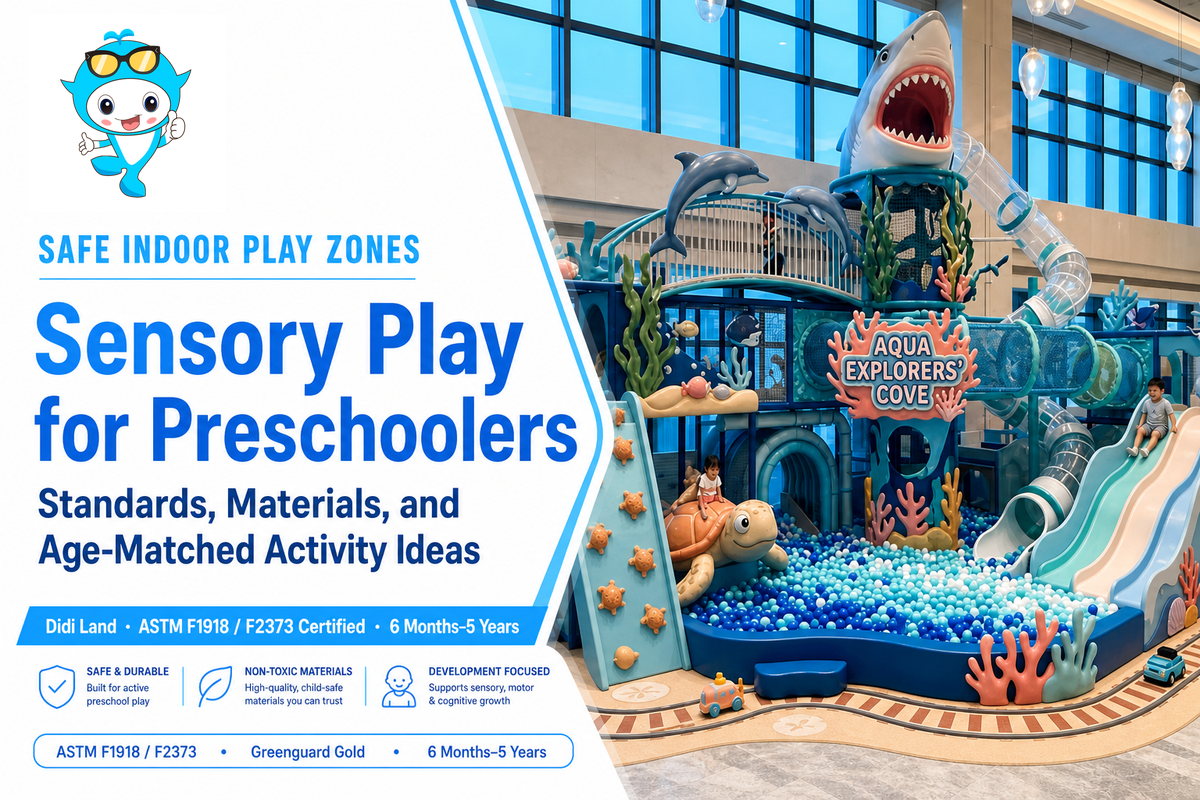
Sensory play for preschoolers is the process by which children ages three to five use all five senses to learn to manage impulse control, develop motor skills, and build their language through tactile and kinesthetic experiences with common elements like rice, water, foam, or patterned panels — and it can give the typical classroom more than just an open corner bin. If you operate an indoor play space and want to go beyond that, you have three key practical questions to ask yourself before purchasing your first toy: What standard applies to soft-contained play structures like yours, what are the acceptable thresholds for the materials you want to use, and which play format-a bin, tabletop, or play zone-best suits your physical footprint and budget. We’ll go through all three of these, as well as age-appropriate activity suggestions and common mistakes that can transform a well-intended play zone into an accident waiting to happen.
Especificações rápidas
| Faixa etária abrangida | 6 months – 5 years (ASTM F1918 covers the soft-contained equipment for ages 2–12; the 6–23-month band sits in a published standards gap — see the comparison table below) |
| Primary equipment standard | ASTM F1918 (soft-contained play), not the broader ASTM F1487 series |
| Material certification to request | Greenguard Gold (360+ VOCs screened) + CPSIA phthalate compliance |
| Typical zone footprint | Corner bin: 10-30 sqft · Table station: 40-80 sqft · Built-in zone: 150-800+ sqft |
| Typical investment range | DIY bin: under $100 · Commercial toddler play equipment: roughly $5,000-$300,000+ depending on scale (verify current pricing with your supplier) |
What Is Sensory Play and Why It Matters for Preschoolers
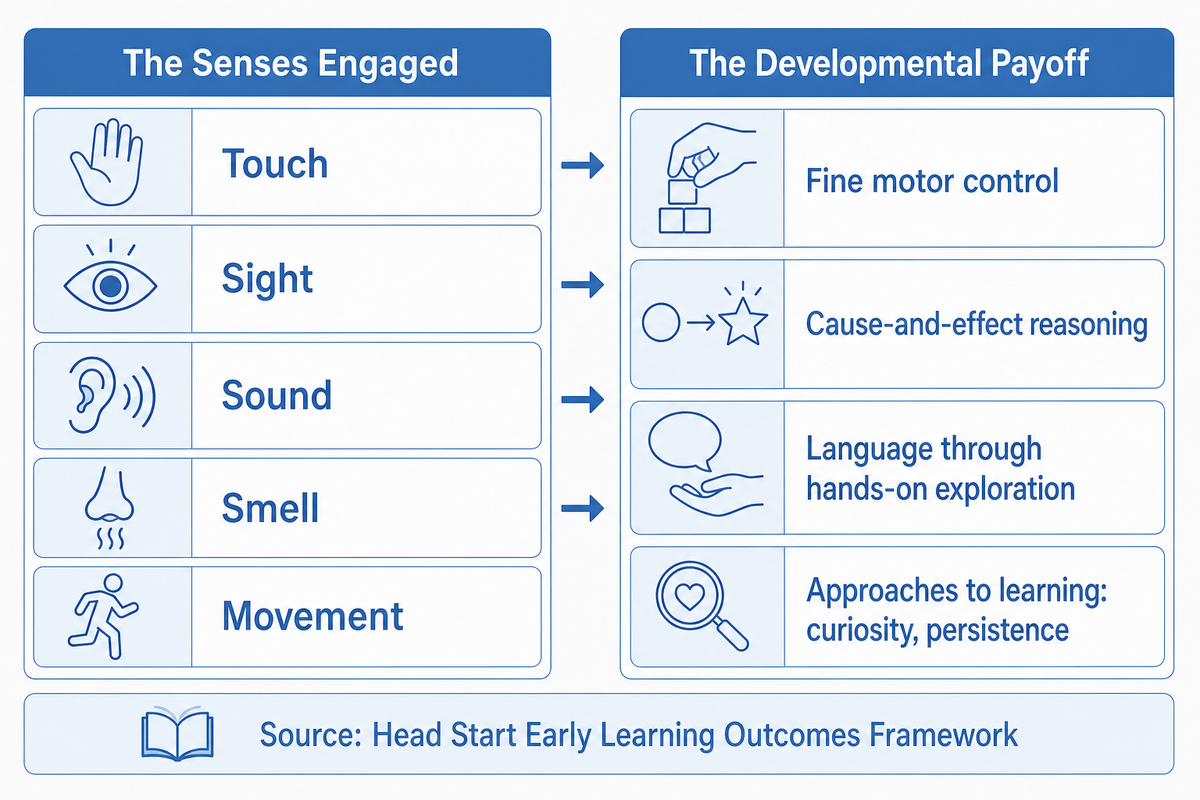
Sensory play for preschoolers is any activity that engages a child’s senses of touch, smell, taste, sight, sound, or movement through hands-on exploration — a water table, a bin of rice, a textured wall, a light table with translucent objects. It matters because young children’s brains develop through the body before language catches up: pouring, scooping, and sorting build the fine motor control kids later use for writing and for picking up a spoon.
This point is supported directly by the federal Head Start program’s own guidelines for learning through play. Head Start research has documented the benefits of messy and sensory play in which open-ended exploration of materials promotes several of Head Start’s Early Learning Outcomes Framework areas, including motor development, the discovery of cause-and-effect and a host of “approaches to learning” including curiousity, initiation, and persistence. None of this needs to involve fancy equipment to start-simply the development of a clearly designated, safely enclosed space and materials that can withstand repetition.
This is what happens when preschool or a family entertainment center graduates from a single bin in the corner of the classroom to a built-in sensory station for daily group rotation. That’s when questions transition from “what’s fun?” to “what’s Code-built, safety certified, and physically fit for the space?” — which is what the rest of this guide covers.
The stakes of getting this wrong scale with the room size. One bin in the corner of a classroom is forgiving — a spilled tray of rice is a five-minute cleanup. But get the material wrong for a child under 3 years old, and a bin of rice becomes a choking risk, not a fine-motor exercise; miscalculate supervision ratios across a built-in station and a minor mess turns into a real incident report. That’s the practical reason preschool directors, daycare procurement teams, and school district facilities staff increasingly treat a $20 craft-aisle bin and a $5,000-and-up built-in sensory station as two different purchasing decisions, not the same one scaled up: age-appropriateness, material safety, and supervision load all apply, just less visibly than they do on a slide or climbing structure.
Designing a Safe Indoor Sensory Play Zone: Standards Buyers Should Know
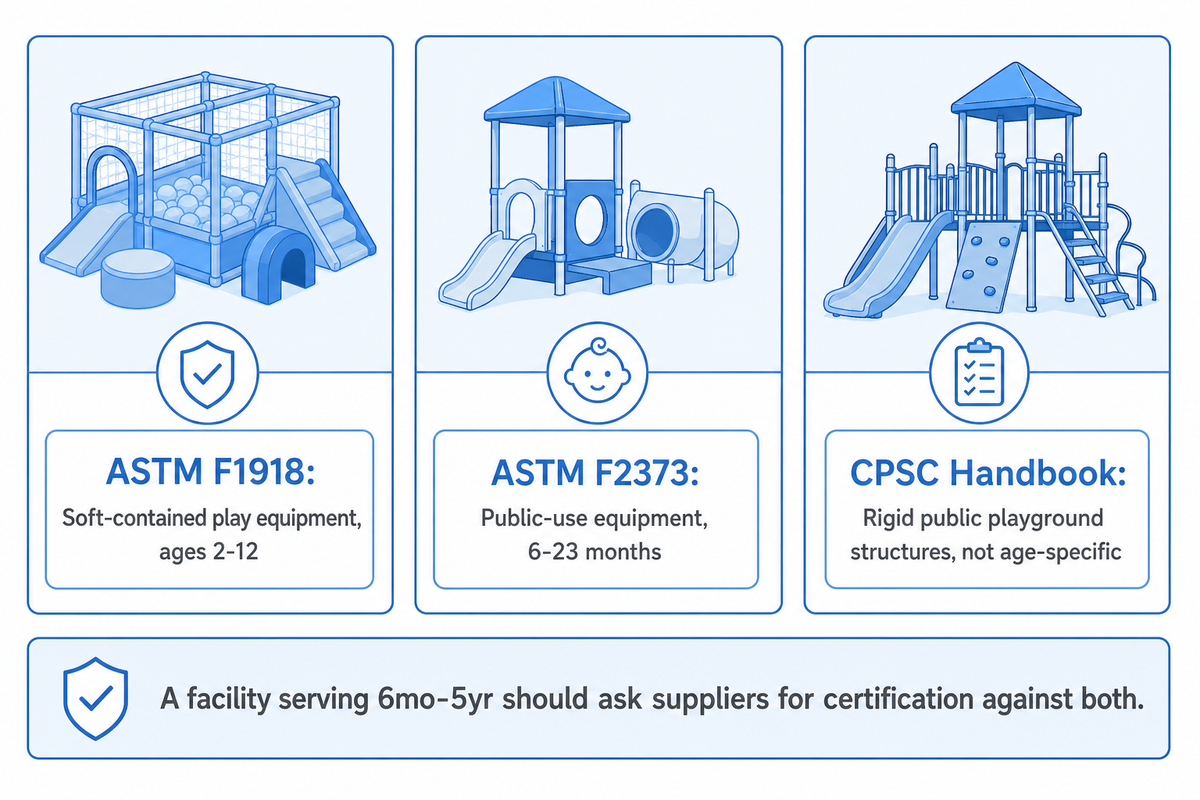
Building a permanent sensory play zone from soft-contained equipment, foam blocks, ball pits, padded panels, puts you under a specific U.S. standard: ASTM F1918, not the broader ASTM F1487 series that most people associate with “playground standards.” F1918’s own published scope explicitly excludes public playground equipment, home playground equipment, sports equipment, and toys — it’s the dedicated specification for soft-contained play, covering structural integrity, fire safety, evacuation routes, and access/egress. Equipment for children ages 6 through 23 months sits in a published scope gap: ASTM F1918 (soft-contained play equipment) only covers ages 2 and up, and ASTM F2373 — the standard written for that youngest public-use age band — explicitly excludes soft-contained play equipment from its own scope (it covers rigid structures like composite climbers and slides instead). Facilities serving the full 6-month-to-5-year range should ask suppliers directly what they test the youngest-band soft-contained equipment against, since no single named standard covers it by its own published terms.
Before specifying a room you want to get one nuance absolutely right: the CPSC’s new Public Playground Safety Handbook revision – published in July 2025, the first significant rewrite since 2010 – says very explicitly its guidance is for rigid public play structures and doesn’t apply to soft contained play equipment. If the room is a hybrid with a soft sensory play zone coupled with hard climbing structures, both sets of rules apply to different sections: to the soft contained sensory stations use ASTM F1918, for hard surfaces and platforms use the general principles in the CPSC Handbook (see our breakdown of the CPSC Handbook) and ASTM F1487 (see our ASTM F1487 edition comparison). Either way, neither is technically mandatory, but inspectors, lawyers, and insurance brokers treat the published guidelines the same way: as the measure of what’s a “reasonably prudent” play design, effectively mandating the standards.
Even so, there are a few figures derived from the CPSC’s own guidance worth building in, no matter what kind of equipment you’re putting in: the 22-26 inch handrail height is the one most commonly quoted for ages 2-5, the Handbook uses a 17-28 inch opening-perimeter range with torso and head probes when it evaluates flexible net openings, and the July 2025 edition, importantly, declined to exempt partially bounded gaps below 24 inches from entrapment-hazard review – a detail you should raise with anyone showing you modular wall panel options. The CPSC reports roughly 190,000 emergency-room visits a year tied to playgrounds, another indicator that softplay doesn’t come with zero risk.
💡 Dica profissional
Ask any soft play supplier what they actually test the equipment against for each age band, and get the standard number and edition in writing. F1918 only covers soft-contained equipment from age 2 up; F2373 is written for rigid public-use structures, not soft-contained equipment, so a supplier citing it for a 6-23-month soft play line should be able to explain exactly what it’s testing. Anything that references generic ASTM certified without naming the number of the standard and matching it to the equipment type can be sent straight back where it came from.
| Comparison point | ASTM F1918 | ASTM F2373 | CPSC Handbook |
|---|---|---|---|
| Full title | Standard Consumer Safety Performance Specification for Soft Contained Play Equipment | Standard Consumer Safety Performance Specification for Public Use Play Equipment for Children 6 Months through 23 Months | Manual de Segurança de Playgrounds Públicos (Publication 325) |
| Faixa etária abrangida | 2-12 years | 6-23 months | Not age-specific; equipment-specific instead |
| Equipment covered | Soft-contained play: foam blocks, ball pits, padded panels | Rigid public-use structures for the youngest age band: composite structures, climbers, swings, slides — explicitly excludes soft-contained play equipment (scope clause 1.5) | Rigid public playground structures: slides, climbers, swings |
| Publishing body | ASTM Internacional | ASTM Internacional | Comissão de Segurança de Produtos de Consumo dos EUA |
| Última edição | F1918-21 | F2373-24 | 2025 update, first major revision since 2010 |
| Obrigatório ou voluntário | Voluntary industry-standard reference | Voluntary industry-standard reference | Voluntary guidance |
| Applies to soft-contained sensory equipment | Yes — primary standard (ages 2-12 only) | No — explicitly excluded from scope (clause 1.5) | No — explicitly excluded from scope |
| Applies to rigid public playground structures | Não | Não | Yes — primary reference |
| Where it’s cited in this guide | Quick Specs, RFQ checklist | Background and scope-gap context only | Background and adjacent-context only |
Choosing Safe Materials: What to Look for in Sensory Play Equipment
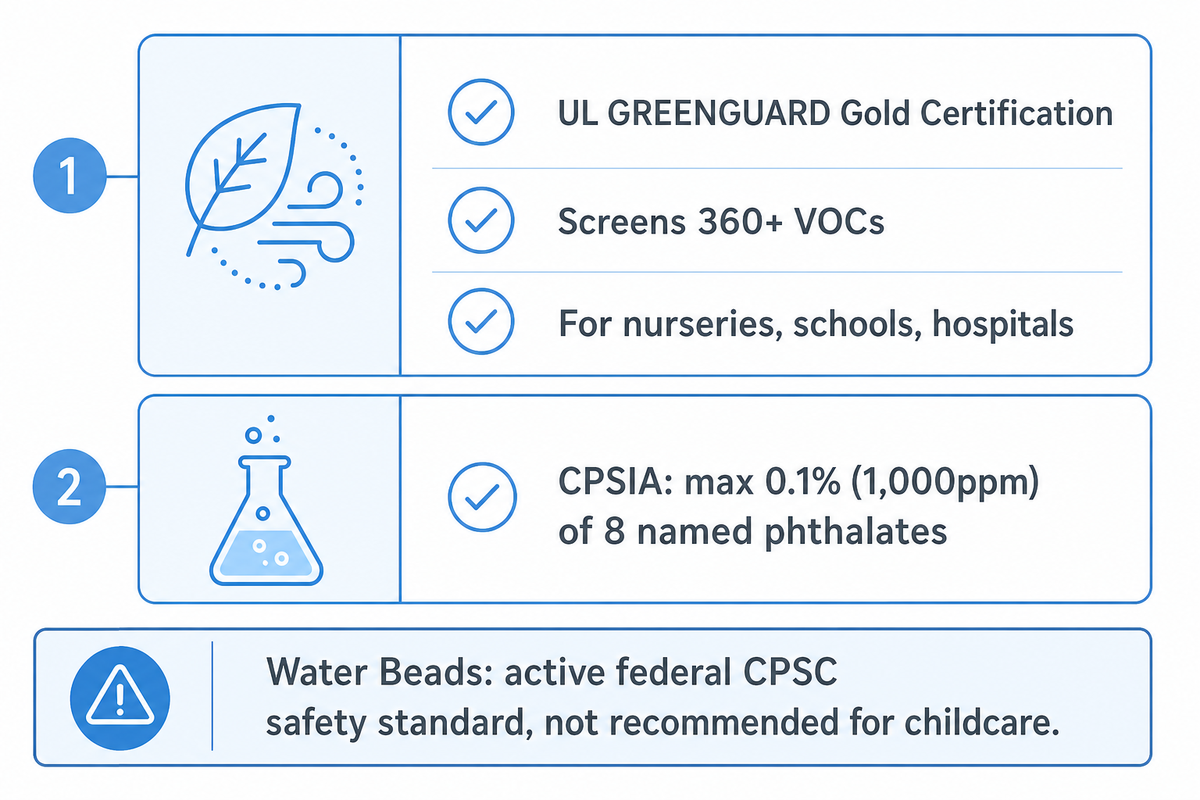
Material safety in a commercial sensory zone comes down to two verification points to ask suppliers for, plus one hazard specific to a very popular sensory-play material — not a complete safety checklist.
Emissions: Any softplay or sensory product that’s to be sold to an environment where low VOC (volatile organic compounds) is key (as it’s for nurseries, schools, and hospitals) will now typically come with the UL GREENGUARD Gold Certification. This is a program developed by UL Solutions (the same organization that certifies this product standard) which tests over 360 different individual chemical components to ensure they fall well within established limits for airborne emissions of chemicals emitted from flooring and surfaces and interior furnishings and building materials. Greenguard Gold is the stricter tier, not the base Greenguard certification, so make sure your supplier is referencing which one they’re supplying!
Chemical content: While CPSIA only regulates a named list of phthalates, it sets a limit of no more than 0.1% (1,000 ppm) for each of the eight named phthalates in “accessible plastic parts of children toys or childcare articles” where it specifically applies. “Safe” and “non-toxic” products are in fact just a marketing tactic unless the products are verified by one of the above criteria. Ask suppliers for their test results number and not just their stamp.
Lista de verificação RFQ, copie-os em sua solicitação de orçamento:
| Parâmetro | Gama recomendada | Por que isso importa | Como verificar |
|---|---|---|---|
| Equipment standard | ASTM F1918 (2-12yr); for the 6-23 month band, ask directly what’s tested — F2373 excludes soft-contained equipment from its scope | Confirms the right spec for the age range in the room | Ask for the standard number and edition on the test report |
| Material emissions | Ouro Greenguard | Lower VOC threshold appropriate for a childcare/school setting | Request the UL certificate, not just a logo |
| Chemical content | CPSIA-compliant (≤0.1% of 8 named phthalates) | Federal requirement for toy/child-care-article components | Ask for a third-party lab test report, not a self-declaration |
| Fill/loose materials (if using water beads, sand, etc.) | Confirm current CPSC guidance for the specific material | Some popular sensory fillers carry active federal safety warnings — see below | Check cpsc.gov before purchasing any loose fill material |
One specific material warning you might want to know, just for your information: Water beads. These are the small plastic spheres that soak up water and plump up into gelatinous spheres (you know, the ones often appearing in “sensory bin ideas”). Thanks to approximately 6,300 emergency department visits between 2017 and 2022 for ingestion injuries to children in the United States (including at least one death), these things now have an official federal safety standard that became effective on March 12, 2026. Ingested water beads keep growing inside the body, which is why CPSC says a swallowed bead can cause blockages serious enough to need surgery. If a supplier or activity list mentions water beads but fails to note this recent guidance, that’s a warning sign the recommendation predates the latest safety guidelines.
“CPSC urges parents and caregivers to remove these products from any environment with children. CPSC also urges childcare centers, camps, and schools to avoid these products entirely.”
Sensory Bins and Table Setups for a Preschool Classroom or Facility
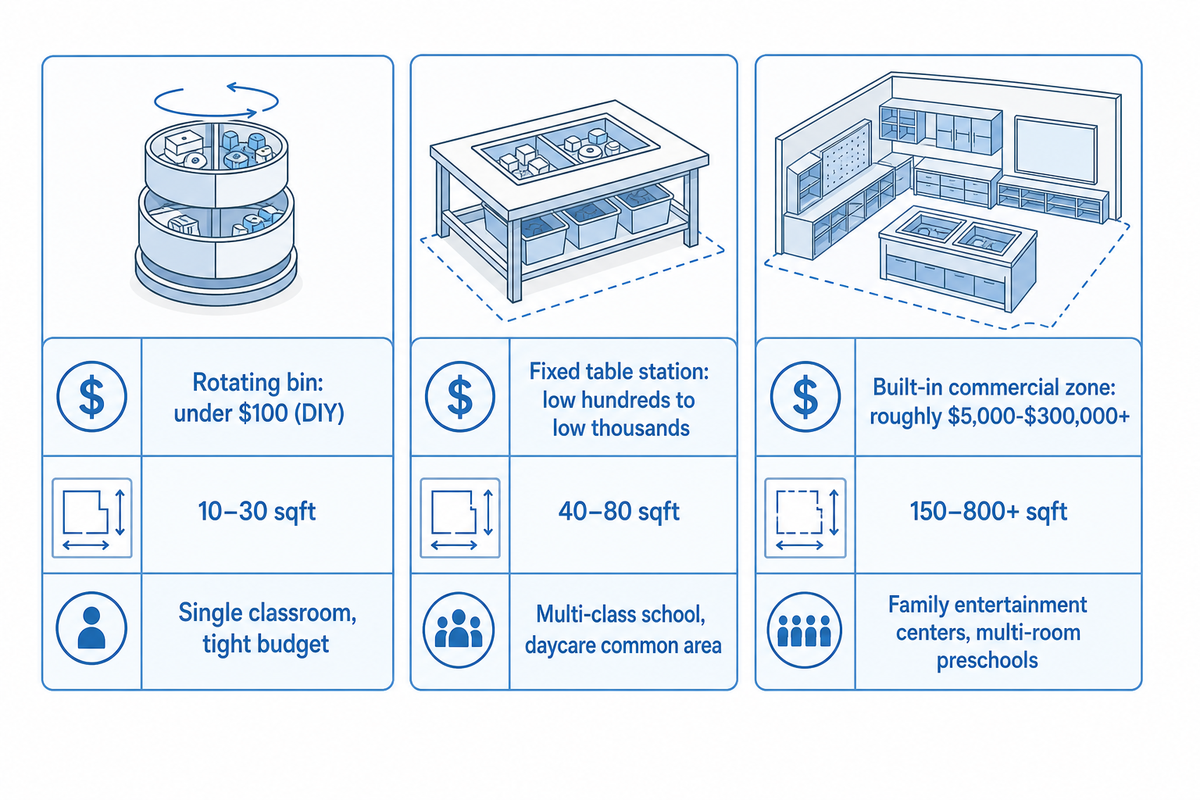
After you’ve nailed down some materials, let’s get practical and talk about format: A rotating bin? A static table? A built-in area? Each format will compromise differently – to a different extent! – across cost, space, wear, and the number of facilitators you’ll need for supervision.
| Formato | Typical cost | Pegada | Durabilidade | Supervision need | Melhor ajuste |
|---|---|---|---|---|---|
| Rotating bin | Under $100 per bin (DIY) | 10-30 sqft | Low — plastic bins wear/crack, materials need frequent replacing | High — small children need close 1:1 or small-group watching | Single classroom, tight budget, rotating themes |
| Fixed table station | Low hundreds to low thousands | 40-80 sqft | Medium — built for repeated daily use, moderate maintenance | Medium — group-level supervision workable | Multi-class school, daycare common area |
| Built-in commercial zone | Roughly $5,000-$300,000+ depending on scale (verify with supplier) | 150-800+ sqft | High — commercial-grade materials rated for daily multi-group use | Lower per-child — designed sightlines support facility-scale supervision | Family entertainment centers, kindergartens, multi-room preschools |
The shift from DIY to commercial isn’t just about scale; it’s about determining liability when things go pear-shaped. According to a licensed occupational therapist with more than 25 years of pediatric practice, there’s a critical factor to consider early: many school districts prohibit homemade and second-hand materials for this type of furniture and equipment, even when the homemade version is arguably better built, because they won’t cover them from an insurance and liability standpoint. So if you’re planning for a school or daycare space, rather than your home, be sure to check your facility’s procurement policies before budgeting around your DIY design dreams.
Popular Sensory Bin Ideas and Themes
Whatever the format, most sensory activities for toddlers and preschoolers pull from the same short list of classic fillers — and every one benefits from a quick safety check before it goes in front of children. Popular themed sensory bin ideas include:
- Summer theme bin: colored rice or moon sand paired with small shells and sand toys.
- Dinosaur toys dig-and-discover bin: plastic dinosaur figures hidden in cornstarch “oobleck” or dry beans for a squish-and-search hunt.
- Food coloring water table: playing with water turns into a color sorting exercise.
- A classic gooey bin: whipped cream, shaving cream, or soapy cotton balls give younger toddlers a puffy, mess free way to explore different textures on a tray.
- Slime e play dough (playdough), plus sand slime recipes that combine kinetic sand with slime, round out the easy toddler favorites.
- Ice cubes and splash-friendly water play need a spill mat and closer supervision, not a certification concern.
| Material / theme | Best age range | Loose-parts risk under 3 | Safety note |
|---|---|---|---|
| Colored rice | 3-5 years | Alto | Classic scoop-and-pour filler; avoid for children under 3 |
| Moon sand | 3-5 years | Alto | Same under-3 rule as colored rice |
| Cornstarch “oobleck” | 2-5 years | Baixo | Non-solid, washable, no small parts |
| Dry beans (dig-and-discover) | 4-5 years | Alto | Not for children under 3 |
| Food-coloring water | 6 months-5 years | Baixo | Safe across the full age range with supervision |
| Whipped cream / shaving cream | 18 months-5 years | Baixo | Check for allergies before first use |
| Soapy cotton balls | 2-5 years | Médio | Supervise closely; balls can be pulled apart into small pieces |
| Slime / play dough | 3-5 years | Alto | Same under-3 rule as rice; confirm CPSIA phthalate compliance for store-bought dough |
| Ice cubes | 3-5 years | Médio | Spill mat recommended; supervise for slip and cold-handling |
| Water beads | Not recommended in childcare settings | Alto | Active federal CPSC safety standard — see the material warning above |
These are fun sensory activities, but they’re also fun learning: early childhood research ties these hands-on experiences to developing fine motor skills, hand-eye coordination, cause and effect reasoning, and visual perception — the neural connections a young child’s brain builds through repeated exploration, and the reasoning behind most published benefits of sensory play. That’s why a scoop-and-pour bin or a five senses table shows up in nearly every list of best sensory activities and top sensory play ideas: they combine play-based learning activities with the explore and learn independence a facility wants from a play activities station that runs itself once it’s set up, whether that station lives at home and school or in a commercial facility, combining fun and learning with real developmental gains. The one catch for a commercial setting: toddlers under 3 put everything in their mouth first, so any of these classic fillers needs the same age check as the fixed equipment above before it goes in a toddler-accessible bin serving play for kids that age.
Portable Sensory Tools: Bottles, Bags, and Low-Cost Materials
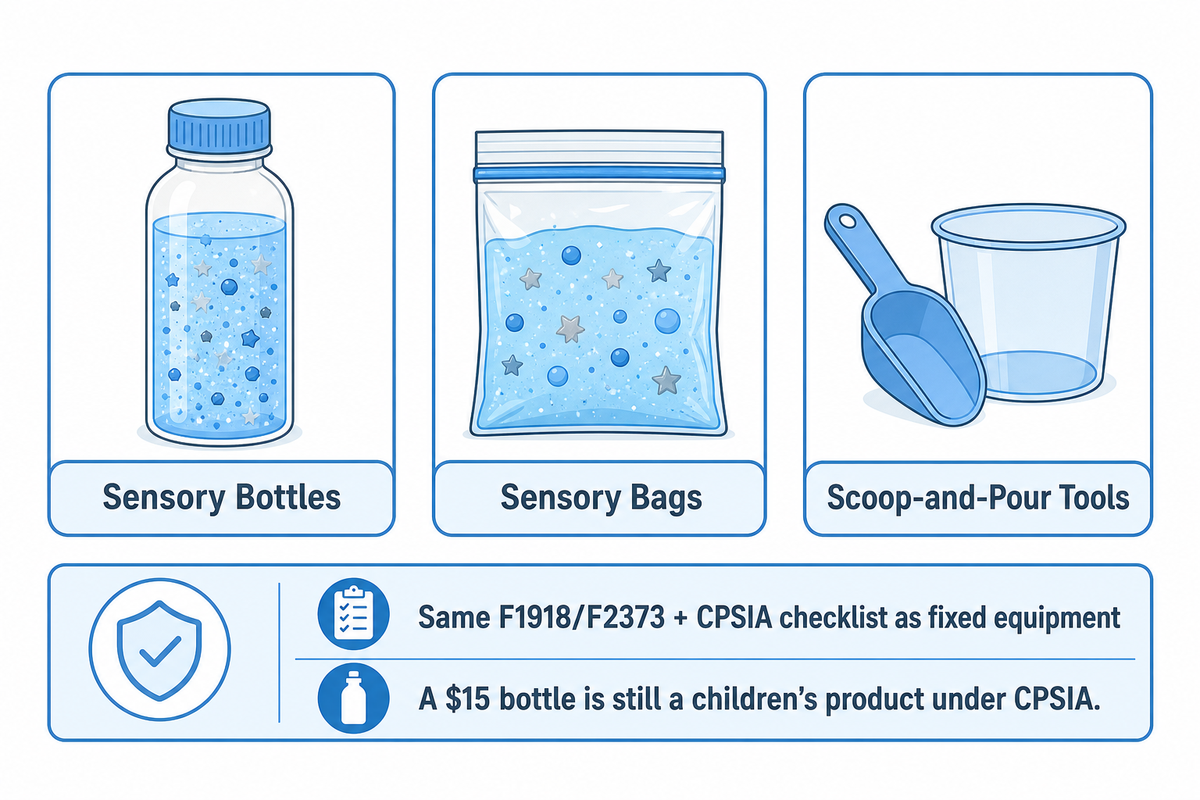
Not all sensory experiences require a dedicated station; you don’t need to designate an entire corner. Sealed sensory bottles hold oil, glitter, or tinted water in a leakproof container. Sensory bags seal thick liquids — hair gel or paint — inside a heavy-duty ziplock bag that kids can squish without popping it. Both, plus simple scoop-and-pour materials, add a sensory dimension to any area without eating up your square footage. Use them in a reading corner, as a calming transition activity, or send one home with a child for their family to use.
There’s one safety standard you should maintain as nonnegotiable: In any item meant for a child younger than age three, there should be no small, separate, loose parts or any material capable of becoming ingested or presenting a choking hazard should a seal fail. This is the same principle we discussed regarding water beads, in that what might be safe for an older preschooler under supervision at a table could pose a serious hazard for a younger child in their play area. When selecting materials, make sure to assess the age of the children who will use them, not just the marketed age range.
For facilities standardizing a supply list across multiple classrooms, portable tools are also where certification paperwork gets skipped most often — a sealed bottle or bag doesn’t look like “equipment,” so it’s easy to assume the ASTM F1918 and CPSIA rules covered above don’t apply. They do. Didi Land manufactures its soft-contained play equipment against a compliance stack that includes ASTM F1918 and CPSIA — use this compliance selector to confirm which standard applies to a given piece of equipment — and treats portable sensory items as part of the same compliance checklist, not an exception — because a $15 sensory bottle sold to a licensed daycare is still a children’s product under CPSIA, whether it’s an $8 bag of colored rice or a $40 set of pre-filled bottles, and a supplier who can’t produce a certified phthalate test report for it shouldn’t make your procurement shortlist.
Designing for Sensory Processing Needs: Inclusive Play Zones
General sensory play for typical development and a sensory-processing-informed zone chase different goals. The inclusive zone specifically serves over- or under-responsive children, many of whom are on the autism spectrum. A sensory-informed space is an issue of environmental design and architectural accommodation-not clinical therapy or treatment. A room that’s well designed and conducive to these needs doesn’t replace the clinical necessity of specialized occupational therapy, and the research has been inconsistent regarding occupational and sensory-integration therapy as a treatment itself. The best you can do as a designer is create an environment that’s helpful and approachable to the children who will use it.
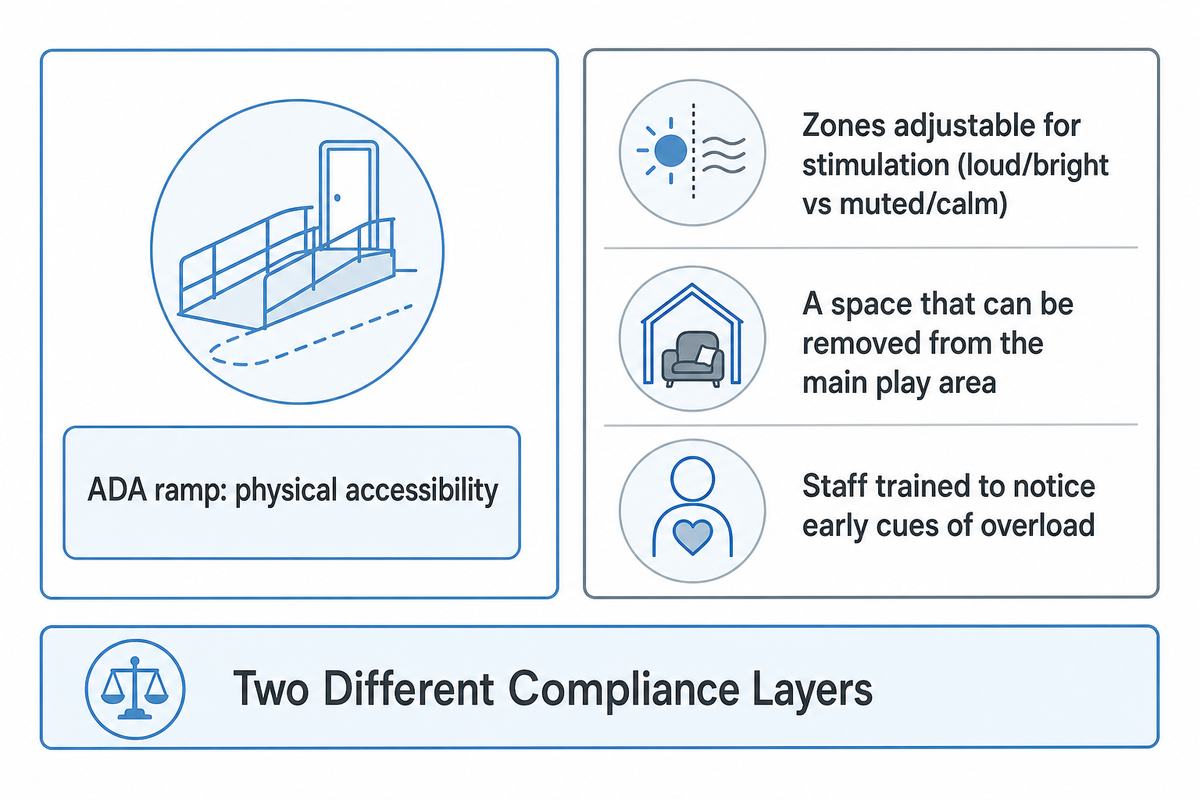
Sensory Escape, a Canton, Ohio youth gym, offers a real-life alternative to marketing copy: two different play areas plus a dedicated, silent room designed so neurodivergent kids can use equipment like swings, slides and jungle gyms in a manner that feels comfortable to them, and with a place to retreat if things become overwhelming. The basic principles are portable to most spaces: zones that can be individually adjusted for stimulation (loud/bright versus muted/calm), a space that can be removed from the main play area, and personnel who learn to notice early cues of overload before they escalate to full meltdown.
Know your distinctions when you plan: the ADA ramp to a table isn’t the same as the quiet cool zone beside it, and the facility that accommodates mobility doesn’t automatically support neurodivergent needs. Physical layout has real numbers behind it, too — U.S. Access Board guidance sets a 36-inch minimum clear width for the accessible route (passing-space conditions apply under 60 inches), and for soft-contained play structures, three or fewer entry points need at least one on that route, four or more need at least two.
When a facility is comparing suppliers for an inclusive sensory room, the specification sheet matters as much as the marketing copy. Didi Land’s product certifications (ASTM F1918, CPSIA-compliant materials) apply the same way to an inclusive zone as to a standard play area, because a sensory-processing-informed room is still built from soft-contained equipment, not therapy tools — so the same procurement checklist from the RFQ section above still applies, and buyers should still ask any supplier for the Greenguard Gold and CPSIA test reports named in that checklist rather than accept a compliance claim at face value. A public agency or school district requesting quotes for a $150,000 renovation should ask suppliers the identical certification questions whether the brief says “inclusive sensory room” or “toddler play zone,” and the same discipline holds for a smaller $12,000 single-room retrofit.
Age-Appropriate Sensory Activity Ideas (6 Months to 5 Years)
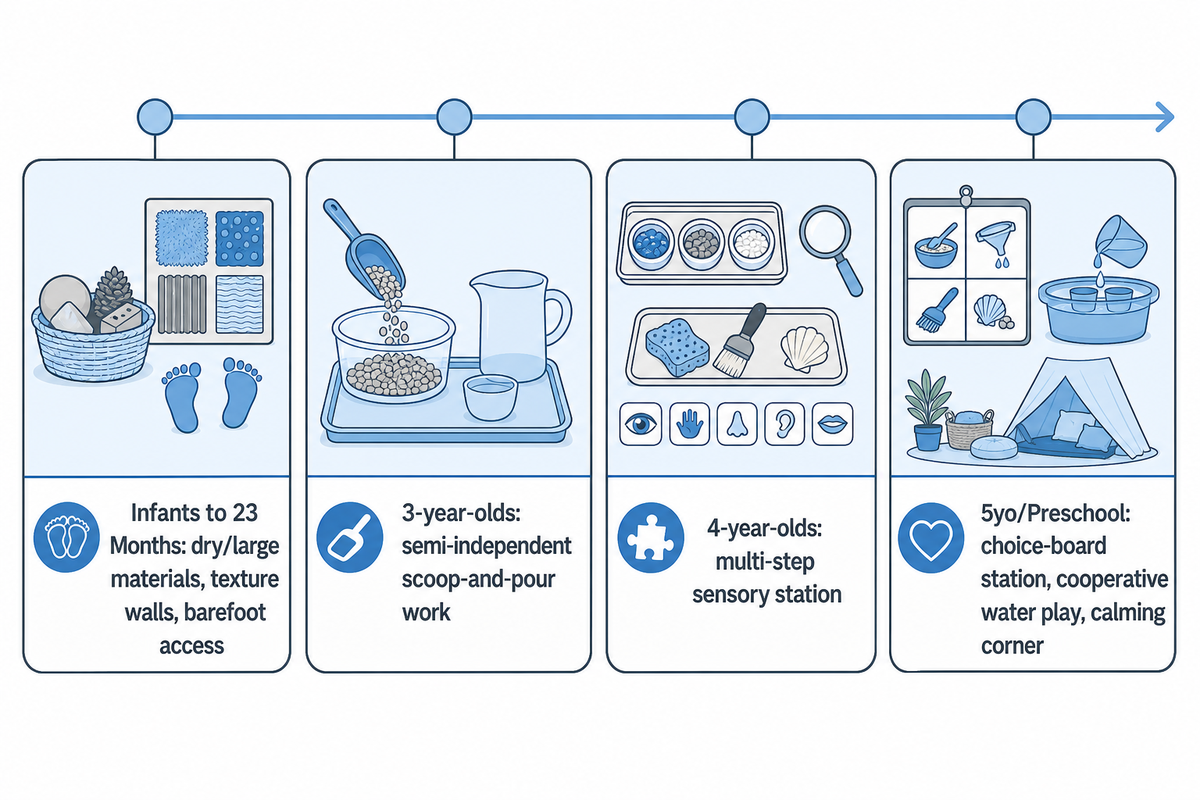
Age-appropriateness trumps material-the same bin of rice, fun for a four-year-old, may be an oral hazard for a 14-month-old still mouthing everything.
Infants to 23 Months: dry/large for safety, plus easy access to materials like paper, jumbo pom-poms, or loose part play; texture walls; barefoot access to grass, sand, or mats for whole-body experience.
What is sensory play for 3 year olds?
Three-year-olds are usually ready for semi-independent scoop-and-pour work, whether that’s a rice-and-cup bin, a water table, or soft dough. Most can follow a simple two-step direction, which is enough for a light sequencing task without becoming too tricky for their attention span. One rotating bin with two or three tools works well at this age.
What is sensory play for 4 year olds?
Four-year-olds: can handle a multi-step sensory station with several steps or longer times to work alone; they can take part in a color-sorting game, a five-senses game, or a simple science exploration; they benefit from prompts that encourage language descriptions during play such as, “What do you think that feels like?”
5 Years old-Preschool: add in some lightweight decision-making, a simple choice-board sensory station, cooperative water play that requires two kids working together, and a calming corner where kids can access a weighted lap pad, quiet textures or a comfortable beanbag chair if they need to reset.
Get the age band wrong in either direction and the room stops working: under-challenge a five-year-old with infant-level materials and you’ll see boundary-testing behavior within 5 minutes; hand a 14-month-old a bin sized for a preschooler and you’ve created exactly the choking risk discussed above. This is why a facility should confirm age-band testing directly with its supplier rather than assume one certification covers the full range: equipment built for ages 2-12 (ASTM F1918) uses different clearances and part sizes than equipment intended for the 6-to-23-month band, and a certification mismatch caught during a licensing inspection can cost a facility $2,000 or more in re-purchased equipment — a common and entirely avoidable expense once a supplier confirms the standard number in writing.
Common Sensory Play Mistakes and Safety Pitfalls to Avoid
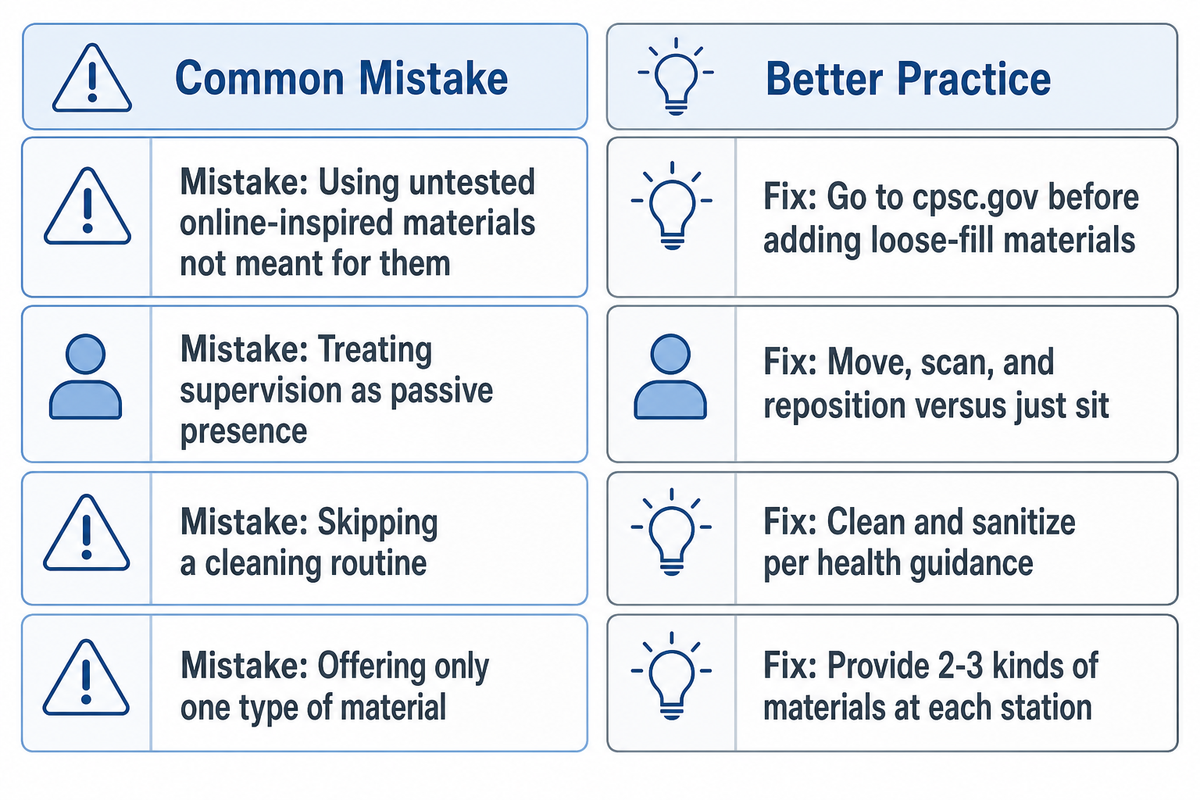
Even after you’ve matched activities to the right age band, the mistakes that undo good planning are rarely dramatic — kids’ most significant sensory-play issues aren’t big, theatrical events, but small problems with the overall process that get compounded. Check the following 4 against what you currently have set up:
⚠ Common Mistakes
- Using Pinterest-inspired materials for kids that weren’t meant for them-water beads, anyone?-without checking current CPSC guidelines.
- Treating “supervision” as passive presence rather than active scanning
- Skipping a cleaning/sanitizing schedule for shared, mouth-contact materials
- Assuming one sensory tool works for every child — ‘one-size-fits-all’ sensory design doesn’t hold up for neurodivergent children.
✔ Better Practice
- Be sure to go to cpsc.gov before adding any loose-fill sensory materials into any bin.
- Ensure staff are trained to do what’s known as move, scan, and reposition, versus just sit.
- Clean routine surfaces; and sanitize anything mouthed, according to local health code
- Provide 2-3 kinds of materials at each station for children to pick what they’re willing to do.
Regarding the issue of supervision: it’s not just anecdotal. CPSC’s own handbook correspondence acknowledges real limits — on tube slides, for example, it states that “Supervisors should be aware of children using tube slides since the children are not always visible,” and that this “does not in most instances render even trained supervisors capable of seeing precisely the incident at the moment it occurred.” A retired school principal, playground-injury expert witness in negligence cases, and founder of Peaceful Playgrounds puts it plainly: an adequately trained supervisor attentively watching the play area will soon detect if something is going awry — that’s not the same as seeing the exact moment of the incident. Courts look to CPSC and ASTM standards as the basis for the “reasonably prudent” standard – although both are voluntary guidelines – which is why employee training documentation becomes a key to maintaining a safe park as well as using appropriate equipment.
Industry Outlook: Why Sensory Design Is Becoming Standard in Commercial Play Spaces
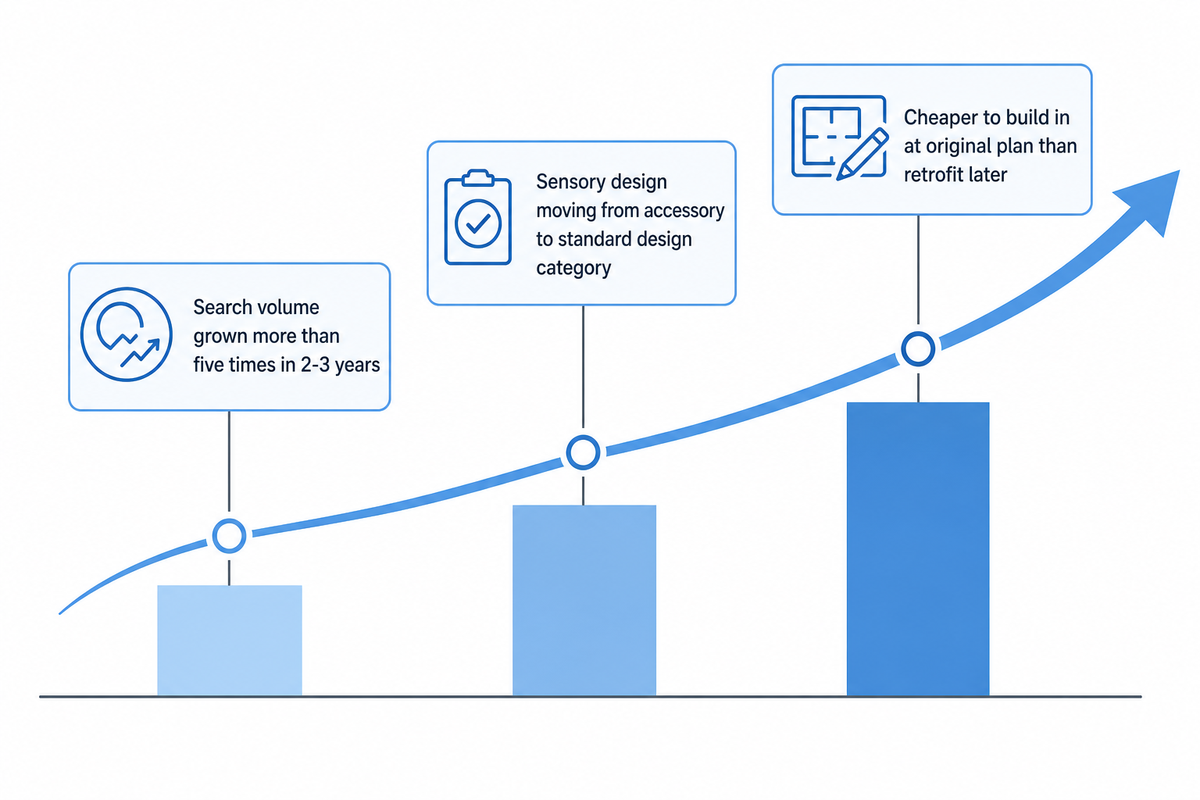
Sensory play has become the new requirement, going from play space accessory to the new standard design category across all new commercial and institutional play areas – driven by inclusion, not just novelty. Industry trade coverage of the July 2025 CPSC playground safety update flags the same shift: sensory elements like textured surfaces, musical panels and calming zones are moving toward not simply enabling neurotypical play, but rather, serving children with sensory processing differences – this comes full circle as facility design.
Search interest in this exact subject certainly confirms it isn’t a blip: 56-month keyword-trend data (DataForSEO) shows search volume for this term up roughly 780% over the past two to three years, even accounting for seasonal slowdowns. If your facility is already in the process of allocating capital dollars to renovate its existing play area, the clear, practical lesson here is to incorporate the design accommodation of sensory-processing needs into the original plan instead of retro-fitting those aspects in later on – it’s much more expensive to install calming corners and customizable environments in a facility once it’s up.
(Note on numbers: published market-size estimates for “sensory rooms” vary by billions of dollars across different reports with no clear methodology in common, that inconsistency itself is a reason to treat any single market-size figure with caution rather than build a budget case around it. The design-trend and search-demand signals above are independently verifiable and are what this section relies on.)
📐 Engineering Note
As you work through a build-out plan, try to run the structural and electrical tasks before the finishes – adjustable lighting costs more to install in a finished relaxation nook than to pull in during rough construction.
Perguntas frequentes
With sensory design headed toward becoming standard rather than optional, here are the specific questions facility buyers and parents ask most.
Q: What is an example of sensory play?
A scoop-and-pour rice bin is a classic example: a shallow container of dyed rice with cups, funnels, and small scoops, letting kids explore touch, sight, and sound while building the hand and finger strength they’ll later use for writing and self-feeding.
Scoop and Pour Rice Bin é uma dessas bandejas de jogo clássicas, uma bandeja rasa de arroz colorido com funis, xícaras e colheres As crianças estão colhendo, derramando e coando arroz, batendo em seus sentidos de toque, visão e som, enquanto fortalecem os músculos dos dedos e das mãos usados em suas tarefas posteriores de escrita e autoalimentação.
Q: What are good sensory activities for preschoolers?
Good sensory activities combine a safe, washable material with a simple tool: rice or bean bins, water tables, playdough, and shaving-cream finger painting, chosen to match the child’s age and supervised closely whenever younger toddlers are in the group.
Se você estiver usando um material diferente, você precisa encontrar algo seguro, lavável e barato que você pode emparelhar com apenas uma ferramenta fácil e simples Exemplos para este grupo envelhecido são caixas de arroz ou feijão com colheres, lençol freático com copos e funis, massa de brincar com pinos de rolamento, pintagem de dedo de creme de barbear em uma mesa baixa Gire os materiais semanalmente; certifique-se de que é a textura não a novidade do material que impulsiona a atividade.
Q: What are some fun 5 senses activities?
Pair one material with one dominant sense: colored rice for sight, scented playdough for smell, a shaker jar for sound, water beads for touch (with caution, see the materials section), and taste-safe dough for taste.
Five-senses activities pair one material with one dominant sense: colored rice (sight), scented playdough (smell), shaker jar of beans (sound), and a taste-safe edible dough (taste). For the touch station, use a texture wall or fabric swatches instead of water beads – see the materials section above for why that material now carries an active CPSC safety warning for childcare settings.
Q: What are some ideas for sensory play?
Beyond bins: a light table with translucent shapes, a mounted texture wall, a calming corner with weighted lap pads, and a water-play station with floating toys.
Outras ideias além das caixas incluem: uma mesa de luz com formas translúcidas, uma parede de textura de amostras de tecido montadas, um canto calmante com almofadas de colo pesadas e uma estação de jogo de água com brinquedos flutuantes Combine a ideia com o espaço que você tem à mão antes de comprar equipamentos.
Q: What safety standards apply to indoor sensory play equipment?
ASTM F1918 governs soft-contained play equipment for ages 2-12; the 6-23-month band sits in a published standards gap, since F2373 (which covers that age range) explicitly excludes soft-contained equipment from its scope, so ask suppliers directly what they test against for that band. Material certifications to check are Greenguard Gold and CPSIA phthalate compliance.
In the US, soft-contained sensory play structures are covered by ASTM F1918 for ages 2-12, rather than the broader ASTM F1487 series which covers rigid public playground apparatus. For the 6-23-month band there’s a published scope gap: ASTM F2373 covers that age range but explicitly excludes soft-contained play equipment from its own scope, and the CPSC’s Public Playground Safety Handbook explicitly states that soft-contained play equipment is outside of its scope. On materials, look for Greenguard Gold certification (screening for 360+ VOCs), and CPSIA compliance (no more than 0.1% of eight specific phthalates in any toy/child-care-article component). None of these is a single blanket certification – ask suppliers for the specific standard number and test report behind each claim, not just a logo.
Q: How many children can safely share one sensory station?
Most preschool sensory stations are sized for 4-8 children with one adult actively supervising, adjusted for the station’s footprint, the material’s risk level, and the children’s age band — younger toddler groups need a tighter ratio.
Most preschool sensory stations are sized for 4-8 children at a time with one adult supervising, though this depends on the station’s footprint and the children’s age band – toddler stations generally need a tighter ratio than a preschool-age table, and any station used by children who still mouth objects need closer, more active supervision regardless of group size.
Artigos Relacionados
- ASTM F1487-certified indoor playground equipment for kindergartens commercial equipment for the ages 3-5 range covered in this guide
- Toddler indoor playground equipment (6 months to 5 years) the product line matching this article’s full age range
- EN 1176 and ASTM F1918 material certification a deeper look at material-standards verification
- Padrões de segurança de playgrounds internos the full standards landscape beyond soft-contained play
- CPSC’s 2025 guardrail and entrapment rules the rigid-equipment side of the 2025 Handbook update
- 6-zone floor plan for indoor play layout where a sensory zone fits into a full facility plan
- 2026 indoor playground design trends sensory design in the broader 2026 trend context
- Playground safety standards by export market how these standards compare internationally
Referências e fontes
- Designing Messy Play for Infants and Toddlers U.S. Administration for Children and Families, Head Start
- Especificação de desempenho de segurança padrão ASTM F1918-21 para equipamentos de jogo macios e contidos ASTM Internacional
- ASTM F2373-24 Standard Consumer Safety Performance Specification for Public Use Play Equipment for Children 6 Months through 23 Months ASTM International (scope excludes soft-contained play equipment)
- ADA Accessibility Guide, Chapter 10: Play Areas Conselho de Acesso dos EUA
- ADA Accessibility Guide, Chapter 4: Accessible Routes Conselho de Acesso dos EUA
- Public Playground Safety Handbook (Publication 325, July 2025) Comissão de Segurança de Produtos de Consumo dos EUA
- Phthalates Business Guidance Comissão de Segurança de Produtos de Consumo dos EUA
- Water Beads Information Center Comissão de Segurança de Produtos de Consumo dos EUA
- UL GREENGUARD Certification UL Solutions
- O que acabou de mudar? Uma olhada nas novas atualizações de segurança do playground CPSC de julho de 2025 Profissionais Playground
- “Sensory Escape” Is a Children’s Gym for Kids on the Autism Spectrum Athletic Business
- Sensory Room on a Budget Victoria Wood, OTR/L, The OT Toolbox
- Playground Supervision and Negligence: What Every Principal Needs to Know Dr. Melinda Bossenmeyer, EdD, Peaceful Playgrounds
Por que escrevemos isso
Didi Land makes commercial indoor playground and soft-play equipment, including a toddler play line spanning 6 months to 5 years — the same range covered here. We wrote this guide because the standards questions we hear most from preschool and daycare buyers — which ASTM standard backs a supplier’s “safe materials” claim, what certification to look for — rarely get a straight answer in general parenting content. Specs here reflect our current catalog; confirm with our team before budgeting.
Reviewed by the Didi Land technical team