
تواصل مع ديدي لاند

رطل إلى كجم: حاسبة ومخطط من جنيه إلى كيلوغرام

Updated August 2026. Lbs to kg is the conversion of a mass stated in international avoirdupois pounds into the equivalent number of kilograms. Multiply the pound value by 0.45359237. To convert kg to lbs, divide the kilogram value by 0.45359237. For example, 100 lb equals exactly 45.359237 kg before rounding.
This bidirectional converter is built for more than a quick answer. It is designed for equipment schedules, packing lists, drawings, and requests for quotation where a correct number still needs a source unit, a precision rule, and a clear definition of what the weight includes.
Pound (avoirdupois) to kilogram converter
Convert between pound (avoirdupois) and kilogram. The unit changes; the measured quantity does not.
Result
kg
1 lb = 0.4536 kg
The international avoirdupois pound is defined as exactly 0.45359237 kilograms. That is the definition stated in the NIST mass-standards publication used for this guide. Every calculation below keeps the full factor; rounding is applied only to the displayed result.
Reliable conversion does not end when a calculator returns a number. In an international project, a value may move from a product sheet to a layout drawing, then into a quotation and finally into a packing list. Each handoff creates another chance to lose the unit, round too early, or confuse an equipment weight with a packaged shipment weight. These sections cover both the arithmetic and the record that keeps it traceable.
How to Convert Pounds to Kilograms (lb to kg)
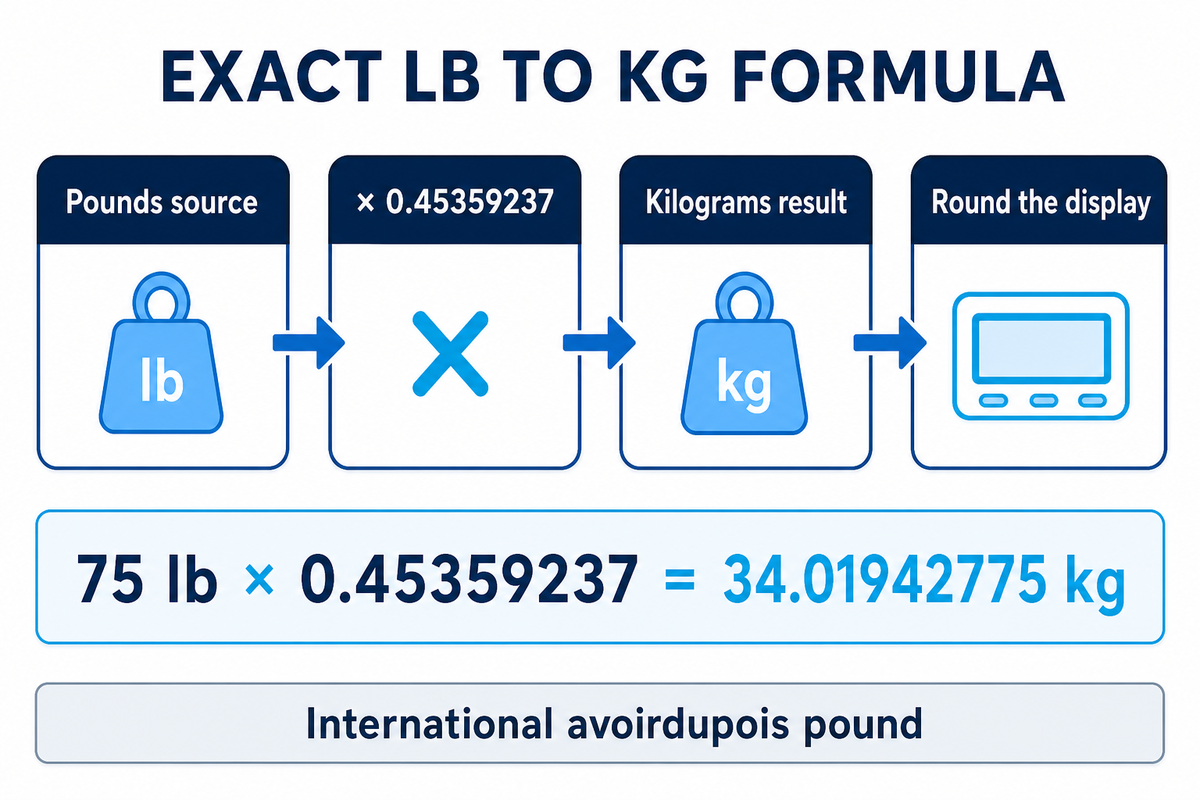
Use this formula:
kilograms = pounds × 0.45359237
The conversion connects the international avoirdupois pound used in United States customary and British imperial contexts with the kilogram, the SI base unit of mass. The 2026 NIST Handbook 44 conversion tables state the same exact relationship, while the NIST guide to SI units of mass also makes an important technical distinction: mass and weight are not identical physical quantities, even though everyday searches commonly use “weight” for values in pounds and kilograms.
Terminology Behind the Pounds to Kilograms Conversion
This guide uses the international avoirdupois pound, the unit of mass used for the pound in the British Imperial system and in the United States customary system. “Imperial and US customary systems” is a compact label widely used in conversion references, while “US customary systems of measurement” is a longer variant. People in the United Kingdom (UK) and the United States may encounter pounds in daily records even when a technical project uses metric units.
The pound used today in this formula has a fixed numerical value of exactly 0.45359237 kilograms, so 1 lb is equivalent to 0.453592 kg when displayed to six decimals. This is not a new definition created by the calculator. Although everyday pages may call the pound a unit of weight or ask about weight or mass, the kilogram expresses mass in the International System of Units.
To convert pounds to kg, multiply the number of pounds by the exact factor; the resulting number of kilograms is the value in kilograms. That sentence states the same pounds to kilograms conversion as the formula without changing its direction or precision.
To convert lbs to kg step by step, first confirm that the source number is actually in avoirdupois pounds. Multiply it by 0.45359237, then label the result in kilograms. The phrases “pounds to kg,” “lb to kg,” “convert lbs to kg,” and “pound to kilogram” all describe this direction of calculation.
If a component is listed as 75 lb, the full calculation is 75 × 0.45359237 = 34.01942775 kg. Most documents might display 34.02 kg, but the source record should still retain 75 lb and the factor used. Reviewers can then reproduce the conversion without treating 34.02 kg as a new measurement.
Do not use 0.45 as the master factor when the result will be reused in a technical list. That shortcut turns 500 lb into 225 kg. The exact definition produces 226.796185 kg, a difference introduced entirely by the abbreviated factor. Similarly, 150 lb equals 68.0388555 kg before rounding. This conversion preserves the same mass; it does not change which parts, packages, or configurations are included in the source figure.
One kilogram contains 1,000 grams, and one gram is 0.001 kg. That relationship can help a reader understand scale, but it does not replace the exact pound-to-kilogram factor. In a specification, the unit attached to the source value always controls the calculation.
Fields to Preserve in a Source-Weight Record
Keep at least five fields for an important converted value: source value, source unit, weight boundary, conversion factor, and displayed value. One record might read: “75 lb; international avoirdupois pound; equipment net mass; × 0.45359237; 34.02 kg displayed to two decimals.”
This small Source-Weight Handoff Card is useful when the product sheet, layout, and purchasing file use different languages or unit systems. It also separates conversion from measurement. The calculator transforms a number; it does not weigh the product or verify that the source value belongs to the latest configuration.
Eight-Owner Weight Record Roster
| Buyer role | Weight category or field | Filled example | Approval question |
|---|---|---|---|
| Design or engineering | Configuration and revision | Module A, drawing Rev C | Does the source weight match this exact configuration? |
| Quality assurance | Source value and status | 75 lb, supplier estimate | Is the value measured, estimated, or copied from an older file? |
| Procurement | Boundary and converted display | Equipment net mass; 34.02 kg | Will the quotation show both the original and converted values? |
| Logistics | Packaging inclusion | Crate and pallet excluded | Is a separate packed gross weight available? |
| Finance or owner | Commercial use | Reference only; not freight price | Which carrier rule and delivery term govern the cost calculation? |
| Operations | Handling use | Reference mass only | Has a qualified reviewer checked lifting and support requirements separately? |
| Carrier or forwarder | Chargeable field | Not yet supplied | Does the carrier need actual, volumetric, or another defined weight? |
| Document controller | Calculation trace | 75 lb × 0.45359237; display 34.02 kg | Can the next reviewer reproduce the result from the preserved source? |
Use the worksheet as a handoff, not as a certificate. The example makes the hidden bottleneck visible: the arithmetic can be correct while the configuration, revision, or packaging boundary is wrong. Each role owns a different question before the number becomes commercial input.
How to Convert Kilograms to Pounds (kg to lbs)
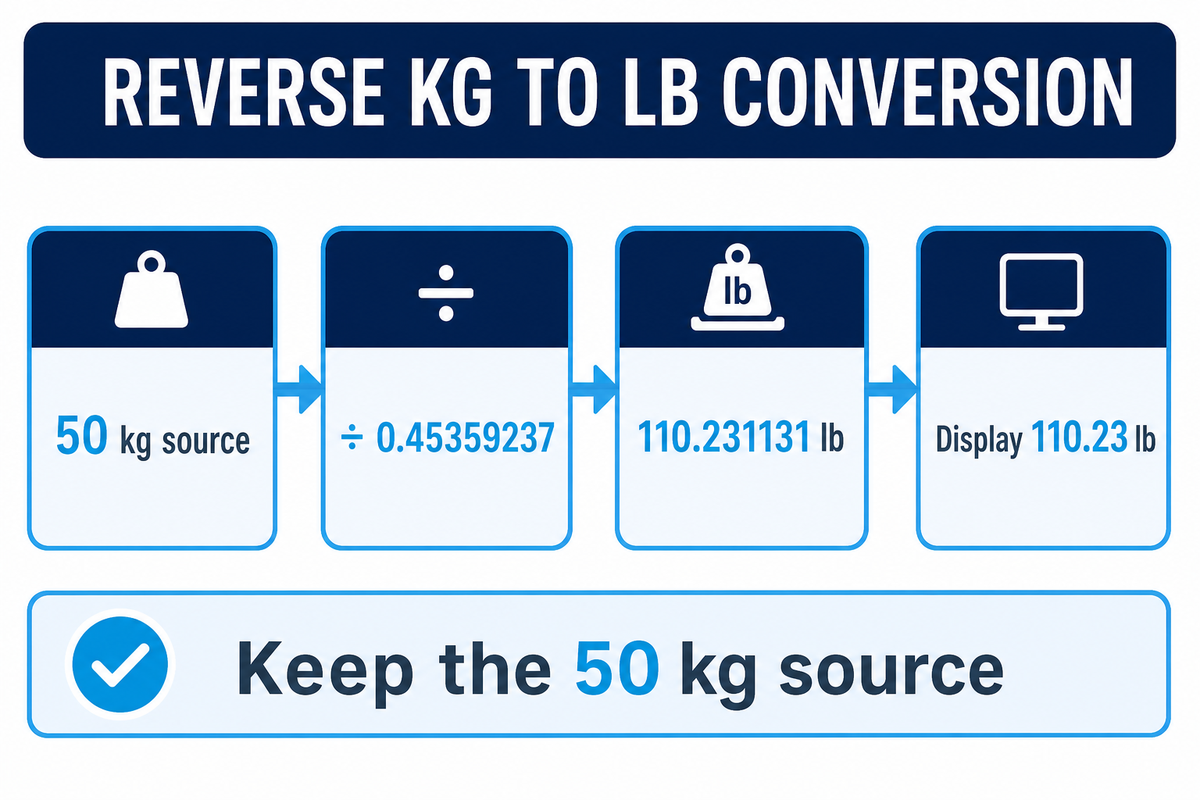
For the reverse direction, use:
pounds = kilograms ÷ 0.45359237
The earlier source-record rule still applies in reverse: preserve the kilogram value, the conversion direction, and the displayed precision.
The inverse can also be expressed as an approximate multiplier of 2.2046226218. For example, 50 kg ÷ 0.45359237 = 110.231131 lb. Displayed to two decimals, that becomes 110.23 lb. A 100 kg value converts to 220.462262 lb, or 220.46 lb with the same display rule.
Direction matters. Multiplying kilograms by 0.45359237 does not convert them to pounds; it produces a smaller number that may look plausible while being mathematically wrong. The calculator labels the input and output units, shows the lb and kg symbol, and lets the user swap direction so that the math is never hidden. The same kg calculator handles both directions.
Because this reverse operation comes from the same exact NIST pound definition, an engineering drawing or supplier RFQ should preserve the 50 kg source beside the 110.23 lb display. That trace prevents a reviewer from treating the rounded pound value as a second measurement. Buyers sending a weight question to Didi Land should identify the equipment configuration and document revision as well as the unit, since a correct formula applied to the wrong source remains a project risk.
Quick Pounds and Kilograms Conversion Table
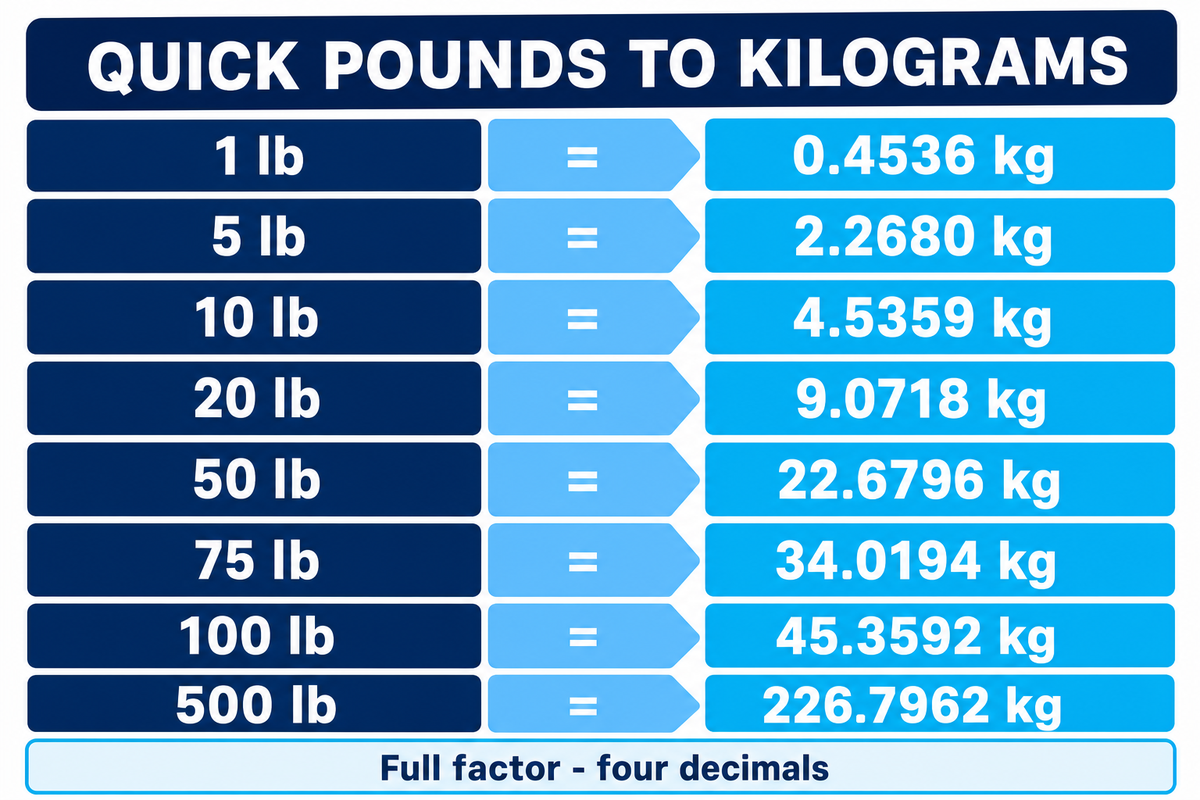
The chart below uses the exact factor without intermediate rounding and displays four decimal places. It is a quick reference, not a substitute for a supplier-confirmed measurement when a project document requires one.
For a Didi Land equipment RFQ, copy both the row value and its unit into the supplier or engineering record. The NIST factor is evidence for the arithmetic, but it cannot prove that 50 lb belongs to the current drawing. Because an unlabeled or stale number can create a specification error, the source file, configuration, and revision should travel with every table lookup.
| Pounds (lb) | Kilograms (kg) |
|---|---|
| 1 | 0.4536 |
| 5 | 2.2680 |
| 10 | 4.5359 |
| 20 | 9.0718 |
| 25 | 11.3398 |
| 50 | 22.6796 |
| 75 | 34.0194 |
| 100 | 45.3592 |
| 150 | 68.0389 |
| 200 | 90.7185 |
| 300 | 136.0777 |
| 500 | 226.7962 |
When copying a row, include the heading or write the unit beside the number. The bare value “50” could mean 50 lb or 50 kg; those two values represent very different masses.
How to Round Without Changing the Source Weight
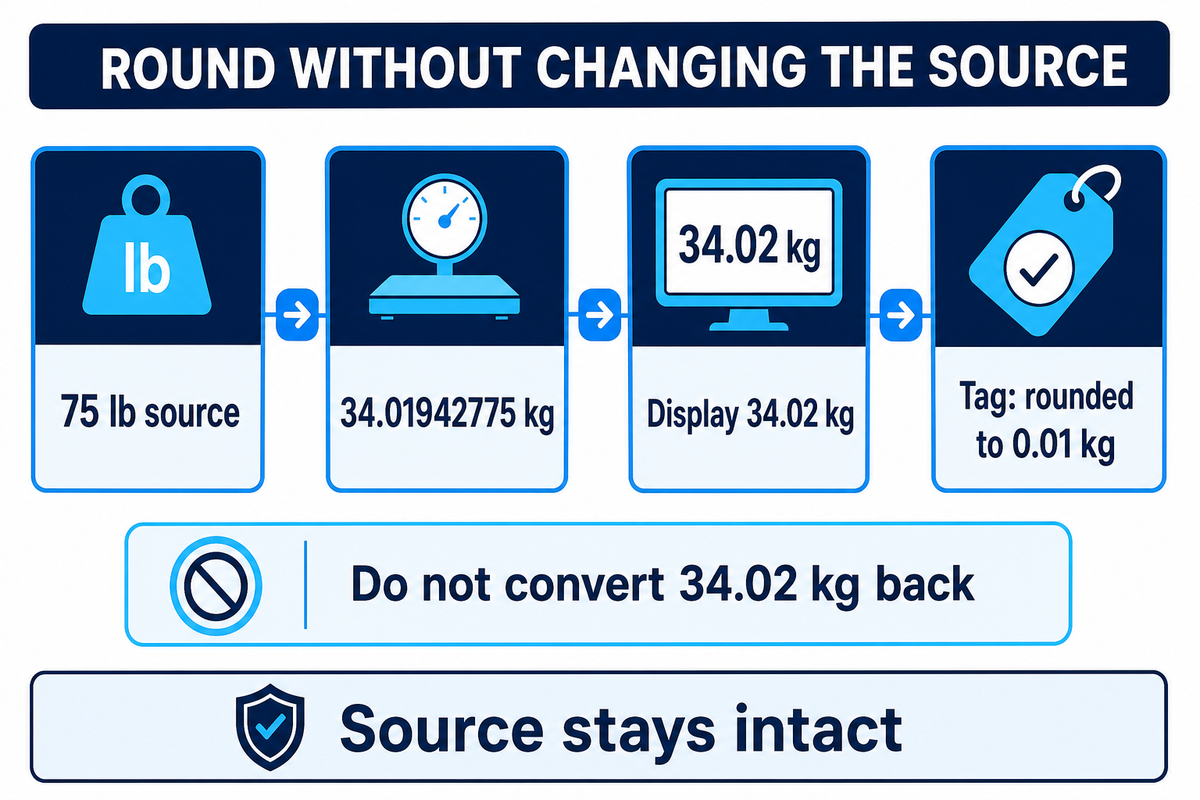
Match the displayed decimals to the use of the data. Two decimals are often readable in a quotation or overview table. During a chain of calculations or a technical review, keep more digits internally and round only the final displayed value. Extra decimals should not imply that the original scale, supplier estimate, or drawing was more precise than it really was.
Use a Rounding Evidence Stamp
Add a short label such as “rounded to 0.01 kg,” “displayed to two decimals,” or “unrounded value retained in calculation file.” The note tells the next reader that 34.02 kg came from 34.01942775 kg rather than from an independent measurement with one-hundredth-kilogram resolution.
Avoid round-trip conversion as an editing method. If 75 lb becomes 34.02 kg and that displayed value is then converted back, the result is about 75.0013 lb. The difference is small, but repeated conversions across a long equipment list can create unnecessary drift. Keeping 75 lb as the source prevents it.
In a supplier RFQ or engineering drawing, premature rounding is a data-quality risk because the shortened value can be copied into later calculations. The exact NIST definition and a retained 75 lb source let the reviewer reproduce the 34.01942775 kg result before choosing a display precision. When Didi Land receives a mixed-unit project list, each line should therefore carry its source unit and rounding tag rather than an unsupported claim of measurement accuracy.
Net, Gross, Tare, and Shipping Weight
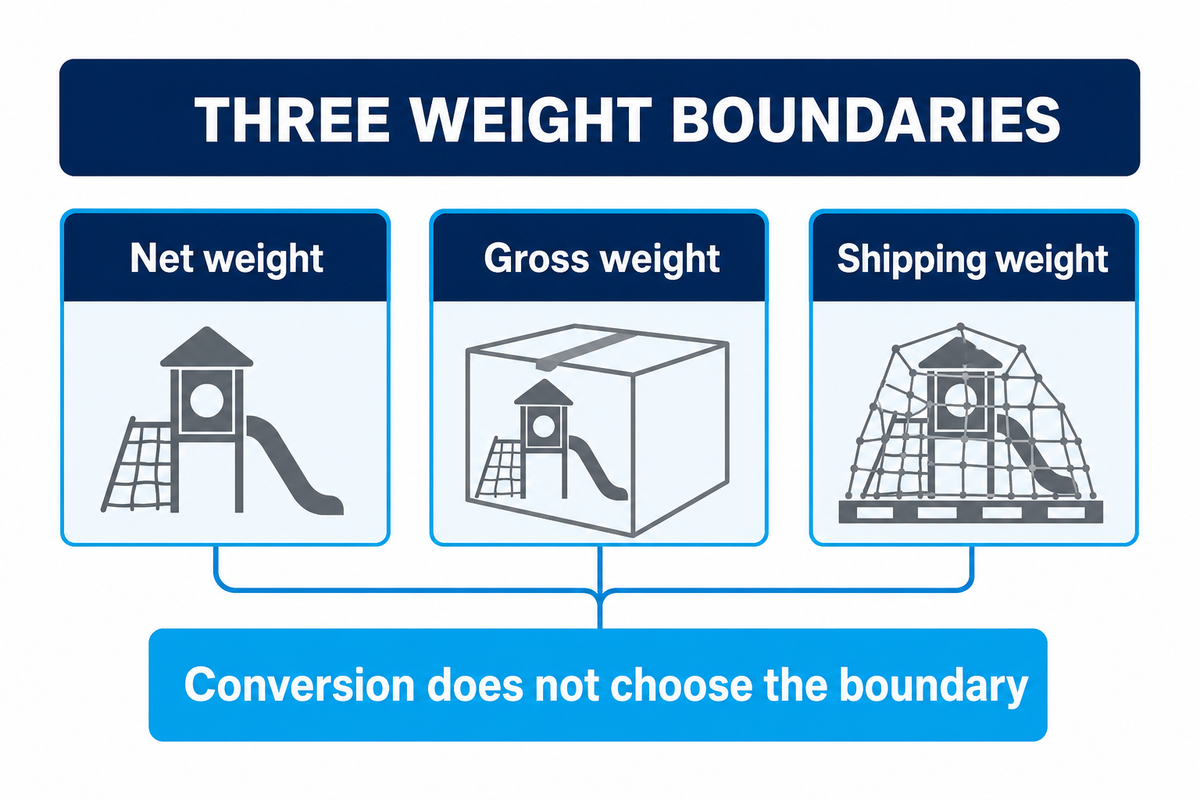
Before converting, confirm what the number represents. Net weight, packaged gross weight, tare weight, and the amount used to price freight are not interchangeable. An exact conversion of the wrong category is still the wrong answer for the document.
In the Maersk shipping weight guide, net weight is the product or cargo alone, tare weight is the empty packaging or container, and gross weight is the combined total. That guide also explains why these boundaries matter for freight quotes, customs documentation, and operating limits. The applicable contract, carrier, customs system, or country may define the required reporting field more narrowly, so the governing document still needs to be checked.
On a Didi Land supplier RFQ, label a 500 lb entry as equipment net mass, packed gross mass, or another defined field before conversion. Because Maersk’s categories describe different logistics boundaries, mixing them can create a freight or customs error even when 500 lb is converted exactly. The buyer, supplier, and forwarder should approve the same boundary before the converted kilograms enter a commercial document.
Run the Net-Gross-Shipping Check
Review three lines separately before approving a converted figure:
- Net weight: identify the pieces or goods included and every excluded item.
- Gross weight: identify the packaging, crates, frames, or pallets included in the total.
- Shipping or chargeable weight: identify the value and rule requested by the carrier or commercial document.
Do not infer one line from another without a confirmed component list. The supplier may first quote the mass of one equipment module, while a later packing list groups several modules with protective material. Converting lb and kg cannot fill in that missing scope.
How to Record Weight in an Equipment RFQ
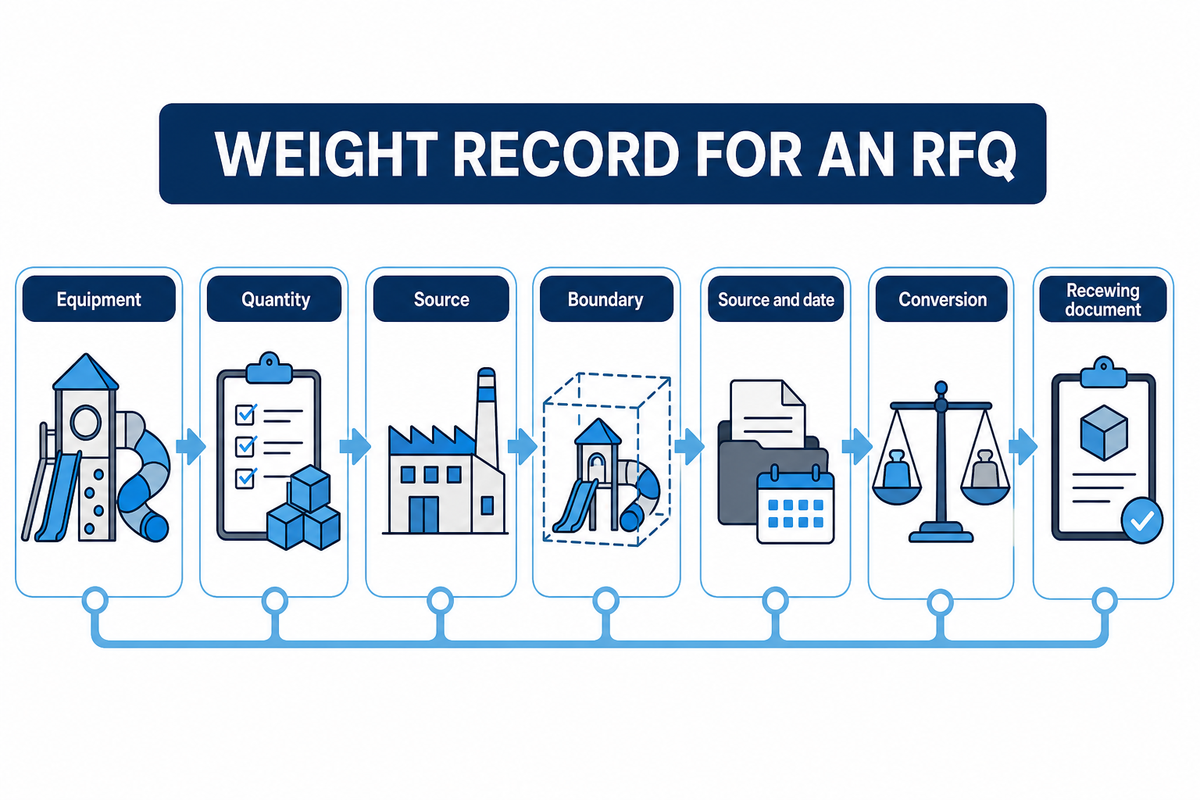
An indoor playground request for quotation normally combines dimensions, configuration, materials, quantities, and delivery terms. The BIPM SI Brochure provides the international measurement framework for expressing mass, and the NIST mass guide supplies a second public reference for the kilogram context. You can also visit Didi Land’s indoor playground equipment page; the final weight must remain tied to the exact configuration being quoted.
Record these fields for each weight line:
- equipment name or line identifier;
- quantity and configuration;
- original value and unit;
- whether the number is net, gross, packed, estimated, or measured;
- the source and date of the data;
- converted value, conversion direction, and rounding rule;
- the drawing, quotation, packing list, or other document that will use it.
If the project is still being defined, related Didi Land pages include the indoor playground design and layout guide and the custom-design process walkthrough. For linear dimensions, use the separate centimeters-to-inches guide; a mass conversion cannot transform length or area.
Didi Land’s public quotation context currently presents FOB, CIF, and DDP shipping options. Those terms describe delivery scope and responsibilities; they do not automatically turn the mass of a component into a freight charge or carrier-approved weight. For a related planning resource, see Didi Land’s total landed cost calculator page. To confirm which source data belongs in a quotation, send the project details to Didi Land.
What a Mass Conversion Does Not Solve
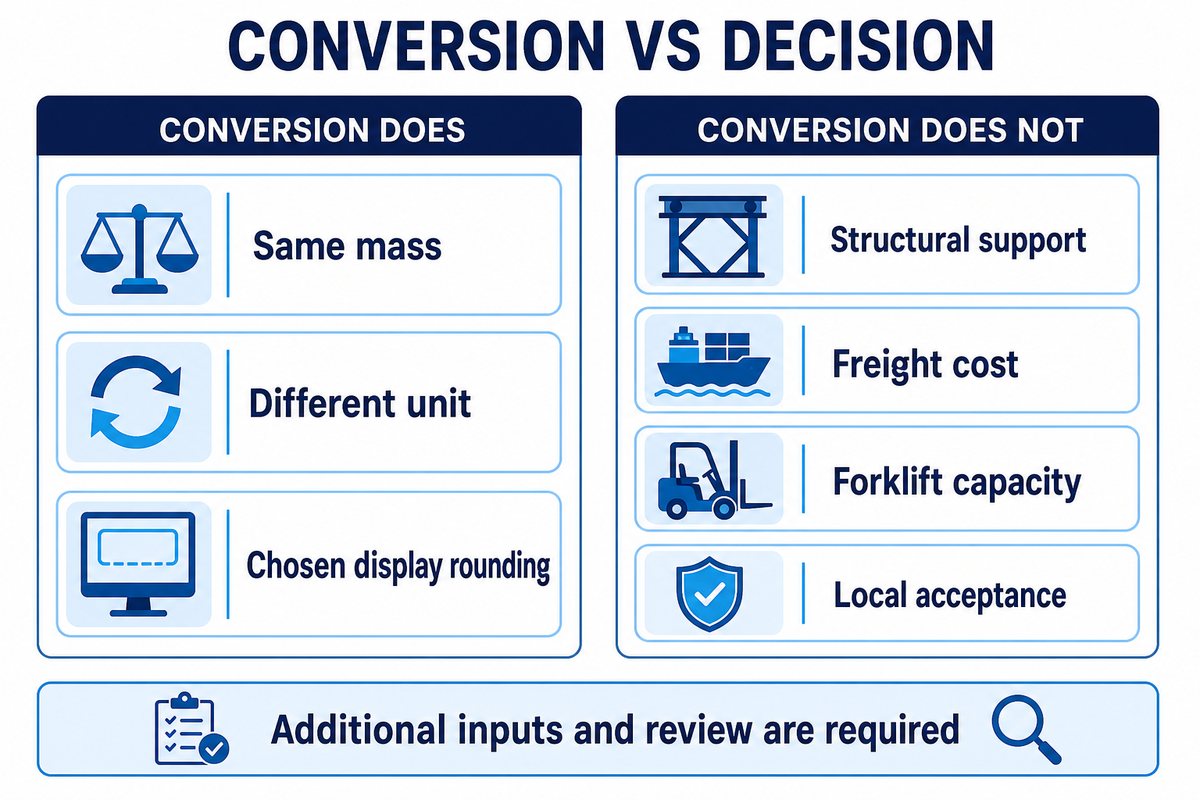
A mass conversion calculator answers one question: what number expresses the same mass in another unit. It does not determine whether a structure supports a load, how much the equipment costs to transport, what forklift capacity is required, or what a local authority will accept. Those decisions need additional inputs, applicable rules, and appropriately qualified review.
It also does not calculate dimensional or volumetric freight weight. Carriers may compare actual mass with a volume-based chargeable figure. Package length, width, height, route, and the carrier’s divisor may all be necessary. Do not substitute a simple lb-to-kg conversion for that separate calculation.
Searchers also use pounds and kilograms for fitness, body weight, and medical dosing. Those uses are outside this guide. No health or dosage advice is provided here. The same boundary applies to force: a structural load analysis may require forces, support points, distribution, and dynamic conditions, not merely a mass in kg or lb.
Finally, a converter cannot validate the source. If an older file says 250 lb and a newer sheet says 250 kg, both can be converted correctly without showing which document belongs to the current equipment. Version, configuration, and approval status still need to be resolved.
For a Didi Land RFQ, that unresolved 250-unit conflict should be returned to the supplier or drawing owner instead of being guessed. The NIST definition proves how to convert an identified pound value; it does not resolve which revision is valid. Because a wrong source can affect a purchase order, layout, or handling plan, the buyer needs an approved configuration record before using the result.
Eight Errors to Check Before Approving a Specification
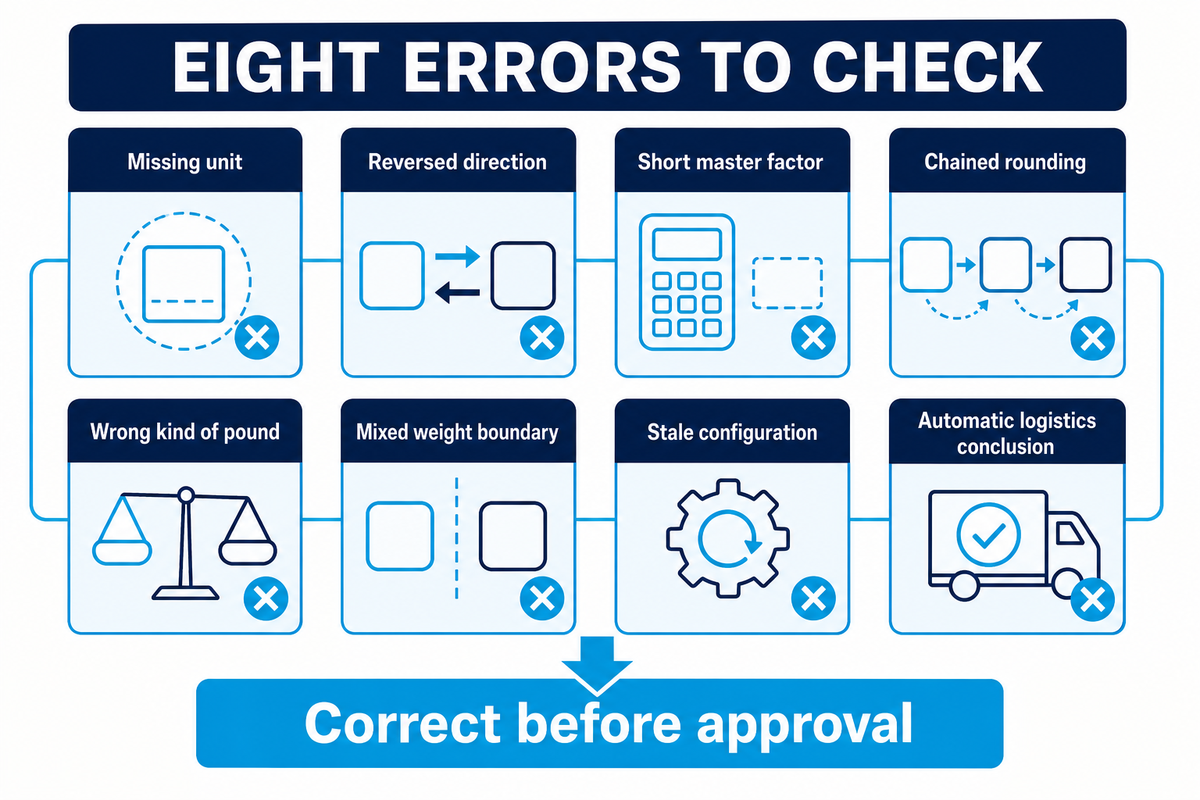
A Didi Land buyer or supplier can use this list while reviewing an RFQ, engineering drawing, or packing record. The NIST factor explains the exact arithmetic, but the review is still needed because using 0.45 in place of 0.45359237 or attaching the wrong unit can create a measurable specification error. Record the source and configuration before approving any converted value.
- Missing unit: a number appears without lb or kg.
- Reversed direction: the lb-to-kg factor is applied to a kg-to-lb task.
- Shortened master factor: 0.45 is reused as though it were the exact definition.
- Chained rounding: each document converts the previous document’s displayed value.
- Wrong kind of pound: an avoirdupois pound is confused with a troy pound.
- Mixed weight boundary: a net figure is entered as gross or shipping weight.
- Stale configuration: the source weight belongs to another quantity, revision, or component set.
- Automatic logistics conclusion: cost, capacity, or compliance is inferred from conversion alone.
This short review is usually more valuable than adding more decimals. The aim is not the longest number. It is a reproducible, correctly labeled value that fits the document receiving it.
Frequently Asked Questions About Lbs to Kg
Does 2 pounds equal 1 kilogram?
No. Two international avoirdupois pounds equal 0.90718474 kg. One kilogram equals about 2.20462262 lb. Dividing a rough rule by eye can be useful for an estimate, but use the full factor for a specification or packing record. Preserve the original 2 lb value, label the converted result in kilograms, and state the rounding rule if another person will reuse the number.
How many pounds are in 1 kg?
One kilogram equals approximately 2.2046226218 lb. This is the reverse of the exact definition 1 lb = 0.45359237 kg. Keep the kilogram source value if the result will be reused. A document should record the direction, the factor, and the displayed decimals so that a later reviewer does not mistake the converted weight in pounds for a separate measurement. For purchasing or logistics work, also label whether the source describes net equipment mass, packaging, or a packed gross total.
What is 100 lb in kg?
One hundred international avoirdupois pounds equal 45.359237 kg. Displayed to two decimals, the result is 45.36 kg. Retain “100 lb” as the source and label the rounding, especially when the figure moves into a specification, equipment list, or packing document. The calculation does not tell you whether the source includes one module, a complete configuration, a crate, a pallet, or installation hardware. Confirm that boundary against the current drawing or supplier record before using 45.36 kg in a quotation. If freight is the decision, request the required packed or chargeable field from the carrier instead of deriving it from this conversion alone.
What is 170 lb in kg?
Multiply 170 by 0.45359237 to get 77.1107029 kg. Rounded to two decimals, that is 77.11 kg. The result does not by itself identify whether the source was net, gross, packed, or estimated.
Is an avoirdupois pound the same as a troy pound?
No. This calculator uses only the international avoirdupois pound, equal to 0.45359237 kg. A troy pound and troy ounce belong to a different historical unit system and must not be substituted in the formula.
Can converting kg to lb calculate shipping cost?
No. Conversion only expresses the same mass in another unit. A freight quotation may also depend on packaging, volume, number of pieces, route, delivery terms, carrier rules, and the required commercial documents. Confirm those inputs first, then use the converter to present the same source mass in kg or lb.
References and Sources
SYS.00 //الكشف عن EET
لماذا أكتب هذا
باعتباري الرئيس التنفيذي والمؤسس المشارك لمنشأة تصنيع متخصصة، فإن هدفي هو تقديم رؤى فنية واضحة ومباشرة من المصنع حول هندسة الملاعب الداخلية التجارية، والامتثال للسلامة، وتخطيط المشاريع. أهدف إلى سد فجوة المعلومات للمشترين العالميين الذين يبحثون عن بيانات هيكلية ومادية موثوقة، مما يضمن اتخاذ قرارات مستنيرة تعتمد على عائد الاستثمار دون زغب التسويق.
حول عملي
شركة قوانغتشو ديدي لاند لمعدات التسلية المحدودة (العلامة التجارية: ديدي لاند) هي شركة تصنيع معدات ملاعب داخلية تجارية تأسست في عام 2014. تعمل من بانيو، قوانغتشو، الصين، ونحن نقوم بتصميم وإنتاج وتصدير هياكل اللعب التجارية إلى أكثر من 40 دولة. دول حول العالم. تلتزم خطوط الإنتاج لدينا بشكل صارم بأطر السلامة الدولية، مما يضمن المتانة والسلامة للبيئات ذات حركة المرور العالية.
خدماتنا
نحن نقدم حلولاً تجارية شاملة لـ B2B: بدءًا من التصميم المكاني ثلاثي الأبعاد المخصص وتصنيع المعدات الأصلية وحتى لوجستيات التصدير العالمية واختبار الامتثال. ينصب تركيزنا على تمكين مراكز الترفيه العائلية (FECs) ومراكز التسوق ورياض الأطفال وأماكن الضيافة من خلال بنية تحتية موثوقة وعالية السعة للعب.
DATA_MATRIX //MUBLICER_PROFILE
اسم:
الكرز
دور:
الرئيس التنفيذي والمؤسس المشارك
اسم العلامة التجارية:
ديدي لاند
شركة:
شركة قوانغتشو ديدي لاند لمعدات التسلية المحدودة.
موقع:
قوانغتشو، بانيو، الصين
تأسست:
2014
منتجات:
معدات الملاعب الداخلية، معدات اللعب الناعمة، تصميم الملاعب ذات الطابع الخاص، مناطق اللعب FEC، وحدات الترامبولين، وحدات ملعب النينجا/العوائق
بريد إلكتروني:
conglizhang1@gmail.com
هاتف:
+86 199 2587 9517
موقع إلكتروني:
didiplayarea.com
الامتثال والمعايير:
ASTM F1487 · ASTM F1918 · EN 1176 · CPSIA · CE · ISO 9001 · IPEMA
اتصل بالمصنع مباشرة
ASTM F1487 · ASTM F1918 · EN 1176 · CPSIA · CE · ISO 9001 · IPEMA


![حاسبة القدم المربعة إلى المتر المربع [مخطط]](https://didiplayarea.com/wp-content/uploads/2026/08/square-feet-to-square-meters-indoor-playground-featured-768x512.png)